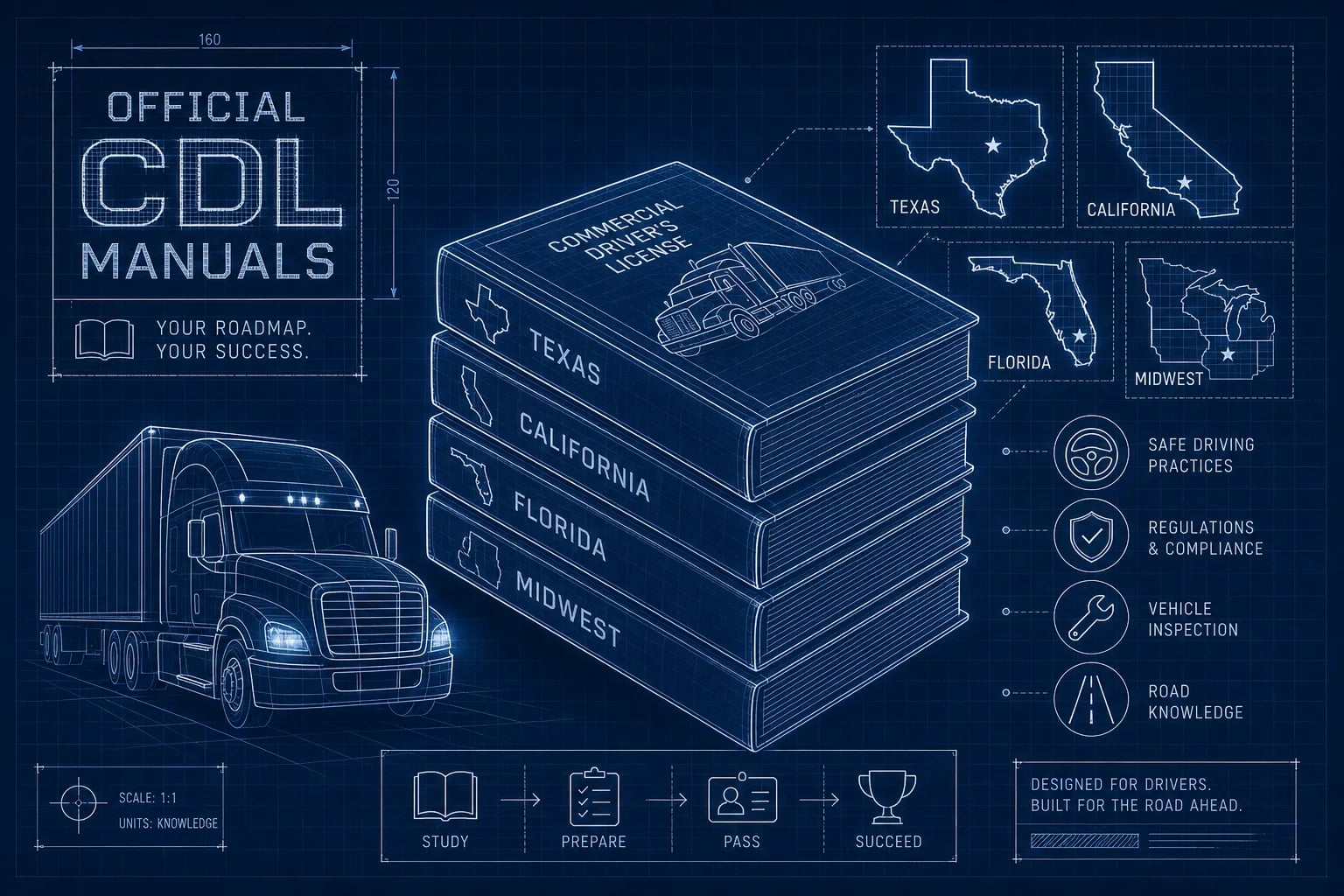
Most CDL candidates figure out the hard way that not every state manual is identical. You can spend hours searching for a CDL study guide and end up with an outdated PDF from the wrong state, or a generic FMCSA document that leaves out your state's specific licensing rules. That confusion costs real time and, in some cases, a first-attempt failure you didn't see coming. This guide cuts through it. You'll find the official CDL manual for Texas, California, Florida, and Midwest states, all seven core freight-corridor states included, along with a breakdown of what's actually different between them and a section-by-section study map so you know exactly what to read first.
If you'd rather have everything in one place, CDLTest360 bundles state-specific CDL handbooks directly alongside practice tests, so the manual hunting stops before it starts. Here's why getting the right state handbook matters as much as it does.
Why state CDL manuals matter even though FMCSA sets the rules
FMCSA regulations govern what the CDL knowledge exam must cover, which is why the core topics, general knowledge, air brakes, combination vehicles, hazmat, look similar across the country. But every state publishes its own commercial driver's license manual that layers state-specific licensing rules, fee structures, disqualification procedures, and eligibility requirements on top of that federal baseline. Studying a generic FMCSA document alone leaves those state-specific gaps wide open, and those gaps generate real test questions.
The knowledge exam questions come from the state-issued handbook, not directly from the federal rulebook. If you study an outdated edition or a handbook from a neighboring state, you risk encountering questions about rules and procedures that don't match what your state's DMV actually tests. Candidates who fail this way usually don't fail because they know nothing; they fail because they confidently selected an answer from a different or superseded rule set. Using the right, current state CDL manual is one of the most controllable factors in your first-attempt pass rate.
CDL manual for Texas, download and study focus
The Texas Department of Public Safety publishes the official Texas Commercial Motor Vehicle Driver Handbook under the designation DL-7C. The PDF is hosted on the DPS Internet Forms page, and the direct file is accessible by searching "DL-7C" on the DPS site. Bookmark the source page rather than saving a local copy, since DPS updates the document periodically and the official page stays reliable even when content changes.
Key chapters to study
The General Knowledge exam draws primarily from the Driving Safely, Transporting Cargo Safely, and Pre-Trip Inspection chapters. If you're pursuing endorsements, the Air Brakes and Combination Vehicles sections are common trouble areas for candidates. Read those chapters before attempting any practice test so you have context for why the answers work the way they do, rather than memorizing isolated facts.
Texas includes state-level details on medical certification, driving record requirements, and endorsement fees that won't appear in an FMCSA federal guide. Pay particular attention to the Texas-specific disqualification rules in the early chapters, especially if you're coming from a commercial driving background in another state and transferring your license. One other change worth knowing: as of June 2026, Texas requires all CDL and commercial learner's permit knowledge exams to be taken in English. If you were planning to test in Spanish, that option is no longer available for the written exam portion.
CDL manual for California, sections that align with the knowledge exam
The California DMV hosts the Commercial Driver's Handbook on its CDL page. California has been converting its CDL testing sites to the modernized testing model, with roughly 22 of 25 sites running the updated system. Downloading directly from the DMV site ensures you're studying the version that matches the test you'll actually take.
What to read and what to skip
California's General Knowledge test covers the Introduction and CDL requirements chapter, the Driving Safely chapter, and the Transporting Cargo Safely chapter as core reading. Emergency procedures and hazard recognition also show up consistently. For endorsements, each has its own dedicated section: Air Brakes, Combination Vehicles, Doubles and Triples, Tank Vehicles, Hazmat, Passenger, and School Buses. Those only apply if you're testing for those specific endorsements, so don't burn study time on sections that won't appear on your exam.
The modernized CDL testing model changes how the vehicle inspection and basic control skills tests are structured, not the written knowledge content itself. For the written exam, your study approach stays the same. The practical difference shows up during your skills test, where the inspection procedure is revised but maintains comparable difficulty standards.
Florida CDL manual, endorsement sections mapped out
The Florida DHSMV hosts the official CDL handbook as a PDF on its website. Florida also offers a Spanish-language version for candidates who prefer to study in their first language, though the knowledge exam itself has been administered in English only since February 2026. Both versions are available from the same FLHSMV source page, so confirm you're downloading the current edition rather than a cached copy from an earlier year.
Where each endorsement lives in the manual
Florida's manual is organized so that each major endorsement area has its own dedicated chapter. Leading with the topic makes navigation faster:
-
Air brakes (Section 5), system components, testing procedures, and driving with air brakes
-
Passenger transport (Section 4), loading procedures, safety, and emergency exits
-
Hazardous materials (Section 9), communication, placarding, loading rules, and emergency response
-
Combination vehicles (Section 6), coupling, uncoupling, and combination vehicle operation
Knowing which section covers which endorsement lets you skip straight to what you need instead of reading the entire handbook front to back.
Florida's handbook includes state-specific commercial vehicle weight and length limits that differ from generic FMCSA guidelines. The chapters on general licensing eligibility and out-of-state CDL transfers also contain Florida-specific procedures. Read those early in your study plan so you're not surprised by administrative requirements when you arrive at the testing center. Florida also uses a modernized skills test supplement that replaced Chapters 11 and 12 for candidates testing at modernized CDL sites, so confirm which testing system your local site uses before test day.
CDL manual for Midwest states, official downloads for seven states
The core Midwest freight corridor includes Illinois, Indiana, Iowa, Michigan, Minnesota, Ohio, and Wisconsin. Each state agency publishes its own CDL manual, and all seven are available from their respective DMV, DOT, or Secretary of State agency pages. Indiana's BMV offers a direct PDF through the in.gov portal. Iowa DOT links its CDL manual from the DOT publications page. Wisconsin DOT and Minnesota DVS both maintain stable PDF links through their official sites. Illinois and Michigan direct candidates to their Secretary of State resources pages, where the handbooks are listed alongside other driver education materials, check each agency page directly, as direct PDF URLs may change with document updates.
Indiana stands out because the Indiana BMV publishes a separate state-specific CDL supplement, form SP 283, in addition to the main CDL manual. This supplement covers Indiana-specific applicant and testing information including CDL eligibility, required knowledge exams, commercial learner's permit procedures, and skills test requirements by vehicle class. Before you start studying, check the Indiana BMV CDL page to confirm the current supplement version and whether it affects any General Knowledge content for your testing session. Iowa's DOT identifies its CDL manual as the primary study resource for all knowledge exams, with no separate state supplement noted as of 2026.
Ohio's Bureau of Motor Vehicles CDL manual follows the FMCSA content baseline closely but includes Ohio-specific vehicle weight regulations and state disqualification rules. Michigan's Secretary of State CDL manual page is regularly updated and specifies version dates, so always verify you have the current edition before building a study plan around it. Wisconsin DOT's CDL manual PDF is updated on a rolling basis when regulations change. Wisconsin is also the only confirmed Midwest state that has fully transitioned to the AAMVA Modernized Testing System for vehicle inspection and basic control skills, a change implemented in November 2024.
What actually differs between state CDL handbooks
General Knowledge chapters look largely similar across states because they all trace back to the AAMVA model CDL handbook. The meaningful differences show up in the administrative and regulatory sections, licensing fees, eligibility requirements, testing center procedures, state-specific weight and size limits, and local exemptions. Those sections vary enough from state to state to affect your exam.
The written knowledge exam pulls questions from the state-specific manual, not a generic national pool. Candidates who study an out-of-state manual most often lose points not on core safety content but on state-specific procedural questions that seem straightforward until you realize you prepared for a different state's rules. The modernized AAMVA testing system changes how vehicle inspection and skills tests are administered, but the written knowledge test structure itself remains tied to whatever handbook your state publishes.
FMCSA explicitly directs CDL candidates to use the manual published by the state where they intend to test. If you recently moved from Texas to Ohio, or you're testing in Illinois but downloaded Indiana's handbook because it came up first in search results, you're working with the wrong document. The content overlap is high, but the gaps are exactly where you're most likely to lose points. Always verify the revision date on any PDF you download, and go directly to the state agency's website rather than third-party aggregators that may host older versions.
How to map your study plan section by section
Every CDL candidate takes the General Knowledge exam regardless of vehicle class or endorsement. The Driving Safely, Transporting Cargo Safely, and vehicle inspection chapters should be your first reading priority in any state's handbook. Trying to cover all sections simultaneously before you've absorbed the General Knowledge material is one of the most common reasons candidates feel overwhelmed and underprepared heading into test day.
Read one major chapter per study session, then immediately attempt 20 to 30 practice questions on that chapter's content before moving on. This active recall approach, retrieving information rather than passively re-reading, is a well-established technique for improving retention. Endorsement sections work the same way: read the chapter, drill the questions, identify your weak spots, and re-read only the sections tied to your missed answers.
If you're pursuing a Class A CDL, the Combination Vehicles and Air Brakes sections are non-negotiable reading after General Knowledge. Hazmat adds a significant study load and also requires a TSA background check, so many candidates tackle that endorsement in a second phase after passing the core exams. Passenger and school bus endorsements involve their own dedicated chapters and work best as standalone study units once General Knowledge is solid. Spreading everything out this way prevents information from blurring together and gives you clear checkpoints to measure readiness before you schedule your exam appointment.
Why a bundled prep platform beats hunting down PDFs on your own
Tracking down the current edition of your state CDL handbook, verifying it's up to date, and then separately finding practice tests that align with your state's content is a fragmented process. Many candidates end up studying from a manual PDF downloaded several revisions ago, or running practice questions built from a different state's content. Neither scenario gives you an accurate picture of where you actually stand before test day.
CDLTest360 keeps state-specific CDL manuals accessible directly inside the platform alongside its question bank, so you're studying the same content the practice tests are built from. The platform covers all major knowledge areas, General Knowledge, Air Brakes, Combination Vehicles, Hazmat, and ELDT Theory, with topic-specific quiz modules and a timed exam simulation mode that mirrors the real test format. The missed-question review system re-drills only the questions you answered incorrectly, which compresses your study time significantly compared to re-reading full manual chapters searching for what you got wrong.
CDLTest360 also includes a Pre-Trip Inspection phrase trainer that drills the exact wording you'll need to recall during the inspection portion of your skills test, a different skill set from simply reading about inspection procedures in a handbook. A 90-day access pass runs $39.99, and a monthly option is available at $19.99 with no long-term commitment. No account is required to start, so you can explore the platform before committing.
Getting your preparation right from the start
Getting the right CDL manual for your state is the foundation of a solid test prep strategy, and now you know exactly where to find it. Texas, California, Florida, and each of the Midwest states covered here all publish free, official handbooks through their licensing agencies. The content overlap between states is real, but so are the differences in state-specific rules, fees, and endorsement procedures, and those differences are testable.
Study the CDL manual for Texas, California, Florida, or whichever Midwest state you're testing in, and make sure you're using the version published by that state's agency, not a generic or outdated copy. Start with General Knowledge before any endorsement chapters, drill practice questions after each section, and verify the revision date on any PDF you download. If you want your state handbook and aligned practice tests in one place without the scavenger hunt, CDLTest360 has both. Start with the free trial, identify your weak spots early, and walk into the testing center knowing exactly where you stand.
{ "@type": "Article", "datePublished": "2026-10-07T11:02:12.004Z", "dateModified": "2026-10-07T11:02:12.004Z", "headline": "Official CDL Manuals: Texas, California, Florida & Midwest", "description": "Download official CDL manual PDFs for Texas, California, Florida & key Midwest states. See state differences, section maps, and where to find practice tests.", "publisher": { "@type": "Organization", "name": "CDLTest360" }, "image": [ ] }