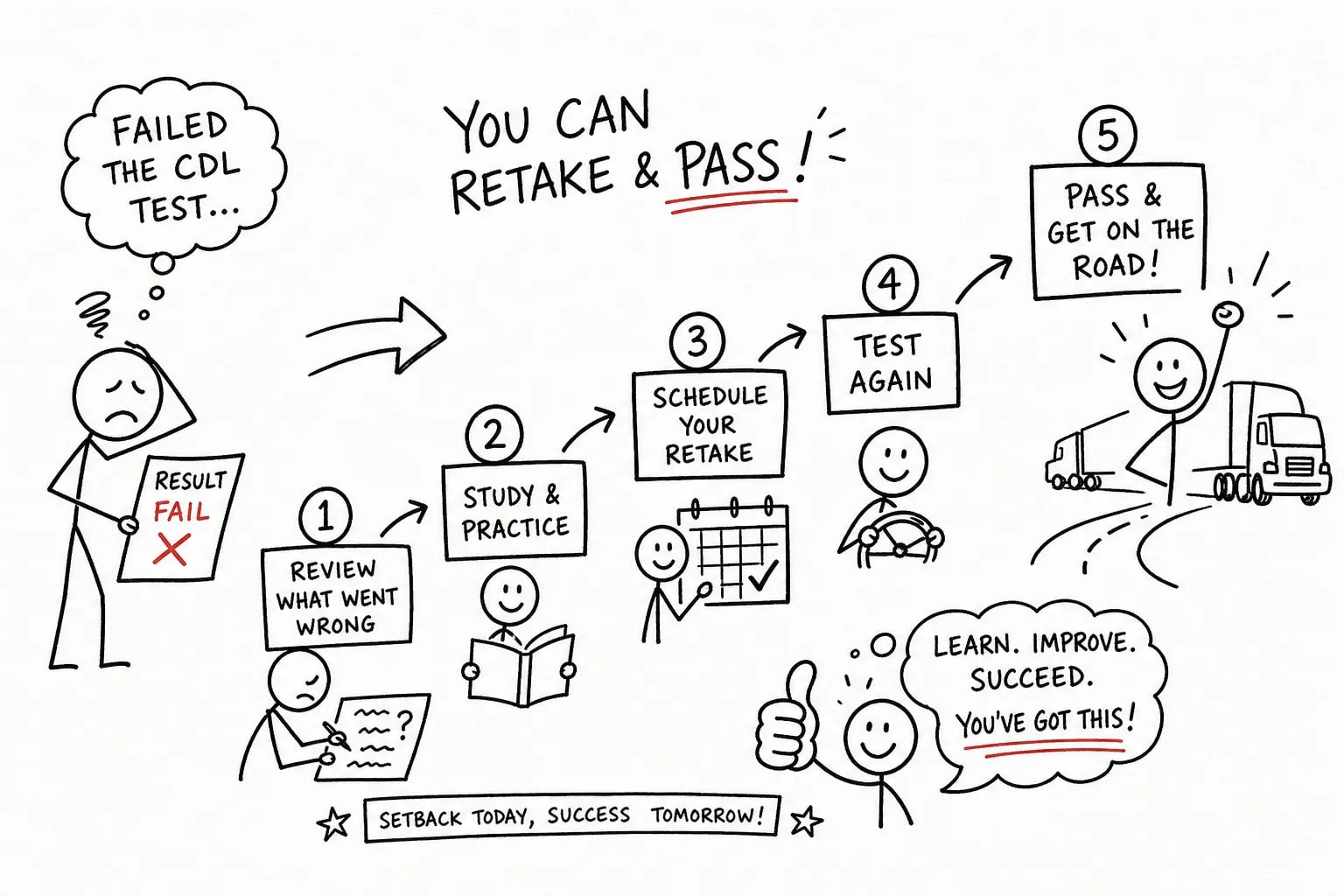
A CDL test failure stings. You put in time, you thought you were ready, and now you're staring at a score report that says otherwise. That frustration is real, and you don't need anyone to minimize it. What you do need is a clear picture of exactly what went wrong and a focused plan to fix it before your next attempt.
Industry estimates suggest roughly 40% to 50% of CDL candidates don't pass the written knowledge exam on their first try. That number climbs even higher for the air brakes section, though air-brake failure figures vary widely depending on the source. Failing once doesn't mean you'll fail again. Trainers consistently point to one factor that separates retakers who pass from those who don't: studying the right material in the right way the second time around, rather than repeating what you already did.
CDL test failure splits into two distinct scenarios: the written knowledge exam and the skills or road test. Each one requires a different recovery approach. This article covers both, but spends serious time on the written exam because that's where a large share of preventable failures occur. Most candidates underestimate it, and many retakers repeat the same mistake by not targeting their actual gaps.
What happens right after a CDL test failure
Your score report and what it tells you
Many states hand you a score report immediately after a failed written exam, though not every jurisdiction provides sectional feedback, verify what your state DMV offers. When you do receive it, this document typically shows your score by section, the 80% passing threshold, and which topic areas fell below the line. Don't discard it. That report is the most valuable tool you have for your retake, because it tells you exactly where to spend your study time.
Candidates who tuck the score report away and restart their prep from page one of the CDL manual are making a costly mistake. If you scored 92% on general knowledge but 61% on air brakes, you don't need a full review of general knowledge. You need to drill air brakes until that number is consistently above 85% in practice. The score report gives you that direction. Use it.
State wait periods, retest fees, and what to expect
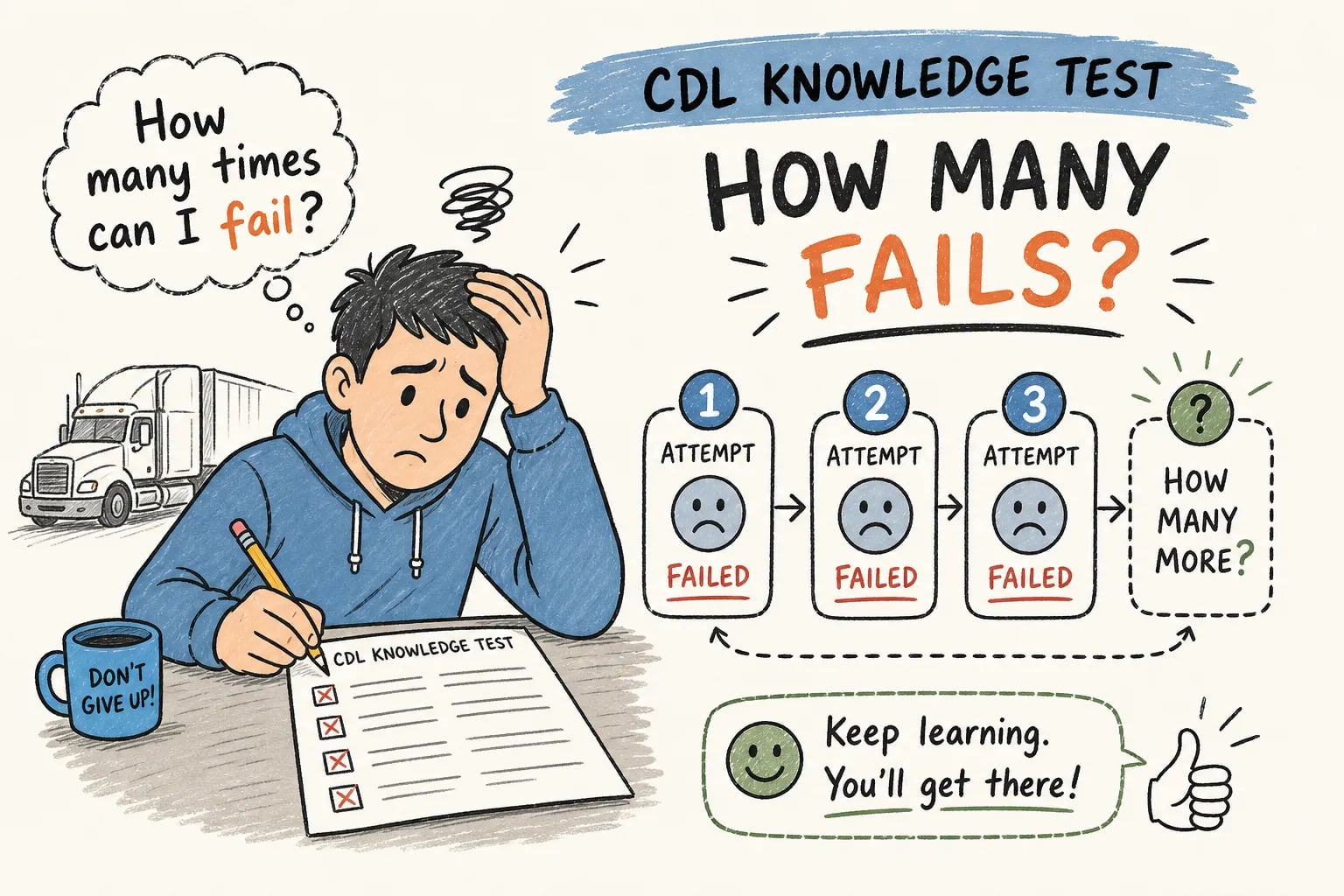
Wait times and attempt limits for the written knowledge test vary significantly by state, some publish a 24-hour cooling-off period, others have no mandatory wait but cap your total attempts. For example, California and Texas cap you at three failed attempts before your application expires and you have to reapply. New York is more permissive on attempt counts. Florida typically follows a three-attempt structure, but rules can vary depending on how you tested, so verify directly with the Florida DHSMV. Check your state DMV's current rules immediately after any failed attempt.
For the skills test, the financial stakes are higher. State retest fees alone typically run $20 to $150, but if you're retaking through a third-party tester and need a truck, total costs can reach $150 to $700 or more depending on vehicle rental and examiner fees. The more important deadline for most candidates isn't the attempt count; it's the expiration of your CLP or permit. If your CLP expires before you pass the skills test, you may have to restart part of the process from scratch.
Why the CDL written knowledge test has such a high failure rate
It's not bad luck, it's always the same topics
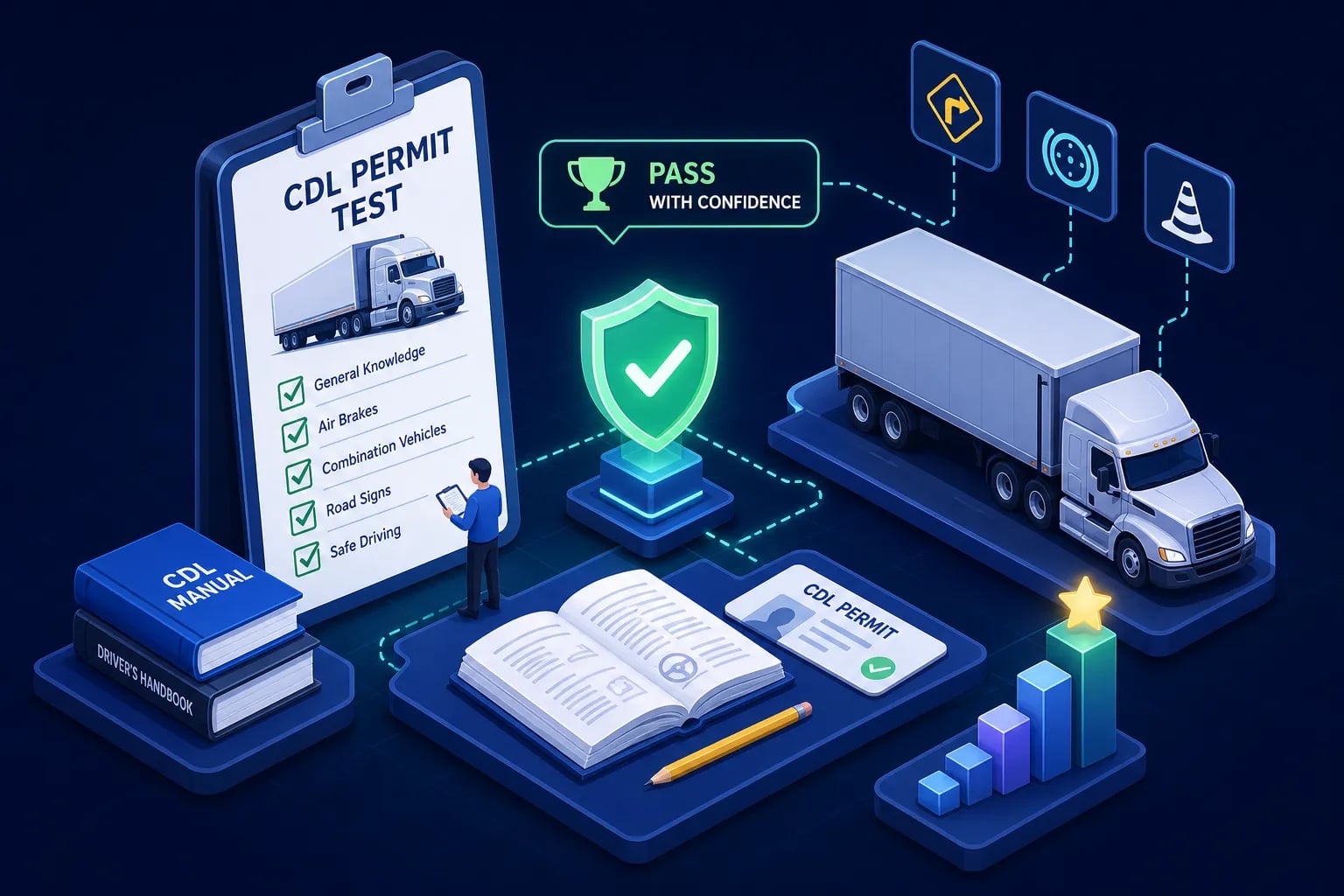
The CDL written exam doesn't fail candidates randomly. Failures cluster around a predictable set of topic areas that are technically dense, counterintuitive, or consistently underdrilled during self-study. General knowledge and air brakes account for a disproportionate share of written test failures. Combination vehicles and hazmat content follow closely. These sections contain specific numbers, sequences, and thresholds that can't be approximated. You either know that the dual air system must build from 85 to 100 psi within 45 seconds, or you don't.
Understanding this pattern matters because it means your CDL test failure wasn't random. It was predictable, which also means the fix is predictable. The sections that failed you are the same sections that fail thousands of other candidates every year, and the knowledge gaps within those sections are well-documented.
The study trap most retakers fall into
The most common retake mistake is reopening the state CDL manual at page one and reading straight through. This approach feels productive, but it burns study time on material you already know while giving only passing attention to the sections where you actually lost points. A retaker who scored 95% on vehicle systems and 62% on air brakes needs targeted air brakes drilling, not another full read of the manual. The rest of this article gives you exactly that: a section-by-section breakdown of where candidates lose points and how to close those gaps efficiently.
Air brakes: the written test section with the highest failure rate
What the air brakes knowledge test actually covers
The air brakes section tests your understanding of how an air brake system works as a whole, including individual components like the compressor, air tanks, valves, slack adjusters, and brake chambers. It also covers the low air pressure warning threshold, brake fade on downgrades, the parking brake system, and the behavior of dual air brake systems. None of these concepts appear in everyday driving, which is exactly why the section trips up candidates who feel otherwise prepared. The section is unforgiving precisely because it tests specific numbers, pressure values, build times, activation ranges, not general principles you can reason through on the fly. Know those numbers cold before you sit for the exam.
The specific thresholds that knock candidates below 80%
The air brakes exam tests a consistent set of pressure values and sequences. Memorize these:
-
The low air warning must activate before pressure drops below 60 psi (federal rules use 55 psi or half of governor cut-out pressure, whichever is less; use your state manual's exact wording)
-
Spring brakes apply automatically as pressure falls through the 20 to 45 psi range
-
A dual air system must build from 85 to 100 psi within 45 seconds at operating RPM
-
Governor cut-in is approximately 100 psi; governor cut-out is approximately 120 to 140 psi
-
With the engine off and brakes released, maximum air loss is 2 psi per minute for a single vehicle and 3 psi for a combination vehicle
Memorizing the right answer to one question isn't enough. Exam questions are often paraphrased, so you need to understand what each threshold means and why it exists. A candidate who understands that spring brakes activate automatically when air pressure gets dangerously low will answer correctly even when the question is worded differently than expected.
General knowledge gaps that catch candidates off guard
Where general knowledge study tends to go shallow
General knowledge is the largest section on the CDL written exam, covering vehicle systems, cargo securement, communication, hazardous driving conditions, and hours of service basics. Candidates tend to study the obvious content well: speed limits, following distance, basic signaling. They underdrill the nuanced material that shows up consistently on the actual exam, cargo weight distribution, lighting requirements, inspection sequences, and emergency signaling placement.
The section is wide enough that reading it once creates a false sense of preparation. You recognize the material, and that recognition feels like knowing it. Timed practice under exam conditions reveals a different picture.
The question categories that produce the most wrong answers
Cargo securement questions are among the most frequently missed on the general knowledge section. The exam tests specific rules: at least one tiedown for every 10 feet of cargo, a minimum of two tiedowns regardless of cargo length, and a combined working load limit of at least 50% of the cargo's weight. Candidates also consistently miss questions about weight distribution, too little weight on drive axles reduces traction; a high center of gravity increases rollover risk, the proper placement of reflective triangles during a roadside stop, and the rules around mirror use during lane changes and turns. These topics are commonly emphasized across state CDL manuals, and the candidates who miss them are typically the ones who read the manual once without ever testing themselves under timed conditions.
Other topic areas where candidates commonly lose points
Combination vehicles: a section that rewards system-level thinking
Combination vehicles questions trip up candidates who try to memorize isolated facts instead of understanding how the systems connect. The most missed categories include coupling and uncoupling procedures, the role of the converter dolly, rearward amplification (the crack-the-whip effect), and rollover risk with high-center-of-gravity loads. A candidate who understands why rearward amplification increases with trailer length will answer correctly even when the question presents an unfamiliar scenario. A candidate who memorized a single Q&A without understanding the concept will get the paraphrased version wrong every time.
Hazmat basics and pre-trip inspection content across sections
Even candidates who aren't pursuing a full hazmat endorsement encounter hazmat fundamentals on the general knowledge section. The most commonly missed content involves placard requirements by weight threshold, the nine hazard classes, and restricted routes for hazmat vehicles. Pre-trip inspection content also appears across multiple written test sections. Candidates who skip PTI study because they assume it only matters for the road test leave easy points on the table during the written exam.
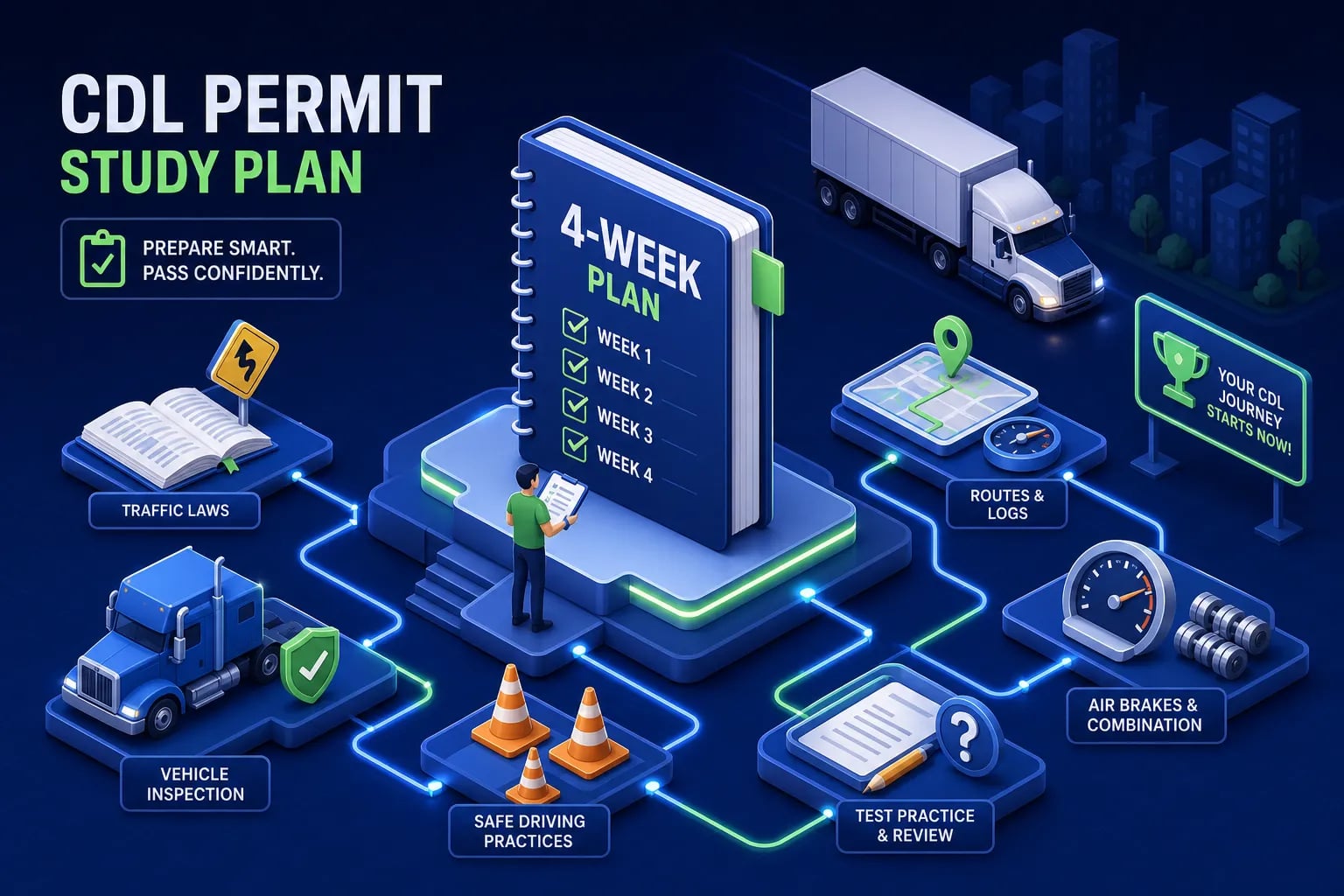
A targeted retake study plan that closes your specific gaps
Why reviewing everything again is the wrong move
If you failed the written test by a few points, you don't need to relearn everything. You need to isolate the specific sections and question types where you lost points and drill those repeatedly until the correct answers are automatic. A full re-read of the CDL manual takes hours and returns modest gains for a retaker. What actually moves the needle is focused, repetitive practice on weak spots, specifically the sections your score report identified as below threshold. The goal isn't to feel more prepared. It's to answer paraphrased versions of your missed questions correctly under timed conditions, and that outcome requires drilling, not reading.
How CDLTest360's missed-question system addresses this directly
One tool worth knowing about is CDLTest360, which addresses the retake trap directly. Instead of cycling through randomized question sets, CDLTest360's missed-question review system identifies every question a student answered incorrectly and re-drills only those questions in subsequent sessions. For a retaker, that means every minute of study time goes toward the content that actually cost points the first time, not material already mastered.
The platform's topic-specific quiz modules let candidates focus an entire session on air brakes, combination vehicles, or general knowledge independently. There's no need to mix topics when your score report already tells you where the problem is. The timed exam simulation mode mirrors the real test format with 50 questions and an 80% passing threshold, giving you a realistic readiness check before you schedule the official retake. A 90-day pass is available at $39.99, and a monthly option runs $19.99 with no long-term commitment. Start before your retake is scheduled. Waiting until after a second CDL test failure costs you time and money you don't need to lose.
What to do if you also failed the CDL skills or road test
The most common road test failure points
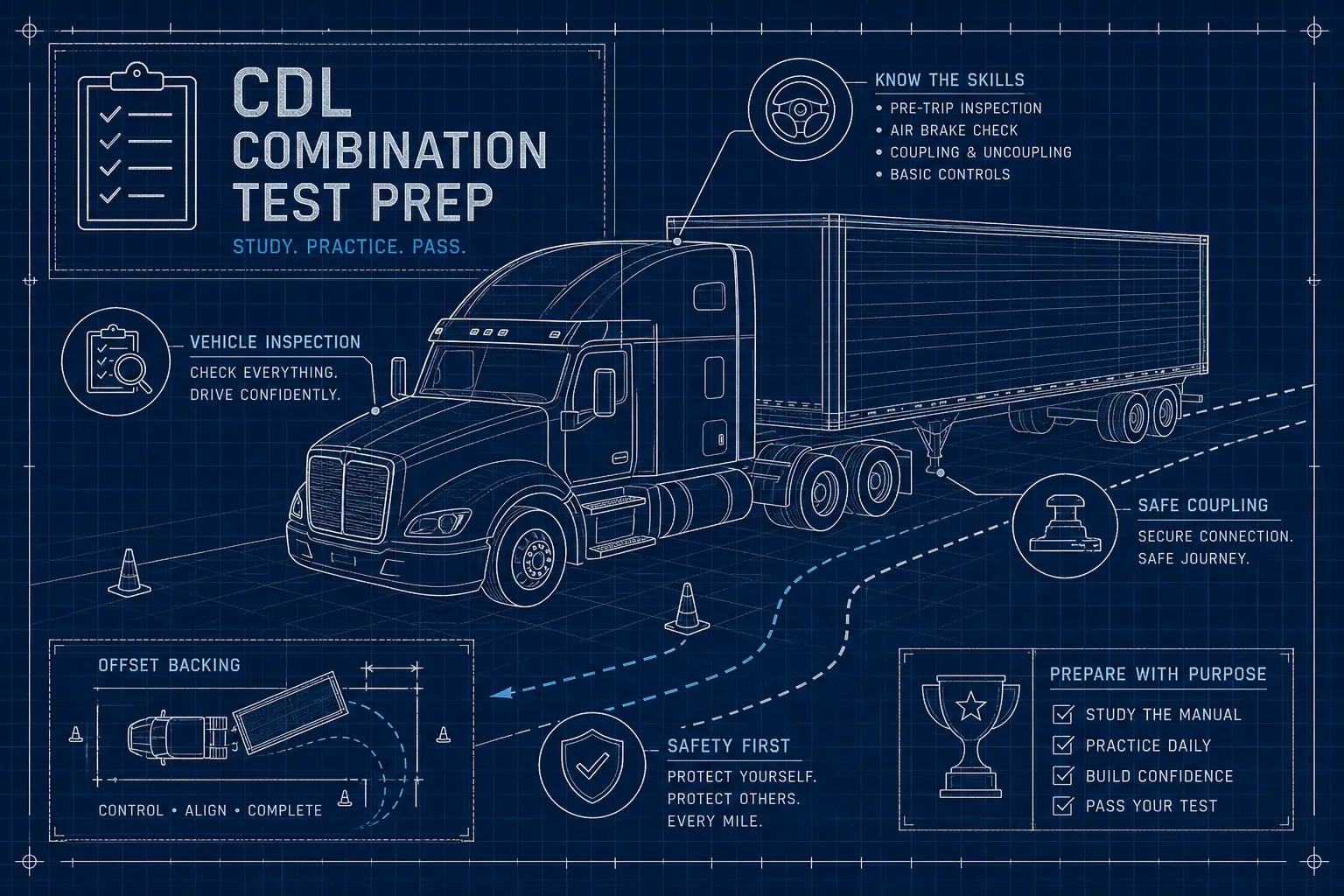
Skills test failure patterns are just as predictable as written test failures. The most common causes include incomplete pre-trip inspection walkarounds, excessive pull-ups during backing maneuvers, rolling stops, insufficient mirror scanning, and unsafe turns. Pre-trip inspection failure is particularly common because candidates underestimate the verbal precision the examiner requires. Pointing at a component and saying "looks good" won't pass. The examiner expects you to name the component, describe what you're inspecting, and identify the specific defect you're looking for.
Backing maneuvers, especially alley docking and offset backing, cause more failures than any other road test element. Candidates rush, overcorrect, lose track of the trailer's path, or use too many pull-ups. Slow, controlled repetitions with deliberate mirror use are what fix these errors.
High-impact drills to fix the top failure points before retesting
Use a structured 30-minute daily drill rotation rather than running full mock tests every session. Break it down as follows:
-
8 minutes: Pre-trip "Touch-Name-Explain" circuit, touch each component, name it, and state what defect you're inspecting for
-
8 minutes: Slow backing repetitions using the GOAL method (Get Out And Look) with boundary cones to replicate test conditions
-
5 minutes: Controlled shifting loop on a quiet route
-
5 minutes: Mirror-scan and lane-management practice with a partner recording missed checks, late signals, and rolling stops
-
4 minutes: Spoken emergency procedure scenarios, verbalize the first three safe actions for each scenario without moving the vehicle
Track only three numbers after each session: pre-trip omissions, backing boundary encroachments, and road-test observation errors. Practice the weakest category first at the next session. Consistent tracking makes improvement visible and keeps the drills purposeful rather than repetitive without direction.
How to explain a CDL test failure to a potential employer
What employers actually want to hear
A CDL test failure is not a career-ending event. Fleet managers and trucking employers are practical people who understand that the CDL test is difficult and that first-attempt failures are common. What they're actually evaluating when this topic comes up isn't the failure itself, it's how you handled it. A candidate who can explain the specific gap, describe the steps taken to address it, and confirm the retake outcome demonstrates accountability, self-awareness, and follow-through. Those qualities matter more to a hiring manager than a clean first-attempt record.
Framing the situation without undermining your candidacy
Keep the explanation brief, factual, and forward-facing. Name the specific section that caused the failure, then describe the targeted steps you took to fix it, topic-specific drilling, exam simulation practice, or additional behind-the-wheel time, and confirm the result. Avoid extended apologies or over-explaining. A composed, specific answer builds more confidence with an employer than deflecting the topic or pretending the failure didn't happen.
If the failure was on the skills test, name the specific maneuver or section and the drills you used to correct it. "I failed the backing portion the first time, drilled alley docking for two weeks using the GOAL technique, and passed the retake" is a complete, professional answer. It shows the employer exactly the kind of problem-solver they want behind the wheel of their equipment.
Your path forward after a CDL test failure
CDL test failure is common, predictable in its causes, and fully fixable with the right approach. The three-part recovery framework is straightforward: understand your score report and retake logistics, drill the specific topic areas where you lost points, and use a system that automatically focuses your prep on your actual weak spots rather than recycling generic review material. Air brakes, general knowledge, and combination vehicles carry the highest failure risk, those are the sections that deserve the most time.
Experienced CDL trainers consistently note that candidates who pass on the retake tend to share one trait: they studied the right content rather than simply studying longer. Low-air warning thresholds, spring brake activation ranges, tiedown minimums, and combination vehicle system logic all need to be automatic, not approximate. Practicing under timed conditions before you reschedule, not after you walk out of the test center a second time, is what separates candidates who close the gap from those who don't.
CDLTest360's topic-specific quiz modules, missed-question review system, and timed exam simulation give you exactly the focused retake prep that closes gaps efficiently. You can start a free trial without creating an account and run through the sections where your score report showed weakness to see where you actually stand before paying another retest fee. The retake is winnable. Candidates who treat their score report as a roadmap and drill with specificity almost always close the gap.
FAQ: CDL test failure and retake rules
How long do I have to wait before retaking the CDL written knowledge test?
Wait times vary by state. Some states require only a 24-hour waiting period between attempts, while others have no mandatory cooling-off period but limit your total number of attempts. Check your state DMV's current rules immediately after any failed attempt.
How many times can I retake the CDL test?
Attempt limits differ by state. California and Texas typically cap candidates at three failed attempts before requiring them to reapply. New York is more permissive. Always verify your state's specific rules, since they can change and may vary depending on whether you're retaking the written or skills test.
What does a CDL retake cost?
Written knowledge retest fees vary by state, often ranging from $10 to $50 per attempt. Skills test retake fees through state DMVs typically run $20 to $150. If you're testing through a third-party examiner and need to rent a truck, total costs can reach $150 to $700 or more.
What should I study after a CDL test failure?
Start with your score report. Focus your study on the specific sections where you scored below the 80% threshold rather than re-reading the entire manual. Air brakes, combination vehicles, and cargo securement are the sections that trip up the most candidates.
{ "@type": "Article", "datePublished": "2026-10-06T11:02:07.543Z", "dateModified": "2026-10-06T11:02:07.543Z", "headline": "CDL test failure? Here's your step-by-step retake plan", "description": "Failed your CDL test? Learn why candidates fail the written knowledge exam, which topics hurt most, exact retake rules, and how to target your gaps before retesting.", "publisher": { "@type": "Organization", "name": "CDLTest360" }, "image": [ ] }