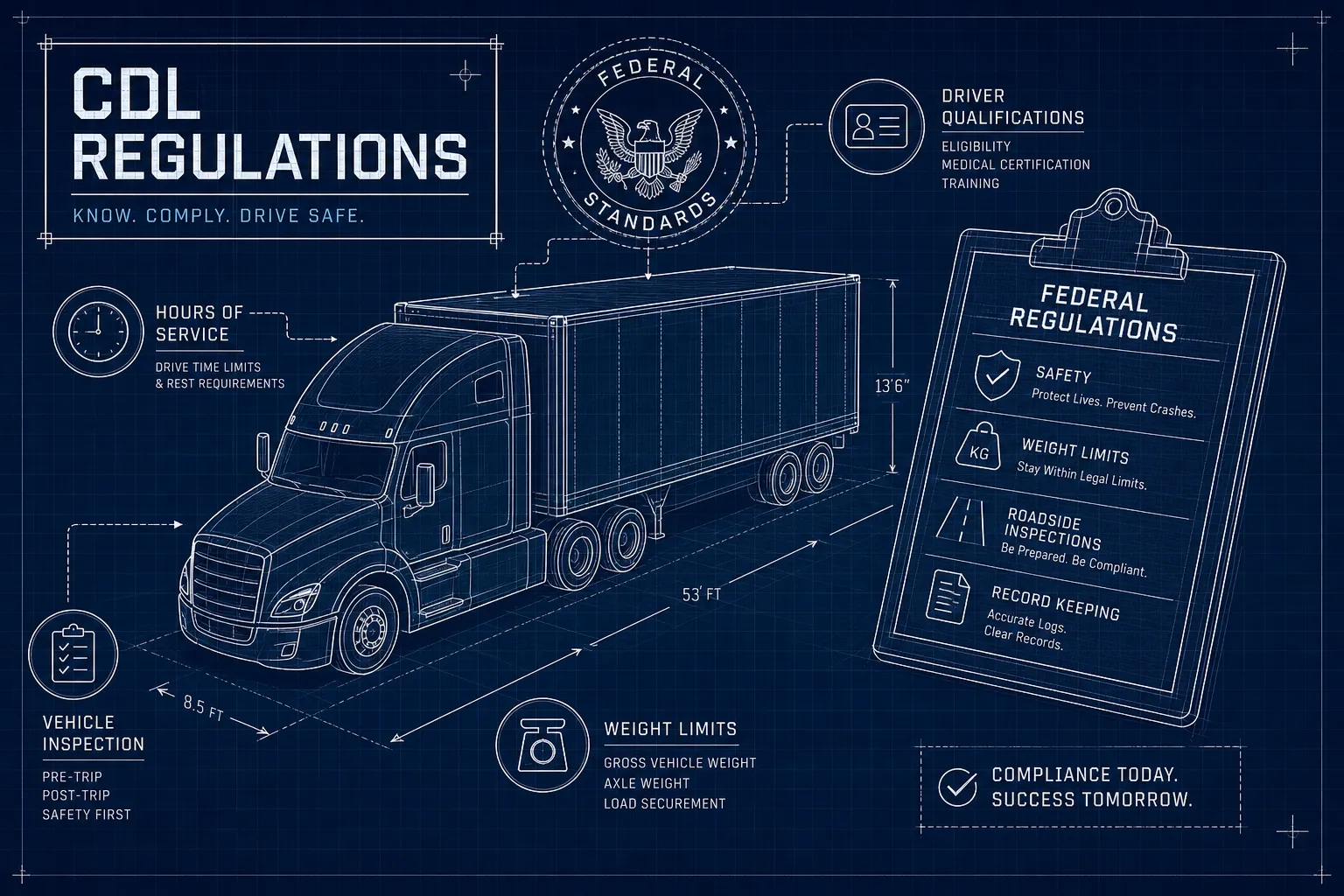
The federal trucking regulations every CDL candidate must understand cover several critical areas, with hours-of-service rules under 49 CFR Part 395, federal weight limits under FHWA standards, and vehicle inspection requirements under 49 CFR Part 396 among the most heavily tested. These areas appear consistently on the CDL general knowledge exam, and the FMCSA writes the federal standard that state exams draw from. Understanding these rules is not optional background knowledge; it is the foundation of the test itself.
At CDLTest360, we build our entire quiz bank directly from FMCSA regulations and state CDL manuals. Every practice question you work through maps back to an actual rule you will face on test day. This article is a plain-language breakdown of those rules, organized the way they appear when you sit down at the testing terminal. Read it through once, then start practicing, and you will see exactly how the regulations translate into multiple-choice questions.
Key takeaways
-
HOS rules under Part 395: The 11-hour driving limit, 14-hour duty window, and weekly hour caps are among the most commonly tested hours-of-service topics on the CDL knowledge exam.
-
Federal weight limits: The interstate gross vehicle weight limit is 80,000 pounds, with single-axle and tandem-axle caps that CDL candidates must recognize by number.
-
Pre-trip inspection scope: Federal law under § 396.13 requires drivers to inspect brakes, tires, lights, steering, coupling devices, and more before every trip.
-
Driver qualification standards: Part 391 sets the medical, vision, and hearing requirements every CDL applicant must meet before operating a CMV.
-
Drug and alcohol testing: Six categories of testing apply to CDL drivers, and post-accident testing has strict time windows that cannot be missed.
-
CDLTest360 alignment: Our question bank is sourced directly from FMCSA content, so practicing with us is practicing the regulations in the format the test uses.
What exactly are the Federal Motor Carrier Safety Regulations (FMCSR)?
The FMCSR is the official federal rulebook for commercial motor vehicle operations. Published under Title 49 of the Code of Federal Regulations and enforced by the FMCSA, it covers everything from how drivers qualify for a CDL to how a brake inspection must be documented. The regulations span Parts 300 through 399, but CDL candidates focus primarily on Parts 383 and 390 through 396.
For new candidates, the sheer size of the FMCSR can feel overwhelming. The practical shortcut is to follow the structure of the CDL knowledge exam itself, which draws from a defined set of those parts. Focusing your study on the right sections makes the material manageable without cutting corners on what actually matters.
Why the FMCSR matters on your CDL knowledge test
State CDL knowledge exams are built around FMCSA-standardized content, so the federal standard forms the core of what you will be tested on whether you are sitting for the exam in Texas, California, or Ohio. States create and administer their own tests and may include some state-specific material, but the overwhelming majority of exam content maps to federal standards. Knowing the FMCSR is, in practical terms, knowing the bulk of the test. Understanding which FMCSR sections to prioritize is where focused study pays off most.
Which parts of 49 CFR show up most on the CDL exam
Several parts carry the most weight for CDL candidates. Part 383 covers CDL classifications and endorsements. Part 391 covers driver qualification standards. Part 392 covers safe operation while driving. Part 395 covers hours of service. Part 396 covers inspection and maintenance. These parts are the core chapters every CDL candidate should treat as required reading before test day.
How do hours-of-service rules work for commercial drivers?
Hours-of-service rules under 49 CFR Part 395 are among the most commonly tested topics on the CDL general knowledge exam, according to FMCSA guidance and state CDL study materials. They prevent fatigued driving by setting hard limits on how long a driver can operate a commercial motor vehicle in a single day and across a weekly cycle. Knowing these numbers precisely matters because the exam tests exact thresholds, not general concepts.
Federal trucking regulations: the 11-hour driving limit and the 14-hour duty window
After at least 10 consecutive hours off duty, a property-carrying driver may drive no more than 11 hours. That driving must be completed within a 14-consecutive-hour on-duty window that begins the moment the driver goes on duty after those 10 hours off. Off-duty breaks generally do not pause the 14-hour clock, and that detail surprises many candidates who assume a rest stop resets the timer.
A mandatory 30-minute break is also required after 8 cumulative hours of driving. On-duty, not-driving time can satisfy this break requirement, so a driver who spends 30 minutes on fuel and paperwork after 8 hours of driving has met the rule. The 14-hour window and the 30-minute break are two separate requirements, and both must be tracked independently.
Weekly hour limits and the 34-hour restart
Drivers face a weekly cap as well. A driver may not drive after accumulating 60 on-duty hours in 7 consecutive days if the carrier does not operate every day of the week, or 70 on-duty hours in 8 consecutive days if the carrier operates every day. To reset that calculation, a driver must take at least 34 consecutive hours off duty.
Here is what that looks like in practice. Imagine a driver on an 8-day carrier schedule who reaches 70 hours on Thursday. That driver cannot legally drive again until completing 34 straight hours off duty, which resets the counter for the next 8-day window. Carriers plan dispatch schedules around this reset, and every CDL candidate should understand why it exists.
HOS exceptions CDL candidates are expected to recognize
Study materials commonly emphasize three HOS exceptions. The short-haul exception applies to drivers operating within a 150-air-mile radius of their normal reporting location; these drivers may work up to a 14-hour shift, but the 11-hour driving limit still applies. The adverse driving conditions exception allows up to 2 additional hours of driving when unexpected weather or traffic could not reasonably have been known before dispatch. The sleeper-berth provision lets drivers split the required 10 hours off duty into two periods: one of at least 7 consecutive hours in the sleeper berth and another of at least 2 consecutive hours off duty or in the berth, totaling at least 10 hours combined.
One rule to fix in your memory before test day: each exception changes only the specific limit it covers. It does not waive every HOS requirement across the board. Recognizing that boundary is exactly the kind of nuanced question you will see in the exam simulation on CDLTest360.
What federal weight limits apply to commercial motor vehicles?
Federal weight limits are set under FHWA standards and enforced at weigh stations and ports of entry across the country. They exist to protect roads and bridges from structural overload, and CDL candidates are expected to know the basic thresholds before they ever dispatch a load. Getting caught overweight is a serious compliance issue with real financial consequences for carriers and drivers alike.
Federal trucking regulations on gross vehicle weight, axle limits, and the bridge formula
For commercial motor vehicles operating on the Interstate System, the federal maximum gross vehicle weight is 80,000 pounds. The single-axle limit is 20,000 pounds, and the tandem-axle limit is 34,000 pounds. Beyond those flat caps, the Federal Bridge Formula applies to other axle groups and limits weight based on the number of axles and the distance between the outermost axles in the group.
The bridge formula exists because a shorter vehicle concentrates its load over a smaller section of roadway, placing greater stress on a bridge than a longer vehicle carrying the same total weight. A vehicle can be under 80,000 pounds in total and still violate the formula if too much weight sits over a particular axle group. Compliance is checked across overlapping groups of consecutive axles, not just against the truck's total weight.
Why weight limits show up on the CDL test
Overweight violations are among the most common citations at roadside inspections. CDL candidates need to recognize these numbers because weight decisions happen before dispatch, not after a citation at the scale. Knowing the 80,000-pound gross limit and the single-axle and tandem-axle thresholds gives a driver the grounding to catch a loading problem during pre-trip rather than at a weigh station hundreds of miles down the road.
What do FMCSA inspection requirements actually cover?
Part 396 is the federal framework for keeping commercial vehicles roadworthy. Inspection requirements apply at three distinct levels: before every trip, at the end of each workday, and on an annual basis. The CDL general knowledge exam tests all three because a commercial driver is responsible for compliance at every level, not just the day-to-day checks.
Pre-trip inspection: FMCSR § 396.13 checklist
Under § 396.13, before every trip a driver must be satisfied that the vehicle is in safe operating condition. Federal regulations identify the systems that must be covered: service brakes including trailer-brake connections, parking brake, steering mechanism, lighting devices and reflectors, tires, horn, windshield wipers, rear-vision mirrors, coupling devices, wheels and rims, and emergency equipment. Drivers must also inspect frame and frame assemblies, suspension systems, and axles as part of a complete walkaround.
The pre-trip inspection wording is a tested component of the CDL exam, not just a general concept. Our PTI phrase trainer at CDLTest360 drills the exact language for each vehicle component so nothing gets left out when it counts. That feature is specifically designed for candidates who know the concepts but freeze on the precise wording during the exam.
Driver vehicle inspection reports (DVIR)
Under § 396.11, at the end of each day's work a driver must complete a written Driver Vehicle Inspection Report covering specified vehicle components and note any defects or deficiencies found. The next driver must review and sign off on that report before operating the vehicle. This creates a documented paper trail connecting one driver's observations to the next driver's responsibilities, and carriers are required to retain those records as part of their maintenance documentation.
Annual and periodic inspections under federal law
Section 396.17 requires that every commercial motor vehicle pass a periodic inspection at least once every 12 months. Only inspectors who meet the qualifications in § 396.19 may perform it. This annual requirement sits above the daily DVIR system; it is a carrier-level obligation that ensures each vehicle meets federal safety standards regardless of what individual drivers note on a day-to-day basis.
What driver qualification standards does the FMCSR set?
Part 391 sets the baseline for who is legally allowed to drive a commercial motor vehicle. These standards exist to ensure that only physically and professionally qualified drivers operate CMVs, and every CDL candidate should understand this system because it governs their own entry into the profession.
Medical certification requirements every CDL applicant faces
Drivers must pass a DOT physical examination conducted by a medical examiner listed on FMCSA's National Registry. The vision standard requires at least 20/40 distant acuity in each eye, with or without corrective lenses, and at least a 70-degree horizontal field of vision in each eye. The hearing standard requires the ability to perceive a forced-whisper voice at 5 feet in the better ear, with or without a hearing aid. Certification is generally valid for up to two years but may be shortened if a condition requires periodic monitoring, such as hypertension or a sleep disorder.
What goes into a driver qualification file
The § 391.51 driver qualification file that a carrier maintains for each driver includes the employment application, the motor vehicle record obtained from each state licensing authority, a road-test certificate, medical qualification documentation, and documentation of the prior-employer safety-performance inquiry covering the applicant's three-year history. The motor vehicle record must be placed in the file within 30 days after employment begins. The file must be retained for the duration of employment and generally for three years after the driver leaves.
CDL candidates benefit from knowing this system before they get hired, because it defines exactly what a carrier will collect and review during the onboarding process. The CDL exam may include questions drawn from this onboarding framework, so knowing the file contents before you sit down is a practical advantage.
What drug and alcohol testing rules do CDL drivers need to recognize?
Part 382, combined with Part 40, governs drug and alcohol testing for all safety-sensitive commercial driving functions. CDL candidates are tested on the categories of required testing and the consequences of violations. DOT drug panels test for marijuana, cocaine, opioids, amphetamines including methamphetamine, and PCP.
The types of testing and when they apply
Six testing categories apply to CDL drivers. Pre-employment testing requires a negative controlled-substance result before a driver operates a CMV for a new carrier. Random testing is unannounced and scientifically randomized. Reasonable suspicion testing is ordered by a trained supervisor based on specific, contemporaneous observations of possible alcohol or drug use. Post-accident testing follows qualifying crashes. Return-to-duty testing is required after a driver violates the drug-and-alcohol prohibitions and completes the required substance-abuse professional process. Follow-up testing continues after return to duty for the period specified by the substance-abuse professional.
Post-accident testing rules and timing requirements
Post-accident testing rules hinge on what happened in the crash and whether the CMV driver received a moving traffic citation related to the accident. The table below shows exactly when testing is required:
  Accident result
  Citation issued to CMV driver?
  Testing required?


  Fatality
  Yes or no
  Drug and alcohol tests required


  Bodily injury requiring immediate medical treatment away from the scene
  Yes
  Drug and alcohol tests required


  Bodily injury requiring immediate medical treatment away from the scene
  No
  No FMCSA post-accident test required


  Disabling damage requiring tow-away
  Yes
  Drug and alcohol tests required


  Disabling damage requiring tow-away
  No
  No FMCSA post-accident test required
The alcohol test must be administered as soon as practicable, generally within 8 hours. The drug test must be administered generally within 32 hours. If the alcohol test window closes without a completed test, the employer must stop attempting to obtain it and document why. The same procedure applies to the drug test at the 32-hour mark. The driver must avoid consuming alcohol for 8 hours after the accident or until testing is completed, whichever comes first.
How CDLTest360 prepares you for FMCSA-based exam questions
Knowing federal trucking regulations is one thing. Recognizing them under timed test pressure, across 50 questions, with an 80% passing threshold standing between you and your CDL, is a different challenge entirely. Structured practice built directly from FMCSA content is what closes that gap, and that is exactly the design principle behind CDLTest360.
Quiz content sourced directly from FMCSA federal guidelines
CDLTest360 builds its entire question bank from FMCSA regulations and state CDL manuals, the same source documents the CDL knowledge exam is written from. Every HOS scenario, every weight limit question, and every inspection requirement prompt in our platform maps back to an actual regulation. When you practice with us, you are working through the regulations in the exact format the testing center uses.
Study modes built for how CDL candidates actually learn
CDLTest360 offers topic-specific quiz modules covering General Knowledge, Air Brakes, Combination Vehicles, ELDT Theory, Hazardous Materials, and Pre-Trip Inspection. The timed exam simulation runs 50 questions at an 80% passing threshold, mirroring the real test so you know precisely where you stand before you walk into the testing center. The missed-question drill re-isolates only the regulations you have not yet mastered, making every study session more efficient than starting over from scratch.
You can start a free trial with no account required and begin practicing immediately. A full 90-day pass is available at $39.99 for candidates who want comprehensive access, or you can go month to month at $19.99 with no long-term commitment. Either way, the content is the same: FMCSA-sourced, exam-aligned, and built to get you ready for test day.
Study federal trucking regulations the right way before test day
HOS rules, federal weight limits, inspection requirements, driver qualification standards, and drug-and-alcohol testing rules are the core of CDL knowledge, and all of them are grounded in FMCSA's 49 CFR framework. While states administer their own exams and may include some state-specific material, the majority of what you will face on test day maps directly to these federal trucking regulations. Treating them as the test, not as background reading, is the mindset that separates candidates who pass from those who go back for a second attempt.
Start a free practice session with CDLTest360 today, no account needed, and find out exactly where your knowledge stands before you walk into the testing center.
Frequently Asked Questions
How long is a DOT medical certification valid for?
A DOT medical certification is generally valid for up to two years. It can be shortened if a medical condition requires more frequent monitoring, such as hypertension or a sleep disorder.
What are the time limits for post-accident drug and alcohol testing?
The alcohol test must be administered generally within 8 hours and the drug test generally within 32 hours after a qualifying accident. If the testing window closes without a completed test, the employer must stop attempting to obtain it and document why, and the driver must avoid consuming alcohol for 8 hours after the accident or until testing is completed, whichever comes first.
What records go into a driver qualification file and how long must they be kept?
A driver qualification file must include the employment application, motor vehicle record, road-test certificate, medical qualification documentation, and prior-employer safety-performance inquiry documentation covering three years. The motor vehicle record must be placed in the file within 30 days of employment, and the file must be retained for the duration of employment and generally for three years after the driver leaves.
What practice features and pricing does your CDL test preparation offer?
We offer topic-specific quiz modules and a timed exam simulation of 50 questions with an 80% passing threshold, plus a missed-question drill and a pre-trip inspection phrase trainer. You can start a free trial with no account required; a full 90-day pass is $39.99 or month-to-month access is $19.99.
{ "@type": "Article", "datePublished": "2026-10-28T11:02:35.332Z", "dateModified": "2026-10-28T11:02:35.332Z", "headline": "Federal trucking regulations every CDL candidate must know", "description": "Master federal trucking regulations before your CDL test. This beginner guide covers HOS rules, weight limits, and inspection requirements straight from FMCSA.", "publisher": { "@type": "Organization", "name": "CDLTest360" }, "image": [ "https://composeo-article-images.s3.us-east-1.amazonaws.com/federal-trucking-regulations-every-cdl-candidate-must-know-1793102906746.webp" ], "author": { "@type": "Organization", "name": "CDLTest360" } }
{ "@type": "FAQPage", "mainEntity": [ { "@type": "Question", "name": "How long is a DOT medical certification valid for?", "acceptedAnswer": { "@type": "Answer", "text": "A DOT medical certification is generally valid for up to two years. It can be shortened if a medical condition requires more frequent monitoring, such as hypertension or a sleep disorder." } }, { "@type": "Question", "name": "What are the time limits for post-accident drug and alcohol testing?", "acceptedAnswer": { "@type": "Answer", "text": "The alcohol test must be administered generally within 8 hours and the drug test generally within 32 hours after a qualifying accident. If the testing window closes without a completed test, the employer must stop attempting to obtain it and document why, and the driver must avoid consuming alcohol for 8 hours after the accident or until testing is completed, whichever comes first." } }, { "@type": "Question", "name": "What records go into a driver qualification file and how long must they be kept?", "acceptedAnswer": { "@type": "Answer", "text": "A driver qualification file must include the employment application, motor vehicle record, road-test certificate, medical qualification documentation, and prior-employer safety-performance inquiry documentation covering three years. The motor vehicle record must be placed in the file within 30 days of employment, and the file must be retained for the duration of employment and generally for three years after the driver leaves." } }, { "@type": "Question", "name": "What practice features and pricing does your CDL test preparation offer?", "acceptedAnswer": { "@type": "Answer", "text": "We offer topic-specific quiz modules and a timed exam simulation of 50 questions with an 80% passing threshold, plus a missed-question drill and a pre-trip inspection phrase trainer. You can start a free trial with no account required; a full 90-day pass is $39.99 or month-to-month access is $19.99." } } ] }