The CDL hazmat application, the full five-stage process for earning your H endorsement, covers eligibility confirmation, document collection, ELDT hazmat theory training, the state knowledge test, and the TSA security threat assessment. Only after all five stages are complete will your state issue the H endorsement on your CDL. This guide walks through each stage in sequence, with exact fees, required documents, realistic timelines, and the state-level quirks you need to know before you walk into any DMV or enrollment center.
One critical framing note before you start: the order of these steps is not the same in every state. Some states require TSA clearance before you can sit for the knowledge test. Others let you test first and fingerprint afterward. Knowing your state's specific sequence before you begin prevents wasted trips and weeks of unnecessary delay. Read your state DMV's hazmat page in full before scheduling anything.
Key takeaways
-
Five sequential stages: Eligibility confirmation, document collection, ELDT theory training, state knowledge test, and TSA security threat assessment all must be complete before the H endorsement is issued.
-
ELDT is mandatory for first-timers: First-time H endorsement applicants must complete FMCSA-approved hazmat theory training through a provider in the Training Provider Registry before testing.
-
Timeline is 30 to 60 days: Plan for a full month to two months from fingerprinting to H endorsement issuance, and build that into any job start or carrier onboarding schedule.
-
Document names must match exactly: Mismatches between your birth certificate, CDL, and other submitted documents are one of the most common causes of processing delays.
-
State rules vary significantly: Wisconsin, Maryland, New Mexico, New York, and other states each handle testing location, form requirements, and step sequencing differently from the federal baseline.
Who actually qualifies to apply for a hazmat endorsement?
Federal eligibility requirements you must meet first
Three federal requirements govern who can apply, and none are optional. You must hold a valid CDL or commercial learner's permit (CLP), be a U.S. citizen, U.S. national, or lawful permanent resident, and be able to pass a TSA security threat assessment. These are federal minimums set by FMCSA and the Department of Homeland Security, not optional state guidelines. The H endorsement uniquely requires a TSA security threat assessment tied to citizenship and immigration eligibility; other common CDL endorsements do not require the same federal process.
Lawful permanent residents can qualify, but they must present an unexpired Permanent Resident Card (Form I-551) or acceptable temporary I-551 documentation. If your immigration status does not fall into one of the approved categories, you cannot receive the H endorsement, regardless of your CDL class or driving record.
What the ELDT rule means for first-time HME applicants
Under the FMCSA Entry-Level Driver Training (ELDT) mandate, applicants obtaining the H endorsement for the first time must complete hazmat theory training through a provider listed in the FMCSA Training Provider Registry before sitting for the state knowledge test. This applies generally where the applicant's CLP was issued on or after February 7, 2022, according to FMCSA. Drivers who already held the H endorsement before February 7, 2022 are generally not subject to this requirement for renewals.
Why CDL retakers and career changers often miss step one
A common mistake is assuming the TSA background check can be initiated at any point in the process. In some states, you cannot even schedule fingerprinting until after you pass the knowledge test. In others, TSA enrollment can run concurrently with testing. The sequence is state-controlled, and starting steps out of order can waste application fees and reset waiting periods. Check your state DMV's hazmat page first, confirm the sequence, then proceed.
What documents do you need to gather before applying?
Identity and citizenship documents: what TSA and the DMV both want
Every applicant needs two categories of documents. First, a government-issued photo ID: your current CDL, a U.S. passport, a military ID, or a TWIC card all qualify. Second, a citizenship or immigration-status document: a U.S. birth certificate with an official seal, a valid or expired U.S. passport, a Certificate of Naturalization or Certificate of Citizenship, or an unexpired Permanent Resident Card for lawful permanent residents. Virginia's DMV, for example, allows either one qualifying List A document or a photo ID from List B combined with citizenship proof from List C. End after "List C." This illustrates how some states accept document combinations rather than requiring a single top-tier document.
Your CDL and medical certificate requirements
You must present your current state-issued CDL during the application process. Several states, including Maryland, also require a valid DOT medical certificate or an applicable waiver as part of the application package. All document names must match consistently across every submitted item. A CDL showing one name and a birth certificate showing another will stop your application before it starts.
Name-change documentation: a small detail that causes big delays
A mismatch between a maiden name on a birth certificate and a current married name on a CDL is one of the more common reasons appointments end without a submission. A marriage certificate, divorce decree, or court order that bridges those names must accompany your application package. Gather this document before your fingerprint appointment, not after, because returning with missing paperwork means restarting the appointment process entirely.
Step 1: Complete ELDT hazmat theory training
What hazmat theory training covers and where to find a provider
FMCSA-approved hazmat ELDT theory covers the classification of hazardous materials, placarding rules, proper shipping documentation, and safe handling requirements, all drawn from 49 CFR Part 380, Appendix E. You find a qualified provider through the FMCSA Training Provider Registry (TPR), available at the FMCSA website. The training must be completed and your provider must electronically submit your certification to the TPR before most states will allow you to schedule the knowledge test. According to FMCSA, providers must submit that certification by midnight of the second business day after training is completed. Providers require applicants to achieve at least 80% on the theory assessment to satisfy the federal standard. Once your record appears in the TPR, verify with your state DMV that it is visible on their end before booking your test appointment, because state procedures vary on how they confirm ELDT completion.
How CDLTest360's hazmat quiz module fits into this stage
Finishing ELDT theory does not mean you are ready to pass the state knowledge test. There is a gap between completing a provider's curriculum and sitting at the DMV counter, and that gap is where targeted practice makes the real difference. Our hazmat quiz module at CDLTest360 is built directly from FMCSA regulations and mirrors the structure of the state exam: 50 questions, 80% passing threshold, with both a practice mode and a timed exam simulation mode. You can start without creating an account and run a readiness check the same day your ELDT course wraps up.
ELDT sequencing: does it have to come before or after TSA?
FMCSA requires ELDT to be completed before the knowledge test, but the TSA background check can often run concurrently with your study period. New Mexico and Wisconsin both require ELDT completion before knowledge testing, according to their respective state DMV pages. Some states allow TSA enrollment to happen in parallel with ELDT, which can shorten the overall timeline. The practical rule: confirm your state's specific sequence before scheduling either the knowledge test or the fingerprint appointment, because getting the order wrong can cost you test fees.
Step 2: Pass the CDL hazmat knowledge test at your state DMV
What the hazmat knowledge test actually covers
The state hazmat knowledge test covers identification of hazardous materials, proper use of the hazmat table, shipping papers, placards and labels, emergency response procedures, and driver safety rules. It draws from the same FMCSA material your ELDT training covered, but the state test is a formal pass/fail exam that goes on your CDL record. Check your state DMV for its specific retest policy, since walking in prepared matters both financially and practically.
How the CDLTest360 hazmat module helps you walk in ready
After finishing ELDT theory, knowledge gaps often remain in two specific areas: placarding rules and emergency response procedures. These are also among the most tested topics at the DMV counter. CDLTest360's missed-question review system isolates only the questions you answered incorrectly and re-drills those specific items, which is a more efficient use of study time than re-reading the entire state manual the night before your appointment. Running the timed simulation mode at the 80% passing threshold shows you exactly where you stand before you pay a test fee.
State variation in test timing and location
Testing logistics differ enough between states to create real scheduling complications. Wisconsin allows walk-in hazmat knowledge testing at DMV offices. New Mexico requires TSA clearance before you can test, and testing happens at a Motor Vehicle Division office. Maryland allows testing only at designated full-service MVA offices and only after TSA approval. New York requires applicants to visit a DMV office for the written test as well. Confirm your state's exact rules before assuming you can walk in and test on any given day.
Step 3: Enroll in the TSA security threat assessment
How to pre-enroll and book your fingerprint appointment
Pre-enroll online through TSA Enrollment by IDEMIA or start the process by calling 855-347-8371. After pre-enrollment, schedule your appointment at an HME enrollment center. Many centers accept walk-ins, but scheduling an appointment reduces wait time and confirms the location has capacity. The fingerprint appointment itself takes roughly 15 to 30 minutes, and no decision is communicated to you on the spot. Bring every required document to that appointment because returning for missing items means requiring a new scheduling cycle.
What happens during the fingerprint appointment
A technician electronically captures your fingerprints, verifies your identity and citizenship documents, and processes payment. All document names must match at this stage, which is why resolving name-change documentation before this appointment is non-negotiable. The technician submits everything to TSA, and from that point the review period begins. You will not leave the appointment with an approval or denial; TSA's determination arrives separately, typically to both you and your state DMV.
Hazmat application fees: TSA assessment and the TWIC comparability discount
The standard HME threat assessment fee is $85.25, according to TSA Enrollment by IDEMIA. The reduced rate requires a valid TWIC with sufficient time remaining on the threat assessment, generally at least one year or four years, depending on the state's rules, and the application must be submitted in a state that participates in the comparability program.
This TSA fee is completely separate from state CDL application fees, testing fees, endorsement fees, and issuance fees. Some state pages display a combined total that includes TSA-related charges alongside state fees, which can cause confusion. Check the hazmat endorsement fee charged by your state in addition to the TSA fee to confirm your full out-of-pocket cost before your appointment.
What does the TSA background check actually review, and what can get you denied?
The three layers of the security threat assessment
TSA's review combines an FBI fingerprint-based criminal history check, an immigration-status verification, and a check against terrorism-related watchlists. The result is sent to both you and your state DMV. If approved, the state moves forward with issuance once all other requirements are complete. If flagged, TSA issues an Initial Determination of Threat Assessment and provides appeal and waiver instructions. Applicants generally have 60 days after receiving that notice to initiate an appeal under 49 CFR Part 1515.
Permanent disqualifiers: offenses that close the door entirely
The following offenses are permanently disqualifying under 49 CFR § 1572.103, regardless of when they occurred:
-
Espionage, sedition, or treason
-
Federal terrorism offenses or comparable state offenses
-
A crime involving a transportation security incident
-
Improper transportation of hazardous materials under 49 U.S.C. § 5124
-
Unlawful possession, manufacture, sale, distribution, or transport of explosives or explosive devices
-
Murder
-
Certain RICO violations where the predicate act involves terrorism or murder
-
Conspiracy or attempt to commit any of the above
A finding of not guilty by reason of insanity for any of these offenses can also trigger permanent disqualification under 49 CFR § 1572.103. There is generally no waiver pathway for permanently disqualifying offenses, though applicants may appeal or seek correction of inaccurate records.
Temporary disqualifiers and what the seven-year rule means
Certain convictions disqualify an applicant only if they occurred within the previous seven years, or if the person was released from incarceration within the previous five years. Key categories under this temporary bar include assault with intent to murder, kidnapping, rape or aggravated sexual abuse, firearms offenses, extortion, fraud or identity theft, bribery, drug distribution, smuggling, arson, robbery, voluntary manslaughter, and making threats or conveying false information. An applicant who is currently wanted or under indictment for any listed felony is also disqualified while that status is unresolved.
Temporary disqualification does not mean permanent rejection. Applicants may appeal factual errors in criminal records by submitting corrected court documents or certified dispositions to TSA. If the record is accurate but rehabilitation factors apply, a waiver request can be submitted within 60 days of a Final Determination, and TSA evaluates mitigating evidence including completion of treatment programs, restitution, and other rehabilitation documentation.
How long does the hazmat application process take from start to finish?
Typical TSA clearance window and what drives it
TSA typically clears most applicants within two to four weeks of fingerprinting. The full end-to-end process, including ELDT, knowledge testing, TSA enrollment, processing, and state issuance, commonly takes 30 to 60 days. Build this timeline into your job start date or carrier onboarding schedule before accepting a position that requires the H endorsement on day one. Carriers understand the process, but giving them accurate timeline expectations avoids unnecessary complications.
What causes delays and how to avoid them
Document mismatches, name inconsistencies, immigration record issues, and criminal history entries requiring manual review are the primary delay triggers. In rare cases, processing has stretched to 180 days. Two actions reduce delay risk significantly: verify that every document you bring to the fingerprint appointment shows the exact same name, and keep a copy of your TSA enrollment receipt so you can follow up with your state DMV if the standard processing window passes without a result.
Hazmat application checklist: state variations and final steps after TSA clearance
Why your state's sequence changes everything
States share a federal baseline but diverge significantly in how they administer the this endorsement process. Pennsylvania allows in-person submission at a Driver License Center or mailing the application with payment to PennDOT. New York requires the HAZ-44 form mailed with legal-status documents to the state DMV. Wisconsin requires fingerprinting within seven days of passing the H test at a Wisconsin Fieldprint location. Maryland separates the state MVA transaction from the DPSCS fingerprint-based background check entirely. Your state's DMV website is the authoritative source on sequencing, not the federal process description alone.
State forms you may need depending on where you live
Wisconsin requires both the standard driver-license application (MV3001) and the state HazMat application (MV3735). Pennsylvania lists the DL-11CD self-certification form as part of its sequence. South Carolina uses Form DL-400. New York uses Form HAZ-44 along with copies of qualifying legal-status documents. Texas requires CDL Form CDL-1 and the Texas Hazardous Materials Endorsement Application, Form CDL-6. Florida provides a state-specific HazMat application that must be completed and printed before the fingerprinting visit. Most states require at least the standard CDL application plus a separate hazmat-specific form, and several add a self-certification document on top of those.
Completing the process: what happens at the DMV after TSA approves you
Once TSA sends its approval to the state, you visit the DMV to complete the CDL endorsement transaction, pay any remaining state fees, and receive your updated CDL with the H endorsement. State fees vary and should be confirmed before your final DMV visit so you arrive with the correct payment method. Some states process this as an in-person appointment; others handle it electronically during the visit. The final step is straightforward once TSA's clearance is in place; the complexity lives earlier in the process.
Before you leave the DMV, verify that the H endorsement appears correctly on your new CDL. If you are enrolling as a student at a CDL school, ask your instructor or program administrator whether the school uses a management platform to track your progress and endorsement status. Our CDL school dashboard at CDLTest360 gives instructors visibility into student readiness across every knowledge area, including hazmat prep, so schools can catch gaps before students reach the DMV rather than after.
Getting your hazmat endorsement: the path forward
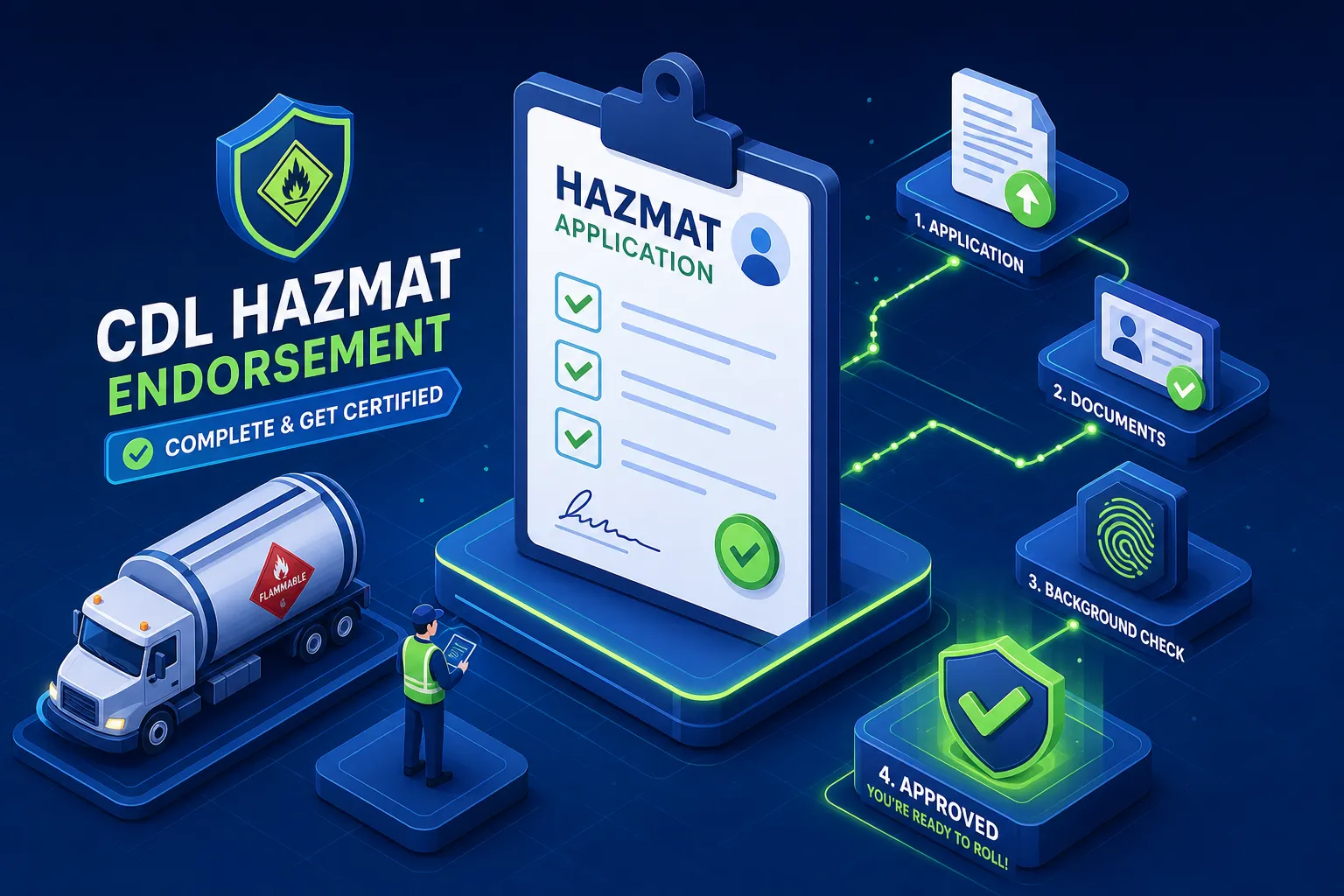
The process has real moving parts, but each step is manageable when you know the sequence. Confirm eligibility, collect your documents, complete ELDT theory through an FMCSA-registered provider, pass the state knowledge test, and clear the TSA security threat assessment. Build at least 30 to 60 days into your timeline, and confirm your state's exact order of operations before you initiate any single step.
The knowledge test is the one stage where targeted preparation has the clearest payoff. A failed test costs a fee and resets your schedule at a point when TSA processing may already be underway. Before you book your DMV knowledge test appointment, run through CDLTest360's hazmat quiz module. The missed-question drill and timed simulation mode give you a realistic read on your readiness, and you can start without creating an account. A few hours of focused practice on placarding and emergency response procedures is a reliable investment before sitting for an exam that directly affects your earning timeline.
The hazmat application has moving parts, but none of them are complicated once you know what comes next. Confirm the sequence for your state, get your documents in order, and use every available study tool. Give yourself realistic time to complete the process, and the H endorsement is well within reach.
Frequently Asked Questions
Can I start the TSA enrollment before I finish ELDT hazmat theory training?
Yes, TSA enrollment can often run concurrently with ELDT hazmat theory training in many states. Some states require ELDT completion before the knowledge test but still allow fingerprinting while you study, so confirm your state's sequence before scheduling to avoid wasted fees or steps.
What happens if the name on my CDL doesn't match my birth certificate or other documents?
A name mismatch will stop your application and likely force you to restart the appointment process. You must bring bridging documentation such as a marriage certificate, divorce decree, or court order that proves the name change before your fingerprint appointment to avoid delays.
How much will the TSA threat assessment cost and can that fee be reduced?
The standard TSA HME threat assessment fee is $85.25. A reduced rate can apply if you hold a valid TWIC with sufficient remaining time and your state participates in the comparability program, but state CDL and testing fees are separate and vary by state.
How can I confirm my ELDT completion was reported so I can schedule the state knowledge test?
Providers are required to submit your ELDT completion to the FMCSA Training Provider Registry by midnight of the second business day after training, and you should verify with your state DMV that your record is visible on their end before booking the test. Doing so prevents scheduling a test appointment that the state will refuse because the ELDT record hasn't yet appeared.
{ "@type": "Article", "datePublished": "2026-10-29T11:02:23.793Z", "dateModified": "2026-10-29T11:02:23.793Z", "headline": "How to Complete Your CDL HazMat Endorsement Application", "description": "Ready to file your CDL hazmat endorsement application? Get a step-by-step breakdown of TSA background check, required docs, fees, and timeline. Start prepping now.", "publisher": { "@type": "Organization", "name": "CDLTest360" }, "image": [ "https://composeo-article-images.s3.us-east-1.amazonaws.com/how-to-complete-your-cdl-hazmat-endorsement-application-1793189338377.webp" ], "author": { "@type": "Organization", "name": "CDLTest360" } }
{ "@type": "FAQPage", "mainEntity": [ { "@type": "Question", "name": "Can I start the TSA enrollment before I finish ELDT hazmat theory training?", "acceptedAnswer": { "@type": "Answer", "text": "Yes, TSA enrollment can often run concurrently with ELDT hazmat theory training in many states. Some states require ELDT completion before the knowledge test but still allow fingerprinting while you study, so confirm your state's sequence before scheduling to avoid wasted fees or steps." } }, { "@type": "Question", "name": "What happens if the name on my CDL doesn't match my birth certificate or other documents?", "acceptedAnswer": { "@type": "Answer", "text": "A name mismatch will stop your application and likely force you to restart the appointment process. You must bring bridging documentation such as a marriage certificate, divorce decree, or court order that proves the name change before your fingerprint appointment to avoid delays." } }, { "@type": "Question", "name": "How much will the TSA threat assessment cost and can that fee be reduced?", "acceptedAnswer": { "@type": "Answer", "text": "The standard TSA HME threat assessment fee is $85.25. A reduced rate can apply if you hold a valid TWIC with sufficient remaining time and your state participates in the comparability program, but state CDL and testing fees are separate and vary by state." } }, { "@type": "Question", "name": "How can I confirm my ELDT completion was reported so I can schedule the state knowledge test?", "acceptedAnswer": { "@type": "Answer", "text": "Providers are required to submit your ELDT completion to the FMCSA Training Provider Registry by midnight of the second business day after training, and you should verify with your state DMV that your record is visible on their end before booking the test. Doing so prevents scheduling a test appointment that the state will refuse because the ELDT record hasn't yet appeared." } } ] }