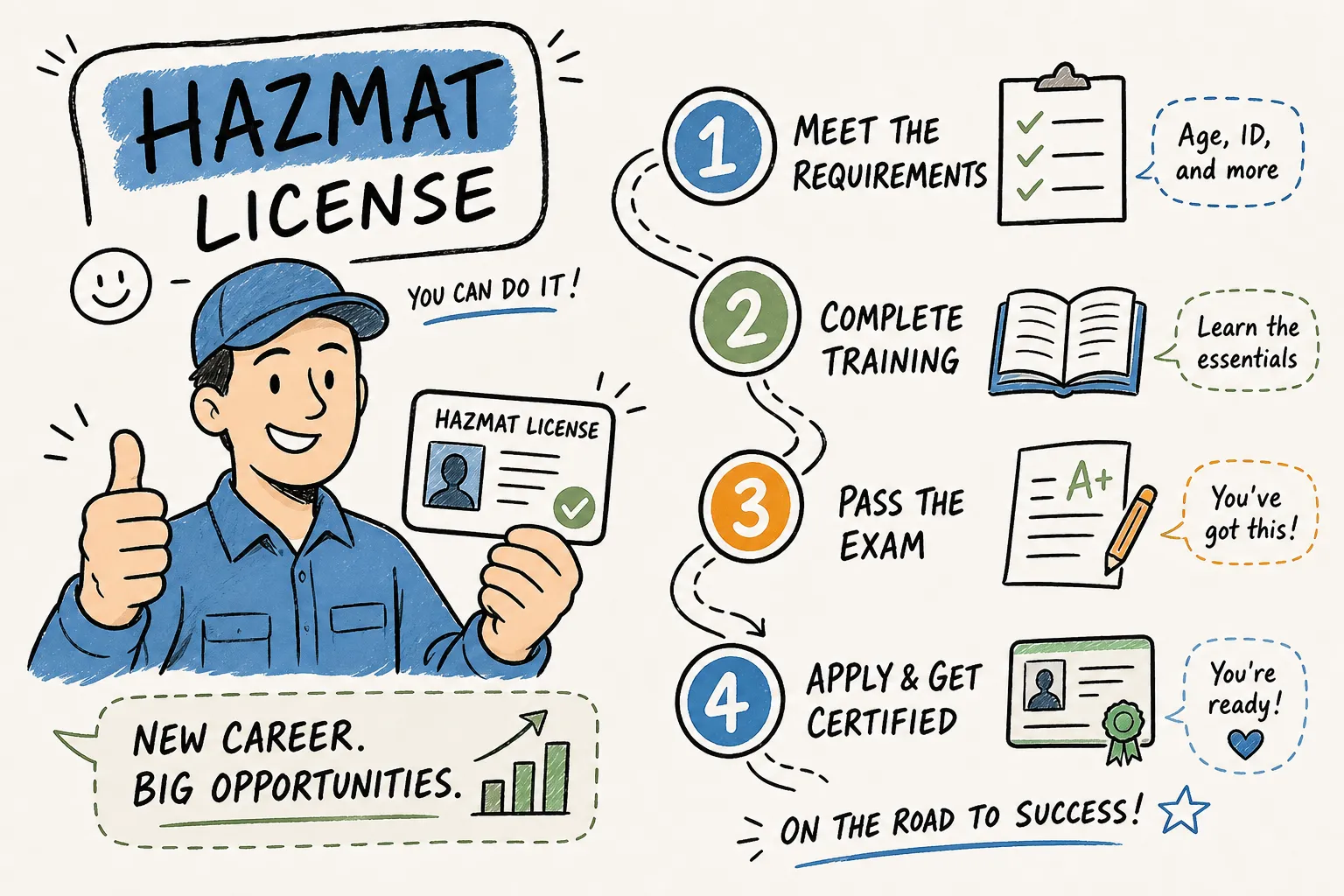
Getting a hazmat license, officially the H endorsement added to your CDL, means satisfying three federal requirements: ELDT hazmat theory training, a state CDL hazmat knowledge test, and a TSA Security Threat Assessment. FMCSA requires ELDT completion before you take the knowledge test, and TSA clearance must be in place before your state DMV can issue the endorsed CDL. The exact order of the TSA step relative to the knowledge test varies by state, so confirm the sequence with your state DMV before you begin. The full process typically takes four to ten weeks, with the TSA background check being the longest single step. This guide walks through each requirement so you know exactly what to expect, what to bring, and how to avoid the delays that send other drivers back to the DMV a second time. When it comes time to prepare for the knowledge test, CDLTest360's hazmat quiz module gives you a targeted, efficient way to close knowledge gaps before you sit down at the testing terminal.
The H endorsement is a significant credential. It opens access to a broad category of freight and, in many cases, higher pay. But the process has more moving parts than most endorsements, and the sequencing matters. Start in the wrong order and you waste time; show up to the DMV with the wrong documents and you waste a trip. Here is exactly how to do it right in 2026.
Key takeaways
-
Three federal requirements: ELDT hazmat theory training, the state H knowledge test, and the TSA Security Threat Assessment (STA) must all be satisfied before the DMV issues your hazmat license. FMCSA requires ELDT before the knowledge test; your state may require TSA clearance before or after the test, confirm the exact order with your DMV.
-
TSA processing drives the timeline: The Security Threat Assessment typically takes one to eight weeks; apply at least 60 days before you need the endorsement.
-
Check disqualifiers early: Permanent and temporary criminal offenses under 49 C.F.R. § 1572.103 can end the process before it starts.
-
Virginia and Washington are exceptions: Online ELDT hazmat courses may not be accepted in these two states; verify with your state DMV before enrolling.
-
TSA approval lasts five years: The STA expiration is separate from your CDL renewal cycle, so track both dates independently.
-
Use the wait productively: Study for the knowledge test while TSA processes your background check so you are ready the moment clearance arrives.
What is a hazmat license and when do you actually need one?
The H endorsement is added to your existing CDL
A hazmat license is not a separate document you carry alongside your CDL. It is the H endorsement added directly to a CDL (or a qualifying commercial learner's permit), making it the federal authorization to transport placardable quantities of hazardous materials. You cannot obtain the hazmat license without first holding a valid CDL; the endorsement has no standalone form.
This distinction matters for planning purposes. If you are still working toward your CDL, the hazmat license is a future step, not a parallel track. Get the base CDL first, then start the endorsement process.
When federal placarding rules require the endorsement
The H endorsement kicks in when cargo must be placarded under the federal hazardous materials regulations. Common examples include certain flammables, corrosives, explosives, and compressed gases transported in quantities that meet the federal threshold for required placarding. Not every shipment that touches hazardous material triggers the requirement; quantities below the placard threshold in many categories are exempt.
Before investing time and money in the endorsement process, confirm that your specific cargo type and quantity actually require placarding. Your carrier or employer can tell you, or you can reference the federal hazardous materials table directly. Starting the process unnecessarily adds cost with no return.
Is the X endorsement worth considering?
The X endorsement combines hazmat and tanker authorizations into a single code on your CDL. Drivers who regularly haul liquid hazardous materials in bulk need both endorsements, and states will display X rather than H and N separately once both are on record. If your work involves bulk liquid hazmat hauling, plan for both endorsements from the start. Keep in mind that the tanker knowledge test is also required, so factor in additional study time for that component as well.
Who qualifies for a hazmat endorsement and who gets disqualified?
Federal citizenship and CDL requirements
Federal rules generally limit the H endorsement to U.S. citizens and lawful permanent residents. Beyond citizenship, you need a valid CDL, a current DOT medical certification, and no active disqualifying legal issues. TSA makes the final eligibility call through the Security Threat Assessment process, not the state DMV; the DMV simply cannot issue the endorsement without a TSA determination of no security threat.
Permanent disqualifiers you need to know about
Certain convictions permanently bar an applicant from receiving the H endorsement, regardless of how long ago they occurred. Under 49 C.F.R. § 1572.103, permanent disqualifying offenses include murder, terrorism-related offenses under 18 U.S.C. chapter 113B, espionage, sedition, treason, unlawful possession or transfer of explosives or explosive devices, improper transportation of hazardous materials, a crime involving a transportation security incident, and conspiracy or attempt to commit any of these offenses. A conviction for any one of them ends the application permanently.
Temporary disqualifiers: the seven-year and five-year windows
Other offenses create a temporary disqualification: a conviction within the previous seven years, or release from incarceration within the previous five years, for crimes including robbery, extortion, fraud, firearms violations, drug distribution, arson, smuggling, bribery, immigration violations, kidnapping, rape, and certain RICO violations. The full list appears in 49 C.F.R. § 1572.103. Drivers with any prior record should review that regulation carefully before paying for ELDT training or scheduling a knowledge test, because the TSA decision is independent of anything the state DMV can override.
Documents you need for a hazmat license
Identity and citizenship documents
State DMVs typically require a valid CDL, a primary government-issued ID, and proof of U.S. citizenship or lawful permanent resident status to add the H endorsement. Accepted citizenship documents commonly include a valid U.S. passport, a certified birth certificate, a Certificate of Naturalization or Citizenship, or an unexpired Permanent Resident Card. The exact list varies by state, so pull your state DMV's specific hazmat checklist before you visit the counter.
Some states also require a second form of identification for the fingerprinting appointment at the enrollment center. Showing up with one document when two are required means a wasted trip and a rescheduled appointment. Check the requirements for both the DMV visit and the IdentoGO enrollment center separately.
Medical certification and Social Security verification
You need a current DOT Medical Examiner's Certificate, commonly called a medical card, meeting the federal requirements in 49 CFR Part 391. If you are operating under a federal medical waiver or exemption, bring that documentation as well. The medical card addresses medical qualification, while the TSA background check and citizenship proof address hazmat-specific eligibility; neither substitutes for the other.
Most states verify your Social Security number through your existing CDL record, though some require a separate document at the counter. If your medical certificate is about to expire, renew it before starting the hazmat process so an expiration does not stall your application mid-sequence.
How do you complete ELDT hazmat training?
What FMCSA requires and where to find an approved provider
First-time H endorsement applicants must complete ELDT hazmat theory training through a provider listed in FMCSA's Training Provider Registry (TPR) before taking the state knowledge test. No behind-the-wheel component is required for the H endorsement; it is theory only. The TPR is searchable at tpr.fmcsa.dot.gov, and you should confirm that your chosen provider appears there before enrolling and paying.
Providers report completion electronically to the FMCSA system, so no paper certificate needs to be hand-delivered to the DMV. That said, verify that your provider has transmitted your completion record to the TPR before you schedule the knowledge test. A missing electronic record can delay the DMV transaction even when you hold a course receipt.
What the course covers and how long it takes
ELDT hazmat theory courses cover hazardous materials classification, shipping papers, placards and labels, loading and unloading rules, emergency response procedures, and driver responsibilities. FMCSA does not prescribe a minimum number of theory hours; providers must cover the required curriculum and administer a final assessment requiring at least 80% to pass. Online courses typically run 1.5 to 2 hours for basic programs and up to 6 to 16 hours for more comprehensive options.
State exceptions that catch drivers off guard
Virginia and Washington do not accept all online ELDT hazmat formats. Drivers in those two states must verify that their specific provider is accepted by their CDL-issuing state, not just listed in the FMCSA TPR. Being "FMCSA-approved" is a necessary condition, not a sufficient one in every state. Call your state's CDL office to verify format requirements before paying for a course, especially if you are in Virginia or Washington, where in-person training may be required.
How do you prepare for and pass the state hazmat knowledge test?
What is actually tested on the hazmat written exam
The state knowledge test covers hazardous materials classes and divisions, shipping paper requirements, proper placarding selection and placement, loading and unloading and segregation rules, emergency response procedures, and driver responsibilities during an incident. Most states use roughly 30 questions with an 80% passing threshold, though question counts and retesting rules vary by state. The topics that appear most consistently across state tests include hazard classification, placarding thresholds (particularly the Table 1 "any quantity" rule and the general 1,001-pound threshold for Table 2 materials), shipping paper basics, and the Emergency Response Guidebook.
Classification, placarding, and shipping papers together account for the majority of questions on most state exams. Loading and unloading rules and emergency response round out the rest. Knowing those five areas cold puts you in a strong position regardless of which state you test in.
Why targeted practice beats reading the manual cover to cover
The CDL hazmat chapter is dense with regulation-specific language, definitions, and numerical thresholds. Passive reading is an inefficient way to prepare because the knowledge test rewards recognition of specific rule details under time pressure, and that skill is built through practice questions, not rereading paragraphs. Many drivers find that spending the same amount of study time on active practice, working through questions, reviewing misses, and drilling weak spots, is more effective than re-reading the manual a second time.
Using CDLTest360's hazmat quiz module to close knowledge gaps fast
Our hazmat-specific quiz module at CDLTest360 is built directly from FMCSA regulations and covers the topics that appear most consistently on state exams. The module runs in both practice mode and timed exam simulation mode, with the 80% passing threshold built in so you know exactly where you stand before walking into the testing center. The missed-question review loop re-drills only the items you got wrong, which means your study time targets actual knowledge gaps rather than material you already know.
No account is required to start the free trial, so you can begin practicing the same day you finish your ELDT course. For drivers working through the full endorsement sequence, state-specific CDL manuals are available inside the platform as well. Flexible pricing at $39.99 for a 90-day pass or $19.99 per month with no long-term commitment.
How does the TSA security threat assessment work?
Pre-enrollment and scheduling your fingerprinting appointment
Start by pre-enrolling online through the TSA Enrollment by IDEMIA program. You can also apply by calling the TSA HME Call Center at 855-347-8371, which is open Monday through Friday, 8 a.m. to 10 p.m. Eastern. During pre-enrollment, you provide your legal name and any aliases, date of birth, Social Security number, CDL information, citizenship or immigration status, and address history. After pre-enrollment, you schedule an in-person appointment at an approved enrollment center, commonly an IdentoGO location.
Use the TSA Enrollment by IDEMIA Enrollment Center Locator to find the nearest site that services HME applicants, searching by ZIP code or city. Select "HAZMAT Endorsement / HME Threat Assessment Program" as the service, because not every IdentoGO location handles HME enrollment. Appointments are strongly recommended, though many centers accept walk-ins; confirm with your specific center before traveling.
What happens at the enrollment center
Bring your acceptable identity and citizenship documents to the appointment. The enrollment agent verifies your documents, captures your digital fingerprints, and submits the full package to TSA. The total federal processing fee is approximately $86.50 when all three fee components apply: the $34.00 TSA threat-assessment fee, the $14.50 FBI criminal-history fee, and the $38.00 information-collection fee, according to TSA fee schedules.
How long does the background check take?
TSA recommends applying at least 60 days before you need the endorsement. Most assessments complete in one to eight weeks, but some states advise allowing up to 90 days to account for high-demand periods or document issues. TSA sends the eligibility result electronically to your state DMV; you generally do not need to bring an approval letter to the DMV unless your state specifically requires it. If you have not received a result within roughly six weeks of fingerprinting, contact the TSA enrollment call center at 855-347-8371.
How do you complete the state DMV application and get your updated CDL?
Submitting the application after TSA approval
Once TSA sends approval to your state, you can complete the DMV transaction. Bring your valid CDL, the completed hazmat endorsement application, proof of citizenship or lawful permanent resident status, your current DOT medical card, and confirmation that your ELDT completion is recorded in the FMCSA system. The state will not issue the endorsement until TSA approval is confirmed in their system, regardless of whether you have already passed the knowledge test. All three requirements, ELDT training, the knowledge test, and TSA clearance, must be complete before the H code appears on your credential.
State fees and what your updated CDL looks like
Once all requirements are satisfied, the state issues a new CDL credential displaying the H endorsement code. Drivers who also hold a tanker endorsement will see X on the new credential instead of H and N listed separately.
Renewal: what changes when the endorsement expires
The TSA Security Threat Assessment is valid for up to five years, and that expiration date is separate from your CDL renewal cycle. Renewing your CDL alone does not renew the STA. Most states align hazmat renewal with the CDL renewal schedule, but the STA must remain current throughout. Start the STA renewal process at least 60 days before your current approval expires so you avoid a lapse that temporarily removes the endorsement from your license.
What does a hazmat license cost and how long does it take?
Cost breakdown by component
The total breaks down into three expense categories. The TSA Security Threat Assessment totals approximately $86.50 for most applicants when all fee components apply, per TSA fee schedules. The ELDT course and test prep are the components you control; TSA and state fees are largely fixed.
Realistic timeline from first step to endorsed CDL
The ELDT course can be completed in a single day, typically 1.5 to 6 hours online. Scheduling availability for the knowledge test varies by state and DMV workload, check your state's scheduling portal for current wait times. The TSA background check is the longest single step: four to eight weeks in most cases, with some states advising up to 90 days. State DMV processing after TSA approval is generally a same-day or next-day transaction once you arrive with the correct documents. The total realistic timeline is four to ten weeks, almost entirely determined by how quickly TSA processes your Security Threat Assessment.
The most productive use of that waiting period is preparing for the knowledge test. Scheduling the test early and using the weeks of TSA processing for focused practice means you can pass the exam and be ready to complete the DMV transaction the moment TSA clearance arrives. Drivers who wait to start studying until after they hear from TSA only push their finish line further out.
Getting your hazmat license without the headaches
The process comes down to six sequential actions: confirm your eligibility under 49 C.F.R. § 1572.103, gather your documents, complete ELDT hazmat training through an FMCSA TPR-listed provider, pass the state hazmat knowledge test, clear the TSA Security Threat Assessment, and finish the state DMV application. Each step is straightforward on its own. The challenge is keeping the sequence straight and not letting any single step stall the rest.
The two most common sources of delay are starting the TSA process late and showing up to the DMV without the correct documents. Apply for the Security Threat Assessment as early as possible, at least 60 days before you need the endorsement, and pull your state DMV's specific document checklist before your appointment. Use CDLTest360's hazmat quiz module to prepare for the knowledge test during the weeks TSA spends processing your application. That way, when clearance arrives, the only thing left is a DMV counter transaction.
The hazmat license process has more steps than any other CDL endorsement. Knowing the sequence, the costs, and the documents required at each stage removes the uncertainty that trips most drivers up. Work through the steps in order, give the TSA timeline the lead time it needs, and you will have your hazmat license on your CDL without surprises.
Frequently Asked Questions
Can I wait to do ELDT until after I finish the TSA background check?
No, you must complete ELDT hazmat theory training before you take the state knowledge test, because FMCSA requires ELDT completion first. The TSA Security Threat Assessment's timing relative to the knowledge test varies by state, so confirm the exact sequencing with your state DMV before you begin.
If I pre-enroll with TSA online, do I still need to go to an enrollment center in person?
Yes, you must attend an in-person enrollment center appointment so an agent can verify your documents and capture your digital fingerprints. The enrollment center then submits your package to TSA and the federal processing fees are applied.
Once TSA clears me, does the H endorsement automatically appear on my CDL?
No, TSA approval is necessary but not sufficient by itself; the state DMV will not issue the endorsement until your ELDT completion, your knowledge test, and TSA clearance are all confirmed. The state issues a new CDL credential displaying the H (or X if you also hold tanker) only after all three requirements are satisfied.
What should I do if my DOT medical certificate will expire during the endorsement process?
Renew your DOT medical certificate before starting the hazmat process so an expiration does not stall your application mid-sequence. The current DOT medical card is required for the DMV transaction and must remain valid through the process.
{ "@type": "Article", "datePublished": "2026-10-23T11:02:23.106Z", "dateModified": "2026-10-23T11:02:23.106Z", "headline": "How to Get Your Hazmat License in 2026: Step by Step", "description": "Getting a hazmat license means passing an ELDT course, TSA background check, and state knowledge test. Here's exactly how to do it in 2026. Start prepping now.", "publisher": { "@type": "Organization", "name": "CDLTest360" }, "image": [ "https://composeo-article-images.s3.us-east-1.amazonaws.com/how-to-get-your-hazmat-license-in-2026-step-by-step-1792670856594.webp" ], "author": { "@type": "Organization", "name": "CDLTest360" } }
{ "@type": "FAQPage", "mainEntity": [ { "@type": "Question", "name": "Can I wait to do ELDT until after I finish the TSA background check?", "acceptedAnswer": { "@type": "Answer", "text": "No, you must complete ELDT hazmat theory training before you take the state knowledge test, because FMCSA requires ELDT completion first. The TSA Security Threat Assessment's timing relative to the knowledge test varies by state, so confirm the exact sequencing with your state DMV before you begin." } }, { "@type": "Question", "name": "If I pre-enroll with TSA online, do I still need to go to an enrollment center in person?", "acceptedAnswer": { "@type": "Answer", "text": "Yes, you must attend an in-person enrollment center appointment so an agent can verify your documents and capture your digital fingerprints. The enrollment center then submits your package to TSA and the federal processing fees are applied." } }, { "@type": "Question", "name": "Once TSA clears me, does the H endorsement automatically appear on my CDL?", "acceptedAnswer": { "@type": "Answer", "text": "No, TSA approval is necessary but not sufficient by itself; the state DMV will not issue the endorsement until your ELDT completion, your knowledge test, and TSA clearance are all confirmed. The state issues a new CDL credential displaying the H (or X if you also hold tanker) only after all three requirements are satisfied." } }, { "@type": "Question", "name": "What should I do if my DOT medical certificate will expire during the endorsement process?", "acceptedAnswer": { "@type": "Answer", "text": "Renew your DOT medical certificate before starting the hazmat process so an expiration does not stall your application mid-sequence. The current DOT medical card is required for the DMV transaction and must remain valid through the process." } } ] }