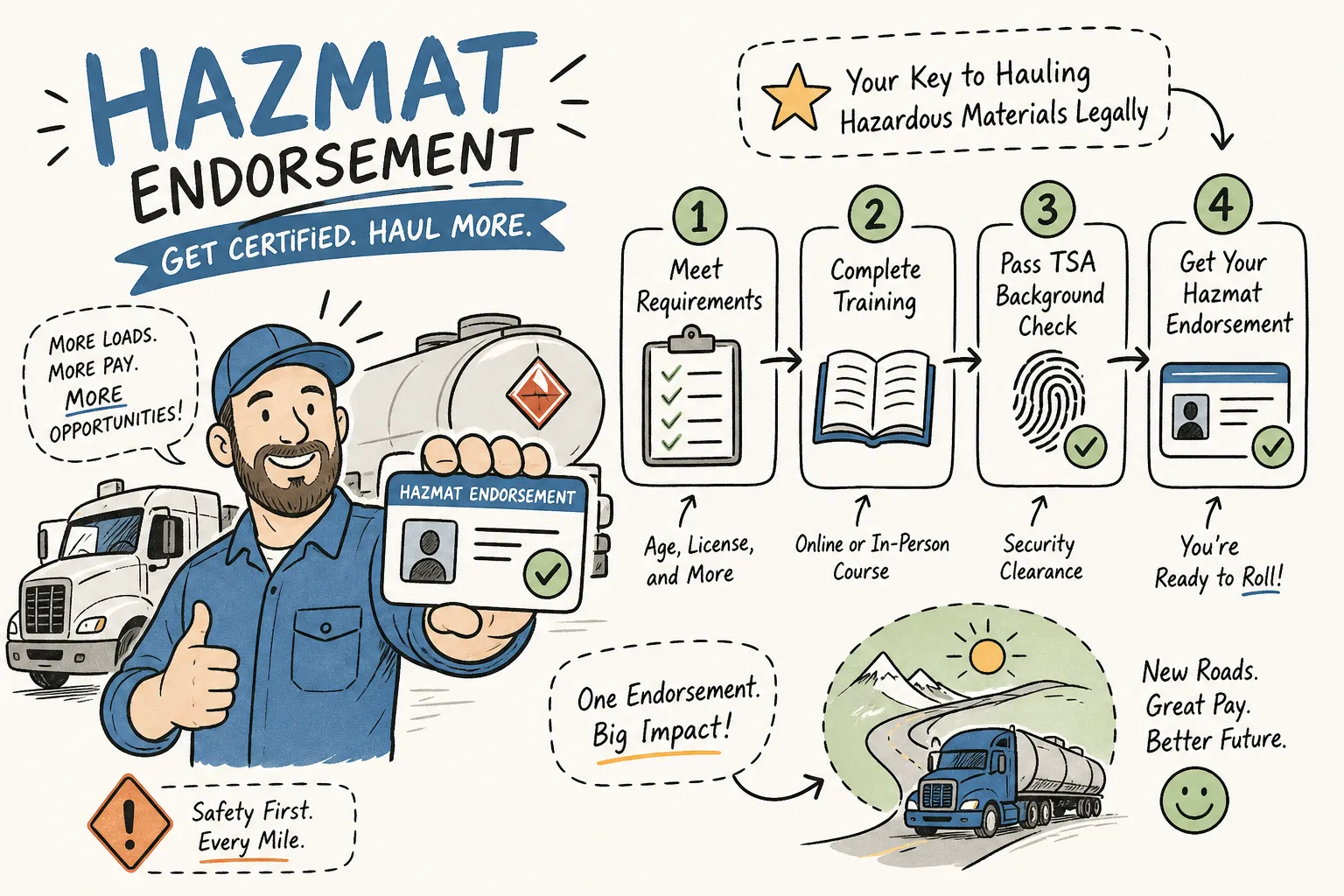
To obtain a hazmat endorsement (HME) on your CDL, you need to complete three things in the right order: pass the H endorsement knowledge test, clear the TSA Security Threat Assessment (STA) with fingerprinting, and finalize the transaction with your state DMV. The full process typically takes four to eight weeks from start to finish, TSA guidance sets a 30-day processing target, though straightforward cases often resolve in two to three weeks and complex ones can run longer. This guide walks through each stage in sequence, what it costs, what documents you need, and what can delay or derail your application so you can move through the process without surprises.
Key takeaways
-
Three-step sequence: Pass the H endorsement knowledge test, complete TSA fingerprinting and STA, then finalize with your state DMV. Doing these out of order costs time.
-
ELDT is mandatory first: First-time H endorsement applicants must complete FMCSA-registered hazmat theory training before the state can administer the written exam.
-
TSA fee is $85.25: The 2026 federal STA fee for a standard new applicant is $85.25, plus separate state DMV fees. The fee is nonrefundable.
-
Processing takes 2–8 weeks: Most clean applications receive a TSA decision in two to three weeks. Any record discrepancy stretches that window.
-
Some states run their own process: Florida, Kentucky, Maryland, New York, Pennsylvania, South Carolina, Texas, Virginia, and Wisconsin have state-directed fingerprinting or application routes. Mississippi's procedures have changed; verify your state's current process before scheduling anything.
-
Renewal is every five years: Both the TSA assessment and, in many states, the knowledge test itself must be repeated at renewal. Track your expiration date yourself.
What is the H endorsement and who actually needs one?
The HME, formally known as the CDL H endorsement, is a federal add-on to any Class A or Class B commercial driver's license. It authorizes the holder to transport placardable quantities of hazardous materials as defined by the Department of Transportation. Not every piece of cargo that carries a hazmat label triggers the placarding threshold; the quantity and hazard class together determine whether a placard is required, and the placard requirement is what determines whether the HME is legally necessary.
Common cargo categories that cross that threshold include Division 1.1 and 1.2 explosives, Class 3 flammable liquids such as fuel transported in bulk, and Division 2.1 flammable gases. If you're hauling quantities of these materials that require placards, you need the endorsement. Carriers in fuel delivery, chemical distribution, and certain industrial gas transport will almost certainly require it of their drivers.
The H endorsement works differently from most other CDL add-ons. Adding doubles/triples or a passenger endorsement involves only a state knowledge test. The HME adds a federal background clearance layer through TSA, which is why the process takes weeks rather than days. One common combination is pairing the H endorsement with the tanker endorsement (N). Drivers who hold both automatically qualify for the X endorsement, which is the combined HazMat-tanker designation that appears on the CDL itself.
How to obtain a hazmat endorsement, knowledge test and ELDT requirements
The H endorsement written exam is a standalone test; you do not retake General Knowledge or any other CDL exam just to add the HME to an existing license. The exam covers hazardous materials definitions and regulations, placarding rules, shipping paper requirements, emergency response procedures, and safe handling practices. Most states administer it at a DMV testing counter. While passing thresholds can vary by state, many require a score of approximately 80%; confirm your state's specific requirement with your CDL licensing agency. Because the content is drawn directly from FMCSA hazardous materials regulations, the subject matter is consistent across all 50 states.
Federal rules add one more requirement for first-time applicants: ELDT. The FMCSA mandates that anyone seeking an H endorsement for the first time must complete hazmat theory training through an FMCSA Training Provider Registry provider before the state will administer the knowledge test. This applies in all 50 states without exception. ELDT does not replace the knowledge test; it is a prerequisite to taking it. Your training provider submits your completion record to the registry, and the state verifies it before scheduling your exam.
Drivers who study specifically for the H exam perform better than those who rely on general CDL review materials, simply because the H exam draws from a defined pool of hazmat-specific content. A focused study approach, working through the H endorsement question bank and drilling missed items, targets the material that actually appears on the test rather than spreading study time across unrelated endorsement content.
How do you start the TSA security threat assessment?
The TSA Security Threat Assessment is a federal background check that must be completed and approved before any state can issue or renew an HME. You initiate it by completing the TSA HME application online through the TSA Universal Enrollment Services portal, or by calling the UES Help Desk at 855-347-8371. Pay the federal fee and submit the application before you arrive for fingerprint capture. You receive a confirmation number to bring to the appointment, and TSA's enrollment center locator shows approved fingerprinting sites near you.
At the enrollment center, staff verify your identity documents, capture your fingerprints electronically, and transmit the biometric data to TSA. TSA then runs three parallel checks: a fingerprint-based criminal history review, an immigration status verification, and a terrorism and intelligence screening. Appointments are recommended over walk-ins at most sites, though many centers accept walk-ins. Scheduling reduces your wait time and confirms the site has the equipment and staff available on your visit day.
Several states run their own fingerprinting process instead of using the national UES network. Florida, Kentucky, Maryland, New York, Pennsylvania, South Carolina, Texas, Virginia, and Wisconsin have state-directed routes. Mississippi's procedures have shifted over time, so verify current requirements directly with the Mississippi Department of Public Safety before scheduling. If you live in any of these states, contact your state CDL licensing agency before booking a standard UES appointment. Routing your application through the wrong channel can delay the process by weeks. Maryland, for example, routes fingerprinting through the Department of Public Safety and Correctional Services as a separate transaction from the MVA application. Texas requires TSA clearance before you can schedule the knowledge test at a DPS driver-license office.
What documents do you need to bring to your fingerprinting appointment?
Identity and licensing documents
Bring your current CDL or commercial learner's permit (CLP) if one has already been issued, along with an acceptable photo ID such as a state-issued driver's license or other TSA-approved identification. If your current legal name differs from any document due to marriage, divorce, or a court-ordered name change, bring the corresponding certified legal paperwork, a certified marriage certificate, divorce decree, or court order. Ordinary photocopies of any document are not accepted; bring originals or officially certified copies only.
Citizenship and immigration status documents
TSA also requires proof of U.S. citizenship or lawful immigration status. Acceptable documents include a U.S. passport, a certified birth certificate (not a photocopy), a Certificate of Naturalization or Citizenship, or a Permanent Resident Card. Some document combinations require you to present two identifying items rather than one, depending on whether your CDL or CLP is accepted as one of them. Confirm which combination applies to you when you pre-enroll so you arrive with everything TSA needs on the first visit.
Payment
Payment must be handled before or at the appointment. If you paid during online pre-enrollment, bring your confirmation number. If you're paying at the center, accepted methods typically include credit card, money order, company check, or certified check; cash and personal checks are often not accepted. Check directly with your enrollment center when scheduling, as accepted methods can vary by location. State DMV requirements, including any medical certificate or proof of state residency, are handled separately by your state and are not part of the TSA enrollment step.
How long does TSA processing take and what does it cost?
The federal STA fee for a new standard applicant in 2026 is $85.25. Applicants who hold a valid TWIC (Transportation Worker Identification Credential) may qualify for a reduced fee of $41.00 through TSA's comparability program, depending on whether their state participates. Confirm current eligibility and state participation with TSA or your state CDL agency before assuming the reduction applies. Both the standard fee and the TWIC-comparability fee are nonrefundable, including when an application is denied. State DMV fees for adding the HME to your CDL are separate and vary by state; budget for both.
TSA's processing target after receiving a complete application is approximately 30 days. Most straightforward applications receive a decision in two to three weeks. Applications involving prior convictions, immigration document discrepancies, name mismatches, or record ambiguities can take longer, sometimes well beyond 30 days. TSA recommends applying at least 30 days before you need the endorsement; if your background has any complexity, applying 60 days out is the smarter call. An incomplete application pauses the clock entirely, so accuracy on the initial submission matters more than speed.
Once TSA sends the eligibility determination to your state licensing agency, the endorsement still isn't on your CDL. TSA clearance means TSA found no transportation security threat. The state must then complete its own licensing transaction, which includes verifying your knowledge test score, collecting state fees, and updating your CDL record. That state-side step is usually straightforward and fast, but it requires the TSA determination to arrive first.
How do you complete the state DMV step after TSA clearance?
After TSA sends the eligibility determination to your state, you complete the state's HME licensing transaction: presenting your CDL and required documents, paying the state endorsement fee, and confirming your H endorsement knowledge test score is on record. Some states let you take the knowledge test before TSA processing begins; others require TSA clearance first. Knowing your state's required sequence before you schedule anything prevents you from wasting a DMV trip or having to repeat steps.
States with independent fingerprinting processes each have their own sequencing. Kentucky routes the HME knowledge test through the Kentucky State Police rather than a standard DMV counter, so applicants there follow a different scheduling path than in neighboring states. Wisconsin accepts walk-ins at any DMV office for the knowledge test. Maryland splits the process across two separate agency appointments. In each case, calling your state CDL licensing office before booking anything is what saves time.
ELDT completion must be verified by the state before the knowledge test is administered. If your training provider has not yet submitted your completion record to the FMCSA Training Provider Registry, the state cannot confirm your eligibility and will not administer the exam. Confirm with your ELDT provider that the submission is complete before you schedule the test appointment, not after you arrive at the DMV window.
What gets an HME application denied and how do you appeal?
Permanent disqualifications
TSA uses a two-tier disqualification framework. Permanent disqualifications apply to convictions for espionage, treason, sedition, terrorism-related offenses, crimes involving a transportation security incident, improper transportation of hazardous materials, unlawful explosive activity, and murder, as well as attempts and conspiracies involving those offenses. A conviction on any of these permanently bars the endorsement with no waiver path available.
Temporary disqualifications
Temporary disqualifications cover a longer list of offenses when the conviction occurred within the past seven years or the applicant was released from incarceration within the past five years. Offenses in this category include assault with intent to murder, robbery, and kidnapping. Also covered are arson, bribery, fraud and identity fraud, and distribution or importation of controlled substances. Smuggling, extortion, unlawful firearm activity, and aggravated sexual abuse round out the list, among others. Pending felony warrants and active felony indictments also trigger disqualification until the underlying matter is resolved.
Appeals and waivers
If TSA issues a Preliminary Determination of Ineligibility, the notice explains the reason and gives you 60 days to respond in writing to the TSA HazMat Processing Center. Two response paths exist. An appeal is appropriate when the underlying record is inaccurate, for example, a conviction belongs to someone else, a case was expunged, or a record was misidentified. Submit certified court records and documentation proving the error. A waiver is the route when the conviction is accurate but you believe mitigating circumstances show you no longer pose a transportation security threat. TSA considers the offense circumstances, rehabilitation evidence, and supporting documentation. Waivers are discretionary and are not guaranteed by the nature of the offense alone. TSA makes the final determination, not your state DMV.
When and how to renew your hazmat endorsement
The HME Security Threat Assessment must be renewed every five years, which aligns with most states' CDL renewal cycles. You cannot renew your CDL and keep the H endorsement active without also renewing the TSA assessment when the five-year mark has passed. Some states send renewal reminders; many do not. Tracking your HME expiration date is your responsibility. Letting it lapse means going through the full TSA process again before the state will reinstate the endorsement.
Renewal requires the same sequence as the initial application: pre-enroll, fingerprinting, TSA processing, and then state DMV confirmation. Start the TSA renewal application at least 60 days before your HME expiration date. Some states allow the H endorsement to remain active while a timely renewal is in process; others suspend it immediately at expiration. Confirm your state's bridge policy before assuming you can continue hauling hazmat during the processing window. Carriers often require drivers to hold a valid, uninterrupted HME, so even a brief lapse can affect your ability to run certain loads.
In many states, renewal also means retaking the H endorsement knowledge test. New York requires it within two years of CDL expiration; Missouri requires it every time the H or X endorsement is renewed. Verify current requirements with your state DMV, as rules can change. Do not assume renewal is a TSA-only process. If your criminal record has changed since the last STA, apply even earlier to allow time for any additional review TSA may need.
Your clear path to obtain a hazmat endorsement
Obtaining a hazmat endorsement takes more steps than most CDL endorsements, but each step is predictable once you understand the sequence. Complete ELDT hazmat theory training if this is your first HME, then pass the H endorsement knowledge test. Next, initiate the TSA Security Threat Assessment with fingerprinting, and finish the state DMV transaction after TSA clears you. Budget four to eight weeks and $85.25 for the federal fee, plus your state's add-on costs.
The knowledge test is where many applicants run into trouble. The H exam draws from a specific pool of hazmat content, definitions, placarding rules, shipping paper requirements, emergency response procedures, and studying that material directly is more efficient than working through a general CDL review that mixes in air brakes, combination vehicles, and other endorsements. CDLTest360's hazmat quiz module is built specifically for the H endorsement exam, so every question you practice is relevant to the test you'll actually take. The timed exam simulation and missed-question review loop help you identify and close gaps before you sit down at the DMV counter.
Take a free practice session before your scheduled exam date. Knowing where your gaps are ahead of time is what makes the difference between clearing the knowledge test on the first attempt and having to reschedule, and every delay pushes your entire obtain-hazmat-endorsement timeline back by weeks.
Frequently Asked Questions
Do I need ELDT if I already have a CDL and am adding the H endorsement for the first time?
Yes, first-time H endorsement applicants must complete FMCSA-registered hazmat theory training (ELDT) before the state will administer the H knowledge test. I state that ELDT is a prerequisite in all 50 states and your training provider must submit your completion record to the FMCSA Training Provider Registry for the state to verify.
Can I take the H endorsement knowledge test before the TSA Security Threat Assessment is complete?
Sometimes, whether you can take the knowledge test before TSA clearance depends on your state's sequencing rules. I note that some states allow the test first while others require TSA clearance before the exam, so you should confirm your state's required order before scheduling to avoid wasted trips or repeated steps.
What documents do I need if my legal name changed since my CDL was issued?
Bring your current CDL or CLP plus the certified legal paperwork that documents the name change, such as a certified marriage certificate, divorce decree, or court order. I emphasize that TSA requires originals or officially certified copies (photocopies are not accepted) and that presenting the correct certified documents at enrollment prevents delays.
How far in advance should I start the TSA application and fingerprinting if I need the endorsement by a specific date?
Start at least 30 days before you need the endorsement, and if your background has any complexity, start 60 days ahead. I recommend applying earlier because TSA's target is about 30 days but straightforward cases often finish in two to three weeks while record discrepancies or incomplete applications can take much longer.
{ "@type": "Article", "datePublished": "2026-10-21T11:02:22.356Z", "dateModified": "2026-10-21T11:02:22.356Z", "headline": "How to obtain your hazmat endorsement: 2026 guide", "description": "Ready to obtain a hazmat endorsement? This 2026 guide covers the HME knowledge test, TSA fingerprinting, state DMV steps, fees, and renewal. Start prepping now.", "publisher": { "@type": "Organization", "name": "CDLTest360" }, "image": [ "https://composeo-article-images.s3.us-east-1.amazonaws.com/how-to-obtain-your-hazmat-endorsement-2026-guide-1792498082704.webp" ], "author": { "@type": "Organization", "name": "CDLTest360" } }
{ "@type": "FAQPage", "mainEntity": [ { "@type": "Question", "name": "Do I need ELDT if I already have a CDL and am adding the H endorsement for the first time?", "acceptedAnswer": { "@type": "Answer", "text": "Yes, first-time H endorsement applicants must complete FMCSA-registered hazmat theory training (ELDT) before the state will administer the H knowledge test. I state that ELDT is a prerequisite in all 50 states and your training provider must submit your completion record to the FMCSA Training Provider Registry for the state to verify." } }, { "@type": "Question", "name": "Can I take the H endorsement knowledge test before the TSA Security Threat Assessment is complete?", "acceptedAnswer": { "@type": "Answer", "text": "Sometimes, whether you can take the knowledge test before TSA clearance depends on your state's sequencing rules. I note that some states allow the test first while others require TSA clearance before the exam, so you should confirm your state's required order before scheduling to avoid wasted trips or repeated steps." } }, { "@type": "Question", "name": "What documents do I need if my legal name changed since my CDL was issued?", "acceptedAnswer": { "@type": "Answer", "text": "Bring your current CDL or CLP plus the certified legal paperwork that documents the name change, such as a certified marriage certificate, divorce decree, or court order. I emphasize that TSA requires originals or officially certified copies (photocopies are not accepted) and that presenting the correct certified documents at enrollment prevents delays." } }, { "@type": "Question", "name": "How far in advance should I start the TSA application and fingerprinting if I need the endorsement by a specific date?", "acceptedAnswer": { "@type": "Answer", "text": "Start at least 30 days before you need the endorsement, and if your background has any complexity, start 60 days ahead. I recommend applying earlier because TSA's target is about 30 days but straightforward cases often finish in two to three weeks while record discrepancies or incomplete applications can take much longer." } } ] }