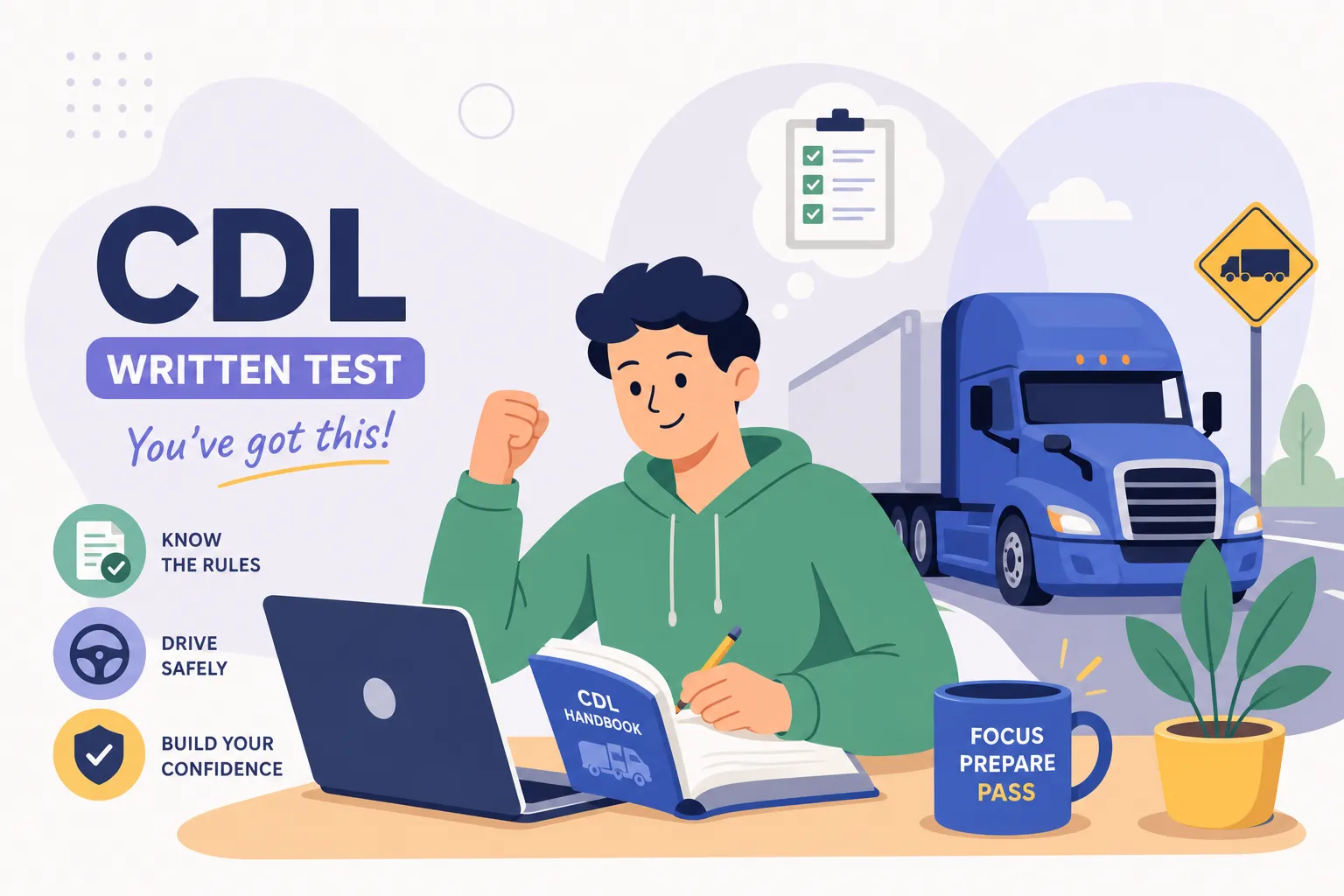
This CDL basic knowledge guide covers everything on the general knowledge written exam: 50 questions drawn from 20 federally required topic areas, and you need to answer at least 40 of them correctly. That's 80%, the threshold required to pass and earn your commercial learner's permit. That scope surprises most first-time candidates who assumed it would be a quick quiz about basic traffic laws. The sections below map every topic the commercial driver license exam covers, walk through real sample questions with explanations, and lay out a practical 7-step study plan you can start today. If you want to benchmark where you stand right now, CDLTest360 lets you jump into a free diagnostic practice test before you even create an account, the smartest first move before you crack open the state manual.
Key takeaways
-
50 questions, 80% to pass: Most states use a 50-question format, and you need at least 40 correct answers. Federal law requires a minimum of 30 questions.
-
20 federal topic areas: Every state exam must cover all 20 knowledge areas defined in 49 CFR §383.111(a), from vehicle inspection to fatigue countermeasures.
-
Endorsements are separate: Air brakes, combination vehicles, hazmat, and other specialty topics are separate knowledge tests, not part of the general knowledge exam.
-
Cargo inspection intervals matter: The exam tests specific numbers: inspect within 50 miles, then every 150 miles or 3 hours, whichever comes first.
-
HOS core rule: 11 hours of driving within a 14-hour window, then 10 consecutive hours off duty.
-
Diagnostic first: Taking a baseline practice test before studying tells you exactly where to focus your time.
What is the CDL general knowledge test, exactly?
The CDL general knowledge test is the written exam every commercial driver's license candidate must pass before taking any skills tests behind the wheel. Under 49 CFR §383.111(a), the federal government mandates 20 knowledge areas that every state's CDL written test must cover. States write their own questions and set their own passing scores, but they cannot skip those federal minimums, and the test must contain at least 30 questions. In practice, most states use a 50-question format with an 80% passing threshold, which means 40 correct answers.
Scoring 80% feels comfortable until you realize it means you can only miss 10 questions across topics you may never have thought about before. Aiming for 90% or higher on CDL practice questions gives you a real safety margin on exam day, accounting for nervousness and unfamiliar question phrasing.
The general knowledge test is always the first step in the CDL process. Passing it earns you a commercial learner's permit (CLP), which lets you practice driving with a licensed CDL holder in the vehicle. Only after holding the CLP for the required period can you schedule the skills tests. One thing candidates consistently misunderstand: air brakes, combination vehicles, hazmat, and other specialized topics are entirely separate endorsement tests. They are not automatically part of the general knowledge exam, so don't let the manual's full length intimidate you when preparing for this first CDL permit test.
CDL basic knowledge: vehicle systems you must know
The vehicle systems section tests whether you understand how a commercial vehicle works at an operational level, not a mechanic's level. The exam covers how the engine and fuel system function in basic terms, what dashboard gauges and warning lights indicate, the role of the steering system, and the critical difference between service brakes, emergency brakes, and parking brakes. A driver who understands these systems can catch problems during a pre-trip inspection before they escalate into a crash on the highway.
In the cab, you need to know what each gauge tells you and when a warning light should prompt you to pull over. Low oil pressure, high coolant temperature, and low air pressure warnings are not minor inconveniences, they signal situations that can cause mechanical failure within minutes. The exam will present scenarios where you must identify the correct response to a warning indicator, so reviewing your state manual's instrument panel section is non-negotiable.
Preventive maintenance is a related topic area that catches candidates off guard because it sounds like mechanic training. It isn't. The exam tests whether you can recognize early signs of mechanical failure: rust or shiny metal streaking around wheel lug nuts, which signals looseness; unusual tire wear patterns, which signal alignment or inflation problems; fluid leaks underneath the vehicle; and cracked or frayed belts in the engine compartment. You don't need to fix these problems, but you do need to recognize them, report them accurately, and know when a defect means the vehicle should not be driven.
How is the pre-trip inspection tested on the written exam?
The written general knowledge test covers pre-trip inspection knowledge conceptually, not physically. You won't walk around a truck during the written test. Instead, the exam asks whether you know what to inspect, in what sequence, and what defects to look for on each component. The major categories include tires, wheels and rims, lights, brakes, the fuel system, coupling devices for combination vehicles, cargo securement equipment, and emergency gear like fire extinguishers and warning triangles.
The written exam tests the "what" and "why" of inspection. For example, it may ask what a cracked brake drum indicates, why valve stem condition matters, or which lighting components must function before the vehicle moves. These questions are straightforward if you've studied the inspection chapter in the state manual with the intent of understanding each component's function, not just memorizing a checklist.
Keep the skills test in mind as you study. The CDL skills test, which comes after you've held your CLP, requires you to verbally describe each inspection step using precise language while pointing to or touching the components. Vague answers during the oral inspection portion cost points. CDLTest360's PTI phrase trainer drills the exact wording for each component so you're not caught off-guard when an examiner asks you to explain what you're looking for on a brake chamber. Building that language early, even while studying for the written test, gives you a clear head start.
What traffic laws and safe operating rules show up on the test?
The safe operating practices section is one of the heaviest on most state exams, covering following distance rules, speed adjustment for weather and road conditions, and space management around a large vehicle. The key rule on following distance is the 1-second-per-10-feet guideline at speeds under 40 mph, with an additional second added for speeds above 40 mph. Under adverse conditions, double that distance. These exact numbers appear on most state CDL exams, and candidates who haven't memorized them give up easy points.
Weather and road conditions generate a cluster of frequently tested questions. Bridges and overpasses freeze before the surrounding road because cold air circulates above and below the structure. In fog, the correct response is reduced speed and low-beam headlights, because high beams reflect off fog and reduce visibility further. Night driving introduces the concept of overdriving your headlights: if your stopping distance exceeds the distance your headlights illuminate, you cannot stop in time for a hazard you see at the edge of your light range. These are practical rules that also make intuitive sense, which makes them easier to retain.
Railroad-highway grade crossings are a distinct topic area with specific rules. Certain vehicles, including those carrying passengers, placarded hazardous materials, or chlorine, must always stop at railroad crossings regardless of whether signals are active or visible. Standard commercial trucks must slow, look, and listen before crossing. Knowing which vehicle types fall under the mandatory-stop rule is a reliable exam question. Similarly, the emergency equipment section tests what warning devices must be carried and where they must be placed when a vehicle is disabled on a road or highway: 10 feet behind and in front of the vehicle, and 100 feet to the rear. These are rule-based questions where memorizing the correct procedure earns straightforward points.
CDL basic knowledge, cargo securement and inspection rules
Cargo securement is tested with specific numbers the exam expects you to recall accurately. The federal inspection schedule requires you to inspect cargo and securement devices within the first 50 miles after loading, then again every 3 hours or every 150 miles, whichever comes first. A change in duty status also triggers a reinspection requirement. These numbers appear in exam questions in several formats, so memorizing the sequence rather than isolated figures helps: start, then 50 miles, then 3 hours/150 miles/duty-status change.
The exam also tests why these rules exist, not just what they are. Improperly secured cargo shifts during braking, acceleration, and turning, affecting the vehicle's steering response, stability, and stopping distance. A shifting load can move the vehicle's center of gravity enough to cause a rollover on a curve that would otherwise be manageable. The exam frames these questions around consequences, so understanding the mechanical reason behind each rule helps you answer scenario-based questions correctly.
Tie-down requirements follow a size-and-weight formula. Cargo no longer than 5 feet and weighing 1,100 pounds or less requires at least one tie-down (both conditions must be met simultaneously; if either limit is exceeded, the next tier applies). Cargo exceeding those limits requires at least two tie-downs for the first 10 feet, plus one additional tie-down for each additional 10 feet or fraction thereof. The combined working load limit of all tie-downs must be at least 50% of the cargo's weight. These specifics will appear on the exam, so writing them out a few times during your study sessions helps lock in the numbers.
What hours of service rules does the CDL written test cover?
The core hours of service rules for property-carrying drivers are tested directly on the general knowledge exam. The 11-hour driving limit means that after 10 consecutive hours off duty, you may drive a maximum of 11 hours. The 14-hour driving window means you may not drive beyond the 14th consecutive hour after first coming on duty, even if you took breaks during that window. These two rules work together: if you start a shift at 6 a.m., your 14-hour window closes at 8 p.m. regardless of how much driving you've done, and you cannot drive more than 11 of those hours under any circumstances.
The 60/70-hour weekly limit adds another layer. A carrier operating every day of the week uses the 70-hour rule: you cannot drive after accumulating 70 hours on duty over 8 consecutive days. The 34-hour restart provision allows drivers to reset that weekly count by taking at least 34 consecutive hours off duty. Exam questions on these limits often present a scenario and ask whether a driver is legally allowed to begin driving, so practicing the mental math of adding and subtracting hours against these limits is worth dedicating real study time to.
Fatigue countermeasures appear as a separate topic area in the federal framework, and the exam treats drowsy driving with the same seriousness as impaired driving. You need to know the signs of fatigue, the correct response (pull over and rest, not open a window and drink coffee), and why ELD and logbook compliance matters: accurate records allow enforcement to verify that hours of service rules are being followed. The exam may present a scenario involving a driver who is tired but close to the destination and ask what the correct action is. The answer is always to stop and rest.
Sample CDL practice questions with explanations
These six questions reflect the types of questions that appear on state CDL general knowledge exams. They represent the topic areas and reasoning patterns the exam consistently uses, not a prediction of specific items on your state's test bank, but a solid preview of how basic CDL knowledge is actually tested.
Questions on vehicle inspection and systems
Q1: What does rust streaking around a wheel lug nut indicate? It signals that the lug nut may be loose. When a fastener moves against metal, the friction creates rust and polished streaks. You should not operate the vehicle until the condition is inspected and corrected by someone qualified to do so.
Q2: When must certain commercial vehicles stop at a railroad crossing even when no signals are active? Vehicles carrying passengers, placarded hazardous materials, or chlorine must always stop, check, and confirm the tracks are clear before crossing. Standard trucks without those conditions must slow, look, and listen, but are not always required to make a full stop. Knowing which category requires a mandatory stop is where candidates lose points.
Questions on cargo and hours of service
Q3: How soon after loading must you inspect cargo securement? Within the first 50 miles, then again every 150 miles or 3 hours, whichever comes first, and whenever your duty status changes. Exam questions on this topic often use "or" phrasing to test whether you know it's whichever comes first, not a required combination of all three.
Q4: What is the maximum number of hours a property-carrying driver may drive in a day? 11 hours of driving time, but only within a 14-hour on-duty window that begins when the driver first comes on duty after 10 consecutive hours off. Candidates frequently confuse the 11-hour driving limit with the 14-hour window. They are two separate constraints, and both apply simultaneously.
Questions on safe driving and emergencies
Q5: What should you do first if a front tire blows out? Grip the steering wheel firmly, hold your lane, and ease off the accelerator. Do not brake immediately. Braking too early on a blown front tire can cause a sudden pull that leads to loss of control. Let the vehicle slow naturally, then apply gentle braking once your speed has dropped.
Q6: What is the legal BAC limit for operating a commercial motor vehicle? 0.04%, exactly half the standard 0.08% limit that applies to non-commercial drivers. The exam tests whether you know this distinction, and it comes up in both the general knowledge section and the fatigue and awareness topic area because alcohol impairs driving well below that legal threshold.
These examples show how the exam pairs a clear question with an answer that requires you to know not just the rule but the reasoning behind it. Working through CDLTest360's topic-specific quiz modules will expose you to similar question patterns across all 20 topic areas before you sit for the real exam.
A 7-step study plan for first-time CDL candidates
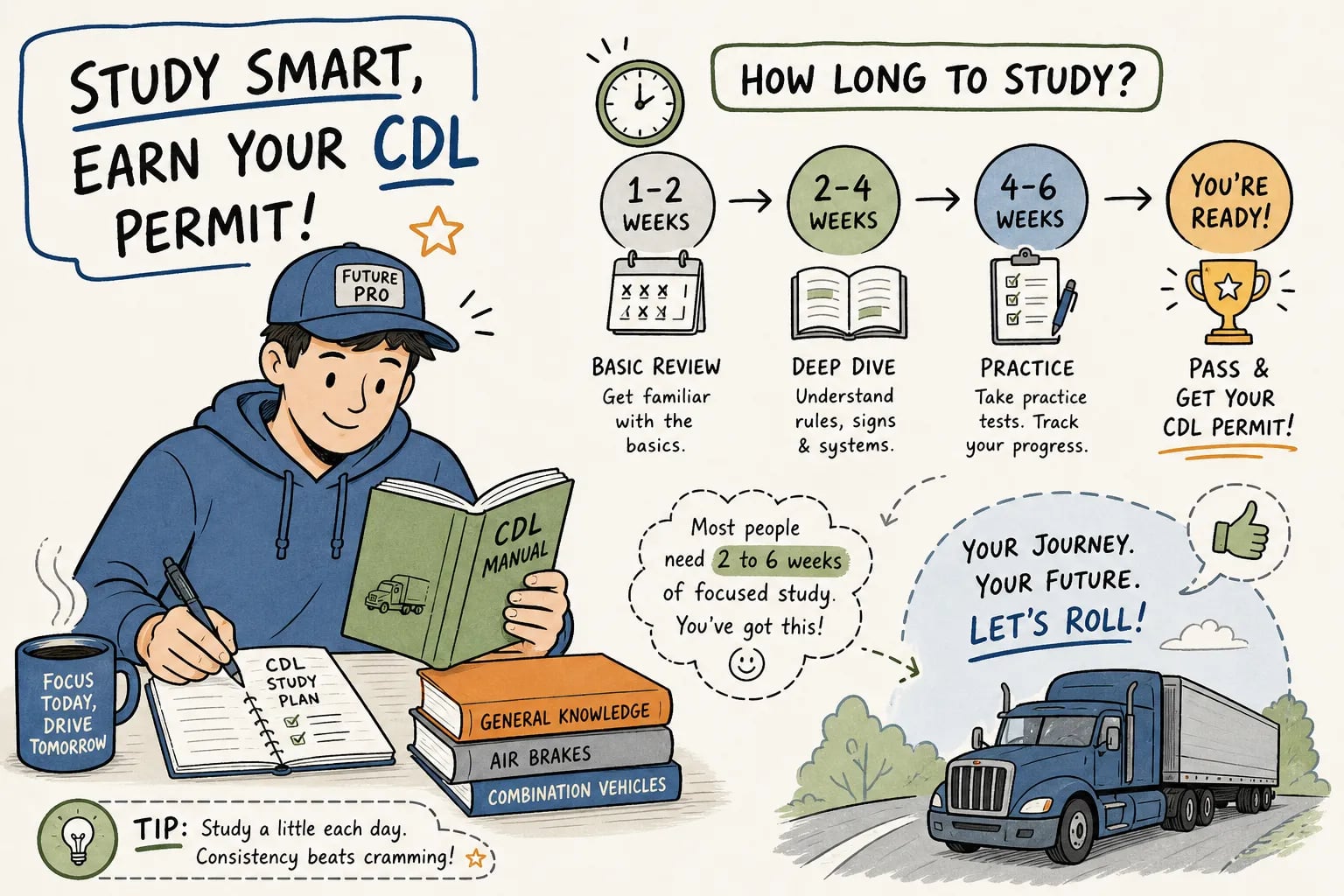
Most first-time candidates pass the general knowledge test with 2 to 3 focused hours of study per day over 2 to 4 weeks. The plan below is built around how adults actually retain information: short active sessions, immediate self-testing, and targeted review of weak spots rather than re-reading everything repeatedly.
Steps 1-3: build the foundation
Step 1: Take a free diagnostic practice test first. Before you read a single page of the manual, take a baseline practice test. CDLTest360 lets you do this immediately with no account required. Your score identifies which topic areas need the most attention, so your study time is directed from day one rather than scattered across the entire manual.
Step 2: Get your state's current CDL study guide. Download the official manual from your state DMV website. This is the controlling document: the exam questions are written from it, not from any third-party guide. Third-party materials are useful for practice, but the manual is the source of truth for any question where you see a conflicting answer.
Step 3: Read one chapter per study session. Work through the general knowledge chapters first. Read actively by taking brief notes and highlighting any rule that involves a specific number, distance, weight, or time limit. Mark anything you don't immediately understand for a follow-up review rather than skipping it.
Steps 4-5: practice and target weak spots
Step 4: Take topic-specific practice quizzes after each chapter. Don't wait until you've finished the full manual to start testing yourself. Quiz each section immediately after reading it, while the content is fresh. CDLTest360's topic-specific quiz modules align directly with the major content categories, so you can test vehicle inspection knowledge right after reading that chapter.
Step 5: Drill only the questions you missed. This is where most candidates waste significant time, re-reading entire chapters when the real issue is two or three specific rules they haven't locked in. CDLTest360's missed-question review loop isolates only the questions you answered incorrectly and re-drills them in subsequent sessions, making each study period more efficient than a general review pass.
Steps 6-7: simulate the real exam and set a readiness benchmark
Step 6: Run full timed exam simulations. Once your topic quiz scores are consistently above 85%, switch to 50-question timed simulations that replicate real exam conditions. The time pressure is part of the preparation: the actual exam has a clock, and candidates who haven't practiced under timed conditions sometimes make avoidable errors. Complete at least three full simulations before test day, and target 90% or higher to give yourself a comfortable margin.
Step 7: Review errors and rest before the exam. The final two days should be low intensity. Revisit your missed-question list, take one practice test at a relaxed pace, and prioritize sleep. Cramming the night before the exam produces anxiety, not retention. The material you've covered over the preceding weeks is already in memory; the goal in those last 48 hours is to arrive at the testing center focused and rested.
You now have everything you need to start
The CDL general knowledge test is broad, but it isn't random. Every question maps to one of 20 federally defined topic areas: vehicle systems, traffic laws, cargo securement, pre-trip inspection knowledge, hours of service, and the supporting areas around fatigue, emergencies, and safe operating practices. Once you see the structure clearly, the exam stops feeling like an overwhelming document and starts feeling like a manageable set of specific rules to learn.
The 7-step plan above gives you a repeatable framework for building that CDL basic knowledge before test day. Read actively, test immediately after each section, and drill your weak spots rather than reviewing everything equally. The candidates who fail the written exam aren't the ones who studied too little overall, they're usually the ones who studied broadly without ever targeting the specific rules they hadn't retained.
Start with a free diagnostic test on CDLTest360. No account, no payment, no setup required. Jump in, see your current score across topic categories, and let the results tell you where to focus your next study session. That's a CDL basic knowledge study plan built around how real candidates actually learn: start with what you don't know, and close those gaps one at a time.
Frequently Asked Questions
Are endorsement topics like air brakes or hazmat included in the general knowledge test?
Yes, I explain that endorsement topics are separate knowledge tests and are not part of the general knowledge exam. You must take those specialty endorsement tests (air brakes, combination vehicles, hazmat, etc.) separately if you want those endorsements.
How long should I study each day to pass the general knowledge test?
Most first-time candidates pass with 2 to 3 focused hours of study per day over 2 to 4 weeks. That schedule uses short active sessions, immediate self-testing, and targeted review of weak spots rather than long passive reading.
Is the general knowledge exam given under time pressure?
Yes, the actual exam has a clock, so practicing under timed conditions matters. I recommend running full 50-question timed simulations once your topic quiz scores are consistently above 85% to build speed and accuracy.
What happens after I pass the general knowledge test?
Passing the general knowledge test earns you a commercial learner's permit (CLP) so you can practice driving with a licensed CDL holder and later schedule your skills tests. You must hold the CLP for the required period before taking the behind-the-wheel skills tests.
{ "@type": "Article", "datePublished": "2026-10-20T11:02:20.536Z", "dateModified": "2026-10-20T11:02:20.536Z", "headline": "CDL basic knowledge: a beginner's guide to the written test", "description": "CDL basic knowledge spans 20 FMCSA topics on a 50-question exam. Learn what's tested, see real practice questions, and get a 7-step study plan. Start free today.", "publisher": { "@type": "Organization", "name": "CDLTest360" }, "image": [ "https://composeo-article-images.s3.us-east-1.amazonaws.com/cdl-basic-knowledge-a-beginner-s-guide-to-the-written-test-1792411703154.webp" ], "author": { "@type": "Organization", "name": "CDLTest360" } }
{ "@type": "FAQPage", "mainEntity": [ { "@type": "Question", "name": "Are endorsement topics like air brakes or hazmat included in the general knowledge test?", "acceptedAnswer": { "@type": "Answer", "text": "Yes, I explain that endorsement topics are separate knowledge tests and are not part of the general knowledge exam. You must take those specialty endorsement tests (air brakes, combination vehicles, hazmat, etc.) separately if you want those endorsements." } }, { "@type": "Question", "name": "How long should I study each day to pass the general knowledge test?", "acceptedAnswer": { "@type": "Answer", "text": "Most first-time candidates pass with 2 to 3 focused hours of study per day over 2 to 4 weeks. That schedule uses short active sessions, immediate self-testing, and targeted review of weak spots rather than long passive reading." } }, { "@type": "Question", "name": "Is the general knowledge exam given under time pressure?", "acceptedAnswer": { "@type": "Answer", "text": "Yes, the actual exam has a clock, so practicing under timed conditions matters. I recommend running full 50-question timed simulations once your topic quiz scores are consistently above 85% to build speed and accuracy." } }, { "@type": "Question", "name": "What happens after I pass the general knowledge test?", "acceptedAnswer": { "@type": "Answer", "text": "Passing the general knowledge test earns you a commercial learner's permit (CLP) so you can practice driving with a licensed CDL holder and later schedule your skills tests. You must hold the CLP for the required period before taking the behind-the-wheel skills tests." } } ] }