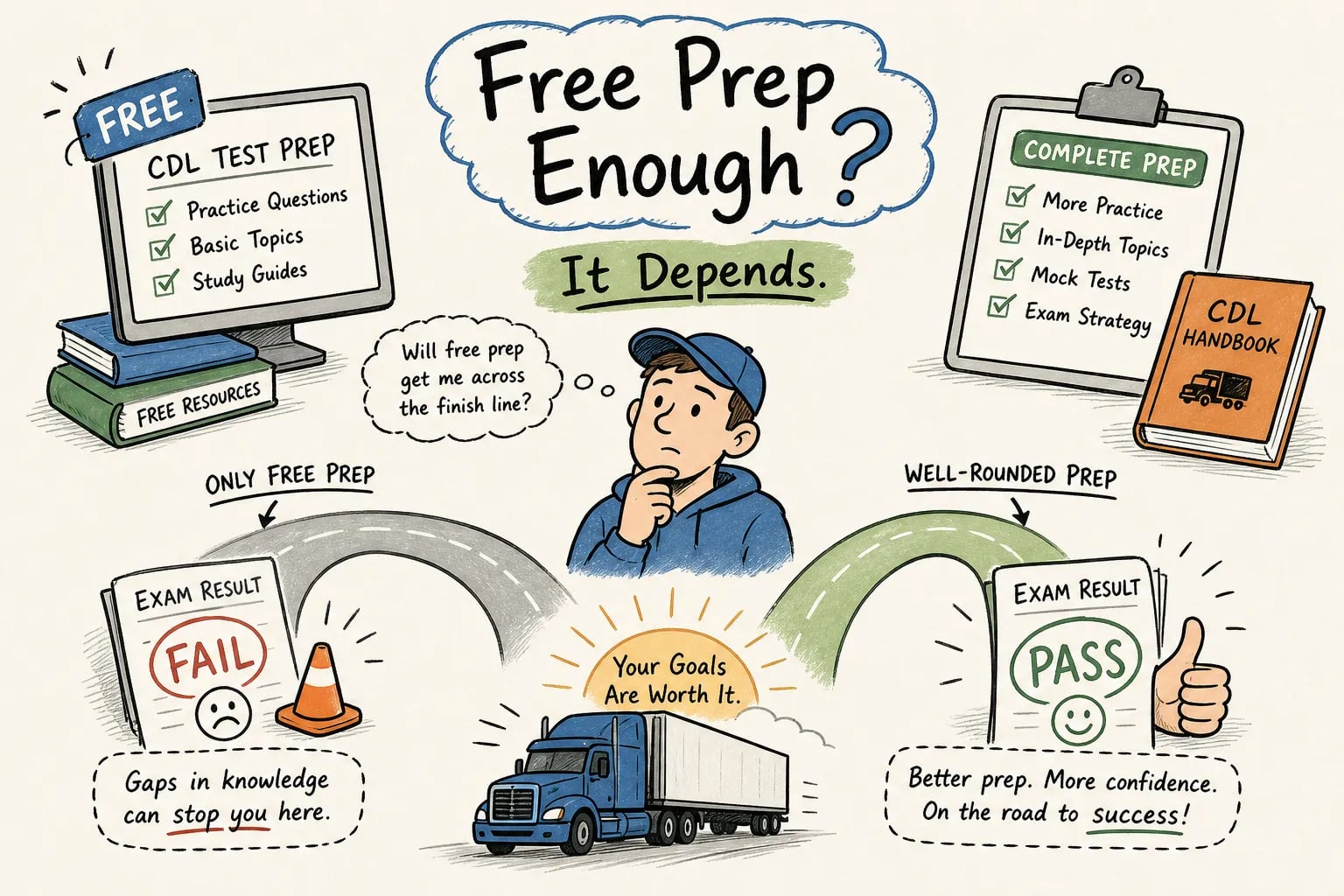
Is free CDL test prep actually enough to pass the knowledge exam? That question deserves a straight answer, not a sales pitch. Free CDL practice tests are everywhere. A quick search pulls up dozens of sites promising full question banks, state-specific exams, and guaranteed preparation, all at no cost. So why do many CDL candidates walk out of the testing center without a passing score on their first attempt? The answer isn't that free resources are useless. It's that free resources have a specific structural limitation that catches unprepared candidates off guard, and most people don't discover that limitation until after they've already failed.
This article gives you an honest breakdown of what free CDL prep actually delivers, where it consistently falls short, which topics trip up candidates who rely on it exclusively, and how to build a study plan that works whether you spend money or not. Some platforms, including CDLTest360, let you start practicing immediately with no account required, so the cost barrier to getting started is essentially zero. The real question isn't whether free CDL test prep exists. It's whether it's enough for your specific situation.
By the end, you'll have a clear answer to that question, a concrete study schedule, and a framework for knowing when to add structure to your prep before you sit for the exam.
What free CDL practice tests actually give you
Most free CDL practice tests are built from FMCSA regulations and state CDL handbooks, which means topic coverage is broadly solid. They use the same multiple-choice format as the actual knowledge exam, and for core areas like general driving safety, vehicle inspection, and cargo handling, the alignment with official content is close. The gap between free tools and structured prep is not in format or topic breadth. It's in depth and specificity.
One caveat worth knowing: CDL exams are federally standardized under FMCSA, but states can add their own requirements and manual sections. A generic free practice test built on the federal manual won't always reflect your state's exact phrasing or local rules. Using a state-specific practice test paired with your actual state CDL handbook is a meaningful upgrade over a generic question bank. Look for providers that explicitly update their state-specific content to match current FMCSA standards, they're more reliable than tests built on outdated or fully generic federal content.
The deeper limitation, though, is adaptability. Free tools typically serve up random questions from the full pool. You can rack up hours of practice without ever drilling the specific topics you're most likely to miss. That structural gap, the inability to target and loop on failure points, is what separates free tools from structured prep. It doesn't make free tools useless. It means you have to compensate with your own discipline and tracking.
Are free CDL test prep resources actually enough? The honest pass rate numbers
FMCSA does not publish a single national first-attempt CDL knowledge pass rate, so comparisons between free and paid prep come from third-party surveys rather than audited federal data. The estimates that exist put free-only studiers at roughly a 65, 75% first-time pass rate, compared to 70, 85% for those who used structured paid courses. Treat those numbers as directionally useful, not definitive. Marketing claims of 94, 99% pass rates from paid programs are outlier figures from the providers themselves, and they deserve skepticism.
The most important finding in the data is this: a third-party survey of CDL candidates found the CDL exam pass rate gap between free and paid prep approaches near zero when self-studiers complete 500 or more practice questions. Volume and consistency matter more than the tool itself for many candidates. A disciplined free-resource user who tracks weak spots, completes full-length timed practice exams, and reviews the state CDL handbook can absolutely pass. Upgrading to a paid platform is a decision based on study habits and specific knowledge gaps, not a blanket requirement.
Topics that consistently trip up free-only studiers
Air brakes, pre-trip inspection, and cargo securement are the three most commonly cited failure points for candidates who studied only with free resources. Air brakes questions require precision on PSI thresholds, brake test sequences, and failure indicators. The governor cuts out at roughly 120, 140 PSI and cuts back in around 100 PSI. The low-air warning must activate before pressure falls below 55 PSI, and spring brakes apply in the 20, 45 PSI range. Free tests often cover these topics, but they rarely force repeated drilling until those numbers are automatic under timed conditions.
Pre-trip inspection errors tend to cluster around sequence, exact terminology, and knowing which components require which specific checks. Cargo securement mistakes center on tie-down counts, working-load limits, and the difference between GVWR and actual GVW. These aren't areas where a general familiarity with the handbook is enough. They require the kind of repeated, targeted drilling that most free tools don't structure for you, making them prime territory for a CLP practice exam that focuses specifically on those weak spots.
Combination vehicle questions on coupling and uncoupling steps, fifth-wheel checks, off-tracking, and jackknife risk are technical enough that a shallow read of the handbook won't hold under exam pressure. Stopping distance questions require understanding perception time, reaction time, and brake lag as separate components, not just a single rule. Hours-of-service rules trip up learners in scenario form: applying the 11-hour driving limit, the 14-hour on-duty window, and the 60/70-hour weekly limits to a specific situation requires more than memorization. These are the topics where repeated timed practice under exam conditions makes the biggest measurable difference.
How many hours it actually takes to pass
Research on successful first-time CDL knowledge exam takers clusters around 30, 50 total study hours, spread over three to six weeks at roughly one to two hours per day. That number surprises a lot of people who assume a few afternoons of CDL permit practice questions will be sufficient. The candidates who pass on their first attempt don't study longer in one sitting; they study more consistently over a longer window, starting with the CDL general knowledge study guide, meaning their state handbook, before they ever touch a practice question.
Front-loading handbook review before jumping into practice tests produces better outcomes because it gives your practice sessions a framework. Without that foundation, practice tests become a guessing exercise rather than a diagnostic one. Once you've read the relevant handbook sections, practice tests reveal actual knowledge gaps instead of just exposing your unfamiliarity with the material.
The evidence-based method mix breaks down like this:
-
Approximately 30, 40% handbook and manual review (CDL handbook practice and active reading, not passive skimming)
-
Approximately 30, 40% timed practice tests under exam-like conditions
-
Approximately 10, 20% targeted flashcards and missed-question drilling
Timed practice tests are the largest single component, not passive reading. The CDL knowledge exam has time pressure, and practicing without it doesn't build the same recall speed you need when the clock is actually running. That's one specific area where structured platforms with built-in timed simulation modes have a functional advantage over open-ended free question banks.
How to tell if your free prep is actually working
The benchmark that matters most: consistently scoring 85% or higher on full-length timed practice exams across multiple sittings, not just one strong performance on a good day. One passing score doesn't signal readiness. Three or four consistent scores above 85% across different topic configurations do. The official CDL knowledge exam requires at least 80% to pass, and practicing to exactly 80% leaves you no margin for questions that are phrased slightly differently than what you've seen before. Many experienced CDL coaches recommend targeting 85, 90% on practice exams precisely because that buffer accounts for the phrasing variations you'll encounter on test day.
Equally important is scoring across all tested topic areas, not just strong performance on general knowledge while still struggling with air brakes or combination vehicles. If your general knowledge scores are solid but your air brakes practice scores are hovering around 70%, you're not ready. The real exam covers all those areas, and a weak performance on one section pulls your total score down regardless of how well you did elsewhere.
The red flags that signal free-only prep isn't working are specific: stagnant scores after repeated practice attempts, passing full exams but still missing the same individual questions every time, struggling with timed conditions even when you know the material untimed, or having no visibility into whether your weak topics are actually improving over time. When those warning signs show up, a platform that isolates and re-drills missed questions starts delivering results that more random practice simply can't replicate.
A practical study plan using free resources
Weeks 1, 2: handbook review and baseline testing
Read the state CDL handbook cover to cover in the first two weeks, starting with the general knowledge section. Don't jump into practice questions before you've done at least one full read-through, that's the mistake most candidates make. After your first pass through the relevant handbook chapters, take a full baseline practice exam to identify your weakest topic areas before doing any targeted study.
Use state-specific free practice tests from providers that explicitly update for current FMCSA standards to build familiarity with question format without yet drilling for score. The goal in this phase is knowledge acquisition and gap identification, not score optimization. You're building the map of what you know and what you don't before you start navigating toward readiness.
Weeks 3, 4: timed exams, weak-spot drilling, and a final readiness check
Shift to full-length timed practice exams in weeks three and four, tracking your scores by topic area rather than just overall percentage. Return to the handbook only for sections where practice scores reveal a real gap. A 78% score on air brakes after two weeks of study means you need more air brakes drilling, not more general knowledge review.
Run a final readiness check three to five days before your scheduled exam. Take two or three full timed practice exams in exam conditions: no pausing, no looking things up, no open tabs. If your scores hold consistently above 85%, you're ready to schedule the real test. If specific topics are still inconsistent, that's your signal to add a structured drill layer before test day rather than scheduling and hoping for the best. Think of this step as your personal CDL exam pass rate audit before the real thing counts.
How to tell if free CDL test prep is actually enough, or when to upgrade
Some learners consistently benefit from paid prep over free-only study. Candidates who have already failed the knowledge exam once need targeted remediation rather than more random practice, taking the same kind of undifferentiated practice test again after failing doesn't fix the problem, it repeats it. First-time takers studying under hard time pressure, such as a new job start date, can't afford the delay and cost of a retake. And candidates preparing for multiple endorsements simultaneously, tracking progress across air brakes, hazmat, and combination vehicles at the same time, find it genuinely difficult to manage without a system.
CDLTest360 is built specifically for these situations. You can start practicing immediately with no account required, working through topic-specific quiz modules in both practice mode and timed exam simulation. The missed-question review system isolates only the questions you answered incorrectly and re-drills them until your responses become reliable, a targeted approach that differs from reshuffling the same full question pool at random.
The PTI phrase trainer inside CDLTest360 covers the exact wording candidates must recall for the pre-trip inspection, including sequence and component-specific language that most free tools never address. This feature directly closes one of the biggest gaps in free prep for candidates heading toward the CDL skills test. For current pricing and feature details, visit the CDLTest360 website directly, plans are structured to cost less than a single exam retake fee for most candidates. The right way to use CDLTest360 is to start free, measure your gaps honestly against the readiness benchmarks above, and upgrade only if the data tells you that more random practice won't get you where you need to be.
The bottom line on free CDL test prep
Is free CDL test prep actually enough to pass the knowledge exam? For a focused, disciplined studier who uses state-specific resources updated to current FMCSA standards, logs 30, 50 study hours over three to six weeks, and consistently scores above 85% on full-length timed practice exams before scheduling the real test, yes, it can be. The limitation of free tools isn't topic coverage. It's the absence of adaptive drilling for your specific weak spots, which is a real limitation for candidates who aren't carefully tracking their own progress.
For candidates who have already failed once, who are working under time pressure, or who are preparing for multiple endorsements at the same time, a platform that targets missed questions and simulates exam conditions is a smarter use of time than more random practice. In most cases, the combined cost of a retake fee and lost income while waiting to start a new job exceeds what a short-term structured prep pass costs, making the upgrade a practical financial decision, not just a convenience.
Start with free resources. Read your state CDL handbook, take baseline tests from a state-specific provider updated for current FMCSA standards, and track your scores by topic area. If your scores plateau, if you're missing the same questions repeatedly, or if timed conditions still feel uncomfortable three weeks in, that's your data. Act on it before you sit for the real exam, not after.
{ "@type": "Article", "datePublished": "2026-09-19T11:01:57.394Z", "dateModified": "2026-09-19T11:01:57.394Z", "headline": "Is Free CDL Test Prep Enough to Pass the Knowledge Exam?", "description": "Is free CDL test prep enough to pass the knowledge exam? See what free tools miss, which topics trip up most students, and when upgrading makes sense.", "publisher": { "@type": "Organization", "name": "CDLTest360" }, "image": [ ] }