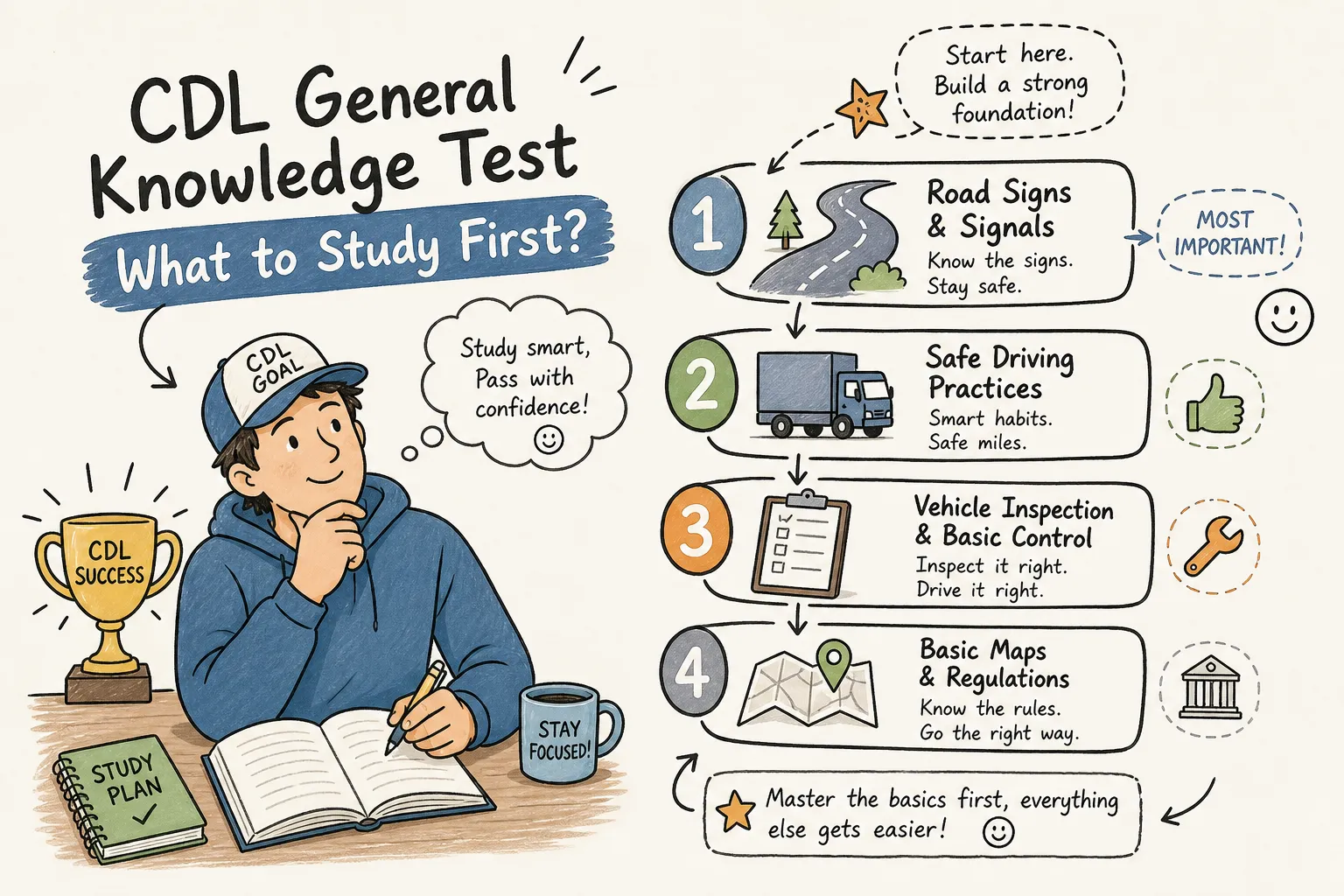
What should I study first for general knowledge on the CDL exam? Start with basic vehicle controls, shifting, and braking, then move into pre-trip inspection, coupling procedures, and hazard recognition. A structured 30-day study plan built around that sequence is far more effective than reading the state CDL manual cover to cover and hoping material sticks under pressure.
This article gives you a prioritized topic list, a week-by-week schedule, a daily study routine that fits around a work shift, and a clear readiness benchmark to hit before you book the exam. CDLTest360 is FMCSA-aligned and includes timed simulations, missed-question drills, and a PTI phrase trainer that support this sequence, whether you're going for a Class A, Class B, or preparing as part of your ELDT theory requirement.
Key takeaways
-
Start with vehicle controls: Basic vehicle operations, shifting, and braking are the highest-yield first-week topics and underpin every other area on the exam.
-
80% is the minimum: The CDL General Knowledge exam commonly contains 50 questions, and most jurisdictions require 80% (40/50) to pass, check your state DMV for exact rules.
-
Vehicle inspection is heavily tested: Pre-trip inspection and defect recognition consistently appear across 6 to 8 questions and are among the most commonly failed areas.
-
Active practice beats passive reading: Timed multiple-choice quizzes that mirror the real exam format build the recognition speed the test demands.
-
Save endorsements for last: Air brakes, hazmat, and combination vehicles are separate exams; master General Knowledge first before adding endorsement exams.
-
Consistent 80%+ is your green light: Score at or above 80% across three or four different mixed-topic practice tests before scheduling the real exam.
What does the CDL general knowledge test actually cover?
The FMCSA topic areas you will be tested on
The CDL General Knowledge exam is standardized across all 50 states under FMCSA federal regulations, which means the same core subject areas appear whether you're testing in Texas, Ohio, or California. The FMCSA defines a set of core knowledge areas that state tests draw from, including basic vehicle controls, shifting and backing, coupling and uncoupling, pre-trip vehicle inspection, handling cargo, hazard recognition, emergency situations, and mountain driving. Most states draw their 50 questions from this FMCSA-defined pool, and candidates typically need at least 40 correct answers (80%) to pass, though you should confirm the exact requirement with your state DMV.
Understanding the full scope of what's covered matters before you start, because it lets you make deliberate choices about where to spend your study time. Treating every topic equally is one of the most common prep mistakes, and it's one the 30-day plan below is specifically designed to avoid.
How the topic weight is distributed
Not all topic areas carry the same question load. Vehicle inspection alone accounts for roughly 6 to 8 questions on a standard 50-question exam (approximate study weights based on CDL prep resources, not an FMCSA-published breakdown), making it the single heaviest-weighted category. The following areas each contribute an estimated 3 to 4 questions:
-
Basic vehicle control
-
Seeing and communicating
-
Speed management
-
Space management
-
Hazard perception
Emergency maneuvers, driving in extreme conditions, fatigue and alertness, and cargo securement each add roughly 2 to 3 more questions. Safe driving and vehicle operation, including inspection, control, hazard management, and emergencies, collectively make up the majority of the exam. Cargo, hours of service, and hazardous-materials awareness round out the remaining questions. Knowing this distribution helps you allocate study hours based on return, not habit.
Why the format matters for how you study
The CDL knowledge exam is multiple choice, typically with several answer options per question. There are no essays, no fill-in-the-blank sections, and no extended written responses. That format has a direct implication for study strategy: you need to recognize the correct answer under time pressure, not produce it from scratch. Passive reading builds familiarity; multiple-choice practice builds the recognition speed the exam actually tests. This is exactly why quiz-based study tools outperform CDL manual reading sessions when used correctly.
What should I study first for general knowledge: prioritized topics
Start with basic vehicle controls and systems
For general knowledge for beginners, basic vehicle controls are the highest-yield starting point. These questions appear consistently across the exam, and the concepts here, steering mechanics, braking systems, and transmission basics, provide the foundation that makes every other topic easier to absorb. Candidates who skip this area and jump straight into cargo or endorsement content often find themselves confused by questions that assume a working knowledge of how the vehicle operates.
As an example study plan, try spending your first three days on vehicle controls, shifting, and basic braking before moving forward. The payoff extends beyond the questions directly on these topics; it accelerates comprehension across the entire exam.
Move into coupling, backing, and pre-trip inspection next
Once basic controls feel solid, shift to coupling and uncoupling procedures and backing techniques. These are procedural topics that reward repetition, and they show up in sequence-based questions that ask you to identify the correct order of steps. Pre-trip inspection comes right after because it tests specific component knowledge, exact procedural wording, and defect identification, and many candidates significantly underestimate how much detail it demands.
Pre-trip inspection is consistently one of the most commonly failed areas on the CDL General Knowledge exam. CDLTest360 includes a PTI phrase trainer that drills the exact inspection wording for each vehicle component, a level of inspection-phrase practice some generic study tools lack entirely. If you're preparing for the pre-trip inspection portion, that tool is worth starting early rather than saving for the last week.
Save endorsement-specific content for last
Air brakes, hazardous materials, and combination vehicles are separate knowledge exams with their own question pools. They are not part of the standard General Knowledge test. Beginners who try to study all of this content simultaneously in week one are the most likely to burn out before they ever build a solid foundation. Establish your General Knowledge base first, then layer in endorsement content based on the CDL class you're pursuing. This sequenced approach keeps the workload manageable and the study progress measurable.
What does a realistic 30-day CDL study plan look like?
Week 1: baseline and foundations
On day one, take a diagnostic practice test without studying first. Record the score and note every missed question by topic category. This baseline gives you a before-and-after comparison at the end of the 30 days and immediately shows you which areas need the most attention. Spend the rest of week one on basic vehicle controls, shifting, braking, and introductory inspection concepts, with study sessions of 45 to 50 minutes daily, six days per week.
The goal in week one is broad coverage, not mastery. You're building vocabulary and familiarity with the subject areas, think of it as general knowledge for beginners, so that week two reinforces concepts rather than introducing everything at once. A brief GK topics list review at the start of each session helps orient your focus before you go into active practice.
Week 2: expand and start reviewing
Add cargo securement, hazard recognition, and emergency procedures in week two. Begin dedicating the final 10 minutes of each session to re-drilling week-one material. This is where a missed-question review system becomes essential. The missed-question drill in CDLTest360 isolates only the questions you answered incorrectly and re-drills them, a far more efficient use of time than re-reading entire manual chapters looking for the fact you missed.
Hours of service and fatigue are also worth introducing in week two. These topics show up across 1 to 3 questions on the exam, and the regulatory details, like log requirements and driving-hour limits, are easy to confuse without repeated exposure.
Weeks 3 and 4: timed tests and targeted remediation
By week three, you have covered the full General Knowledge topic list at least once. Now the focus shifts to mixed-topic review, weak-area drilling, and timed simulation. The table below outlines how to structure those final two weeks as part of your general awareness study plan.
  Week
  Daily focus
  Session length
  Saturday activity


  3
  Mixed topics, weak areas
  50 min
  50-question timed simulation


  4
  Cumulative review only
  45 min
  Final practice test, score comparison
By day 29, run a full 50-question timed simulation under test-like conditions and compare that score to your day-one baseline. The gap between those two numbers tells you clearly whether you're ready to book the exam or need one more focused week. According to the Washington State Department of Licensing, candidates should aim to score 90% or higher on practice exams before sitting for the real test, not simply the passing threshold of 80%.
What should a daily study session look like?
A 50-minute routine that works on any schedule
Structure each session in four blocks. Spend 20 minutes on new material from your state CDL manual or a topic-specific quiz module. Follow with 15 minutes of active recall: close the notes and say or write out loud what you remember from the section you just covered. Then complete 10 to 20 multiple-choice questions timed for 10 minutes, a GK practice quiz works well here. Close with 5 minutes logging every wrong answer with the correct fact and a one-line explanation of why it's correct.
This routine keeps sessions short enough to fit around a full work schedule while making the majority of study time active rather than passive. Passive reading produces recognition of familiar-looking text; active recall and timed questions build the retrieval speed that actually matters on test day.
How to work the CDL manual into your daily habit
Spend 5 minutes at the start of each session skimming one new section of the state CDL manual before the main study block begins. Think of it as a warm-up, light daily contact with the source document before you go into quiz mode. Over 30 days, this adds up to full manual coverage without requiring a dedicated reading session. CDLTest360 stores state-specific CDL manuals inside the platform, so you don't need to track down a separate PDF or visit the DMV website every time you need to reference something.
What to do when motivation drops
Motivation drops around week two for most test-prep students. The fix is not longer sessions but shorter, more frequent ones. If 50 minutes feels heavy on a given day, break it into two 25-minute blocks with a 5-minute break in between. Your error log from the previous session gives you a ready-made agenda for the next one, which removes the friction of deciding what to study. Showing up consistently for 30 minutes beats an occasional two-hour cram session every time.
What question types will you see on test day?
Multiple choice is the entire exam
Every CDL General Knowledge question is multiple choice, typically with several answer options. No fill-in-the-blank, no true/false, no written responses. The practical implication is straightforward: candidates who study using multiple-choice quiz tools are practicing the exact cognitive task the real exam demands. Reading the manual is useful for building understanding, but it does not train you to recognize the correct answer under time pressure with multiple plausible-looking distractors in view.
The question patterns that appear most often
"Which of the following is NOT correct" questions test your ability to identify the exception rather than the rule. Sequence questions test the correct procedural order for tasks like pre-trip inspection steps or coupling procedures. Scenario-based questions describe a driving situation and ask what action to take. Recognizing these patterns through repeated GK practice quiz exposure builds test-day speed and confidence, you know what the question is doing before you read all the options.
Inspection questions and cargo securement questions are consistently among the most missed areas on the CDL General Knowledge exam, based on CDL test-prep instructor experience. These are not difficult concepts, but they require familiarity with specific details: defect identification criteria, tiedown requirements, working-load limits, and center-of-gravity principles. These are the basic GK questions where targeted drilling delivers the most points.
How timed simulation changes your readiness
Practicing without a timer and practicing with a timer produce different outcomes on test day. Timed exam simulation, available in CDLTest360 alongside the standard practice mode, trains you to pace through 50 questions in the actual time window your state DMV allows. Candidates who study only in untimed mode often run short on time during the real test, not because they don't know the material, but because they haven't built the habit of moving efficiently through questions. Add timed simulation to your Saturday sessions from week three onward.
Which tools and resources are actually worth using?
Why CDLTest360 is a practical starting point for general knowledge
CDLTest360 is built specifically around the CDL General Knowledge exam and FMCSA-aligned content covering every major topic area, including General Knowledge, Air Brakes, Combination Vehicles, Hazmat, and Pre-Trip Inspection. The missed-question drill feature isolates only the questions you got wrong and re-drills them, which is more efficient than re-reading chapters looking for what you missed. No account is required to start; the free trial is accessible immediately without registration, so you can take a baseline practice test within the next few minutes.
The PTI phrase trainer prompts you to recall the exact inspection wording for each vehicle component, the kind of detail that catches many candidates off guard in the exam room. Flexible pricing at $39.99 for a 90-day pass or $19.99 per month gives you full access without a long-term commitment.
The state CDL manual: free and non-negotiable
Every state DMV publishes a free CDL manual, and the exam questions come directly from it. Think of the manual as the source document and practice quizzes as the training method. Both are necessary. The manual tells you what is true; the quizzes tell you what you actually remember when answer options are in front of you and the clock is running.
What to avoid when picking study tools
Generic flashcard apps and broad trivia platforms are not built from FMCSA regulations and won't match the actual question format or content of the CDL exam. Candidates who rely on these often feel prepared but score poorly because the content doesn't transfer. Stick to tools that draw directly from the CDL manual and simulate the multiple-choice format of the real exam. The goal is not general familiarity with trucking; it's precise readiness for a specific standardized test.
How do you know you're ready to schedule the test?
The benchmark that matters: consistent 80%+ on mixed quizzes
Scoring 80% or higher on three or four different mixed-topic practice tests across separate days is the clearest readiness signal. One strong score on a familiar quiz module isn't enough. Consistency across varied question sets on different days reflects the kind of stable recall the real exam demands, and it's the difference between a good day and actual preparedness. The Washington State Department of Licensing recommends aiming for 90% or higher on practice tests before sitting for the real exam. Use that as your personal benchmark, not the official 80% minimum.
What to check in your error log before booking
Before scheduling the exam, review your full 30-day error log and flag any topic category where the same type of question appeared wrong more than twice. If pre-trip inspection questions or cargo securement questions keep showing up in that log, do one more focused drill before booking, not after failing the first attempt. Your error log is a more accurate picture of your weak spots than your overall practice score, because overall scores can mask concentrated gaps in specific areas.
The cost of failing versus the cost of one more week
Most states charge a fee for each CDL knowledge test attempt, and some states, like California and Texas, limit how many attempts a candidate can make before the application becomes invalid and must be restarted entirely. One additional week of targeted study costs nothing compared to a second test fee, a mandatory waiting period, and the time pressure of rescheduling around work. Treat the consistent 80% benchmark as a minimum entry point, not a ceiling, before you book your test date.
What to study first for general knowledge: build your readiness from day one
Figuring out what to study first for general knowledge is the most important decision you'll make in CDL prep. Start with vehicle controls and systems, move into pre-trip inspection and coupling procedures, and save endorsement-specific content, like air brakes and combination vehicles, for after you've built a solid foundation. A 30-day general awareness study plan with consistent 45 to 50-minute daily sessions, a structured error log, and regular timed simulations gives you measurable, real readiness from a standing start.
Active practice beats passive reading at every stage. The multiple-choice format of the exam rewards recognition speed, and the only way to build that is to practice under conditions that mirror the real test. CDLTest360's topic-specific quiz modules, missed-question drill system, PTI phrase trainer, and timed exam simulation are designed exactly for this kind of focused, efficient preparation.
Frequently Asked Questions
How often should we take full 50-question timed simulations during prep?
Take full 50-question timed simulations weekly starting in week three and again at day 29. We recommend a timed simulation on Saturdays in week three and a final full timed run on day 29 to compare against your baseline.
Can we rely on only reading the state CDL manual to pass the exam?
No, reading the manual alone is not sufficient. The manual is the source document and is non-negotiable, but active multiple-choice practice and timed simulations build the recognition speed the multiple-choice exam requires.
What should we do if we have limited time each day to study?
Break sessions into shorter blocks rather than extending one long session. If 50 minutes feels heavy, split it into two 25-minute blocks with a 5-minute break, and use your error log to provide a ready-made agenda for each short session.
{ "@type": "Article", "datePublished": "2026-10-30T11:02:27.485Z", "dateModified": "2026-10-30T11:02:27.485Z", "headline": "What to study first for the CDL general knowledge test", "description": "Wondering what to study first for the CDL general knowledge test? Get a 30-day plan, daily routines, and topic priorities to pass on your first try.", "publisher": { "@type": "Organization", "name": "CDLTest360" }, "image": [ "https://composeo-article-images.s3.us-east-1.amazonaws.com/what-to-study-first-for-the-cdl-general-knowledge-test-1793275676854.webp" ], "author": { "@type": "Organization", "name": "CDLTest360" } }
{ "@type": "FAQPage", "mainEntity": [ { "@type": "Question", "name": "How often should we take full 50-question timed simulations during prep?", "acceptedAnswer": { "@type": "Answer", "text": "Take full 50-question timed simulations weekly starting in week three and again at day 29. We recommend a timed simulation on Saturdays in week three and a final full timed run on day 29 to compare against your baseline." } }, { "@type": "Question", "name": "Can we rely on only reading the state CDL manual to pass the exam?", "acceptedAnswer": { "@type": "Answer", "text": "No, reading the manual alone is not sufficient. The manual is the source document and is non-negotiable, but active multiple-choice practice and timed simulations build the recognition speed the multiple-choice exam requires." } }, { "@type": "Question", "name": "What should we do if we have limited time each day to study?", "acceptedAnswer": { "@type": "Answer", "text": "Break sessions into shorter blocks rather than extending one long session. If 50 minutes feels heavy, split it into two 25-minute blocks with a 5-minute break, and use your error log to provide a ready-made agenda for each short session." } } ] }