Your state's official CDL manual is the authoritative free CDL study book available to every applicant, and your state DMV publishes it as a free PDF right now. FMCSA guidance directs applicants to use the manual from the state where they will take their knowledge and skills tests, and exam content is derived from that official source. Each state maintains its own version of the manual, so the questions on your CDL knowledge exam are drawn directly from your state's document, not from any generic trucking guide or third-party flashcard deck.
This article tells you exactly where to download your free CDL study book, which chapters apply to your license class, and which free resources work well alongside it. You'll also learn where free materials hit a wall, how structured practice testing bridges that gap, and how to follow a clear 30-day study plan that takes you from first read to permit-ready.
Key takeaways
-
Official manual first: Your state DMV publishes a free commercial driver handbook PDF; download it from the official government site, not a file-sharing mirror.
-
Federal baseline, state specifics: The core manual covers FMCSA-standardized content; the state addendum adds local procedures, fees, and testing rules you must also read.
-
Chapter selection matters: Study only the chapters that match your license class and endorsements; skipping required chapters, especially Air Brakes, carries real consequences.
-
80% to pass, everywhere: Every U.S. state requires 80% correct on each CDL knowledge test, per federal regulations under 49 CFR Part 383.
-
Reading alone isn't enough: Active practice testing with a missed-question review cycle is what converts manual knowledge into passing scores.
-
Free tools have limits: Combine your free CDL study book with structured practice tests and a daily study routine to close the gap before test day.
What a free CDL study book actually covers
State CDL manuals are not written from scratch by each state. They're built on the FMCSA's model driver curriculum, which means the core content, safe driving principles, cargo securement, and vehicle inspection, is standardized across all 50 states. That federal foundation is why the knowledge baseline for a trucker licensed in Texas matches the one for a trucker licensed in Maine.
The main manual chapters cover commercial driving knowledge that applies everywhere: general vehicle operation, space management, hazard recognition, pre-trip inspection basics, and the rules for operating specialty vehicles. The state addendum, published by some states as a separate section or supplement, covers state-specific procedures like application requirements, testing locations, fees, local exemptions, and skills-test scoring criteria. Both sections matter, and reading only the core chapters while ignoring the addendum is a mistake that trips up otherwise well-prepared candidates.
Every CDL knowledge test your state administers, whether it's the General Knowledge exam, the Air Brakes test, or an endorsement exam, draws from the material in your state's official manual. Third-party study guides are useful supplements, but they don't replace the source document. When there's a conflict between a third-party explanation and what your state manual says, the state manual wins every time.
Where to download your free CDL study book by state
The FMCSA maintains a state directory at fmcsa.dot.gov that links to every state's licensing agency. From there, navigate directly to the CDL manual download page to get the current PDF. This step matters because states periodically update their manuals, and studying an outdated version could expose you to different wording than what appears on your actual exam.
Most states publish one complete manual as a single downloadable PDF. A few states break the CDL manual download into separate sections organized by subject; New York is a well-known example of this format. Virginia provides both a main manual and a supplemental state document as separate PDFs. Always download from an official government website. A ".gov" domain or a direct link from your state's motor vehicle agency is the standard you should hold every source to.
Third-party directories like CDL Study Hub compile state CDL handbook PDF links with direct pointers to official sources, which can save you time locating the right page. CDL Study Hub states it is independent and not affiliated with FMCSA or any DMV, so use it to find the link, then confirm you're downloading from the official government domain. A free CDL manual from an unofficial mirror may be outdated or formatted differently, and two weeks of studying the wrong version is time you can't get back.
The table below shows the official licensing agency for each U.S. state. Use this alongside the FMCSA state directory to locate your state's official CDL manual page.
  State
  Official licensing agency


AlabamaAlabama Law Enforcement Agency
AlaskaAlaska Division of Motor Vehicles
ArizonaArizona Department of Transportation, Motor Vehicle Division
ArkansasArkansas Office of Driver Services
CaliforniaCalifornia Department of Motor Vehicles
ColoradoColorado Division of Motor Vehicles
ConnecticutConnecticut Department of Motor Vehicles
DelawareDelaware Division of Motor Vehicles
District of ColumbiaDC Department of Motor Vehicles
FloridaFlorida Highway Safety and Motor Vehicles
GeorgiaGeorgia Department of Driver Services
HawaiiHawaii Department of Transportation
IdahoIdaho Transportation Department, Division of Motor Vehicles
IllinoisIllinois Secretary of State
IndianaIndiana Bureau of Motor Vehicles
IowaIowa Department of Transportation
KansasKansas Department of Revenue
KentuckyKentucky Transportation Cabinet
LouisianaLouisiana Office of Motor Vehicles
MaineMaine Bureau of Motor Vehicles
MarylandMaryland Motor Vehicle Administration
MassachusettsMassachusetts Registry of Motor Vehicles
MichiganMichigan Department of State
MinnesotaMinnesota Driver and Vehicle Services
MississippiMississippi Department of Public Safety
MissouriMissouri Department of Revenue
MontanaMontana Motor Vehicle Division
NebraskaNebraska Department of Motor Vehicles
NevadaNevada Department of Motor Vehicles
New HampshireNew Hampshire Division of Motor Vehicles
New JerseyNew Jersey Motor Vehicle Commission
New MexicoNew Mexico Motor Vehicle Division
New YorkNew York Department of Motor Vehicles
North CarolinaNorth Carolina Division of Motor Vehicles
North DakotaNorth Dakota Department of Transportation
OhioOhio Bureau of Motor Vehicles
OklahomaOklahoma Department of Public Safety
OregonOregon Driver and Motor Vehicle Services
PennsylvaniaPennsylvania Department of Transportation
Rhode IslandRhode Island Division of Motor Vehicles
South CarolinaSouth Carolina Department of Motor Vehicles
South DakotaSouth Dakota Department of Public Safety
TennesseeTennessee Department of Safety and Homeland Security
TexasTexas Department of Public Safety
UtahUtah Driver License Division
VermontVermont Department of Motor Vehicles
VirginiaVirginia Department of Motor Vehicles
WashingtonWashington Department of Licensing
West VirginiaWest Virginia Division of Motor Vehicles
WisconsinWisconsin Division of Motor Vehicles
WyomingWyoming Department of Transportation
Which sections of the manual do you actually need to study?
Not every chapter applies to every applicant. For a standard Class A CLP, you need General Knowledge, Air Brakes (if your vehicle has them), and Combination Vehicles at minimum. Class B applicants typically cover General Knowledge and, depending on the vehicle, Air Brakes. Adding endorsements like Hazardous Materials, Tank Vehicles, Doubles/Triples, Passenger, or School Bus means adding the corresponding chapters and knowledge tests for each one.
The Air Brakes chapter deserves specific attention. If you take the skills test in an air-brake-equipped vehicle without completing the Air Brakes knowledge component, or if you fail it, you'll receive an air brake restriction on your CDL that limits the type of commercial vehicles you can legally operate. Read the Air Brakes chapter regardless of how confident you feel going in. The test questions are specific and include numerical limits, things like warning pressure levels and brake lag distances that require deliberate study rather than a quick skim.
Don't skip the state addendum. The addendum is where states list their specific testing procedures, endorsement rules, medical certification requirements, and local exemptions. Candidates who study only the model-based chapters and ignore the addendum often arrive at the DMV with missing documents or incorrect expectations about their test format. Read the entire addendum once, before your exam week, and pay particular attention to any sections labeled "CDL tests," "endorsements," "restrictions," "skills test," and "exemptions."
Free third-party CDL permit study materials worth your time
Several reputable platforms offer free CDL permit study materials that work well alongside your state manual. CDL Study Hub links to official state PDFs and offers free practice questions. TruckingTruth provides chapter-based study material, quizzes, and endorsement prep through its free "High Road" training program. Driving-Tests.org offers state-specific practice tests organized by manual and license class. Roehl Transport offers free practice tests with answer explanations covering General Knowledge, Air Brakes, and Combination Vehicles.
The right way to use these resources is as a testing layer on top of your manual reading, not as a replacement for it. Read the relevant section of your state manual first, then test yourself using a third-party quiz to identify weak spots. When a third-party explanation conflicts with your state manual, go back to the manual. Avoid any site that claims to offer "real exam questions" or "guaranteed pass" materials. No third-party platform has access to the actual test question bank, and any site making that claim is overpromising.
One practical note on free apps and downloadable study guides: some are legitimate supplements built on current FMCSA standards. Others are outdated, padded with irrelevant content, or designed primarily to upsell you to a paid tier. Before committing time to any resource, confirm it references the current FMCSA standards and your specific state's manual. A free practice test built from a 2021 manual version isn't an asset in 2026.
Where free CDL study materials fall short
The biggest limitation of any free CDL handbook, official or otherwise, is that reading it feels productive but doesn't simulate test conditions. The CDL knowledge exam is timed, multiple-choice, and designed to test recall under pressure, not the ability to look up answers. Many candidates find that reading the manual thoroughly still leaves them unprepared for their first practice test, because recognition and recall are two entirely different skills.
State manuals also cover everything equally. They don't flag sections with the highest failure rates, indicate which numerical limits are most frequently tested, or prioritize topics by difficulty. You could spend equal time on a chapter that produces three test questions and one that produces fifteen, and your manual gives you no signal about the difference. Under FMCSA standards, the General Knowledge exam typically runs 50 questions, Air Brakes runs 25, Combination Vehicles runs 20, and Hazardous Materials runs 30, all requiring 80% to pass. Note that exact question counts can vary by state, so confirm the numbers in your own state's manual. Knowing the general breakdown still helps you allocate study time more deliberately.
A PDF manual also has no mechanism to identify what you got wrong, isolate the topic, and make you practice it again. That feedback loop, reading a topic, testing it, identifying errors, and re-drilling only the questions you missed, is what consistently moves candidates from 60% scores to 85% and above. Without that mechanism built into your study routine, progress is slower and less predictable than it needs to be.
How CDLTest360 fills the gap, no sign-up required
CDLTest360 is built directly from FMCSA regulations and state CDL manuals, so the practice questions align with the same source your official exam draws from. You can start a free practice test right now with no account, no email address, and no registration required. That zero-friction access means you can test yourself in the first few minutes of a study session rather than spending that time on onboarding screens.
Where any free CDL study book stops, CDLTest360 picks up with its missed-question review system. After each practice session, the platform isolates only the questions you answered incorrectly and re-drills them until you get them right. You're not re-reading chapters you already know; you're targeting the specific gaps keeping your score below 80%.
CDLTest360 covers General Knowledge, Air Brakes, Combination Vehicles, Hazardous Materials, and other endorsement areas in both practice mode and timed exam simulation mode. The timed simulation matches the actual exam format: 50 questions with an 80% passing threshold. There's also a PTI phrase trainer that drills the exact inspection wording students must recall during the pre-trip inspection portion of the skills test, a feature most CDL prep tools skip entirely.
For CDL schools, an instructor dashboard lets administrators assign tests, manage custom question banks, and monitor individual student progress at scale. Per CDLTest360's pricing page, a 90-day pass is available for $39.99, or $19.99 per month with no long-term commitment. Using CDLTest360 alongside your free state CDL manual turns a passive reading plan into an active, measurable study system.
A 14-to-30-day plan with your free CDL study book and practice tests
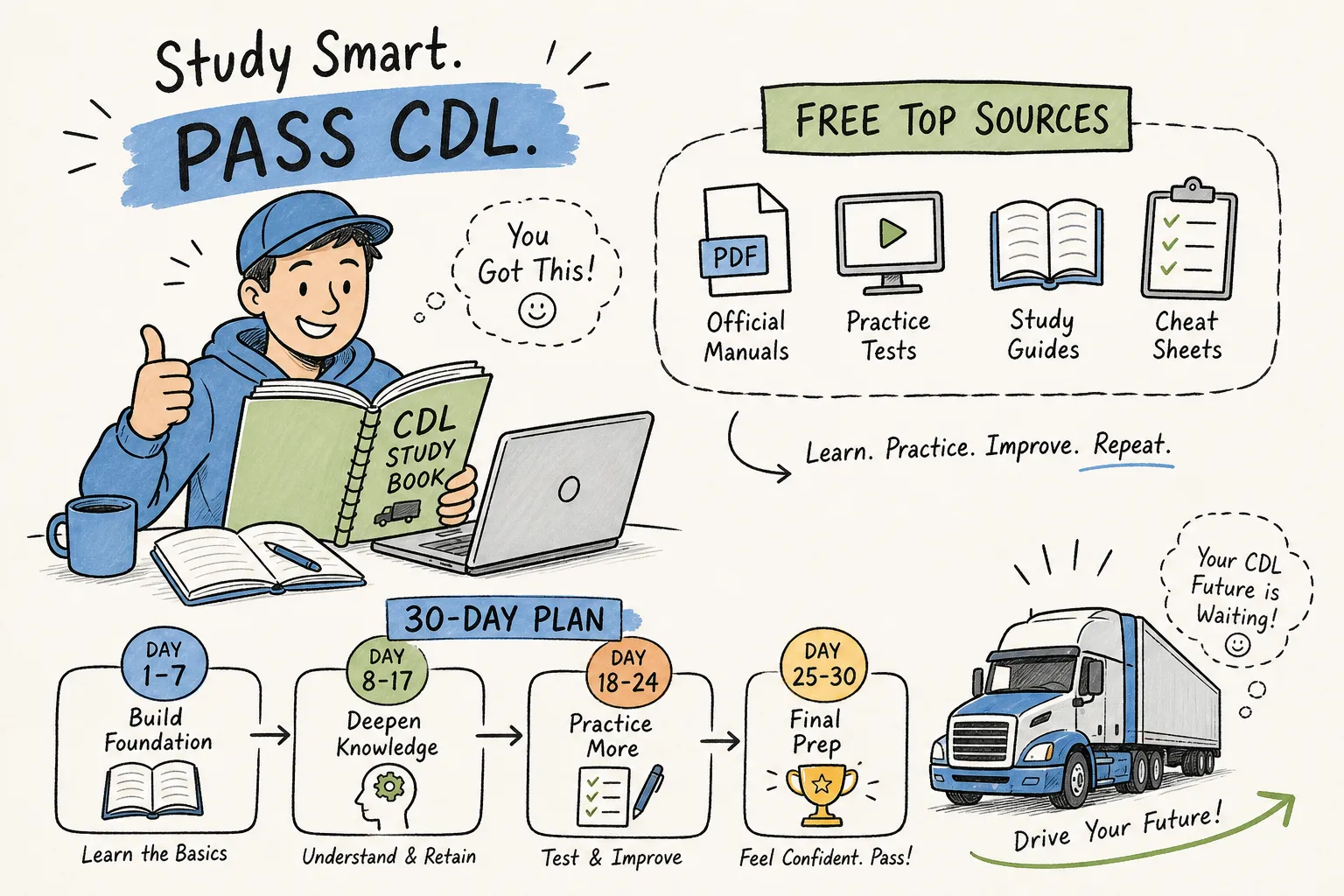
The most effective CDL study plan follows a repeating cycle: read one section of your state manual, take a topic-specific practice test, record every missed question, then re-read only the related manual pages before retesting. Aim for 60 to 90 minutes of focused study daily. Schedule your permit exam only after you're scoring 85 to 90% consistently on every required section, not just on your best day.
The 14-day accelerated plan
Start on Day 1 by taking a cold General Knowledge practice test before opening the manual. Your score establishes your baseline and flags your three weakest topics before you've read a single page. Days 2 through 5 cover the core General Knowledge sections: vehicle controls, safe driving, space management, cargo securement, and hazard recognition. Days 6 and 7 focus on Air Brakes, with flashcards for warning pressure levels, brake lag distances, and spring brake rules. Days 8 and 9 cover Combination Vehicles: coupling and uncoupling, trailer swing, off-tracking, and jackknife prevention.
Days 10 through 13 mix timed simulations, targeted re-reading of sections connected to your missed questions, and endorsement chapters if your license class requires them. Day 14 is light review only. Go through your missed-question log, not new material, then confirm your appointment, required documents, fees, and state-specific testing requirements. Avoid cramming new content on Day 14; a short confidence test is fine, but your brain needs consolidation time more than new information at that point.
Extending to 30 days for a stronger pass rate
The 30-day plan uses the 14-day structure as its first half, then adds a second phase for deeper reinforcement. Days 15 through 17 revisit General Knowledge with focused quizzes. Days 18 through 20 return to Air Brakes, specifically the numerical limits your state manual lists. Days 21 through 23 drill Combination Vehicles again with several targeted tests. Days 24 and 25 address any endorsements you need.
Days 26 and 27 are full timed simulations under test-like conditions with no notes open. Day 28 is a missed-question correction session: review every error and re-read the relevant manual pages. Day 29 is your final simulation. If you're scoring consistently at 85% or better across all required sections, confirm or schedule your exam. Day 30 is light review only. Bring your documents. You're ready.
Keep one missed-question log throughout the entire process with three columns: question or topic, correct answer, and why that answer is correct. Explaining the correct answer in your own words is the clearest signal that you actually understand the material rather than having memorized an answer pattern. That distinction matters on a test designed to check comprehension, not rote recall.
Ready to stop reading and start testing?
Your state's official CDL manual is the most important document in your CDL permit study materials toolkit. It's free, it's current, and your knowledge exam is derived from it. Download it from your state's licensing agency through the FMCSA directory, identify the chapters that match your license class and endorsements, and read the state addendum before you assume you know what the testing process looks like in your state.
The gap to close is between reading the manual and proving you retained it under timed, exam-like conditions. That's where structured practice testing earns its place in your daily routine. CDLTest360's no-registration free practice test lets you start immediately, with a missed-question system that turns each wrong answer into a targeted study moment rather than a dead end. Pair your free CDL study book with CDLTest360 practice tests and the 30-day plan above, and a passing score is well within reach.
Head over to CDLTest360 and take your first free practice test today. No account needed. Just pick your subject and get started.
Frequently Asked Questions
How much does CDLTest360 cost if we want more than the free tests?
We offer paid access beyond the free tests: a 90-day pass is listed at $39.99, or $19.99 per month with no long-term commitment. Those paid options are described on CDLTest360's pricing page for teams or individuals who want extended access.
Will the practice tests simulate the real exam timing and question counts so you get realistic preparation?
We provide timed simulation mode that matches the actual exam format, including a 50-question simulation with an 80% passing threshold. The article also notes typical federal question counts, General Knowledge ~50, Air Brakes ~25, Combination Vehicles ~20, Hazardous Materials ~30, so you should confirm exact numbers in your state manual.
{ "@type": "Article", "datePublished": "2026-10-26T11:02:26.214Z", "dateModified": "2026-10-26T11:02:26.214Z", "headline": "Free CDL Study Book: Best Sources and a 30-Day Plan", "description": "Find the best free CDL study book for your state: official manuals, trusted resources, and a 30-day study plan. Try CDLTest360's free practice test, no sign-up needed.", "publisher": { "@type": "Organization", "name": "CDLTest360" }, "image": [ "https://composeo-article-images.s3.us-east-1.amazonaws.com/free-cdl-study-book-best-sources-and-a-30-day-plan-1792930015375.webp" ], "author": { "@type": "Organization", "name": "CDLTest360" } }
{ "@type": "FAQPage", "mainEntity": [ { "@type": "Question", "name": "How much does CDLTest360 cost if we want more than the free tests?", "acceptedAnswer": { "@type": "Answer", "text": "We offer paid access beyond the free tests: a 90-day pass is listed at $39.99, or $19.99 per month with no long-term commitment. Those paid options are described on CDLTest360's pricing page for teams or individuals who want extended access." } }, { "@type": "Question", "name": "Will the practice tests simulate the real exam timing and question counts so you get realistic preparation?", "acceptedAnswer": { "@type": "Answer", "text": "We provide timed simulation mode that matches the actual exam format, including a 50-question simulation with an 80% passing threshold. The article also notes typical federal question counts, General Knowledge ~50, Air Brakes ~25, Combination Vehicles ~20, Hazardous Materials ~30, so you should confirm exact numbers in your state manual." } } ] }