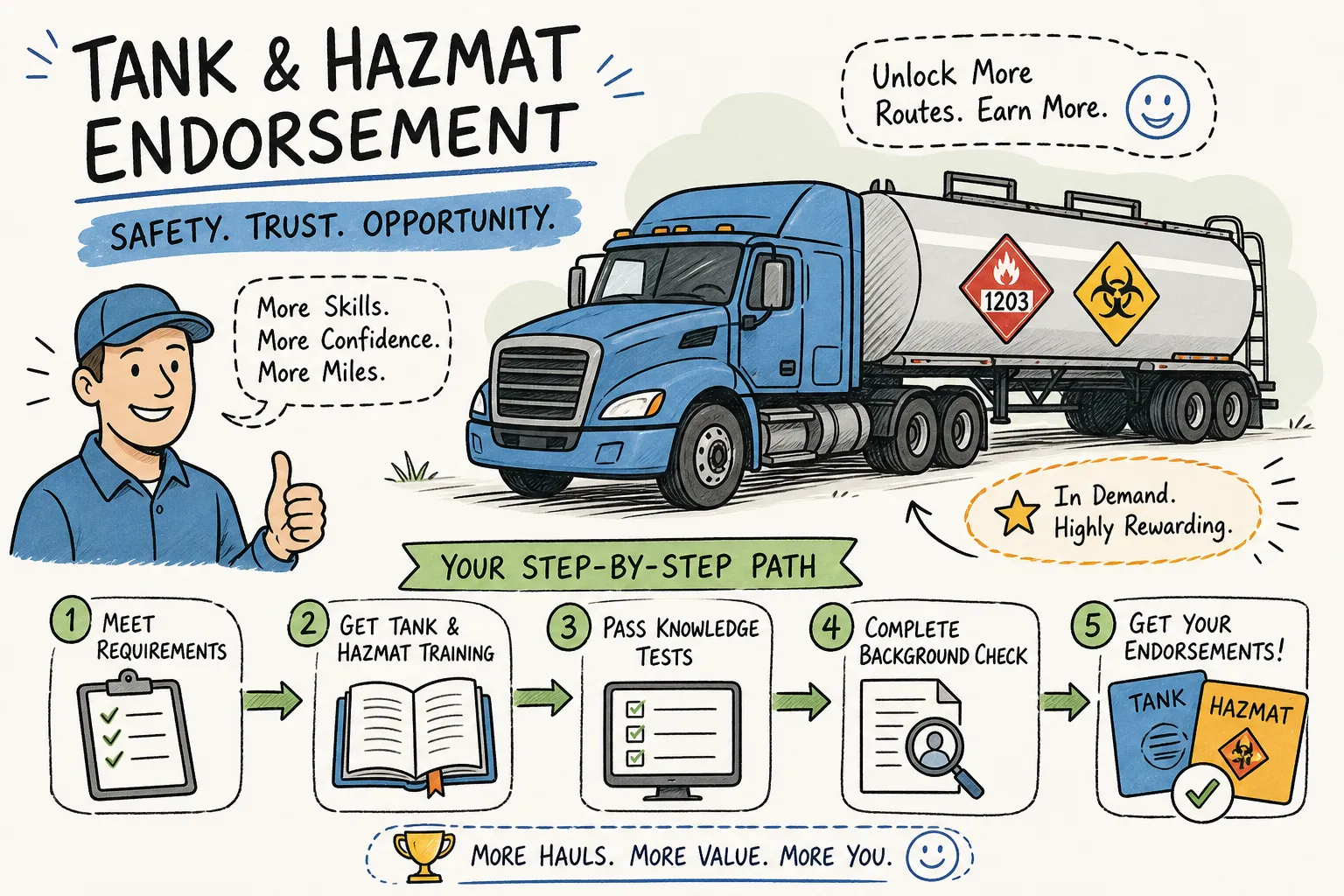
The tank and hazmat endorsement, officially the X endorsement on your CDL, means you've passed both the tanker vehicle (N) and hazardous materials (H) knowledge tests and cleared the federal TSA Security Threat Assessment. Once your CDL shows an X, you can legally haul placarded hazmat loads in tank vehicles, qualifying you for specialized hazmat tanker work that many employers pay more for than dry-van or general freight positions.
This guide covers every step: eligibility, the TSA process, what each knowledge test covers, what it costs, and how to study both endorsements without getting the content tangled. If you're already using CDLTest360 for your CDL prep, the hazmat and tank vehicle quiz modules are exactly where you want to focus your study time for this.
Key takeaways
-
X is not a separate application: Your CDL automatically shows X once you hold both the N (tanker) and H (hazmat) endorsements simultaneously.
-
TSA controls the timeline: Start the federal Security Threat Assessment first. It can take 30 to 60 days and cannot be rushed by studying harder.
-
ELDT is required for first-time H applicants: If you've never held an H endorsement and applied on or after February 7, 2022, you must complete federally approved hazmat theory training before testing.
-
Citizenship rules apply to H: The H endorsement is generally limited to U.S. citizens and lawful permanent residents; some other immigration categories authorized under federal law may also qualify. Check TSA guidance or your state DMV for your specific situation before you pay for fingerprinting.
-
Study H and N separately: Hazmat (30 questions) and tanker (20 questions) draw from different CDL manual sections. Many students find that mixing study sessions creates test-day confusion.
-
N is fast and inexpensive: No background check, no ELDT requirement, and many states issue the updated CDL the same day you pass the written test.
Tank and Hazmat Endorsement: What It Means for CDL Holders
N, H, and X each represent a distinct authorization on your CDL. The N endorsement allows you to operate tank vehicles carrying liquid or gaseous cargo. The H endorsement allows you to transport federally regulated hazardous materials requiring placards. The X endorsement is simply what appears on your license when you hold both. It is not a separate application, a separate test, or a separate fee category. Your state DMV assigns X automatically once both N and H are on file.
The types of cargo each endorsement covers matter for job eligibility. N covers liquid cargo tanks, gas cargo tanks, and portable tanks, the physical vehicle type. H covers what's inside: placarded hazardous materials across all nine DOT hazard classes. Many tanker jobs moving fuel, chemicals, propane, or industrial gases commonly require both, which is why X functions as a realistic standard for that segment of trucking rather than a specialty credential only a few drivers pursue.
The tank and hazmat endorsement isn't a formality; it's a career-level upgrade that narrows the competition and opens routes that most CDL holders simply can't take. Fuel hauling, chemical transport, and propane delivery all fall into this category.
One practical clarification worth understanding upfront: you still apply for N and H separately at your state DMV. The TSA background check is required for H (and therefore X), but N can often be added faster through a knowledge test alone. If you're pursuing X, start the TSA process first so the background check doesn't become the last bottleneck after everything else is done.
Do you meet the eligibility requirements to apply?
You must already hold a valid CDL, or be simultaneously applying for one, before any endorsement can be added. Federal law does not allow a standalone H or N endorsement on a standard driver's license. Both Class A and Class B CDLs qualify for these endorsements. In Texas specifically, the H endorsement cannot be issued on a non-domiciled CDL, and drivers operating under intrastate-only status, such as those with a Texas CDL-5 certification or a Texas limb waiver, are also ineligible.
First-time H endorsement applicants face an additional requirement that took effect February 7, 2022: federally mandated Entry-Level Driver Training (ELDT) for hazmat theory. This means completing a theory-only course through a provider listed on the FMCSA Training Provider Registry before the state can administer the knowledge test. The course covers hazmat classification, operational requirements, emergency response procedures, loading and unloading rules, and route planning, among other topics. You must pass the provider's internal assessment at 80% or higher. States verify completion electronically through the registry, so there's no paperwork to submit manually.
The N endorsement does not carry a comparable ELDT requirement at the federal level. If you already held an H endorsement before February 7, 2022, the ELDT rule does not apply retroactively to renewals. Check with your state DMV to confirm whether any state-level training requirements apply in your situation, since states can add requirements beyond the federal baseline.
Citizenship status is a hard requirement for H. Federal law generally restricts the hazmat endorsement to U.S. citizens and lawful permanent residents; some other immigration categories authorized under federal law may also qualify. Noncitizens who do not hold an eligible immigration status cannot obtain, renew, or transfer the H endorsement. Confirm your specific situation with TSA guidance or your state DMV before you pay for fingerprinting.
What criminal history disqualifies you from the hazmat endorsement?
The TSA Security Threat Assessment includes a criminal background review, and certain offenses bar an applicant permanently. Permanent disqualifications apply to convictions, or findings of not guilty by reason of insanity, for federal terrorism-related offenses, espionage, treason, murder, unlawful possession or transport of explosives, crimes involving transportation security incidents, and conspiracy or attempt to commit any of these. No appeal, no waiver, and no passage of time changes the outcome in this category. If one of these applies, the H endorsement is permanently unavailable.
Temporary disqualifications follow a different rule. If a conviction occurred within the past seven years, or the applicant was released from incarceration within the past five years, the endorsement is denied for the duration of that window. The offense categories that trigger temporary disqualification include assault with intent to kill, kidnapping, rape, firearms and weapons offenses, fraud and identity crimes, smuggling, drug distribution, arson, robbery, bribery, extortion, certain immigration violations, and conspiracy or attempt to commit any of these. Once the relevant window passes and no other disqualifiers exist, the applicant becomes eligible and can apply.
An active warrant or current indictment for any felony on either list also bars an applicant until the case resolves in their favor. TSA can grant waivers in limited circumstances for temporary disqualifications when the applicant can demonstrate they no longer pose a security threat, but waivers are not guaranteed and require a formal process. If your background includes any offense in either category, consult with your state DMV and the TSA HME program before investing time and fees into the process.
How does the TSA Security Threat Assessment work?
The TSA Security Threat Assessment for the hazmat endorsement runs through IDEMIA enrollment centers. The process starts with an online or phone application; walk-in appointments are generally not available. After submitting the pre-enrollment application, you schedule an in-person appointment at an enrollment center for electronic fingerprinting and a digital photograph. The in-person appointment itself averages 9 to 12 minutes. The wait between fingerprinting and receiving clearance is the real variable.
TSA recommends applying at least 60 days before you need the endorsement. Most straightforward cases clear in two to three weeks, but processing can stretch to six weeks or longer in high-demand periods. If no result arrives within six weeks of your fingerprinting appointment, contact the TSA HME call center at 1-855-347-8371. Your state DMV cannot issue the H or X endorsement until TSA clearance comes through, and there is no workaround for that requirement.
For documents, bring what proves both your identity and your citizenship or lawful permanent resident status. A valid U.S. passport satisfies both requirements on its own. Without a passport, bring a valid government-issued photo ID plus a separate citizenship document such as a birth certificate, naturalization certificate, or permanent resident card. Most states also require your current CDL and DOT medical certification at the appointment. Confirm your specific state's required document list before you go, since requirements vary.
Payment is made in person at the enrollment center before fingerprints are taken, not at the time of the online application. Credit cards are the preferred method. The enrollment center also accepts an exact-amount money order, company check, or certified check payable to "IDEMIA." State licensing fees are separate transactions paid to your state DMV.
What topics are on the hazmat knowledge test?
The hazmat knowledge test is built from Section 9 of the federal CDL manual, which means the source material is the same across all 50 states even if the specific question phrasing varies. The test in most states consists of 30 questions with an 80% passing threshold, meaning you need 24 correct answers to pass. Understanding what the test actually covers, at the level the questions probe, is the difference between passing on the first attempt and needing a retake.
The core content areas break down as follows:
-
Hazardous materials classification and the nine DOT hazard classes
-
Placarding requirements and thresholds under Table 1 and Table 2
-
Shipping paper requirements and where those papers must be kept
-
Loading and unloading rules and segregation of incompatible materials
-
Parking and attendance requirements
-
Emergency response procedures
-
Security awareness under the carrier's transportation security plan
-
Cargo tank topics, including emergency shutoffs and liquid surge effects
The question types that trip up first-time test takers are not pure memorization questions. They test whether you understand the reasoning behind the rules. Expect scenarios: which placard applies to this load, where must the shipping paper be kept during a fuel stop, what does the driver do when a package leaks, can these two materials share a trailer. Knowing the nine hazard classes by name is not enough if you can't apply the placarding thresholds to a real situation.
Hazmat content is dense, and it overlaps in surface-level ways with cargo securement and vehicle inspection topics from general knowledge, which can create confusion when studied together. Dedicated hazmat sessions, separate from everything else, keep the material organized in your memory for test day.
What topics are on the tanker vehicle knowledge test?
The tanker vehicle knowledge test covers the unique handling characteristics of tank vehicles and the operational rules specific to liquid and gaseous cargo transport. In most states, the test consists of 20 questions with the same 80% passing threshold as hazmat, requiring 16 correct answers to pass. The content comes from the tank vehicles section of the federal CDL manual, not from the hazmat section, which is why these two tests draw from genuinely separate material.
The core topics include:
-
Liquid surge and how it affects braking, acceleration, and turning
-
The differences between baffled, compartmented, and smooth-bore tanks and how each type handles forward-and-back movement
-
High center of gravity and rollover risk on curves and grades
-
Outage requirements and why tanks are not filled completely
-
Load level differences between full, partially full, and empty tanks
-
Vehicle inspection specific to tanks, valves, vents, manhole covers, and emergency shutoffs
-
Loading and unloading procedures and emergency response for leaks, spills, and rollovers
The N endorsement is a knowledge-only endorsement at the federal level and in virtually every state. No separate tanker driving skills test, road test, or basic-control skills evaluation is required solely to add N to an existing CDL. You pass the written test and the state updates your credential. If you're simultaneously upgrading your CDL class, the applicable skills testing for that upgrade applies, but that's a separate process unrelated to the N endorsement itself.
The key is still studying the tanker material in its own dedicated sessions rather than assuming your general knowledge preparation covers the tanker-specific content. Liquid surge mechanics and outage calculations don't appear in the general knowledge section.
How do you study for both endorsements without mixing up the content?
Hazmat and tanker content share surface-level themes: both involve cargo risk, both include specific equipment checks, and both affect how you operate the vehicle. But the actual test questions come from completely different sections of the federal CDL manual, and studying both at the same time means your brain groups unlike material together. That creates retrieval errors on test day, where you pull a hazmat placard rule when trying to answer a question about liquid surge, or vice versa. The solution is straightforward: treat them as two separate courses with two separate study blocks.
CDLTest360's hazmat and tank vehicle quiz modules are built for exactly this kind of targeted, endorsement-specific prep. The hazmat module covers placarding thresholds, the nine hazard classes, shipping paper requirements, loading segregation, and emergency response procedures, all drawn directly from FMCSA regulations. The tank vehicle module covers liquid surge, high center of gravity, outage requirements, baffled versus smooth-bore tanks, and handling adjustments for partial loads. Running a dedicated hazmat session, then a dedicated tank vehicle session on a separate day, keeps the two knowledge bases from colliding when it matters.
Both modules include a timed exam simulation mode with 50 questions at the 80% passing threshold, plus a missed-question review loop that re-drills only the questions you answered incorrectly. That means your study time goes directly toward your actual gaps instead of re-covering material you already understand. You can start practicing without creating an account, which means there's no reason to delay getting into the material today.
Here's a concrete sequence that keeps the process moving: complete your ELDT hazmat theory training first if you're a first-time H applicant, then submit your TSA application to start the clock on the background check. Use the waiting period, which can run four to eight weeks, to run focused CDLTest360 sessions, alternating hazmat modules and tanker modules on different days. By the time TSA clears, both knowledge tests should be ready to go. Take the knowledge tests at your state DMV before applying to update your CDL. This sequence eliminates the common mistake of waiting until TSA clears to begin studying, which adds unnecessary weeks to your timeline.
Tank and Hazmat Endorsement Costs and Timeline
Once you pass the knowledge test, many states update your CDL the same day or within a few business days. There is no background check fee, no federal waiting period, and no ELDT requirement at the federal level. N is genuinely a straightforward knowledge test and a state DMV transaction.
The hazmat side carries substantially more cost and time. According to the TSA enrollment program, the federal Security Threat Assessment fee is $85.25. In Texas, the TSA fee and state fees are paid separately. Verify the current TSA fee directly with the IDEMIA enrollment website before your appointment, as federal fee schedules are subject to change.
Fees vary based on whether you're completing a new CDL transaction, a renewal, or an endorsement-only update on an existing credential. The numbers above represent the typical range, not a guaranteed figure. Always verify the current fee schedule with your state DMV before scheduling your appointment. In Texas, confirm fees with Texas DPS directly. Other states publish their endorsement fee schedules on their DMV websites, and those figures can shift between publication dates.
The one element of this process that cannot be accelerated by preparation or effort is the TSA background check. You can complete ELDT in a day or two. You can pass the knowledge tests on your first attempt. But TSA processing runs on its own timeline, and the endorsement cannot be issued until clearance arrives. Start the TSA application early. That single decision has more impact on your overall timeline than any other step in the process.
Putting the tank and hazmat endorsement process together
Adding the tank and hazmat endorsement to your CDL is a multi-step process, but every step is predictable once you know the sequence. Start the TSA process first because it controls the timeline. Complete your ELDT hazmat theory training if you're a first-time H applicant, and do it before you schedule your state knowledge test, Texas DPS and most other states verify completion electronically before they'll let you sit for the exam. Study hazmat and tanker content in separate sessions so the material stays organized in your memory. Then pass both knowledge tests and update your CDL.
CDLTest360's hazmat and tank vehicle quiz modules are designed for this kind of structured, endorsement-by-endorsement approach. Run your hazmat sessions, run your tanker sessions on separate days, and use the missed-question loop to work through gaps efficiently rather than re-covering what you already know. You can access the platform at $39.99 for a 90-day pass or $19.99 per month with no long-term commitment, and the no-account-required free trial lets you get started immediately without any registration barrier.
The tank and hazmat endorsement opens CDL routes in fuel hauling, chemical transport, propane delivery, and industrial gas runs that most drivers can't take without it. The prep work is predictable, the costs are fixed, and the knowledge tests are passable with structured study. Get into the CDLTest360 hazmat and tanker modules today, start your TSA application early, and walk into both knowledge tests ready.
Frequently Asked Questions
Can noncitizens get the N (tanker) endorsement?
Yes, the tanker (N) endorsement does not carry the same citizenship restriction as the H endorsement, which is generally limited to U.S. citizens and lawful permanent residents. The N endorsement has no federal background-check or citizenship barrier like H, so noncitizens who otherwise meet CDL requirements can typically add N through the knowledge test process required by their state.
If we already had the H endorsement before February 7, 2022, do we need to complete ELDT to renew it?
No, the ELDT hazmat theory requirement does not apply retroactively to renewals for drivers who already held H before February 7, 2022. Renewal still depends on your state's rules, so check with your state DMV for any state-level training requirements beyond the federal baseline.
Are the TSA Security Threat Assessment fee and state DMV endorsement fees paid together?
No, the TSA Security Threat Assessment fee is paid at the IDEMIA enrollment center and is separate from state DMV endorsement fees, which you pay to your state. In Texas, for example, the TSA fee and state fees are paid separately, and many states publish their own fee schedules that can change over time.
Can we start studying the hazmat and tanker material without creating an account on the prep platform?
Yes, you can begin practicing without creating an account because the platform offers a no-account-required free trial. That lets you start targeted hazmat and tank vehicle sessions immediately before committing to a paid pass.
{ "@type": "Article", "datePublished": "2026-10-25T11:02:25.089Z", "dateModified": "2026-10-25T11:02:25.089Z", "headline": "Tank and Hazmat Endorsement: CDL Step-by-Step Guide", "description": "Learn the exact steps to earn your tank and hazmat endorsement (X). TSA process, knowledge tests, costs, timelines, and how to study smart. Start prepping today.", "publisher": { "@type": "Organization", "name": "CDLTest360" }, "image": [ "https://composeo-article-images.s3.us-east-1.amazonaws.com/tank-and-hazmat-endorsement-cdl-step-by-step-guide-1792843786893.webp" ], "author": { "@type": "Organization", "name": "CDLTest360" } }
{ "@type": "FAQPage", "mainEntity": [ { "@type": "Question", "name": "Can noncitizens get the N (tanker) endorsement?", "acceptedAnswer": { "@type": "Answer", "text": "Yes, the tanker (N) endorsement does not carry the same citizenship restriction as the H endorsement, which is generally limited to U.S. citizens and lawful permanent residents. The N endorsement has no federal background-check or citizenship barrier like H, so noncitizens who otherwise meet CDL requirements can typically add N through the knowledge test process required by their state." } }, { "@type": "Question", "name": "If we already had the H endorsement before February 7, 2022, do we need to complete ELDT to renew it?", "acceptedAnswer": { "@type": "Answer", "text": "No, the ELDT hazmat theory requirement does not apply retroactively to renewals for drivers who already held H before February 7, 2022. Renewal still depends on your state's rules, so check with your state DMV for any state-level training requirements beyond the federal baseline." } }, { "@type": "Question", "name": "Are the TSA Security Threat Assessment fee and state DMV endorsement fees paid together?", "acceptedAnswer": { "@type": "Answer", "text": "No, the TSA Security Threat Assessment fee is paid at the IDEMIA enrollment center and is separate from state DMV endorsement fees, which you pay to your state. In Texas, for example, the TSA fee and state fees are paid separately, and many states publish their own fee schedules that can change over time." } }, { "@type": "Question", "name": "Can we start studying the hazmat and tanker material without creating an account on the prep platform?", "acceptedAnswer": { "@type": "Answer", "text": "Yes, you can begin practicing without creating an account because the platform offers a no-account-required free trial. That lets you start targeted hazmat and tank vehicle sessions immediately before committing to a paid pass." } } ] }