Do I need air brakes for my CDL permit? The air brakes knowledge test is not automatically required for every CDL applicant. Whether you need it comes down entirely to the brake system on the vehicle you plan to drive or test in. Skip the test and your CDL comes stamped with an "L" restriction, locking you out of any commercial vehicle equipped with air brakes. That one restriction can quietly shrink your job options before your career even starts.
This article breaks down exactly when the air brakes test applies, what the L restriction means in practice, who qualifies for exceptions, how to get the restriction removed, and how to prepare so you walk into the DMV ready to pass on your first try.
Key takeaways
-
Vehicle brakes decide it: The air brakes knowledge test is required only when the vehicle you plan to operate uses full air brakes or air-over-hydraulic brakes, regardless of your CDL class.
-
L restriction locks you out: CDL restriction L prohibits operating any commercial motor vehicle with air brakes and cuts off the majority of Class A and many Class B job opportunities.
-
Removal requires re-testing: To remove the L restriction, you must pass the air brakes knowledge test, update your CLP, hold it for at least 14 days, then pass a skills test in an air-brake-equipped vehicle.
-
ELDT does not apply here: Existing CDL holders removing the L restriction are exempt from FMCSA's Entry-Level Driver Training requirement.
-
80% is the federal minimum: Per 49 CFR §383.135, the federal passing standard for the air brakes knowledge test is 80%. Verify your state DMV's specific format and any locally applied thresholds before you schedule.
-
Focused prep pays off: CDLTest360's dedicated Air Brakes quiz module is built around the testable topics in the FMCSA regulations and state CDL manuals, giving you a structured way to drill the content before your exam.
Do I need air brakes for my CDL permit? What the test actually covers
The air brakes knowledge test is a written exam that evaluates whether a CDL applicant understands how air brake systems work, how to inspect them, and how to operate them safely. The FMCSA requires states to include this content as part of the CLP and CDL testing process, so the subject matter is consistent across all 50 states even if the exact test format varies slightly from state to state. Topics include air brake components, pressure thresholds, dual-air systems, spring brake behavior, inspection procedures, and emergency driving techniques.
Under 49 CFR §383.135, the federal passing standard is 80% correct answers, which translates to roughly 20 out of 25 questions in the format most states use. Some states vary the question count or test format, so always treat your state's official CDL manual as the definitive reference before you schedule. The key point is that this exam demands genuine memorization of specific pressure values and step-by-step procedures. Guessing on the pressure thresholds doesn't cut it.
The air brakes section gets its own standalone test because not every CDL vehicle uses an air brake system. Testing it separately lets states apply the restriction only when it's relevant to what a driver will actually operate, rather than making it mandatory for everyone by default. That design is sensible, but it also means the restriction can appear on your license without any warning if you're not paying attention to what vehicle you're testing in.
What the "L" restriction on your CDL actually means
Restriction L on a CDL means one thing: no air-brake-equipped commercial motor vehicle. It's printed directly on your license and prohibits you from legally operating any CMV that uses full air brakes or air-over-hydraulic brakes. This applies even if the vehicle falls squarely within your CDL class. Holding a Class A CDL with an L restriction still means you can't drive a standard tractor-trailer, because nearly all of them rely on air brakes to stop.
The restriction ends up on your license in two common situations: you take your skills test in a vehicle with hydraulic brakes, or you fail or skip the air brakes knowledge test portion during the written exam. Some states also assign it if you don't complete the required air-brake inspection demonstration. The restriction isn't a penalty for doing something wrong; it's simply a record of what brake systems you've qualified to operate.
The career impact of the L restriction is where things get serious. Most commercial trucking jobs require driving vehicles with air brakes: standard semi-trucks, motorcoaches, air-braked dump trucks, transit buses, and fire apparatus. An L restriction rules out the vast majority of Class A driving positions and a large share of Class B work. Many carriers and CDL schools screen for this restriction during hiring, and some training programs won't enroll students who plan to test in a hydraulic-brake vehicle. Removing it early protects your options.
When do you actually need to take the air brakes test?
The FMCSA rule is straightforward: if you plan to operate a CDL-required commercial vehicle equipped with full air brakes or qualifying air-over-hydraulic brakes, you must pass the air brakes knowledge test. Your CDL class matters far less than the braking system on the specific vehicle. A Class A applicant who tests in a hydraulic-brake truck can walk away with an L restriction just as easily as a Class B applicant driving a hydraulic-brake bus.
The test is required when you're planning to drive any of the following:
-
A tractor-trailer or other Class A combination with air brakes
-
An air-braked Class B straight truck, bus, or dump truck
-
A motorcoach, transit bus, or school bus with air brakes
-
Any CDL-required vehicle using air-over-hydraulic brakes where air is essential to brake actuation
-
Any commercial vehicle when removing an existing L restriction from a CDL
You are not required to pass the air brakes test if every vehicle you plan to drive uses hydraulic brakes. In that case, you can complete your CLP and CDL testing without it, and the L restriction will appear on your license to reflect that limitation. The test is also not required when your vehicle has an air compressor solely to supply air to a trailer, but the towing unit's own service brakes are hydraulic. The decisive factor is whether compressed air is part of the vehicle's brake-actuation system itself.
How CDL class affects the air brakes requirement
Class A covers combination vehicles over 26,001 pounds with a towed unit over 10,000 pounds. Most combination vehicles in this class, including tractor-trailers and tanker combinations, are built with air brakes. If you test in one of these vehicles, the air brakes knowledge test is required. The only way a Class A applicant avoids it is by specifically testing in a hydraulic-brake combination, which is less common but does occur in some training programs that use older or specialized equipment.
Class B covers single vehicles over 26,001 pounds: straight trucks, transit buses, school buses, motorcoaches, and dump trucks. Many of these use air brakes. If the vehicle you're testing in has air brakes, you need to pass the test. Class B drivers who carry the L restriction are cut off from most bus and large truck opportunities, since a large share of commercial bus fleets rely on air brakes.
Class C covers CDL-required vehicles that don't meet the size thresholds for Class A or B, such as small passenger vehicles designed to carry 16 or more people or certain hazmat-placarded vehicles. Air-braked Class C vehicles exist but are far less common. Most Class C applicants drive hydraulic-brake vehicles and will end up with the L restriction by default, but it rarely limits their actual job scope since their assigned vehicles don't use air brakes anyway. The vehicle's brake system is the deciding factor at every class level.
Are there any waivers or exceptions to the air brakes requirement?
The most practical exception is a vehicle-weight one, not a true waiver of the federal rule. The L restriction applies only to vehicles that require a CDL. Kansas makes this explicit: a driver with an L restriction can legally operate an air-brake box truck under 26,001 pounds because that vehicle doesn't fall under CDL jurisdiction. Washington states the same principle. Once you're operating CDL-required vehicles, the restriction applies regardless of what state you're in.
Federal regulations allow states to exempt certain categories of drivers from some CDL requirements altogether. Qualifying farmers, firefighters, emergency-response drivers, and seasonal farm-service employees may operate under exemptions that bypass standard CDL testing under specific conditions. These exemptions don't create a blanket authorization to drive air-braked vehicles across state lines; they're narrow and typically limited to the home state, specific vehicle types, and defined operating conditions. Don't plan your career around an exemption that disappears the moment you cross a state line.
Air-over-hydraulic brakes sit in a classification gray zone worth understanding. If the air system is essential to applying the service brakes, meaning the vehicle loses effective braking without air pressure, the system is treated as air-braked and the test applies. Testing in an air-over-hydraulic vehicle typically results in a Z restriction rather than an L restriction, since the Z code specifically addresses systems operating partially on the air-brake principle. When in doubt about how your state classifies a specific vehicle's brake system, a quick call to your state DMV before you schedule your test saves a lot of confusion later.
How to remove the L restriction from your CDL
Removing the L restriction requires completing a multi-step process that mirrors how you would have qualified in the first place. First, you pass the air brakes knowledge test at your state DMV. Second, most states require you to obtain or update your CLP without the restriction, and the FMCSA requires holding that updated CLP for at least 14 days before taking the skills test. Third, you pass the skills test, including the air-brake inspection portion, in a CDL vehicle equipped with air brakes.
Fourth, you pay the applicable fee and receive a newly issued CDL with the restriction removed. The exact process varies enough by state that confirming the steps with your issuing DMV before you start is worth the effort. New Mexico requires a full new road skills test in an air-brake vehicle and charges a new license issuance fee. Virginia requires both the knowledge test and a road test in a vehicle with full air brakes. Some states accept the air brakes knowledge test as a walk-in transaction; others require an appointment. Your state's official CDL manual is the definitive reference for the current process and fee schedule.
FMCSA's Entry-Level Driver Training requirements generally do not apply when a driver is solely removing an L restriction from an existing CDL. This means you aren't required to complete a course through an FMCSA-registered training provider just to qualify for the restriction removal. Passing the required knowledge and skills tests at the DMV is typically sufficient. That makes the process far more accessible for experienced drivers who simply didn't test in an air-brake vehicle when they originally got their CDL.
How to study for the air brakes knowledge test efficiently
Pressure thresholds to memorize
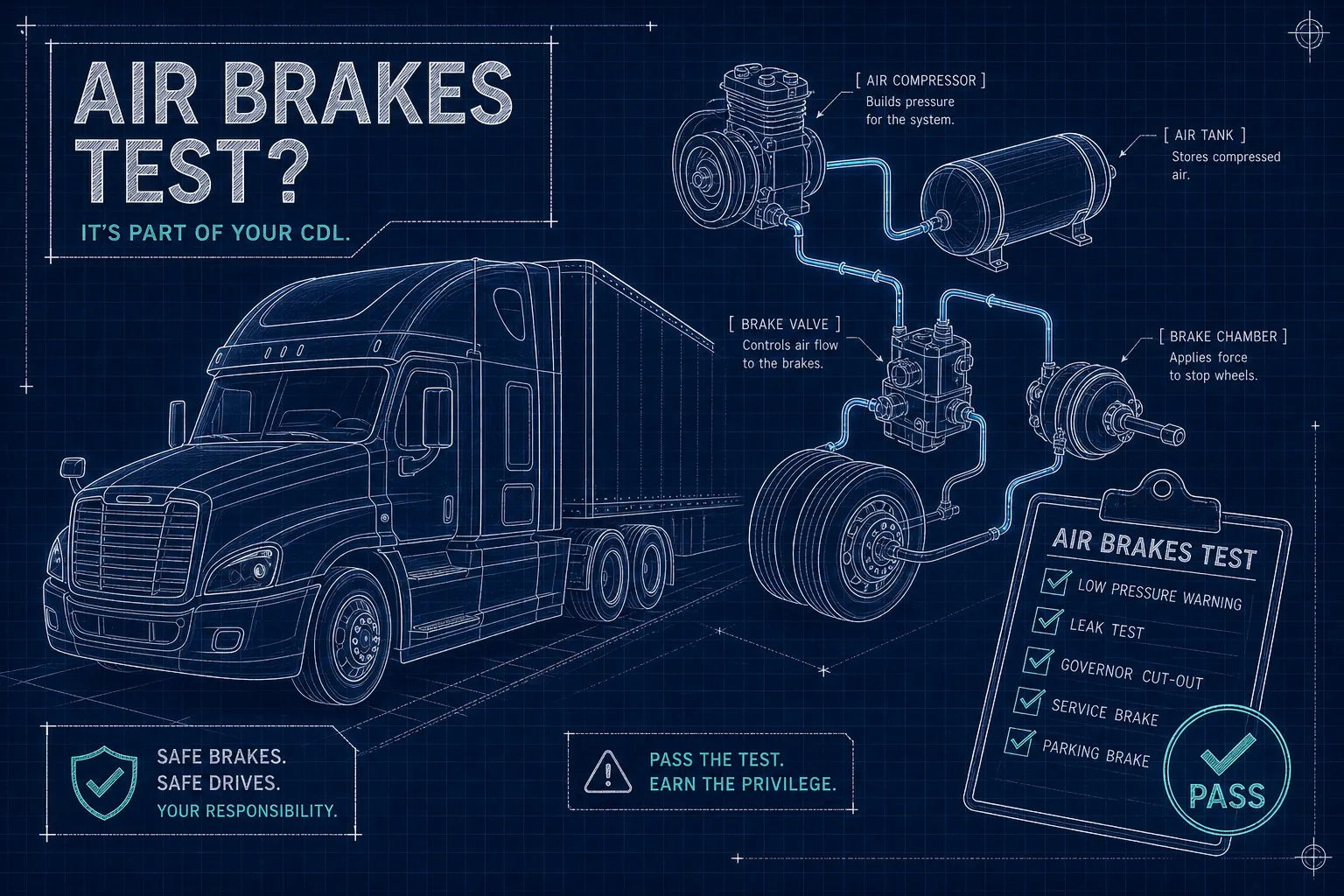
The air brakes test covers a specific set of numbers, procedures, and component names that you need to recall precisely under exam conditions. Focus your study on pressure thresholds first: governor cut-in and cut-out pressure, low-air warning activation level, spring-brake pop-out pressure, and safety valve settings. These numbers generate more questions on real state exams than any other category, and they require actual memorization rather than general comprehension of how brakes work.
Inspection sequence and emergency procedures
Beyond the pressure values, concentrate on the dual-air system layout, the sequence of inspection steps including the static leak test and applied leak test, and emergency driving procedures like controlled braking and preventing brake fade on downgrades. Component identification questions, where you name a part and match it to its function, also appear consistently across state exams. The FMCSA-sourced content in your state's CDL manual covers all of these areas. Studying directly from that manual alongside a focused practice test tool closes the gap between reading and retaining the material.
CDLTest360's Air Brakes quiz module is built around exactly these topics, aligned with FMCSA regulations and the CDL manuals used across all 50 states. It runs in both practice mode and timed exam simulation mode, with a passing threshold that mirrors the federal standard, so you get a realistic sense of where you stand before your DMV appointment. The missed-question review system re-drills only the items you got wrong, which is particularly effective for locking in pressure values and component functions without burning time on content you've already mastered.
If you haven't taken any CDL tests yet, studying for air brakes alongside General Knowledge is the most efficient approach. Both exams draw from overlapping content: vehicle inspection, brake systems, and pre-trip procedures appear in both areas. CDLTest360 lets you run both quiz modules independently, so you can pinpoint weak spots in air brakes specifically without blurring the topics together. One to two weeks of consistent drilling is typically enough to feel confident going into your scheduled DMV appointment.
The bottom line: do I need air brakes for my CDL permit?
If you're asking, "Do I need air brakes for my CDL permit?", the answer depends on the vehicle's brake system. If the vehicle you plan to drive relies on air brakes to stop, the test is required, and skipping it means leaving the DMV with an L restriction that blocks most commercial driving jobs. If it doesn't, the restriction appears on your license by default and you'll need to work through the removal process when you're ready to expand what you can legally operate.
Fortunately, the air brakes knowledge test covers a specific, finite body of content. The pressure values, component functions, and inspection procedures on the exam are the same concepts you'll rely on every day behind the wheel of an air-braked vehicle. Learning them properly before you test isn't just about passing, it's about operating safely once you have your license.
CDLTest360's Air Brakes module gives you a structured, efficient way to prepare alongside your other CDL tests. Start with the practice mode today, identify the topics where your knowledge has gaps, and use the missed-question drill to close those gaps before your DMV appointment. Show up knowing your air brake systems cold, and leave with a license that keeps every door open.
Frequently Asked Questions
How long do I have to hold the updated CLP before I can take the air-brake skills test?
You must hold the updated CLP without the L restriction for at least 14 days before taking the skills test. This 14-day hold is an FMCSA requirement before you can schedule and take the air-brake-equipped road skills exam.
Do I need to complete Entry-Level Driver Training (ELDT) just to remove the L restriction?
No, ELDT generally does not apply when you are only removing an L restriction from an existing CDL. Passing the air brakes knowledge test and then the skills test in an air-brake-equipped vehicle is typically sufficient without completing an FMCSA-registered ELDT course.
What score do I need to pass the air brakes knowledge test?
The federal minimum passing score is 80% under 49 CFR §383.135. In most state test formats this equates to roughly 20 out of 25 questions, though you should verify your state's exact question count and any local thresholds.
If my truck has an air compressor only to supply a trailer, do I still have to take the air brakes test?
No, the test is not required when the towing unit's service brakes are hydraulic and the air compressor only supplies air to the trailer. The decisive factor is whether compressed air is part of the vehicle's own brake-actuation system; if it is, the air brakes test applies.
{ "@type": "Article", "datePublished": "2026-10-22T11:02:22.766Z", "dateModified": "2026-10-22T11:02:22.766Z", "headline": "Do You Need to Pass the Air Brakes Test for Your CDL?", "description": "Wondering if you need air brakes for your CDL permit? Learn when the L restriction applies, what it limits, and how to remove it. Study smarter with CDLTest360.", "publisher": { "@type": "Organization", "name": "CDLTest360" }, "image": [ "https://composeo-article-images.s3.us-east-1.amazonaws.com/do-you-need-to-pass-the-air-brakes-test-for-your-cdl-1792584459652.webp" ], "author": { "@type": "Organization", "name": "CDLTest360" } }
{ "@type": "FAQPage", "mainEntity": [ { "@type": "Question", "name": "How long do I have to hold the updated CLP before I can take the air-brake skills test?", "acceptedAnswer": { "@type": "Answer", "text": "You must hold the updated CLP without the L restriction for at least 14 days before taking the skills test. This 14-day hold is an FMCSA requirement before you can schedule and take the air-brake-equipped road skills exam." } }, { "@type": "Question", "name": "Do I need to complete Entry-Level Driver Training (ELDT) just to remove the L restriction?", "acceptedAnswer": { "@type": "Answer", "text": "No, ELDT generally does not apply when you are only removing an L restriction from an existing CDL. Passing the air brakes knowledge test and then the skills test in an air-brake-equipped vehicle is typically sufficient without completing an FMCSA-registered ELDT course." } }, { "@type": "Question", "name": "What score do I need to pass the air brakes knowledge test?", "acceptedAnswer": { "@type": "Answer", "text": "The federal minimum passing score is 80% under 49 CFR §383.135. In most state test formats this equates to roughly 20 out of 25 questions, though you should verify your state's exact question count and any local thresholds." } }, { "@type": "Question", "name": "If my truck has an air compressor only to supply a trailer, do I still have to take the air brakes test?", "acceptedAnswer": { "@type": "Answer", "text": "No, the test is not required when the towing unit's service brakes are hydraulic and the air compressor only supplies air to the trailer. The decisive factor is whether compressed air is part of the vehicle's own brake-actuation system; if it is, the air brakes test applies." } } ] }