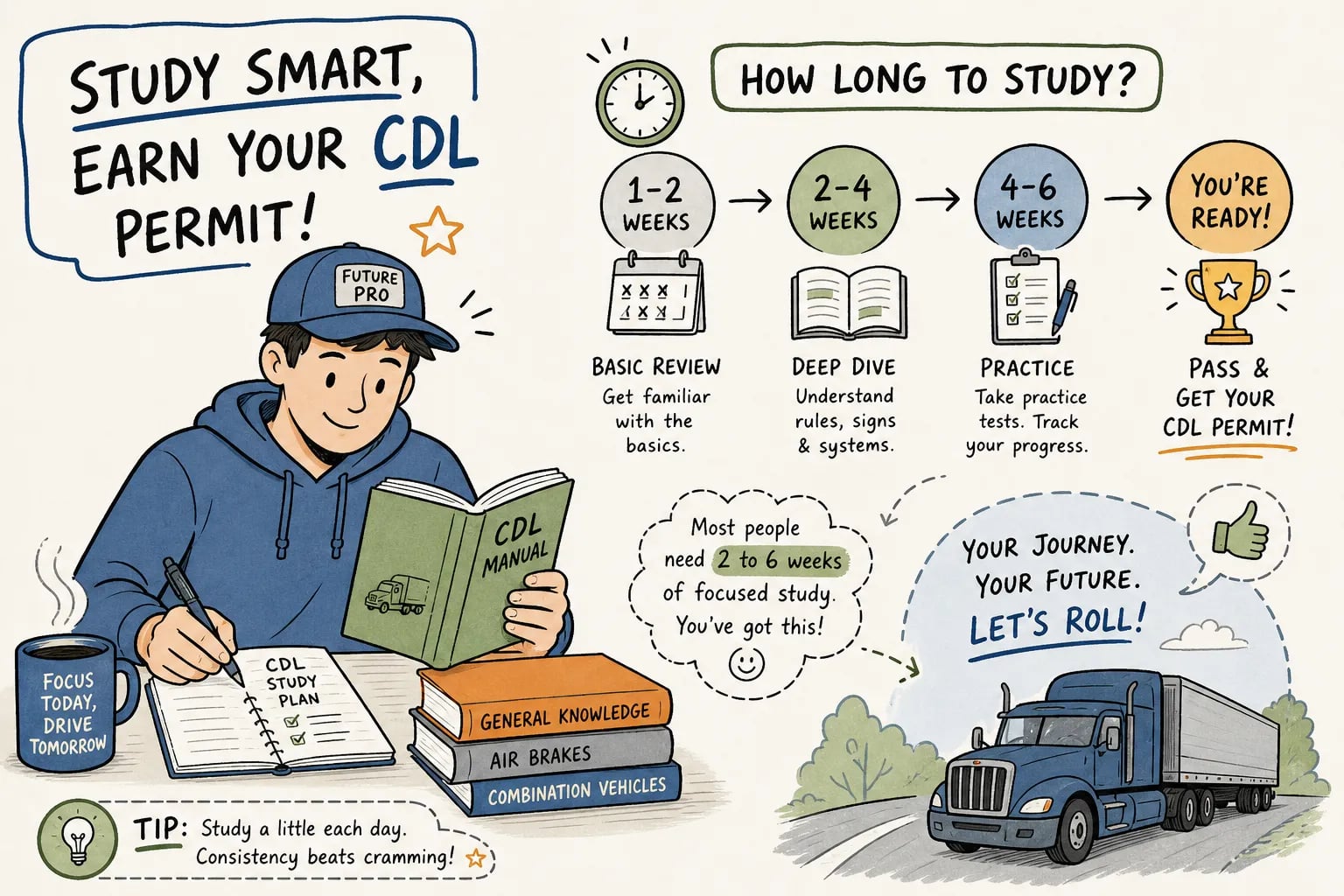
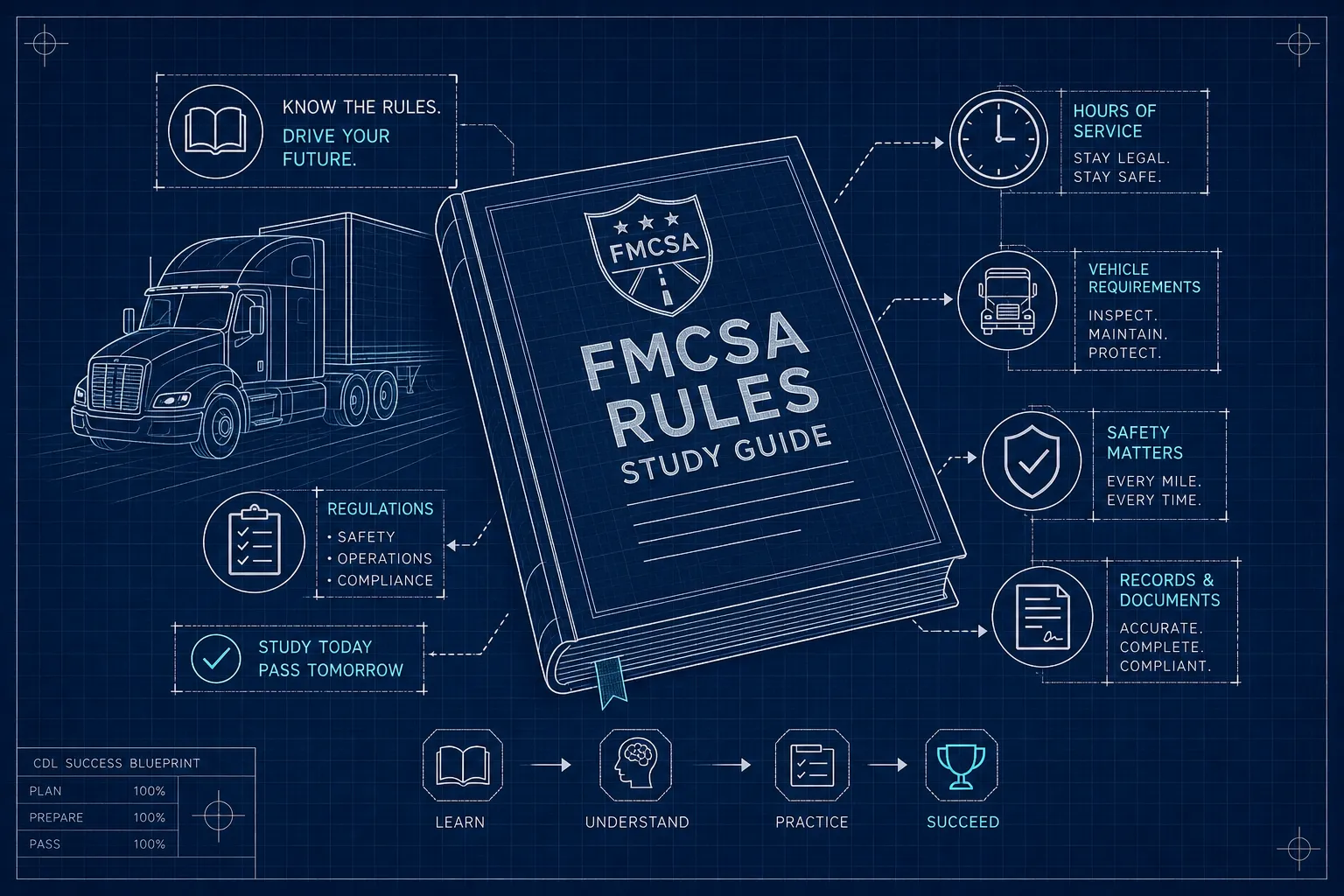
This FMCSA rules study guide covers the five core federal rule areas that appear on every CDL knowledge exam: hours of service, vehicle weights and dimensions, pre-trip inspection requirements, medical certification, and controlled substances and alcohol rules. These aren't abstract compliance topics buried in government documents. They're the exact standards codified under 49 CFR Parts 382, 391, 393, and 395, plus Part 658 for federal vehicle weight limits, and your exam tests whether you can apply them at an operational level, not just recite them. Understanding this changes everything about how you should study.
Most CDL candidates treat exam prep like trivia review. The reality is that most General Knowledge test questions trace back to a specific federal regulation, and the wording of those regulations matters. State manuals derive from the FMCSA model curriculum, so questions typically map closely to Federal Motor Carrier Safety Regulations content, though states may include some state-specific rules as well. This guide maps the key FMCSA sections to what the CDL exam actually tests, section by section, so you focus on what counts.
Key takeaways
-
Five rule areas dominate: Hours of service, vehicle weights, pre-trip inspection, medical certification, and drug and alcohol rules form the backbone of every CDL knowledge exam. These areas align with the FMCSA model curriculum used across all 50 states, though other topics such as cargo securement and safe driving also appear.
-
Wording precision matters: Exam questions test specific thresholds and limits, so studying paraphrased summaries creates knowledge gaps that cost you points.
-
2026 updates are likely testable: The Clearinghouse CDL downgrade rule, effective November 2024, and ongoing ELD enforcement changes are now part of the practical knowledge every new driver needs before licensing. Expect knowledge-level questions on both topics.
-
Source-aligned study wins: Platforms built from FMCSA regulations and state CDL manuals give you questions that closely reflect the actual exam, not approximations of it.
-
Targeted practice beats volume: Drilling missed questions and running timed simulations builds real readiness faster than reviewing topics you already know.
What the CDL knowledge exam actually pulls from FMCSA rules
The CDL General Knowledge test isn't written in isolation. It's built from the FMCSA model curriculum, which references the Federal Motor Carrier Safety Regulations covering Parts 380, 382, 383, and 390 through 399. Your state's CDL manual is itself derived from this curriculum, which means every state exam, despite minor variations, tests the same federal core. When you understand that the exam reflects actual federal trucking compliance rules, you stop studying "test tips" and start studying the regulations.
The exam covers vehicle inspection, basic vehicle controls, shifting, backing, coupling and uncoupling, cargo weight and securement, hazardous conditions, emergency procedures, and regulatory compliance including hours of service, drug and alcohol rules, and medical requirements. That's a broad scope, but each topic connects directly to a CFR section. The candidates who pass on the first attempt aren't necessarily the smartest in the room, they're the ones who studied from materials aligned with the actual source.
Why generic flashcard apps leave dangerous gaps
Generic study apps and unofficial prep materials often paraphrase FMCSA regulations rather than reflect them accurately. On rule-specific questions, that paraphrasing creates real problems. The exam asks about specific thresholds: exactly how many hours, exactly what distance, exactly which condition triggers an out-of-service finding. If your study material rounded those numbers or softened the language, you'll second-guess the correct answer on test day.
This is the practical reason to study from a platform aligned with the source material. CDLTest360 states that its question bank is drawn from FMCSA regulations and state CDL manuals, so when you see a question about the 14-hour driving window, the wording and answer choices are designed to match what the actual exam presents. Studying from regulation-aligned content reduces the risk of paraphrasing gaps on exam day.
FMCSA rules study: Hours of service explained
Hours of service rules for property-carrying drivers are governed by 49 CFR Part 395, and the exam tests them at a scenario application level. You won't be asked to recite the regulation number. You'll be given a driving situation and asked to identify whether the driver is in compliance, which means you need to understand each limit and how they interact.
The 11-hour driving limit and the 14-hour window
After at least 10 consecutive hours off duty, a property-carrying driver may drive a maximum of 11 hours. All driving must occur within the first 14 consecutive hours after coming on duty. These are two separate rules that operate simultaneously. The 11-hour limit caps total driving time. The 14-hour window is a hard clock that does not pause for off-duty breaks taken during the shift. A driver who takes a two-hour rest stop in the middle of the day doesn't gain two hours back on the 14-hour window.
The exam tests whether you understand both limits and can apply them to scenarios. A common question presents a driver who has been on duty for 13 hours with only 9 hours of driving and asks what happens next. The correct analysis requires knowing that the 14-hour window closes in one hour regardless of remaining driving time, not that the driver has two hours of driving left.
The 30-minute break rule and weekly caps
After accumulating 8 cumulative hours of driving time, a driver must take at least 30 consecutive minutes without driving. On-duty, not-driving time satisfies this requirement. The exam tests this threshold precisely, and the wording matters: it's 8 hours of cumulative driving time, not 8 hours elapsed from the start of the shift. These are different things, and the distinction shows up in scenario questions.
Weekly limits cap a driver at 60 on-duty hours in 7 consecutive days or 70 hours in 8 consecutive days, depending on the carrier's operating schedule. A driver who reaches that cap cannot drive again until sufficient hours have elapsed or a 34-hour restart is completed. The 34-hour restart is optional, not mandatory, and a driver must understand when it applies and what it accomplishes.
HOS exceptions the exam expects you to recognize
The short-haul exception allows eligible drivers operating within a 150-air-mile radius to use a 14-hour duty period without maintaining a full record of duty status, provided all conditions are met. The adverse driving conditions extension allows both the 11-hour driving limit and the 14-hour window to be extended by up to 2 hours when unexpected weather or road conditions make it unsafe or impractical to complete the run. These exceptions appear as scenario-based questions on the exam, and many first-time candidates miss them because they focused only on the standard limits.
With HOS rules covered, the next heavily tested area shifts to the physical limits placed on the vehicle itself.
Vehicle weight and size rules the CDL test covers
Federal gross vehicle weight limits are established under 49 CFR Part 658, and the exam tests practical understanding of these limits rather than engineering calculations. Per FMCSA guidance and state CDL manuals, the General Knowledge exam stresses conceptual understanding over full bridge-formula computation. The baseline number every CDL candidate must know is 80,000 pounds, the maximum gross vehicle weight on the Interstate Highway System for most commercial motor vehicles.
Federal gross weight and bridge formula basics
The 80,000-pound limit applies to gross vehicle weight, but axle limits create additional constraints. A single axle is limited to 20,000 pounds. A tandem axle group is limited to 34,000 pounds. These limits exist alongside the gross weight limit, meaning a vehicle can be under 80,000 pounds total and still be overweight if the load is concentrated on too few axles. The Federal Bridge Formula governs how much weight can legally ride on a given axle grouping based on the number of axles and the distance between the outermost axles in the group.
The CDL exam doesn't test the bridge formula calculation itself, but it does test whether you understand the concept: axle spacing and weight distribution both matter, and a legal gross weight doesn't automatically mean legal axle weights. Candidates who only memorize the 80,000-pound number and stop there miss the deeper point the exam is testing.
How weight rules connect to cargo securement
The exam also connects weight distribution to cargo securement requirements. Improperly distributed cargo can shift axle weights over legal limits even when the overall gross weight stays within the cap. A load that's too heavy toward the rear can overload the trailer axles while keeping the steer axle underloaded, affecting steering response and braking stability. This crossover between weight rules and securement is a tested topic on the General Knowledge exam and reinforces why cargo planning is a safety function, not just a logistics one.
Pre-trip inspection requirements: process and exact wording
The pre-trip inspection section of the CDL knowledge exam tests both the sequence of the inspection and the specific items a driver must check within each zone. The systematic inspection starts at the engine compartment, progresses through the cab check, moves around the exterior of the vehicle, and finishes at the rear. Each zone has required items, and the exam asks about both the process and the components.
Critical safety items and out-of-service conditions
Certain defects require the vehicle to be taken out of service before operation: defective brakes, tires with tread depth below legal minimums, inoperable required lights, and steering component failures are the most commonly tested. The exam distinguishes between defects that ground the vehicle and defects that can be noted on the driver vehicle inspection report without stopping operation. Understanding that distinction is a practical skill every driver needs, and the exam reflects it with scenario-based questions that ask you to classify a specific defect.
The relevant numbers matter here. Steer tires require at least 4/32 inch of tread depth. Other tires require at least 2/32 inch. Brake adjustment specifications, light requirements, and coupling condition standards all have specific thresholds. The exam tests these thresholds, not general awareness.
How this FMCSA rules study covers pre-trip inspection wording
The CDL skills test requires candidates to walk through a consistent, checklist-style explanation of each vehicle component using terminology aligned with state skills-test guidance. An examiner doesn't just want to see that you checked the brake drums; they expect to hear a structured description of what you checked and what a pass condition looks like for each item. The degree of specificity varies somewhat by state and examiner, but candidates who arrive without practiced inspection language consistently perform worse on the skills test. Most general study tools focus entirely on the written knowledge test and skip this dimension of exam preparation completely. CDLTest360's PTI phrase trainer is designed to address this gap by drilling inspection language for each vehicle component, one component at a time, so candidates know not just what to check but how to describe it.
Medical and drug testing rules: what shows up on the exam
Medical certification and drug and alcohol requirements appear in the General Knowledge test under the driver qualification and regulatory compliance sections. These aren't deeply technical questions, but they do test foundational awareness of the rules every driver must operate under.
DOT physical requirements and medical certificate validity
A CDL driver must hold a valid medical examiner's certificate issued after a DOT physical conducted by a licensed examiner on the FMCSA National Registry. The standard certificate is valid for up to 24 months, but the examiner can issue a shorter-term certificate when a medical condition requires closer monitoring. Conditions like hypertension may result in certificates valid for 3, 6, or 12 months. The exam tests what the maximum validity period is, what happens when a certificate expires while a driver is still operating, and what conditions can affect medical qualification.
FMCSA Clearinghouse requirements every new driver must know
The Drug and Alcohol Clearinghouse is a federal database that tracks CDL drivers with drug and alcohol violations. Before a new driver can operate a commercial motor vehicle for an employer, the employer must run a full pre-employment Clearinghouse query, and the driver must provide electronic consent. The driver creates a Clearinghouse account, verifies their CDL information, and authorizes the query. A negative pre-employment drug test result is also required separately from the Clearinghouse query. As of November 2024, any driver listed as "prohibited" in the Clearinghouse has their CDL downgraded by the state licensing agency until the return-to-duty process is complete. The exam tests awareness of these requirements at a foundational level, what the Clearinghouse is, what triggers a prohibited status, and what a driver must do to regain their CDL.
How recent FMCSA updates affect what you need to study in 2026
Federal regulations aren't static, and changes from 2025 into 2026 directly affect CDL candidates. Studying outdated materials means studying an incomplete picture of the rules you'll operate under from day one.
The Clearinghouse CDL downgrade rule, effective November 2024, made the consequences of a failed drug test immediate and formal. State licensing agencies must now downgrade the CDL of any driver flagged as prohibited, not just flag the driver internally. For a new CDL candidate, this means the Clearinghouse process isn't just a pre-hiring formality; it's a permanent part of professional driving. Understanding what triggers a prohibited status and how the return-to-duty process works is now likely to appear in knowledge-level questions and is practical knowledge every driver needs.
On the ELD front, FMCSA revoked several non-compliant devices through 2025 and 2026, and a 2026 rule modernized electronic driver vehicle inspection reports. For the CDL knowledge exam, the relevant questions focus on what an ELD records, how a driver should respond to an ELD malfunction, and what supporting documents must accompany electronic records. The correct response to an ELD malfunction is to notify the carrier and use required backup paper documentation, not to continue operating without records. These are scenario-based questions that test operational understanding, and they show up on the exam.
Sample FMCSA practice questions to test your knowledge
The best way to measure your readiness is to answer questions structured the way the exam presents them. These five scenarios are built around the same rule areas covered above, scenario-based, threshold-specific, and matched to the General Knowledge exam format. Work through each one and check your answer before you sit down at the testing center.
Q1: A property-carrying driver comes on duty after 10 consecutive hours off. After 8 cumulative hours of driving, what must the driver do before continuing to drive?
-
A. Take 10 consecutive hours off duty
-
B. Take at least 30 consecutive minutes without driving
-
C. Log a sleeper-berth period
-
D. Complete a post-trip inspection
Answer: B. After 8 cumulative hours of driving time, the driver must take at least 30 consecutive minutes of non-driving time before continuing. This break does not pause the 14-hour window.
Q2: During a pre-trip inspection, you find that the brake adjustment on one axle is out of specification. What is the correct action?
-
A. Note it on the DVIR and continue the trip
-
B. Correct the defect before operating the vehicle
-
C. Drive only on local roads until the next maintenance stop
-
D. Report it to dispatch and let them decide
Answer: B. Brake defects are safety-critical findings that require correction before the vehicle is operated. This is an out-of-service condition.
Q3: A loaded CMV has a gross vehicle weight of 78,000 pounds. The tandem drive axle group shows 36,000 pounds. Is the vehicle legal on the Interstate?
-
A. Yes, because gross weight is under 80,000 pounds
-
B. No, because the tandem axle group exceeds 34,000 pounds
-
C. Yes, because the bridge formula allows 36,000 on a tandem
-
D. No, because only single axles are permitted on Interstates
Answer: B. The tandem axle limit is 34,000 pounds. The vehicle exceeds that limit even though gross weight is under the 80,000-pound cap. Both limits apply simultaneously.
Q4: A driver's medical examiner's certificate expires while the driver is still employed. What is the consequence?
-
A. The driver has a 30-day grace period before any action is required
-
B. The driver must stop performing safety-sensitive functions until a new certificate is issued
-
C. The employer may issue a temporary waiver for up to 60 days
-
D. The driver is automatically disqualified from the CDL permanently
Answer: B. An expired medical certificate disqualifies the driver from operating a covered CMV. The state may downgrade the CDL, and the driver must obtain a new DOT physical and valid certificate before returning to operation.
Q5: An ELD stops functioning during a trip. What should the driver do?
-
A. Continue driving and reconstruct the logs at the end of the shift
-
B. Notify the carrier, use required paper logs for the remainder of the trip, and keep a note of the malfunction
-
C. Stop driving immediately and wait for a replacement device
-
D. Switch to a different driver and continue the trip
Answer: B. ELD malfunction procedures require the driver to notify the carrier, document the malfunction, and use paper records for duty status until the device is repaired or replaced. The driver does not need to stop operating, but must follow the required backup process.
How CDLTest360's exam simulation builds real test readiness
Answering five practice questions is a starting point, not a preparation strategy. Real readiness comes from working through full timed simulations under exam conditions and drilling the specific rules where you make mistakes. CDLTest360's timed exam simulation mode runs 50 questions with an 80% passing threshold, designed to replicate the pressure and format of the actual testing environment. When the clock is running and the format matches the real exam, you find out what you actually know rather than what you think you know.
The missed-question review system is where the targeted work happens. Instead of cycling through every topic after a practice session, CDLTest360 isolates only the questions you got wrong and re-drills those specific rules until you answer them correctly. Targeted practice on weak areas is a well-established study strategy, and for CDL candidates working around job or family schedules, focusing on gaps rather than reviewing material you already know makes each session count. CDLTest360 advertises that no account is required to start a free practice session.
Study the rules that actually appear on your exam
This FMCSA rules study guide covers the five core areas, hours of service, vehicle weights, pre-trip inspection, medical certification, and drug and alcohol requirements, because those are the topics the CDL knowledge exam returns to again and again. They're the foundation of every CDL knowledge exam in all 50 states because the exam exists to verify that drivers understand the federal standards they'll work under every day. Knowing these rules isn't optional. It's the job.
Studying from a platform built on the same FMCSA regulations the exam tests is the most direct path to passing. Generic prep tools, summarized flashcard decks, and paraphrased study guides introduce gaps in exactly the places where exam questions test precision. Source-aligned practice doesn't just help you pass the written test; it builds the operational knowledge base you'll rely on during roadside inspections, DOT audits, and daily compliance decisions throughout your career.
Use this FMCSA rules study guide alongside regulation-aligned practice to pass your CDL exam on the first try. CDLTest360 is built for exactly this purpose: content aligned with FMCSA regulations and state CDL manuals, a PTI phrase trainer for the skills test, timed simulation mode, and a missed-question drill system that targets your weak spots. No registration is required to start. Run a free practice session today and see exactly where your federal regulations knowledge stands before you walk into the testing center.
Frequently Asked Questions
Do I need to create an account to start practicing on CDLTest360?
No, you do not need an account to start a free practice session on CDLTest360. The platform advertises that no registration is required to begin practicing and see where your federal regulations knowledge stands.
Is memorizing the 80,000-pound gross weight limit enough to pass weight-related questions?
No, knowing only the 80,000-pound gross weight limit is not enough. The exam also tests axle limits (20,000 pounds for a single axle and 34,000 pounds for a tandem) and the concept that axle spacing and weight distribution can make a vehicle illegal even if gross weight is under 80,000 pounds.
Do I need to use practiced inspection language for the CDL skills (pre-trip) test?
Yes, you need practiced inspection language for the skills test. Examiners expect a structured description of what you checked and what a pass condition looks like for each component, and candidates who arrive without practiced inspection language consistently perform worse.
Does an employer have to get my permission to query the FMCSA Clearinghouse before hiring me?
Yes, the employer must run a full pre-employment Clearinghouse query and the driver must provide electronic consent. The driver creates a Clearinghouse account, verifies their CDL information, and authorizes the query as part of the pre-employment process.
{ "@type": "Article", "datePublished": "2026-10-17T11:02:17.400Z", "dateModified": "2026-10-17T11:02:17.400Z", "headline": "The FMCSA Rules Study Guide Every CDL Student Needs", "description": "Master FMCSA rules for your CDL knowledge exam. This study guide covers HOS, weight limits, and inspection requirements. Start practicing smarter today.", "publisher": { "@type": "Organization", "name": "CDLTest360" }, "image": [ "https://composeo-article-images.s3.us-east-1.amazonaws.com/the-fmcsa-rules-study-guide-every-cdl-student-needs-1792152540584.webp" ], "author": { "@type": "Organization", "name": "CDLTest360" } }
{ "@type": "FAQPage", "mainEntity": [ { "@type": "Question", "name": "Do I need to create an account to start practicing on CDLTest360?", "acceptedAnswer": { "@type": "Answer", "text": "No, you do not need an account to start a free practice session on CDLTest360. The platform advertises that no registration is required to begin practicing and see where your federal regulations knowledge stands." } }, { "@type": "Question", "name": "Is memorizing the 80,000-pound gross weight limit enough to pass weight-related questions?", "acceptedAnswer": { "@type": "Answer", "text": "No, knowing only the 80,000-pound gross weight limit is not enough. The exam also tests axle limits (20,000 pounds for a single axle and 34,000 pounds for a tandem) and the concept that axle spacing and weight distribution can make a vehicle illegal even if gross weight is under 80,000 pounds." } }, { "@type": "Question", "name": "Do I need to use practiced inspection language for the CDL skills (pre-trip) test?", "acceptedAnswer": { "@type": "Answer", "text": "Yes, you need practiced inspection language for the skills test. Examiners expect a structured description of what you checked and what a pass condition looks like for each component, and candidates who arrive without practiced inspection language consistently perform worse." } }, { "@type": "Question", "name": "Does an employer have to get my permission to query the FMCSA Clearinghouse before hiring me?", "acceptedAnswer": { "@type": "Answer", "text": "Yes, the employer must run a full pre-employment Clearinghouse query and the driver must provide electronic consent. The driver creates a Clearinghouse account, verifies their CDL information, and authorizes the query as part of the pre-employment process." } } ] }