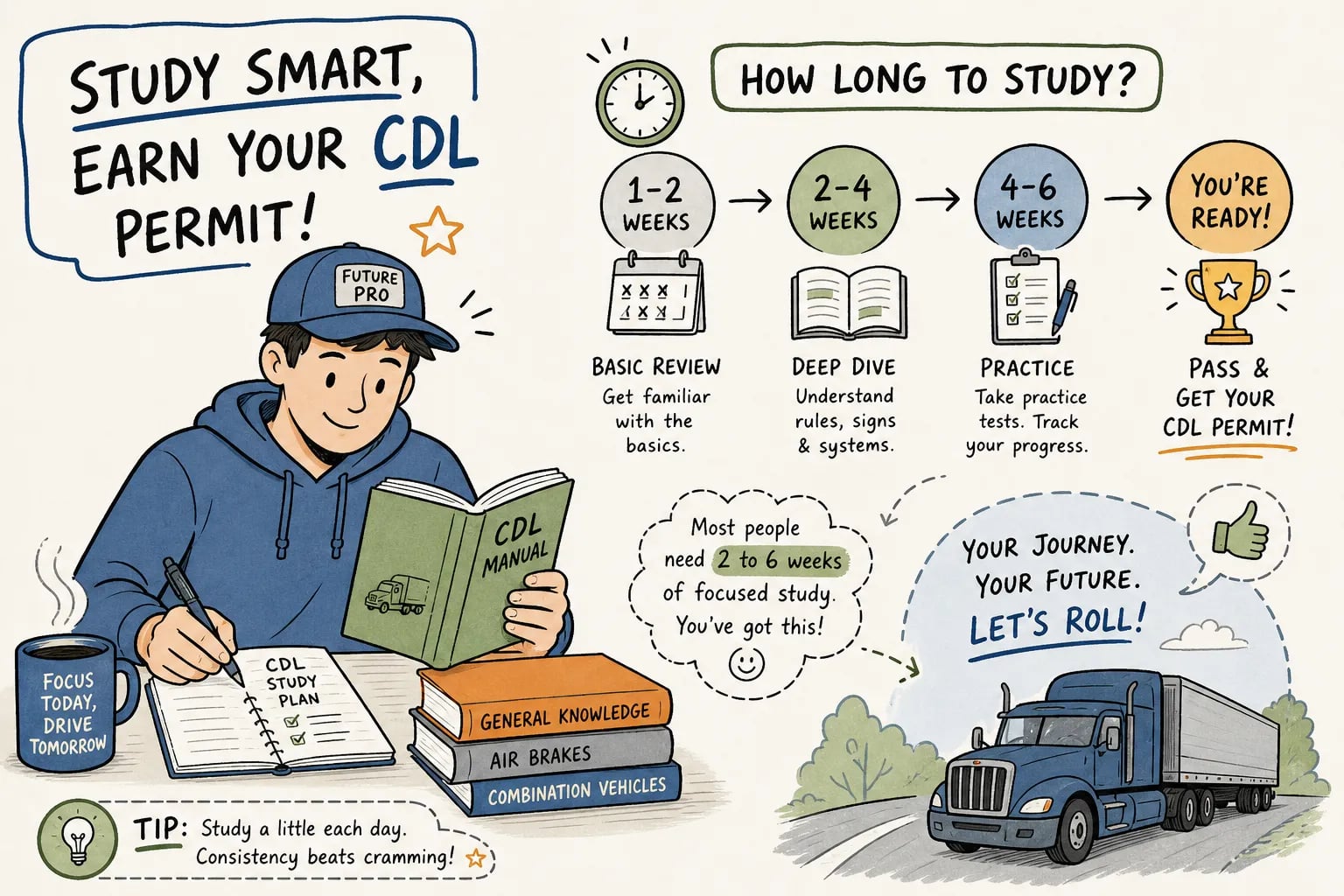
If you're asking how long should I study for my CDL permit, the honest answer depends on three specific variables: which CDL class and endorsements you're pursuing, how much relevant driving experience you already have, and how many hours per day you can realistically commit to studying. Most candidates get the same advice from everyone they ask: "Just study the manual." That's not wrong, but it's nowhere near complete. It tells you what to study but nothing about how long it takes, how to structure your time, or what separates candidates who pass on their first attempt from the ones who walk out of the DMV frustrated and scheduling a retake.
Getting those variables right matters more than most candidates realize. The CDL knowledge test carries an 80% passing threshold, and industry estimates put the first-time pass rate somewhere around 50, 60%, figures that vary by state and module and reflect self-reported industry data rather than a single official national statistic. That means roughly half of all candidates who show up to test are underprepared. The good news is that underpreparing is entirely avoidable. The candidates who pass consistently aren't the ones who spent the most total hours studying; they're the ones who studied strategically, targeted their weak spots, and didn't book the real test until their practice scores gave them a genuine green light.
This guide gives you a concrete, personalized framework. You'll find realistic hour benchmarks, a week-by-week schedule you can adapt to your own availability, a topic sequence that mirrors the actual difficulty curve of the tests, and the readiness signal you need before spending money on a DMV appointment.
How Long Should I Study for My CDL Permit: Total Hours by Candidate Type
Why you can't just "read the manual once and show up"
The CDL knowledge test is not a casual quiz. The General Knowledge section alone covers more than a dozen topic clusters, including vehicle inspection, cargo securement, Hours of Service, adverse conditions, and emergency procedures. Class A candidates don't just sit for one test; they sit for General Knowledge, Air Brakes, and Combination Vehicles separately, each with its own question bank and 80% passing requirement. That's three distinct bodies of knowledge you need to hold in your head at a level that produces consistent, accurate recall under test conditions.
A single read-through of the state CDL manual rarely produces consistent 80%+ practice scores, especially on Air Brakes and Combination Vehicles. California DMV evaluation data found that 80% of original Air Brakes applicants failed on their first attempt, and General Knowledge had a failure rate around 39.5% in the same dataset. Those aren't numbers you overcome by reading through the manual one time and hoping for the best.
The most commonly failed areas within General Knowledge are vehicle inspection and defect recognition, cargo weight and securement rules, and Hours of Service regulatory details. All three deserve extra drilling, not just a single read-through.
The 30, 50 hour benchmark and where it comes from
The industry consensus for CDL permit study time sits at 30, 50 focused hours total. This covers the permit phase only, not behind-the-wheel training or full CDL school hours. "Focused" is the operative word. An hour spent drilling Air Brakes pressure thresholds and reviewing the questions you missed is worth far more than an hour of passive re-reading with your eyes glazing over the same pages.
Candidates who use structured, targeted study methods, specifically drilling weak areas rather than cycling through all material equally, commonly report reaching consistent 85%+ practice scores in 25, 35 hours. Candidates who rely on passive reading or unfocused random question practice often spend 50+ hours and still feel unprepared on test day. The total hours matter less than what happens during those hours.
How your starting point affects your CDL permit study plan
First-timers with no commercial driving background
If you have no professional driving experience, no military vehicle operation background, and no prior exposure to DOT regulations, you're starting from zero on both the content and the vocabulary. Topics like air brake system components, coupling and uncoupling procedures, and Hours of Service rules will feel completely foreign for the first few study sessions. Budget the full 40, 50 hours and plan for a 4, 6 week timeline at a part-time study pace. Air Brakes and Hours of Service deserve extra attention; these are two of the most commonly failed areas and the ones where first-timers have the least intuitive foundation.
Candidates with relevant experience who can move faster
If you've spent years driving straight-truck deliveries, operated military vehicles, or worked in warehouse logistics with regular equipment operation, you already have a mental framework for vehicle dynamics, load securement, and basic safety procedures. That background matters. Candidates with this kind of experience often reach consistent 85%+ practice scores in 20, 30 total study hours rather than 40, 50. The important caveat: familiarity with the physical task of driving does not automatically translate to familiarity with how FMCSA frames test questions. The written test asks about specific pressure thresholds, leakage limits, and regulatory definitions. Take the CDL permit practice tests seriously regardless of your experience level.
CDL class and endorsements: what you're actually signing up to study
Class A: the heaviest knowledge test load
Class A requires General Knowledge, Air Brakes (unless you're willing to accept an air-brake restriction on your license, which most candidates aren't), and Combination Vehicles. That's three separate written tests, each with its own question bank. Budget 3, 5 extra study hours per endorsement you add on top of the base Class A material. Candidates pursuing a HazMat or Doubles/Triples endorsement alongside their Class A should expect to add days or even weeks to their overall timeline, the exact amount depends on how many hours per day they can study and how many endorsements they're tackling at once.
Class B and Class C: what changes and what stays the same
Class B candidates still need General Knowledge and usually Air Brakes if they plan to operate air-brake-equipped vehicles. The Combination Vehicles test is not required for Class B. For Class C, the endorsements drive your study time more than the class designation itself. If you're going after a Passenger or School Bus endorsement, those sections carry their own set of rules, emergency procedures, and safety standards that need dedicated study time. Total study hours for Class B and Class C are similar to Class A at the base level; the difference is which specific material fills those hours.
How each endorsement adds to your timeline
HazMat adds the most complexity of any single endorsement. It covers hazard classes, shipping papers, placards, loading and unloading rules, emergency response, and security requirements. Expect to spend 3, 5 hours studying this material before you're ready to sit for its 30-question test. Tank Vehicles, Passenger, School Bus, and Doubles/Triples each add roughly 2, 4 study hours and require passing a 20-question test. If you're adding multiple endorsements at once, factor in additional days or weeks to your total CDL permit study plan depending on how many hours per day you can study.
A week-by-week study schedule built for your availability
The 1, 2 week intensive plan (full-time study, 3, 4 hours per day)
If you're between jobs, on a break from school, or can genuinely commit to full-time prep, this pace is achievable. Spend the first four days on General Knowledge, one topic cluster per session. Move to Air Brakes on days five and six, then Combination Vehicles on days seven and eight for Class A candidates. Use the remaining days for endorsement material and timed practice tests. Before you book a real test date, complete at least two full-length timed simulations and confirm you're hitting 85%+ on both. This schedule works best for candidates who have no competing daily commitments and can maintain focus for extended study sessions.
The 4, 6 week part-time plan (evenings and weekends, 45, 90 minutes per day)
This is the most common scenario for working adults, and it's the schedule that aligns with what most reputable CDL prep programs recommend. Allocate the first two weeks to General Knowledge, covering one topic cluster per study session. Dedicate week three to Air Brakes and week four to Combination Vehicles or endorsement material. In weeks five and six, shift entirely to full practice tests and missed-question review. This approach distributes the cognitive load evenly, gives you time to let new information settle between sessions, and still gets you to test-ready in a reasonable timeframe without burning out.
The 8-week approach for candidates with minimal daily availability
If you can only find 20, 30 minutes on weekdays with longer sessions on weekends, an 8-week CDL permit study plan is realistic and far better than rushing. Assign one major topic per week, review missed questions at the start of every session before moving to new material, and take a full timed practice test at the end of each study week to gauge your progress. The key is consistency over intensity. Eight weeks of daily review, even in short sessions, builds better retention than an intense two-week sprint followed by two weeks of forgetting. Never schedule the actual test until you're scoring 85% or higher consistently, a widely recommended readiness buffer that accounts for the variability of real exam question banks.
What to study and in what order
Start with General Knowledge: the foundation everything else builds on
General Knowledge covers CDL classes and driver responsibilities, vehicle inspection basics, cargo securement, safe driving in adverse conditions, Hours of Service, and accident procedures. This section appears on every CDL permit test regardless of class. Starting here gives you the vocabulary and mental framework that makes Air Brakes and Combination Vehicles significantly easier to absorb when you get to them. Plan on 15, 20 hours for General Knowledge if you're a first-time candidate with no commercial driving background.
How to layer in Air Brakes, Combination Vehicles, and endorsements
After General Knowledge, move into Air Brakes. Budget 3, 4 hours here, and treat this section as requiring active drilling rather than passive reading. The specific pressure thresholds (governor cut-in and cut-out, low-air warning activation, spring-brake engagement) and the leakage rate limits for single versus combination vehicles are highly testable and are exactly the kind of details candidates forget when they only read once without practice testing. Combination Vehicles comes next for Class A candidates, another 3, 4 hours focused on coupling and uncoupling procedures, off-tracking behavior, and rollover risk. Endorsements come last, because they build directly on the General Knowledge foundation. Studying in this sequence prevents cognitive overload and mirrors the actual difficulty curve of the tests.
How smart study tools compress your effective prep time
Why reviewing material you already know wastes your time
The most common mistake CDL candidates make is re-reading the full manual or repeating all practice questions from the beginning every single session. That approach spends equal time on topics you've already mastered and topics where you're still making errors. Every effective study methodology points to the same conclusion: targeted review of weak domains is the strongest predictor of passing, not raw hours in front of a study guide. If you're consistently answering vehicle inspection questions correctly but still struggling with Air Brakes pressure thresholds, spending another hour on inspection questions does almost nothing for your readiness score.
How CDLTest360's missed-question isolation keeps every session efficient
CDLTest360's missed-question review system isolates only the questions you answered incorrectly, then re-drills those specific questions in your next session. Instead of cycling through all the questions to find the ones you're still missing, the platform surfaces those immediately so every minute of your session is spent on material you actually need. This feature directly addresses the biggest time-waster in CDL prep and is what sets a structured, targeted CDL permit practice test workflow apart from generic flashcard tools or random question banks.
The timed exam simulation mode is built to reflect the General Knowledge test format, including the 50-question count and 80% passing threshold used in that module across most states, with separate simulations for endorsement tests that match those modules' question counts and formats. Taking these simulations on a regular cadence gives you a reliable readiness gauge before you spend money on a DMV appointment. If you're hitting 85, 90% consistently in simulation, you have a genuine buffer for the variability of real test questions. If you're hovering around 80%, you need more targeted work before you book that appointment.
Building practice test cadence into your weekly schedule
Plan for at least one full timed CDL permit practice test per week during the middle and final phases of your study plan. Use the score as a decision point, not just a performance snapshot. If you're below 80% in the final two weeks of your plan, do not schedule the real test yet. Extend your timeline by one week, run the missed-question drill, and retest before booking. If you're consistently hitting 85, 90%, you're ready. The 5, 10% buffer above the official passing score exists because the actual test will surface questions phrased differently or drawn from parts of the question bank you haven't seen yet, and that buffer accounts for that variability.
State-specific factors that can shift your timeline
Permit validity windows and what a short window means for your plan
Most states issue CDL learner's permits (CLPs) for 180 days, while others issue them for up to one year. Federal regulations cap CLP validity at one year total, including any renewals, and some states, including Colorado, Missouri, and Wyoming, issue nonrenewable CLPs. A 180-day permit means you have roughly six months to complete ELDT, hold the permit for the mandatory 14-day minimum period required under 49 CFR § 383.25(e), schedule your skills test, and pass. Build your study plan backward from those deadlines, not forward from when you feel like starting. Running out of permit time before you complete the skills test means retaking the knowledge tests from the beginning.
Retake rules, waiting periods, and DMV scheduling delays
State retake policies vary considerably. Some states impose a waiting period between failed attempts; others limit the number of daily attempts or require a fee for each retake. DMV appointment availability in high-demand states, particularly Texas, California, and Florida, can add one to two weeks to your timeline even after you're fully prepared to test. Factor in the 14-day federal CLP holding period when mapping out your full permit-to-license timeline. Candidates in states with known scheduling backlogs should build in an extra buffer and consider booking their DMV appointment in advance so the slot is waiting when their practice scores confirm they're ready.
How to know you're ready to book the real test
The 85% benchmark: why the passing threshold isn't your target
The official passing score is 80% on most CDL knowledge tests, but treating 80% as your personal readiness benchmark is a risky approach. On a 50-question test, a 5% margin is just two or three questions. Real exam questions come from a larger pool than any single practice test you've taken, and some will be phrased differently or emphasize angles you haven't specifically drilled. Candidates who consistently score 85, 90% on full-length timed simulations have built enough of a buffer to absorb unfamiliar phrasing or unexpected question angles on the actual test. Don't book the appointment until you hit that benchmark on at least three consecutive practice sessions.
Signals that mean you need more time before scheduling
Specific warning signs tell you more prep is needed before you book your DMV appointment. If you score under 80% on any timed simulation in the final week of your study plan, that's a clear signal to extend. If you're still struggling with Air Brakes system components or HazMat placard rules after two dedicated review sessions on those topics, don't schedule yet. And if you've been skipping timed practice tests and relying only on re-reading the manual, you genuinely don't know your readiness level, so don't spend money on a test appointment to find out.
A few extra days of focused, targeted prep is far cheaper than a retake fee, another DMV appointment, and the time cost of waiting for that slot to open. If any of those warning signs apply, extend your plan by one week, use the missed-question drill to isolate your remaining weak spots, and retest before booking. You'll pass faster by taking that extra week than by showing up underprepared and starting the retake process.
Putting it all together
So how long should you study for your CDL permit? Here's the core framework in plain terms. Total CDL permit study time ranges from 25, 50 hours depending on your CDL class, the endorsements you're adding, and your prior driving experience. Most working adults finish the knowledge test preparation phase in 4, 6 weeks at a part-time pace of 45, 90 minutes per day. The study order matters: General Knowledge first to build your foundational vocabulary, then Air Brakes, then Combination Vehicles for Class A candidates, then endorsements. Aim for 15, 20 hours on General Knowledge and 3, 4 hours each on Air Brakes and Combination Vehicles. Give endorsements 2, 5 hours each depending on complexity, with HazMat at the top of that range.
The readiness signal is consistent 85%+ scores on full-length timed practice simulations over at least three consecutive sessions. That's when you book the real test, not before. How you study, not just how long, is what separates first-time passers from repeat test-takers. Targeted review of weak areas, active drilling with practice tests, and honest use of your scores as decision points are the methods that actually move the needle.
CDLTest360 is built specifically around that kind of efficient, targeted prep. The missed-question isolation system, timed exam simulations, topic-specific quiz modules, and state-specific CDL manuals are all designed to make every study session count rather than just add hours to your total. You don't even need to create an account to start practicing today. Start with a diagnostic practice test, find out where your weak spots are, and build from there. Answering "how long should I study for my CDL permit" comes down to your class, your experience, and how strategically you use your study time, follow this plan, hit 85%+ consistently on your practice tests, and you'll be ready to book the real thing with confidence.
{ "@type": "Article", "datePublished": "2026-10-09T11:02:10.572Z", "dateModified": "2026-10-09T11:02:10.572Z", "headline": "How Long to Study for Your CDL Permit: A Practical Guide", "description": "Wondering how long to study for your CDL permit? Get honest timelines by CDL class, a week-by-week plan, and tools to pass on your first attempt.", "publisher": { "@type": "Organization", "name": "CDLTest360" }, "image": [ ] }


