Preparing for the CDL timed exam? Picture this: you've spent three weeks reading the CDL manual cover to cover. You know air brake definitions cold. You've gone through hundreds of practice questions and scored 90% every time. Then you sit down at the testing center, the timer starts, and something shifts. Your reading slows down. A question about hazmat placards that took you four seconds at home suddenly takes 45 seconds. By question 38, you're behind. You rush the last 12 questions, miss five of them, and fall two points short of passing. The material wasn't the problem. The clock was.
That scenario is more common than most candidates expect, because untimed flashcard review and CDL timed exam performance are two completely different skills. One trains recognition; the other trains fast, accurate retrieval under pressure. This article breaks down what the official CDL knowledge test actually looks like in terms of format and timing, why timed simulation practice is the single biggest performance lever most candidates never use, and how to follow a structured two-week plan that builds real exam-day confidence. The plan here is built around CDLTest360's timed simulation mode, which mirrors the 50-question, 80%-threshold format many states administer. That specific structure isn't accidental, and by the end of this article, you'll understand exactly why it matters.
What the CDL timed exam actually looks like
Most candidates walking into their CDL knowledge test for the first time have only a vague idea of how many questions they'll face or how much time they'll have. That uncertainty alone costs them composure before question one. Getting a concrete picture of the format ahead of time removes a major stressor from test day.
Question counts and time windows across test types
Common CDL knowledge test formats follow patterns established by FMCSA guidance, though individual states set their own rules and time limits, so check your state DMV before test day. Many states use 50 questions for General Knowledge, 25 for Air Brakes, 20 for Combination Vehicles, 30 for Hazmat, and 20 each for Tank and Doubles/Triples, but question counts and passing thresholds can vary. State-level time limits are especially inconsistent. Washington D.C. sets a 90-minute cap for General Knowledge and 60 minutes for endorsement tests. Wisconsin advises candidates to plan for at least one to one and a half hours. Many states don't publish an explicit per-minute clock at all, which means you can't rely on the testing center to tell you when you're falling behind. You have to know your own pace before you walk in.
On a 50-question test with 90 minutes available, the math works out to roughly 1.8 minutes per question. With 60 minutes, that drops to 72 seconds per question. Both windows feel generous until you're sitting in front of a screen with 15 questions left and 12 minutes on the clock. Knowing your target pace per question before test day isn't optional. It's the foundation of every time management strategy that actually works.
The 80% pass threshold and what it actually demands
In states that use a 50-question General Knowledge test with an 80% passing threshold, you can miss no more than 10 questions. On a 25-question Air Brakes test at the same threshold, you can miss five. That ceiling is tighter than most candidates realize, because every question you rush through carelessly is a point against that limit. Time pressure doesn't just slow you down; it produces a specific category of errors where you know the answer but retrieve the wrong one because you're moving too fast to read the question fully.
Reframing time management as a direct pass/fail factor rather than a test-taking trick changes how seriously candidates treat it. You're not pacing yourself to feel comfortable. You're pacing yourself because careless errors under pressure are the difference between passing and scheduling a retake.
Why untimed practice creates a false sense of readiness
The confidence that comes from scoring 90% on untimed practice questions is real, but it's measuring the wrong thing. Untimed practice tells you whether you recognize correct answers when given unlimited time to think. The CDL knowledge test doesn't give you unlimited time. Those are genuinely different performance environments, and treating them as equivalent is one of the most common preparation mistakes CDL candidates make.
What changes the moment a timer appears
When a countdown is visible, working memory narrows. Reading speed drops under mild stress. Decision-making on harder questions slows because the brain is now managing both the content problem and the time anxiety simultaneously. A candidate who scores 90% on an untimed practice quiz may score closer to 72% on a timed simulation, not because they forgot the material, but because they couldn't retrieve it fast enough or second-guessed themselves into wrong answers. Think of that gap as an illustration of what time pressure does, not a precise prediction: your numbers will vary, but the direction is consistent. That gap isn't a knowledge gap; it's a performance gap.
This isn't a personal weakness. It's a predictable cognitive response to time pressure. The only way to reduce that gap is to train under the same conditions that produce it, which means running full CDL timed exam simulations regularly before test day, not just doing more flashcards.
The gap between knowing the material and performing under pressure
Knowing something and recalling it accurately on demand under stress are two separate skills. Untimed practice only trains the first one. The parallel to driving makes this concrete: you can understand how to back a trailer in your driveway all day, but that understanding doesn't prepare you for executing the same maneuver under road test conditions. The CDL timed exam environment is its own distinct skill, and it has to be practiced deliberately and separately from content review.
Retrieval practice works this way: attempting to recall information under exam-like conditions, including mild time pressure, strengthens that recall more than passive re-reading does. The retrieval attempt itself is the training mechanism. Adding a clock makes it more exam-accurate.
How simulated pressure trains your brain to recall faster
Every time your brain retrieves an answer under pressure, it reinforces that retrieval pathway. Future retrievals of the same information become faster and more automatic. Casual review doesn't produce that effect at the same intensity because the stakes and pressure aren't present to make the retrieval genuinely difficult.
The retrieval practice effect under timed conditions
Active retrieval outperforms re-study for long-term retention, and that benefit holds even under mild time pressure, as long as learners have enough time to attempt recall rather than simply guess. What this means practically for CDL prep is that running a timed mock exam is more valuable per hour than re-reading the air brakes chapter, even if the mock exam score feels discouraging at first. The struggle to recall under time pressure is the training. The difficulty is the point.
Timed mock CDL exams force the kind of high-stakes active retrieval that mirrors the real test in a way nothing else does. The more often you practice recalling combination vehicle coupling procedures or hazmat placard distance rules against a clock, the more automatic that recall becomes when it actually counts. Drilling CDL permit practice questions under a timer compounds that effect across every topic category.
Why repeated simulation builds pacing intuition
After several full timed CDL practice tests, most candidates stop checking the clock obsessively and start developing a natural rhythm. They know when they're ahead, when they're falling behind, and when to move on from a hard question without losing composure. That pacing intuition can't be read into existence. It has to be earned through repetition in timed conditions, and it's one of the clearest performance advantages separating candidates who pass on their first attempt from those who retake.
CDLTest360's timed simulation mode: built to mirror the real exam
Once you accept that timed simulation is the training mechanism, the next question is where to do it. The platform matters because not all CDL practice tests are built to replicate exam conditions. Some offer hints mid-question. Some provide explanations after each answer. Those features are useful for learning, but they actively undermine timed simulation because they interrupt the retrieval process and reduce the pressure that makes the training effective.
The 50-question, 80% threshold format explained
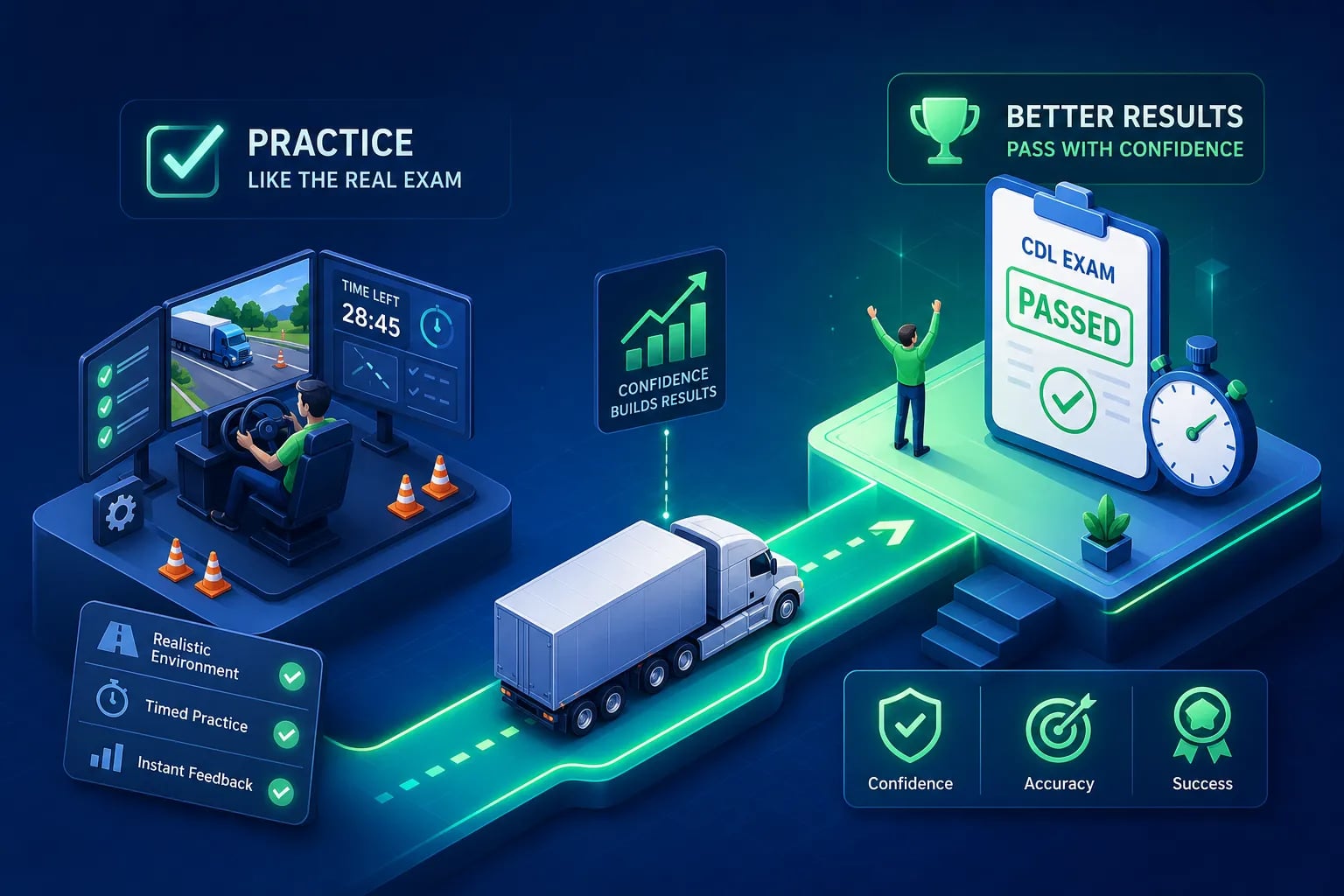
CDLTest360's timed simulation mode runs 50 questions with an 80% passing threshold, no hints, no mid-test explanations, and a score only at the end. That structure mirrors the format used by many states, not because it's the easiest way to build a practice test, but because replicating real exam pressure is the entire purpose. A timed simulation that gives you feedback after each question isn't a simulation; it's a tutoring session. Both have value, but they serve different stages of preparation, and candidates who only use the tutored mode are skipping the most important practice phase entirely.
The 50-question format also means CDLTest360 simulations take meaningful clock time to complete. Running a full simulation forces you to sustain focus for a duration comparable to the real CDL timed exam, a stamina component of test preparation that often gets ignored entirely. Whether your state's actual time limit is 60 minutes or 90, the practice of holding concentration through 50 questions straight transfers directly.
The missed-question review loop as a targeted follow-up tool
After each timed simulation on CDLTest360, the platform isolates every question the student answered incorrectly and drills those specifically in a follow-up loop. This transforms the simulation from a simple score into a diagnostic. Test-takers can see exactly where their timing-related errors cluster, and those errors tend to concentrate on specific question types: complex combination vehicle coupling questions that require longer processing, or air brake definitions that require precise wording. Drilling those specific questions under pressure again is among the most efficient ways to close a performance gap.
That missed-question loop is what makes CDLTest360's simulation mode function as a remediation tool, not just a test generator. Generic CDL practice tests tell you your score. CDLTest360 tells you your score and then targets the gaps that caused it, a meaningful difference for candidates serious about passing on their first attempt.
Time management strategies that actually hold up during the test
Knowing you need to pace yourself and actually executing a pacing strategy under pressure are different things. The techniques below aren't general test-taking advice; they're specific approaches calibrated for the CDL knowledge test format and the question types that consume the most time.
The two-pass method: first sweep, flag, second sweep
On the first pass through the exam, answer every question you're confident about immediately and flag any question that requires more than 10 to 15 seconds of initial processing. Don't linger. Don't debate. If the answer isn't coming quickly, mark the question and keep moving. On the second pass, return to flagged questions with whatever time remains. This prevents any single difficult question from burning minutes that belong to questions you'd answer correctly with a clear head.
The two-pass method only works in practice if you've rehearsed it during timed simulations. The first time you try it under real pressure, flagging a question feels like giving up on it. That discomfort fades after a few timed mock exams, replaced by disciplined pacing.
Setting pace checkpoints before question one
Before you start answering questions, do a quick checkpoint calculation. On a 50-question test with 90 minutes, set a target: by question 25, at least 45 minutes should remain. If you hit question 25 with 35 minutes left, you're behind and need to move faster on straightforward questions. If you hit question 25 with 55 minutes left, you have buffer for harder items ahead. That checkpoint only gives you useful information if you've run timed simulations beforehand. Without a baseline, you have no sense of what your natural pace actually is.
Reading carefully for NOT and EXCEPT wording
One of the most reliable ways timing pressure causes wrong answers is rushing past negation words. "Which of the following is NOT required when transporting hazmat?" reads like a standard question until you miss the NOT under stress and answer with what IS required. Slow down for two seconds on every question containing NOT, EXCEPT, or NEVER. These questions are specifically designed to test careful reading, and they produce the most careless errors when pacing feels tight. Building a deliberate habit of pausing on negation questions during timed simulations carries that habit directly into the real CDL timed exam.
Timing mistakes that sink CDL test-takers before they finish
These failure patterns aren't unique to CDL candidates. They're predictable human responses to pressure that show up on timed tests across every domain. Recognizing them in advance is the first step to avoiding them.
Cramming the night before versus building pacing over weeks
Cramming increases anxiety without building the pacing intuition that only develops over repeated timed simulations. Candidates who study intensively for two days before their CDL knowledge test often know the material, but their brains have never practiced fast retrieval under pressure, so they can't execute efficiently when the clock is real. Contrast that with candidates who run timed mock exams over two weeks. They've already experienced bad pacing in low-stakes conditions and learned how to recover. Test day becomes another simulation with higher stakes, not the first time they've ever raced a clock.
Spending too long on a single hard question
Emotionally investing in a question you're struggling with is one of the most common and costly pacing errors on timed exams. Three minutes spent on one complex hazmat placard question is three minutes stolen from five straightforward questions you'd answer correctly with a clear head. The fix is simple in principle and hard in practice: if a question isn't resolved within 30 to 40 seconds, flag it and move on immediately. Committing to that rule during timed simulations makes it automatic. Without that practice, the pull of the unresolved question wins almost every time.
A 2-week timed practice plan to build exam-day confidence
This plan is designed around the reality that most CDL candidates are studying around work shifts, family obligations, or both. It's not built for someone with eight hours a day to study. It's built for someone with 45 to 90 minutes most evenings and a test date two weeks out.
Week one: baseline timed sessions and identifying gaps
Week 1 is entirely diagnostic. Run three or four full timed CDL practice test simulations without studying beforehand. Take the score, note which question categories produced the most wrong answers, and run the missed-question loop after each session. By the end of Week 1, you should have a clear map of your weak spots and a baseline pacing benchmark: how many questions you're completing per minute on average, and where you tend to slow down or freeze. Don't study topic chapters during Week 1. The point is to measure where you actually are, not where you'd be after reviewing the material.
Most candidates are surprised by their Week 1 scores. If you've done untimed practice before starting, you might expect 85% and get 68%. That gap is exactly what this plan fixes, and seeing it clearly in Week 1 makes the Week 2 work feel urgent and purposeful rather than optional.
Week two: full simulation runs and performance tightening
Week 2 shifts from diagnosis to deliberate improvement. Run a full timed simulation every other day, with focused review of your Week 1 weak categories on the alternating days. After each simulation, use the missed-question drill to reinforce those areas specifically.
By the final two sessions of the week, run back-to-back simulations with no review in between. That replicates the sustained focus the real CDL timed exam demands and builds the mental stamina to stay sharp through question 50 when you're already tired. Track pass/fail on every session and aim for multiple consecutive passing simulations before test day. Consistent passing runs mean your pacing and recall are both working under pressure, not just on good days.
Pre-test checklist: what to do the night before and morning of
All the preparation in the world can be undermined by poor execution in the final 24 hours. This checklist is short because it should be. The work is already done. The night before and the morning of test day are about protecting that work, not adding to it.
The night before: sleep, logistics, and a final light review
No full simulations the night before. A short review of the question categories that were still shaky in Week 2 is fine, but a full timed simulation at 10 PM raises anxiety without adding knowledge. Sleep deprivation slows processing speed, the one thing you cannot afford on a timed test. Aim for at least seven hours; general sleep health guidance consistently points to seven or more hours as the threshold for maintaining cognitive performance. Before you sleep, lay out your ID and any required documentation, confirm your testing center address, and know exactly where you'll park. Solving logistics the morning of the test burns mental energy your brain needs for recall.
Test-day morning: arrival, mindset, and first-question strategy
Arrive 15 to 20 minutes early. Rushing to your CDL knowledge test raises cortisol, which directly impairs the recall speed you've spent two weeks building. Before sitting down, remind yourself of your checkpoint target and your two-pass rule. These aren't new ideas at this point; they're habits you've practiced during simulation. On the first question, read it completely and deliberately. Setting a calm, controlled pace at the start is significantly easier than trying to recover composure after a frantic opening five questions. Your job in the first five questions isn't to race; it's to establish the rhythm you've already practiced.
The CDL timed exam is a performance skill, not just a content test
Every hour you spent reading the CDL manual matters. Every topic-specific quiz you completed built real knowledge. But none of that preparation fully translates to the testing center until you've practiced performing under the same conditions the real exam creates. Candidates who study the material but never train against a clock are preparing for a test that doesn't exist.
CDLTest360's timed simulation mode is built to close that gap: 50 questions, 80% threshold, no hints, missed-question review after each session. It's designed to replicate the CDL timed exam experience as closely as possible outside of an official testing center, and every session you run builds the pacing intuition, retrieval speed, and composure that make the real exam feel familiar rather than foreign.
Don't wait until you feel ready to start timed practice. The simulation is how you get ready. Run your first timed session on CDLTest360, see your actual baseline score, and let the two-week plan do the rest. The candidates who pass on their first attempt aren't the ones who studied longest. They're the ones who practiced under the right conditions.
Frequently asked questions about the CDL timed exam
How long do I have to complete the CDL knowledge test?
Time limits vary by state. Some states set explicit caps, Washington D.C., for example, allows 90 minutes for General Knowledge and 60 minutes for endorsement tests. Other states don't publish a formal time limit at all. Check your state's DMV website before test day so you know exactly what to expect and can set realistic pace checkpoints.
How many questions are on the CDL General Knowledge test?
Many states use a 50-question format for the General Knowledge test, though question counts can differ by state. Endorsement tests like Air Brakes and Hazmat typically run shorter, often 25 and 30 questions, respectively. Confirm your state's specific format through your DMV or a current CDL practice app before you begin your preparation plan.
What is the passing score for the CDL knowledge test?
The most commonly required passing score is 80%, which means no more than 10 wrong answers on a 50-question test. Some states may set a different threshold, so verify the requirement with your state DMV.
Is timed CDL exam practice really more effective than untimed review?
Yes, for exam performance specifically. Untimed practice builds recognition, which is valuable early in your prep. Timed CDL exam simulation builds fast, accurate retrieval under pressure, which is what the actual test demands. Running full timed mock exams during the weeks before your test is the most direct way to close the gap between your untimed scores and your real-test performance.
How many timed practice tests should I run before my CDL exam?
There's no universal number, but the two-week plan in this article targets seven to ten full simulations spread across two weeks. The practical benchmark to aim for is several consecutive passing scores heading into test day, that pattern suggests your pacing and recall are both working under pressure, not just occasionally.
Does CDLTest360 offer a CDL skills test time limit or only knowledge test prep?
CDLTest360 focuses on CDL knowledge test preparation, including timed simulation mode for General Knowledge and endorsement tests. For CDL skills test time limits and behind-the-wheel requirements, consult your state's DMV or a licensed CDL training program.
{ "@type": "Article", "datePublished": "2026-09-27T11:02:05.092Z", "dateModified": "2026-09-27T11:02:05.092Z", "headline": "CDL timed exam: why simulation practice changes your results", "description": "CDL timed exam prep goes beyond reading the manual. Learn question pacing, time management strategies, and use a 2-week simulation plan to pass with confidence.", "publisher": { "@type": "Organization", "name": "CDLTest360" }, "image": [ ] }