CDL test prep starts with targeted practice, not just reading the manual. Most CDL candidates walk into the DMV after reading the manual and walk out without a passing score. That's not a knock on their intelligence. It's a sign they prepared for the wrong test. The CDL written exam isn't a general driving quiz. It's a federal knowledge test built from FMCSA regulations, and it demands specific numbers, exact procedures, and regulatory reasoning that driving experience alone can't give you.
The national first-time pass rate for the CDL knowledge exam sits at roughly 50 to 60 percent. That means nearly half of all candidates fail on their first attempt. Candidates who use structured CDL test prep with consistent practice testing, on the other hand, push that number to 85 to 95 percent. The difference isn't talent. It's method. This article gives you the exam structure, a study schedule that fits your life, the topics that trip up even experienced drivers, and the tools that make your prep time actually count.
What the CDL Written Exam Actually Covers in 2026
The Three Main Knowledge Sections Every Candidate Faces
The CDL written exam is not one test. It's a collection of independently scored sections, and you must pass each one at 80 percent or higher. General Knowledge is 50 questions, which means you need 40 correct answers to pass. Air Brakes runs 25 questions, requiring 20 correct. Combination Vehicles is 20 questions, and missing more than four fails that section outright. Each section tests different material, and a strong score on General Knowledge does not rescue you from a weak Air Brakes result.
Why the 80% Threshold Matters More Than It Sounds
Eighty percent sounds forgiving until you understand what the questions actually test. These aren't general awareness questions. They pull from a large randomized FMCSA database and ask for exact PSI thresholds, specific stopping distances, regulatory coupling sequences, and precise procedural steps. A candidate who "mostly understands" air brakes will hover around 70 to 75 percent and fail. Precision is what the test measures, and precision is what your CDL test prep needs to build.
Why Reading the Manual Cover to Cover Doesn't Cut It
The Passive Study Trap Most Candidates Fall Into
Reading the official state CDL manual is the right starting point, but passive reading creates an illusion of learning. You finish a chapter feeling solid, then blank on a CDL practice question five minutes later. That happens because your brain processed the information without being forced to retrieve it. Retrieval is where memory actually sticks, and passive reading skips that step entirely. Most candidates who fail their first attempt spent their prep time reading and re-reading rather than testing themselves.
What Active Practice Testing Actually Does to Your Score
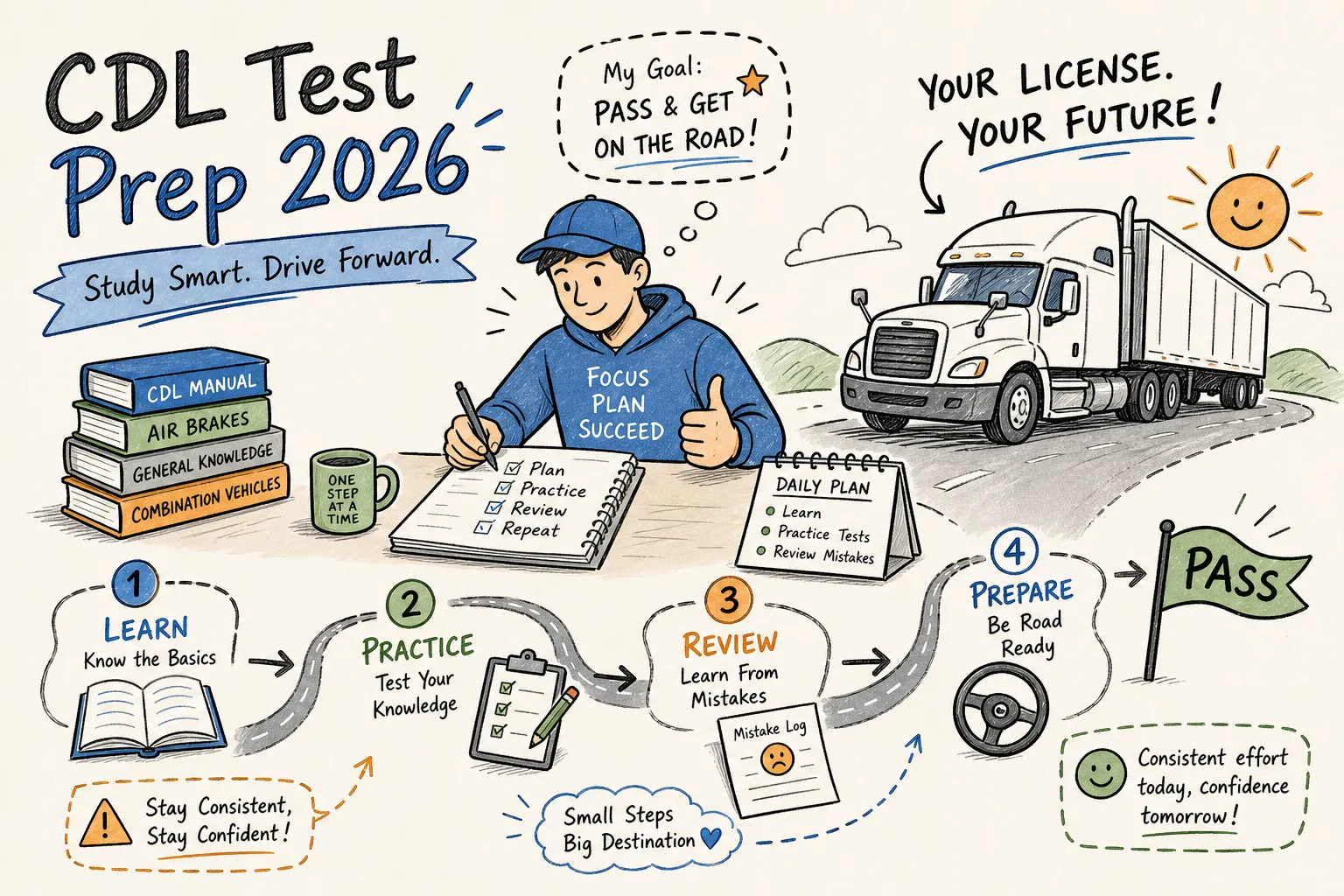
Taking a practice quiz immediately after studying a section forces your brain to retrieve what it just processed. That retrieval attempt, whether you get the answer right or wrong, builds retention in a way that rereading never does. Every serious study on how memory works points to the same conclusion: testing beats rereading. For CDL written test prep specifically, this means working through a read-quiz-review loop for each section rather than finishing the entire manual before touching a single CDL practice question with answers to check your work.
How to Structure Your CDL Test Prep Timeline
The 2-Week Intensive Plan for Candidates with Limited Time
If you can commit two to three hours daily, a focused 10 to 14 day schedule is achievable. Spend the first two days skimming the full manual and taking a diagnostic test to see where you stand. Dedicate days three through six to General Knowledge and Air Brakes separately, taking quizzes after each section and reviewing every missed question before moving on. Use days seven through nine for Combination Vehicles and any CDL endorsement practice you need. Day ten should be a full-length timed simulation, and you shouldn't schedule the real exam until you're consistently hitting 90 percent or above.
The 4-Week Standard Plan for Working Adults
One to two hours daily over four weeks is the most realistic schedule for candidates managing a job or family. Week one focuses on General Knowledge. Week two covers Air Brakes and Combination Vehicles. Week three is for CDL endorsement practice: Hazmat, Tanker, or Passenger depending on your license class. Week four is integration: full-length timed exams, targeted missed-question review, and holding consistent scores at 85 percent or above before booking your DMV appointment. Most first-time passers follow a schedule close to this structure.
The 8-Week Approach for Candidates Who Need to Avoid Burnout
Forty-five to sixty minutes daily over eight weeks works well for candidates managing test anxiety or coming back after a failed attempt. Spread General Knowledge across the first two weeks, work through Air Brakes in weeks three and four, and tackle Combination Vehicles in weeks five and six. Use week seven for CDL endorsement practice and week eight for full timed simulations only. The benchmark here is three consecutive practice scores above 85 percent before you schedule the real test. Entering the DMV with that track record turns test day into a confirmation rather than a gamble.
CDL Test Prep: The Topics That Catch Even Well-Prepared Candidates Off Guard
Air Brakes, Combination Vehicles, and the Numbers That Matter
Air Brakes and Combination Vehicles account for more CDL failures than any other sections. The reason is specific: these sections don't just test whether you understand the systems. They test whether you know exact values. The low-air warning must activate before pressure drops below 60 PSI. Spring brakes engage automatically between 20 and 45 PSI. The applied brake leak rate cannot exceed 3 PSI per minute for a single vehicle or 4 PSI per minute for a combination vehicle. Candidates who understand the concept but haven't drilled the numbers consistently fail these sections even when they feel prepared.
Hazmat layers similar complexity on top. The CDL permit practice questions for Hazmat don't just ask what hazardous materials are. They ask about placard requirements, specific regulatory steps, and loading restrictions that require precise recall. General awareness won't get you to 80 percent on Hazmat. You need to know the rules at the level the FMCSA wrote them. A bridge between these high-stakes sections and the scenario questions below: the same precision that trips candidates up on PSI values is exactly what scenario questions are designed to expose.
Scenario-Based Questions and Why Driving Experience Backfires
The CDL exam uses scenario questions designed to catch candidates who rely on instinct. A question describes a specific situation and asks what the federal regulation requires, not what feels natural. Experienced drivers miss these regularly because they answer based on what they would actually do behind the wheel instead of what FMCSA says to do. Stopping distances, pre-trip inspection sequences, and coupling procedures all fall into this category. The only reliable way to close that gap is to drill scenario questions through structured CDL test prep until the regulatory answer becomes the automatic one.
How CDLTest360 Turns Scattered Study Sessions into a Real Plan
Free Access and the No-Account-Required Practice Start
CDLTest360 is built specifically around the study method outlined above. You can start practicing immediately without creating an account, which removes the friction that stops most candidates from beginning. The platform covers every major CDL section, including General Knowledge, Air Brakes, Combination Vehicles, Hazmat, and ELDT theory, all sourced from FMCSA regulations and state-specific CDL manuals. Each topic includes both a practice mode and a timed exam simulation with 50 questions and an 80 percent passing threshold that mirrors the actual DMV CDL practice quiz format.
The Missed-Question Drill Feature That Changes How You Review
The most useful feature for candidates who have already done some studying is the missed-question review loop. Instead of retaking a full 50-question exam every session, CDLTest360 isolates only the questions you answered incorrectly and re-drills those specifically. If you're consistently missing Air Brakes PSI questions, the platform surfaces those CDL practice questions with answers again and again until you stop getting them wrong. That's the difference between efficient study and wasted time.
The PTI phrase trainer adds another layer by drilling the exact inspection wording candidates must recall during the pre-trip inspection portion, a component most other prep tools completely skip. A 90-day pass runs $39.99, or you can go month-to-month at $19.99 with no long-term commitment.
State-Specific Differences That Can Cost You on Test Day
Why Generic Practice Tests Leave Gaps in Your Preparation
Generic CDL practice tests cover universal FMCSA content well, but they miss state-specific rules that appear on your actual DMV exam. Passing score thresholds vary significantly: Maryland requires 88 percent, California and Pennsylvania require 83 percent, while New York and Texas set the bar at 70 percent. If you're testing in Maryland and practicing against a generic 70 percent standard, you're training for the wrong target. Question counts vary too, ranging from 18 questions in Pennsylvania to 50 in Florida and Nevada, which changes your pacing strategy entirely.
How to Use State-Specific Resources to Close the Gap
The solution is straightforward: always prepare with materials tied to your state's official CDL manual. CDLTest360 includes state-specific CDL manuals inside the app for all 50 states, so you can read your state's actual handbook alongside the DMV CDL practice quiz content. This combination ensures the content you're drilling matches what the DMV in your state will actually ask. It's especially important for states with unique regulations: California's carpool lane rules and Massachusetts' rotary intersection laws won't appear in any generic national practice test, but they'll show up on your exam.
You Already Know More Than You Think. Now Prove It.
Passing the CDL written exam is a skills problem, not an intelligence problem. Candidates who follow a structured read-quiz-review loop and match their schedule to their actual availability consistently outperform those who read the manual and hope. CDLTest360 is built to support exactly that method. The framework is proven, the schedule is flexible, and the platform is ready when you are.
You can start your CDL test prep on CDLTest360 right now with no account required. Pull up the section that concerns you most, run through a quiz, and review every missed question before moving on. Do that consistently across each section and your score will reflect it. Test day isn't a gamble when you've already passed the exam a dozen times in practice.
{ "@type": "Article", "datePublished": "2026-07-18T11:00:49.155Z", "dateModified": "2026-07-18T11:00:49.155Z", "headline": "CDL Test Prep in 2026: A Practical Study Plan That Works", "description": "CDL test prep doesn't have to be overwhelming. Get a proven study plan with timeline options, active practice strategies, and free access via CDLTest360.", "publisher": { "@type": "Organization", "name": "CDLTest360" }, "image": [ ] }