Downloading the FMCSA CDL manual feels like progress. You find a PDF, save it to your phone, and tell yourself you're ready to start studying. But here's the problem: you may have downloaded the wrong version entirely, and even if you got the right one, reading it once won't pass the knowledge exam.
This guide cuts through the confusion. By the time you finish reading, you'll know exactly where to get the authoritative FMCSA CDL manual download and your state's handbook, why those two documents aren't the same thing, what's changed in CDL regulations through 2026, and how to turn that dense handbook into actual test-day performance. Here's what you need to know before you download anything.
What the FMCSA CDL manual actually covers
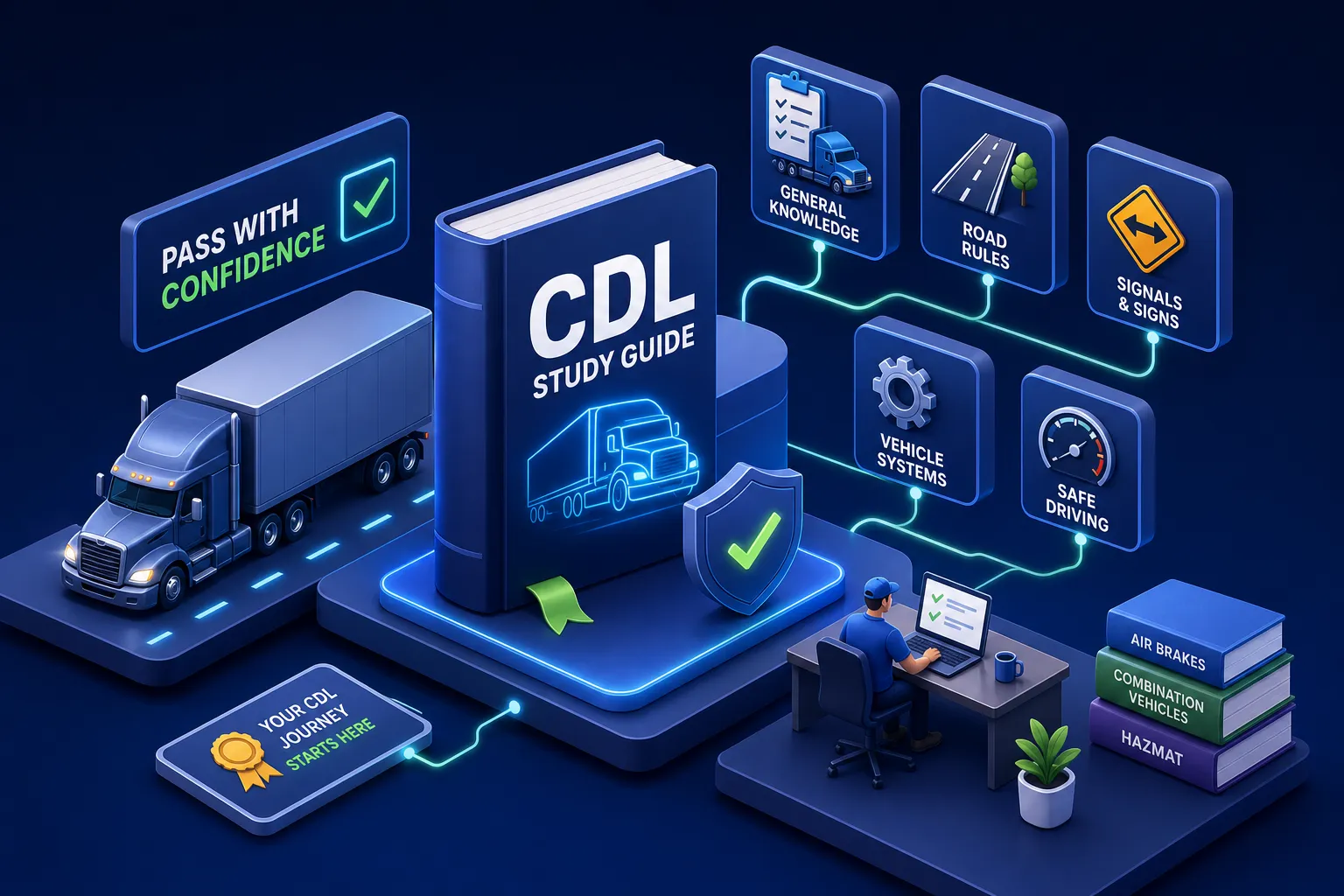
The FMCSA CDL manual is organized around vehicle type, safety category, and endorsement. Sections 1 through 3 form the foundation of the General Knowledge test, which every CDL candidate must pass regardless of class or endorsement. Section 1 covers the CDL system itself: license classes, medical requirements, and disqualifications. Section 2 goes deep on driving safely, vehicle inspection, basic control, shifting, hazard perception, emergency maneuvers, and conditions like winter driving and mountain grades. Section 3 covers transporting cargo safely, from weight and balance to securing loads.
These three sections are your first priority no matter what you're driving. If you're only pursuing a Class B license with no endorsements, Sections 1 through 3 represent the bulk of your written test content. Get these down solid before touching anything else, they're the non-negotiable core of the General Knowledge test.
How endorsement sections map to separate knowledge tests
Sections 4 through 10 each correspond to a specific endorsement knowledge test. Section 4 covers passenger transport, Section 5 covers air brakes, Section 6 covers combination vehicles, Section 7 covers doubles and triples, Section 8 covers tank vehicles, Section 9 covers hazardous materials, and Section 10 covers school bus operation. Study only the sections that apply to your CDL class and the endorsements you're pursuing.
Sections 11 through 13 are skills test prep, covering vehicle inspection procedures, basic vehicle control, and on-road driving evaluation. These sections don't feed a written test, but they're essential for the practical skills portion. Knowing exactly which sections apply to your situation trims your study load and keeps you focused on what actually gets tested.
FMCSA CDL manual vs. your state's CDL handbook
This is the most common mistake CDL candidates make: downloading the federal PDF and treating it as the complete CDL study guide. The federal manual, produced by AAMVA as the Model Commercial Driver Manual and hosted by FMCSA, establishes the uniform minimum standard across all states. But roughly 23 states have added state-specific administrative procedures, local vehicle codes, or modified penalty structures on top of it. States like California and Colorado have restructured or removed certain sections to reflect their own laws.
The federal PDF hosted on FMCSA.gov is dated July 2014 and has not been updated as a standalone document since. Some third-party sites label older files as the "2025" or "2026" handbook, that framing is misleading. For the authoritative federal baseline, go directly to fmcsa.dot.gov, not a repackaged third-party version.
Why your state's handbook is the one that matters for testing
The CDL knowledge exam is written and administered at the state level. Your state DMV draws test questions from its own state CDL manual, not from the generic federal PDF. If your state has modified any section, studying only the federal version leaves real gaps in your preparation.
Use your state's manual as the primary study document and treat the federal manual as a reference for understanding the underlying FMCSA CDL regulations behind the rules. State manuals are updated more frequently than the federal baseline, Wisconsin's manual, for example, carries a revision date of May 2026, per the Wisconsin DOT CDL handbook page. Always check the revision date on your state's version before you start studying to confirm you have the current edition.
How to download the FMCSA CDL manual PDF
For the federal baseline, navigate to fmcsa.dot.gov and search for the CDL manual page. The document hosted there is the July 2014 version. It's still the official federal reference, and it covers all the core content that state manuals are built from. Download it for context, but don't make it your only source.
For your state's handbook, use the FMCSA States page at fmcsa.dot.gov/registration/commercial-drivers-license/states. That page lists every state's licensing agency with direct links. From there, navigate to your state DMV or DOT website and search for "CDL manual" or "commercial driver handbook." Most states offer a free PDF download. Bookmark it, check the revision date, and confirm you're studying the most current version before your exam date.
What's changed in CDL regulations through 2026
Two notable rule changes took effect on July 22, 2026. First, FMCSA rescinded the requirement for carriers to keep a physical ELD operator's manual inside the vehicle. Since electronic logging devices became mandatory in December 2019, the agency determined the physical manual requirement added regulatory burden without a measurable safety benefit. This change doesn't affect exam content, but it's worth knowing as you enter the industry.
Second, CDL holders are no longer required to self-report traffic violations to their state of domicile. States now exchange this information automatically through an electronic system. Neither change affects what's on the knowledge test, but both reflect how FMCSA is modernizing compliance tracking across the board.
What these changes mean for your study approach
Neither update alters the knowledge test question bank for 2026. Pre-trip inspection, air brakes, combination vehicles, and general knowledge content remain the same. The exam still tests on the same core rules and procedures it always has.
One update worth noting for skills test preparation: electronic DVIRs, Driver Vehicle Inspection Reports, are now permitted in place of paper forms. Understand what a DVIR is, what it documents, and why it matters, even if the format has shifted from paper to digital. Check your state's current handbook to see whether this change is reflected in their updated edition before your skills test date.
Why reading the manual alone rarely passes the knowledge exam
The CDL manual is dense by design. Section 2 alone covers vehicle inspection, basic control, shifting, backing, speed management, space management, hazard perception, emergency maneuvers, winter driving, and mountain driving. Reading through it once builds familiarity, but the exam tests retention, and those are two different things.
CDL knowledge tests are multiple-choice, and the wrong answers are carefully constructed to trap candidates who read passively. The test doesn't ask you to summarize a section. It puts you in a scenario, applies time pressure, and asks you to retrieve a specific rule and apply it correctly on the spot. That's a different cognitive task than reading, and it requires a different kind of preparation.
How passive reading creates false confidence
Many candidates who read through the manual once still fail the knowledge exam on their first attempt. The General Knowledge test requires an 80% passing threshold in most states, and every endorsement test carries the same bar. Hazmat has 30 questions; you need 24 correct. Air brakes has 25 questions; you need 20. There's no margin for vague familiarity with the material, note that question counts can vary slightly by state, so confirm the exact format with your state DMV.
Without active recall practice, the test format itself becomes a variable you've never trained for. Studying under simulated exam conditions, timed, multiple-choice, no notes, is what bridges the gap between "I've read this" and "I can demonstrate this." That gap is where most candidates fail, and it's entirely preventable.
A smarter study approach: pairing the manual with active practice
Once you have the right manual in hand, the next step is converting what you've read into retrievable knowledge. CDLTest360 is designed around that exact problem. The platform draws from FMCSA CDL regulations and state CDL manuals, organizing quiz modules by handbook section, General Knowledge, Air Brakes, Combination Vehicles, Hazmat, and others, so your practice maps directly to what your state tests. It also provides access to state-specific handbook content, helping you study the version of the material your state actually uses on test day.
The General Knowledge exam simulation is built around a 50-question, timed format with an 80% passing threshold, matching the standard structure used in most states. By the time you sit down at the DMV testing terminal, you've already practiced under those conditions repeatedly. The format feels familiar. That familiarity reduces test-day anxiety and helps you perform closer to what you actually know.
Using the missed-question drill to close knowledge gaps
After each practice session, CDLTest360 identifies the questions you answered incorrectly and queues those for additional drilling. This is more efficient than re-reading an entire section. It targets your specific weak spots rather than making you review material you've already internalized. For candidates who've already failed the knowledge exam once, that kind of focused repetition changes the entire study dynamic.
Instead of guessing where you went wrong, you see exactly which concepts need more work. Start with the section that corresponds to your CDL class, run through a timed simulation, and let the missed-question loop handle the targeted follow-up. Check the CDLTest360 site for current access options and onboarding details before you begin.
Put the right manual in your hands and the right tools behind it
The FMCSA CDL manual is the official source of truth for everything on the knowledge exam. Getting the right version, specifically your state's current CDL handbook rather than just the federal PDF, is the correct first step. Check the revision date, confirm it covers your CDL class and endorsements, and use it as your content foundation.
The manual and active practice aren't competing approaches. They're complementary. The manual gives you the complete regulatory framework. A CDL study guide platform like CDLTest360 converts that framework into a format your brain can actually retrieve under pressure. Reading tells you what the rules are. Drilling builds the reflex to apply them correctly when it counts.
Download the FMCSA CDL manual and your state's handbook today, identify the sections that apply to your CDL class, and pair them with active practice tools to turn that reading into something you can demonstrate on a timed multiple-choice exam. The test isn't checking whether you've read the book. It's checking whether you know what's in it.
{ "@type": "Article", "datePublished": "2026-07-21T11:00:57.401Z", "dateModified": "2026-07-21T11:00:57.401Z", "headline": "FMCSA CDL manual: where to download and how to study it", "description": "Get the FMCSA CDL manual PDF, find your state's handbook, check 2026 updates, and follow a study plan that actually prepares you for the knowledge exam.", "publisher": { "@type": "Organization", "name": "CDLTest360" }, "image": [ ] }