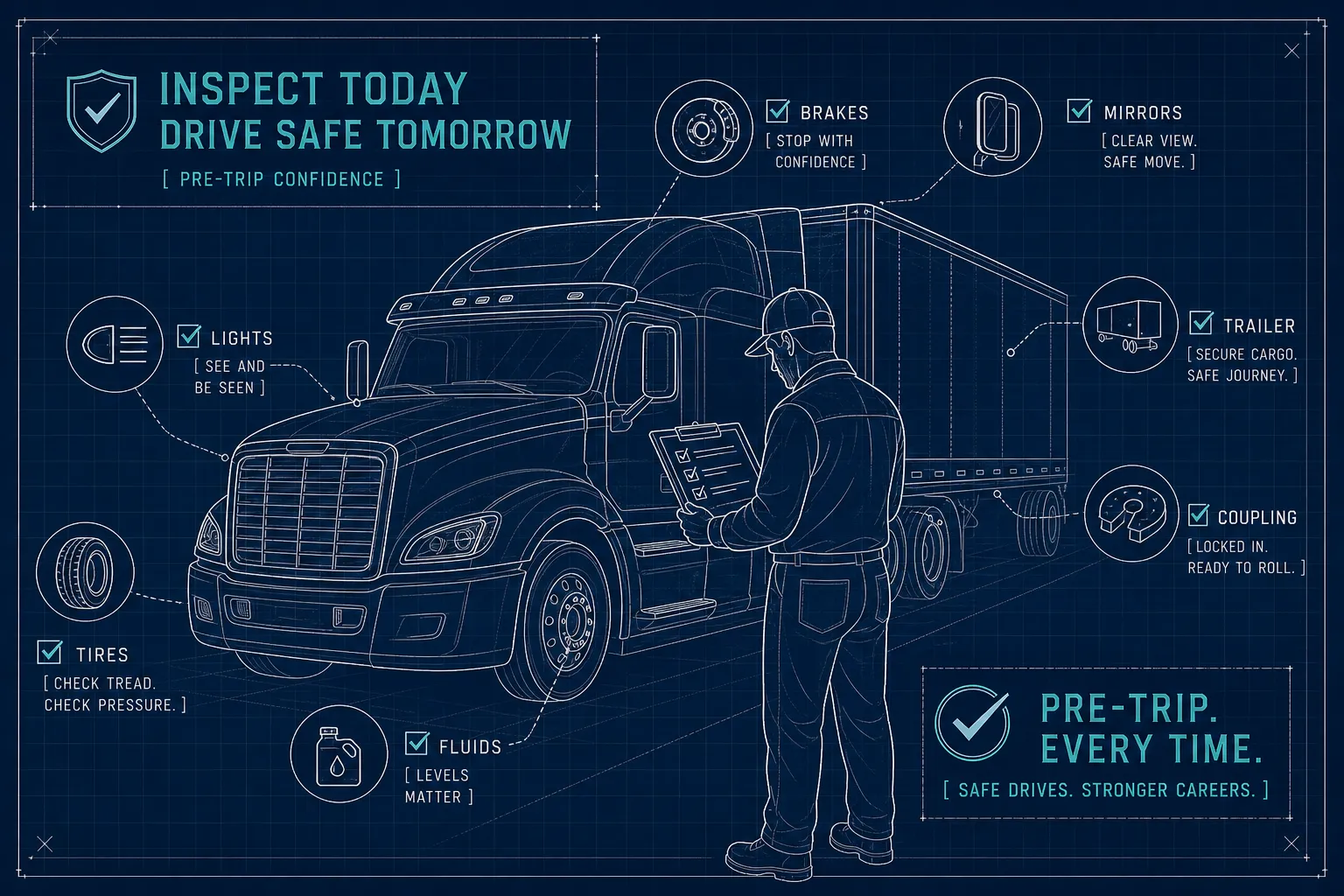
Many CDL candidates spend weeks memorizing what to look for on the pre-trip inspection. Far fewer practice what to say. That gap contributes to candidates being caught off-guard during the PTI portion of the CDL skills test. If you want to pass on test day, your CDL pre trip inspection practice needs to pair verbalization with hands-on repetition, not just silent reading.
The examiner standing next to you isn't just watching your hands. They're listening to your words. You earn credit for each component only when you identify it and describe its condition out loud. Skip the verbalization, use vague language like "looks good," and you lose a point. Get the air brake test sequence wrong, and in most jurisdictions you fail outright. This article walks you through the complete FMCSA inspection sequence, the exact wording examiners expect at each step, the specific failure points that end most attempts early, and two key resources: a printable Class A and Class B pre-trip inspection checklist and 30 exam-style practice questions to work through before your test date.
What the CDL pre-trip inspection actually tests
Many people treat the PTI like a knowledge quiz: if you know what the parts are, you'll pass. That's wrong. The skills test evaluates whether you can identify each component, verbalize its condition, and move through the entire sequence without missing a zone. Knowing the truck is necessary. Saying it correctly while touching it is what gets you a passing score.
The two-things rule most candidates miss
According to FMCSA CDL testing standards, you must say at least two things about every component you inspect. Not "that looks fine" and not a single label like "oil level", something like: "Oil level is at the full mark, no signs of leakage." You also have to point to or physically touch each item as you speak. Reading the CDL manual silently for hours will not prepare you for this because reading doesn't build verbal recall under pressure.
This is the verbalization standard that separates candidates who know the truck from candidates who pass the test. Each missed or incomplete item typically costs you a deduction point, though scoring details can vary by state, so check your state's CDL examiner scoring sheet. Air brake performance is a separate category: based on CDL examiner scoring criteria, a failed air brake sequence is commonly treated as an automatic failure rather than a point deduction. Confirm the rules with your state's licensing agency before test day.
Class A vs. Class B: what changes and what stays the same
Both classes share the same core inspection flow: engine compartment, in-cab, lights, walk-around, and air brake check. Class A candidates add the coupling system, which includes the fifth wheel, kingpin, locking jaws, release arm, glad hands, and both the air and electrical lines connecting the tractor to the trailer. Class B focuses on the straight truck without any coupling sequence, unless the test scenario specifically includes a trailer.
This distinction matters when you're drilling the verbal script. Practicing Class A wording when you're testing in a Class B vehicle wastes prep time and creates confusion on test day. CDLTest360's PTI phrase trainer keeps the two sequences separate so you drill the right version for your vehicle class from day one.
CDL pre trip inspection practice: FMCSA sequence and what to say at each step
The standard inspection order is: approach and overall vehicle check, engine compartment, in-cab, lights, walk-around from left side to rear to right side, air brake check, then coupling and trailer for Class A. Examiners expect this order. Jumping around the sequence signals that your inspection isn't structured, and structured is exactly what they're looking for.
Engine compartment and in-cab: where verbalization begins
Start with the approach. Verbalize what you're looking for: "No signs of leaning, no fluid leaks underneath, no obvious damage to the body or frame." Move into the engine compartment and name each component with two condition statements. Notice the pattern, component name, followed by two observable conditions:
-
Belts: "Belts are not cracked, frayed, or loose, with proper tension."
-
Oil: "Oil level is at the full mark, no signs of leakage."
-
Hoses: "Hoses are not cracked, worn, or leaking, and are properly clamped."
In-cab, cover gauges, warning lights, mirrors, windshield condition, wipers, horn, seat belt, and emergency equipment. For air pressure, state that the system is building normally and confirm the governor cuts out at approximately 120 to 130 psi (check your state's CDL manual, as some sources cite 120 to 140 psi). Don't rush the in-cab. Examiners frequently dock candidates for skipping emergency equipment verbalization.
Walk-around inspection: left side, rear, right side
Tires require specific tread depth call-outs. Per FMCSA standards, steering axle tires must have at least 4/32-inch tread depth; all other tires require at least 2/32 inch. Say the number, don't just say "tires look good." For wheels: "Lug nuts are present, tight, and showing no rust trails. Hub seals are not leaking." For suspension: "Springs are not cracked or missing leaves, U-bolts are tight and secure, no visible damage to hangers or shocks."
For lights and reflectors, name every required light and confirm operation. Clearance lights, marker lights, brake lights, turn signals, and headlights all need to be called out by name. Candidates who rush the exterior light check or skip specific clearance and marker light identification are giving away easy points.
Air brake check and Class A coupling sequence
The air brake test has a specific order, and doing it out of sequence is a common automatic-fail trigger. The thresholds below are drawn from FMCSA CDL training guidance; verify the exact wording accepted in your jurisdiction before test day. Build pressure to governor cut-out (approximately 120 to 130 psi). Turn off the engine. Release the parking brakes and perform the static leak test: note the gauge reading, wait one minute, and state that air loss must not exceed 2 psi. Apply the service brake firmly, hold for one minute, and state that loss must not exceed 3 psi for a single vehicle or 4 psi for a combination. Fan the brakes until the low-air warning activates, it must come on before 60 psi. Continue until spring brakes engage, which typically occurs between 20 and 45 psi depending on the vehicle.
For Class A coupling, verbalize the fifth wheel plate condition, confirm locking jaw engagement with a physical tug test ("I pulled forward and the trailer did not separate, locking jaws are engaged"), check the kingpin, release arm position, apron condition, glad hands, and both air and electrical lines. Every one of these requires two condition statements minimum.
Where candidates fail most often during the PTI skills test
Based on FMCSA test scoring criteria and CDL examiner guidance, the same failure clusters appear repeatedly. Knowing where other candidates lose points tells you exactly where to focus your study time.
Air brake test sequence and brake component errors
The air brake test is the single most common reason candidates fail the PTI portion. The issue is almost never that the candidate doesn't know what the air brake does. The problem is skipping a step, performing tests in the wrong order, or failing to hold the brake long enough during the applied pressure leak check. Slack adjuster pushrod travel and air leak checks are frequently verbalized incorrectly, and the low-air warning and spring brake cut-in points are commonly misstated. Drill the air brake sequence as a standalone exercise, completely separate from the full walk-around, until the order and pressure numbers come automatically.
The transition from identifying failure points to correcting them comes down to one thing: repetition with real narration. The muscle memory section below shows how to structure that.
Coupling, tires, lights, and emergency equipment mistakes
For Class A candidates, the coupling inspection often gets a verbal description without the physical tug test, examiners notice. Tread depth confusion is consistent too: candidates either cite the wrong number or apply the steering axle standard to drive tires, or vice versa. The external light check is frequently rushed, with candidates skipping specific clearance and marker light identification. Emergency equipment is the most overlooked in-cab item: fire extinguisher, reflective triangles, and spare fuses all need to be verbalized during the cab portion, and many candidates never mention them.
How to build muscle memory for the inspection sequence
Reading the CDL manual covers what to check. It doesn't build the automatic verbal recall you need when an examiner is watching and timing you. Muscle memory for the PTI comes from one thing: physical repetition paired with saying each step aloud.
Physical repetition paired with verbal rehearsal
Walk the sequence on a real vehicle, or in a parking lot with a diagram if you don't have regular truck access. Narrate every single step out loud as if the examiner is standing directly beside you. Aim for three to five complete walk-throughs per session, at least three times per week in the weeks before your test date. A fixed order (approach, hood, cab, lights, left side, rear, right side, brakes, coupling) is what builds automatic recall when test-day nerves kick in.
Why most CDL prep tools miss the wording component entirely
Generic CDL practice apps and pre-trip inspection flashcard decks focus on what to check, not what to say. A flashcard that shows "inspect fifth wheel" gives you zero help verbalizing the tug test result, locking jaw position, apron condition, and mounting bolt status in a format the examiner accepts. Many candidates discover this gap only when they arrive at the testing site and freeze during the coupling sequence. The solution isn't more flashcards. It's a tool that prompts you to recall the exact phrasing for each component and flags incomplete answers immediately.
How to run CDL pre trip inspection practice with CDLTest360's phrase trainer
CDLTest360 built its PTI phrase trainer to address the verbalization gap that standard practice tests ignore. Rather than drilling facts you already know, the tool focuses on the specific skill the test actually scores: saying the right words for each component in the right order.
How CDLTest360's PTI phrase trainer works
The phrase trainer prompts you component by component, asking you to recall FMCSA-aligned wording for each vehicle area: engine compartment belts, brake chambers, hub seals, fifth wheel, slack adjusters, glad hands, and more. Each prompt isolates one area, and incomplete answers are flagged and re-drilled before you move on. The trainer covers both Class A and Class B sequences so you work through the exact script for your vehicle class, not a generic version that doesn't match your test scenario.
Using the phrase trainer alongside physical practice
The most effective preparation pairs the CDLTest360 phrase trainer for wording recall with physical walk-around repetition for sequence memory. Use the phrase trainer during commute time, lunch breaks, or any short window when you can't be near a truck. When you do get access to a vehicle, the wording is already loaded, the physical session becomes about connecting your verbal script to the actual components instead of building both skills from scratch at the same time. CDLTest360 doesn't require an account, so you can run the first prompts today without any setup.
Printable pre-trip inspection checklist and 30 exam-style practice questions
Use the checklist below during your physical CDL pre trip inspection practice sessions. Carry it with you and check off each item after you verbalize it, not before. Examiners look for touch-point confirmation, and the checklist helps you verify you're physically pointing to or touching each item rather than reciting from memory with your hands in your pockets. After three or four walk-throughs with the checklist, attempt the full sequence without it and use it only to identify what you skipped.
Class A and Class B pre-trip inspection checklist
-
Approach and overall vehicle: No leaning, no leaks underneath, no prior damage to body or frame
-
Engine compartment: Oil, coolant, power steering fluid levels; belts (not cracked, frayed, or loose); hoses (not cracked, leaking, or loose); battery terminals; no fluid leaks; air compressor secure
-
In-cab: Gauges operational, warning lights clear, mirrors adjusted, windshield unobstructed, wipers functional, horn operational, seat belt present and functional, parking brake set, air pressure building, emergency equipment present and accounted for
-
Lights: Headlights (high and low beam), turn signals, hazards, brake lights, taillights, clearance lights, marker lights, license plate light, all lenses uncracked
-
Left side: Tires inflated, tread depth confirmed (4/32 steer, 2/32 others), no cuts or bulges, lug nuts present and tight, hub seals not leaking, suspension components secure, fuel tank cap tight, air and electrical lines secure
-
Rear: Rear lights and reflectors, rear body or trailer doors secure, rear tires and suspension, mud flaps if required
-
Right side: Same zones as left side, tires, lug nuts, hub seals, suspension, lights, and reflectors. Right-side-specific items include exhaust stack condition and step/catwalk integrity where applicable; confirm all items are in the same acceptable condition as the left side.
-
Air brake check: Buildup to governor cut-out (approximately 120 to 130 psi per FMCSA guidance; verify with your state manual), static leak test (max 2 psi per minute), applied leak test (max 3 psi single / 4 psi combination), low-air warning before 60 psi, spring brakes engage before pressure drops dangerously low
-
Coupling and trailer (Class A only): Fifth wheel secure and lubricated, locking jaws engaged (tug test performed and verbalized), kingpin condition, release arm, air lines and glad hands, electrical connection, trailer landing gear raised and secure, trailer tires and lights
30 CDL pre-trip practice questions and answers
Work through all 30 questions out loud, not silently. Answer each one the way you would during the actual skills test: name the component, state its condition, and explain what makes it acceptable.
In-cab (Questions 1 through 5)
-
Q: What are you checking when you inspect the windshield during the in-cab portion? A: "Windshield is clean and unobstructed, no cracks or chips that impair my vision, wipers are functional and blades are not torn or streaking."
-
Q: What condition must the service brake pedal be in? A: "Pedal feels firm under pressure, no spongy or sinking feel, and the pedal does not travel too close to the floor."
-
Q: What emergency equipment must be present and how do you verbalize it? A: "Fire extinguisher is present, fully charged, and within reach. Three reflective triangles are present and in good condition. Spare fuses are present if the vehicle uses fuses."
-
Q: What do you confirm about the mirrors during in-cab inspection? A: "Mirrors are properly adjusted and secure, not cracked or dirty, providing an unobstructed view of the road and trailer."
-
Q: What should air pressure read before you begin the air brake test? A: "Air pressure should build to normal operating range, approximately 120 to 130 psi, with the governor cutting out at that level."
Engine compartment (Questions 6 through 10)
-
Q: What two things must you say about the engine belts? A: "Belts are not cracked, frayed, or worn, and have no more than three-quarters of an inch of free play. Properly tensioned."
-
Q: What do you inspect on the battery during the engine compartment check? A: "Battery is securely mounted, no cracks in the casing, terminals are clean, tight, and free of corrosion. Cables are not cut or frayed."
-
Q: What are you looking for when you check the hoses? A: "Hoses are not cracked, worn, soft, swollen, or leaking. All clamps are secure and properly positioned."
-
Q: What does an acceptable oil level look like and how do you verbalize it? A: "Oil level is at the full mark on the dipstick, no signs of leakage around the engine block or under the vehicle."
-
Q: What do you check on the air compressor? A: "Air compressor is properly mounted and secure, not leaking, and drive belt is not cracked, frayed, or loose."
Walk-around exterior (Questions 11 through 18)
-
Q: What is the minimum tire tread depth on steering axle tires and how do you verbalize it? A: "Steering axle tires have at least 4/32-inch tread depth in the major tread grooves, no cuts, bulges, or exposed cords."
-
Q: What is the minimum tread depth for drive and trailer axle tires? A: "Drive and trailer tires have at least 2/32-inch tread depth, no visible damage, cuts, or sidewall separation."
-
Q: What do you say about the lug nuts? A: "Lug nuts are present, tight, and showing no rust trails or signs of looseness. No missing or cracked studs."
-
Q: What are you inspecting on the suspension? A: "Springs are not cracked or missing leaves. U-bolts are tight and secure. Shock absorbers are not leaking or damaged. Hangers are not cracked or broken."
-
Q: What do you check on the fuel tank? A: "Fuel tank is securely mounted, no cracks or leaks, cap is on and tight, fuel crossover line is secure if present."
-
Q: What do you inspect on the hub seals? A: "Hub seals are not leaking, no grease or oil on the brake drum or brake shoes, hub cap is secure."
-
Q: What lights must you identify by name during the walk-around? A: Clearance lights, marker lights, reflectors, brake lights, turn signals, taillights, and the license plate light must all be identified by name and confirmed as operational with uncracked lenses.
-
Q: What do you verbalize about the frame during the walk-around? A: "Frame is not cracked, bent, or damaged. No signs of previous repair that compromise structural integrity. No missing bolts or brackets."
Air brakes (Questions 19 through 25)
-
Q: What is the maximum allowable air loss during a static leak test with the parking brake released? A: "Air loss must not exceed 2 psi per minute with the engine off and parking brake released."
-
Q: What is the maximum allowable air loss during the applied service brake leak test on a single vehicle? A: "With the service brake firmly applied, air loss must not exceed 3 psi over one minute. For a combination vehicle, the limit is 4 psi."
-
Q: At what pressure must the low-air warning activate? A: "The low-air warning light and buzzer must activate before air pressure drops to 60 psi."
-
Q: At what pressure should the spring brakes pop out? A: "Spring brakes should apply automatically as air pressure continues to drop, typically between 20 and 45 psi, before the system pressure gets dangerously low."
-
Q: What should you verbalize when confirming the governor cut-out? A: "Air pressure built to normal operating range. The governor cut out at approximately 120 to 130 psi, which is within the acceptable range."
-
Q: What do you check on the brake chambers and slack adjusters? A: "Brake chambers are properly mounted and not leaking. Slack adjusters are not loose or bent. Pushrod travel is within the acceptable limit."
-
Q: What do you look for on the brake drums? A: "Brake drums are not cracked, and there are no signs of heat damage. Brake linings are visible and not worn below minimum thickness. No grease or oil contamination on the braking surface."
Coupling and trailer, Class A only (Questions 26 through 30)
-
Q: How do you verbalize the fifth wheel check? A: "Fifth wheel is properly mounted and secure. The skid plate is not damaged or cracked. The fifth wheel is lubricated. The fifth wheel is tilted for coupling and is in the proper position."
-
Q: How do you confirm the locking jaws are engaged? A: "I pulled the tractor forward and the trailer did not separate. Locking jaws are fully closed around the kingpin. The release arm is in the locked position and properly seated."
-
Q: What do you check on the air lines and glad hands? A: "Air lines are properly connected to the glad hands, no leaks, not kinked or worn. Glad hands are locked and seated, no cracks in the seals."
-
Q: What do you check on the trailer landing gear? A: "Landing gear is fully raised and locked in the up position. No missing pins or damaged cross-shaft. Crank handle is secure."
-
Q: What do you verbalize about the trailer tires and axles? A: "Trailer tires have at least 2/32-inch tread depth, no cuts, bulges, or exposed cords. Lug nuts are present and tight. Hub seals are not leaking. No rust trails or signs of wheel looseness."
Now put it all together
Knowing the truck is only half the job. The CDL pre-trip inspection rewards verbal precision and sequence consistency, and those two skills only come from deliberate, repeated practice. Reading through a checklist once won't build them. Answering 30 questions silently in your head won't build them either. What builds them is saying it out loud, over and over, until the sequence and the phrasing come automatically.
Use the two-part approach: physical walk-arounds for sequence memory and CDLTest360's PTI phrase trainer for exact wording. The phrase trainer runs component by component, flags incomplete answers, and re-drills the gaps before they show up on test day. It covers both Class A and Class B sequences, and you can start without creating an account. Open it today, run through the engine compartment prompts, and then do one physical walk-through using the checklist in this article. Candidates who combine one phrase trainer session with one physical walk-through in the same day consistently close the verbalization gap faster than those who rely on reading alone.
Make CDL pre trip inspection practice part of every session to build the verbal and hands-on muscle memory that examiners are actually scoring. Candidates who report first-attempt success often credit one thing: they practiced saying it, not just reading it.
{ "@type": "Article", "datePublished": "2026-07-24T11:00:58.091Z", "dateModified": "2026-07-24T11:00:58.091Z", "headline": "CDL Pre-Trip Inspection Practice That Actually Prepares You", "description": "Master CDL pre-trip inspection practice with exact FMCSA wording, common fail points, and a printable Class A/B checklist. Start drilling with CDLTest360's PTI phrase trainer.", "publisher": { "@type": "Organization", "name": "CDLTest360" }, "image": [ ] }