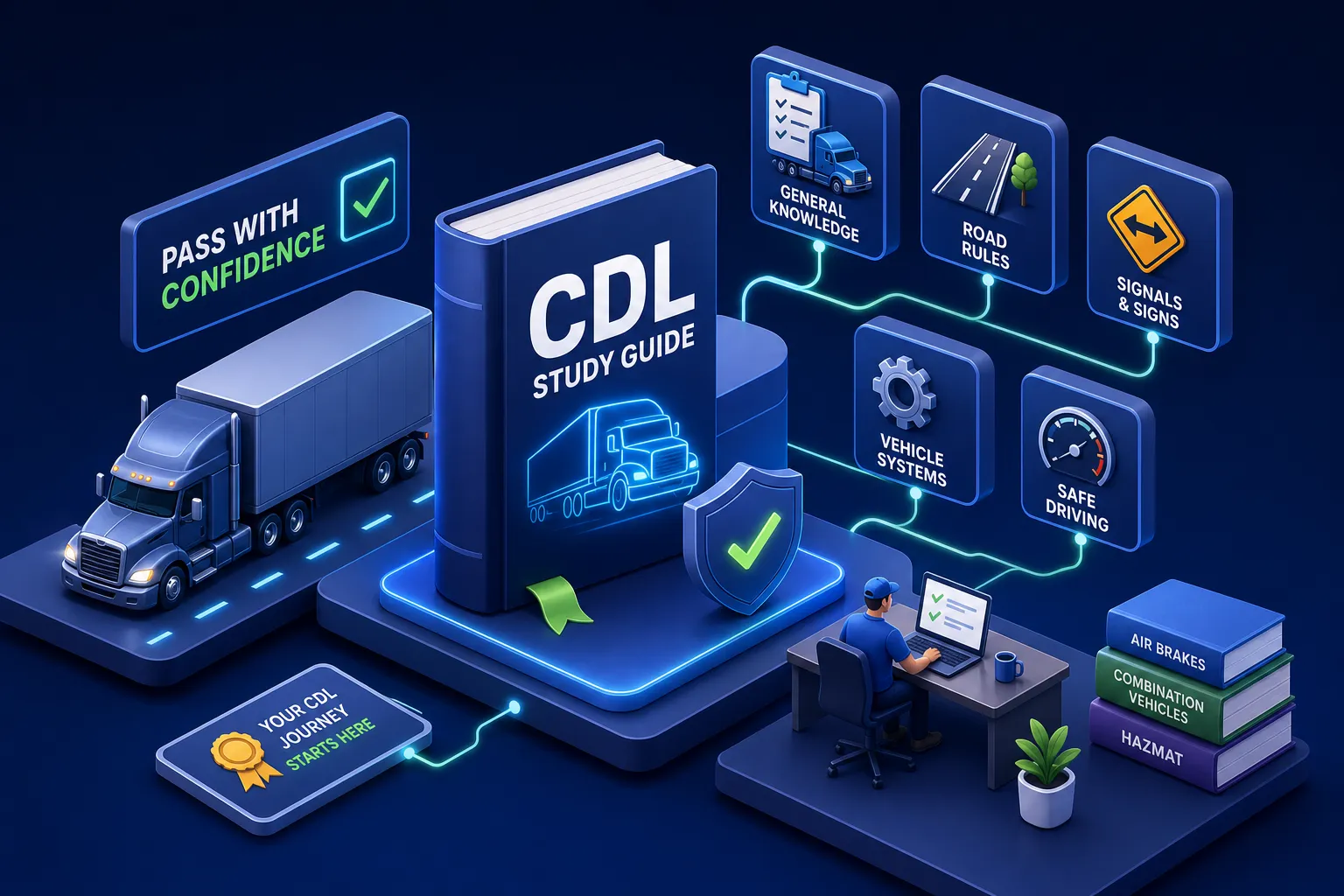
This CDL study guide breaks down everything you need to pass the CDL knowledge exam the first time, the right manuals, a section-by-section breakdown, a realistic 30-day schedule, and test-day strategy that keeps you above the 80% mark. Most candidates underestimate what's actually on the test. The CDL knowledge exam is not one test; it's a set of distinct subject areas, each with its own question bank, its own passing threshold, and its own vocabulary drawn directly from FMCSA regulatory language. Getting through all of it takes more than a single read of the manual.
That's the gap CDLTest360 was built to close. Reading the commercial driver license handbook gives you information. Testing yourself against timed, FMCSA-aligned practice questions shows you what you actually retained and where you'll lose points on test day. This article gives you what you need to approach the exam with a clear plan: the official manuals to use, a section-by-section breakdown of every major test area, a realistic 30-day study schedule, a full endorsement checklist, and test-day strategy that keeps you above the 80% mark.
What your state's CDL handbook actually covers
The CDL handbook used in every U.S. state is derived from the AAMVA Model CDL Manual, which means the technical content is federally standardized. The air brakes rules you study in Texas are the same rules tested in Ohio, Pennsylvania, and California. This matters: a solid foundation in the core sections transfers everywhere, and FMCSA-sourced question language is what every state draws from when building its knowledge test.
Where state manuals diverge is in the front and back matter: application procedures, state-specific traffic laws, residency and medical certification requirements, and locally mandated training prerequisites. You must use your resident state's manual because those details are tested at your DMV. Driving-Tests.org aggregates official PDF links from all 50 state licensing agencies in one place, which saves time tracking down the right document. Third-party summaries of the handbook are never a substitute for the actual manual, state DMV knowledge tests pull questions from official source language, not condensed overviews.
The 10 sections that make up most state manuals
Most state CDL handbooks follow a common 10-section structure, though some states include additional sections or integrate certain topics differently. Sections 1 through 4 cover CDL classes and endorsements, driving safely, transporting cargo, and transporting passengers. These are the foundation of the general knowledge test. Sections 5 through 10 cover air brakes, combination vehicles, doubles and triples, tank vehicles, hazardous materials, and school buses. Each of these latter sections corresponds to its own separate endorsement knowledge test that you take on top of the general knowledge base, so they require dedicated study, not just a skim.
Breaking down the five sections every CDL candidate must know
The 80% passing standard applies uniformly to every section of the CDL knowledge exam. What changes is the total question count, which shifts how many correct answers you need in absolute terms. Understanding each section's format and its specific challenge helps you allocate study time where it matters most.
General knowledge: the foundation of your CDL written exam
The general knowledge test is 50 questions; you need 40 correct to pass. It covers driving safely, cargo securement, vehicle inspections, speed and space management, and hazard recognition. The questions punish surface-level reading because they test application, not simple recall. A question won't ask you to define "space management." It will put you in a scenario and ask what you should do.
The most effective approach is to read each manual section once for the concepts, then immediately switch to timed practice questions to see how the material is actually tested. Research consistently shows that active retrieval practice, testing yourself rather than rereading, is one of the most reliable ways to retain technical material and reduce first-attempt failure rates. Passive reading alone leaves real gaps.
Air brakes: where precision beats memorization
The air brakes test is 25 questions with a passing threshold of 20 correct. It covers system components, pressure thresholds, brake fade, leakage rates, and proper inspection sequences. The two numbers that trip up the most candidates are 60 psi (the low-air warning trigger) and 4 psi per minute (the maximum leakage rate for combination vehicles with brakes released). Memorizing these numbers without understanding what they mean is the biggest mistake candidates make here.
When you understand that air pressure drops trigger spring brakes as a failsafe, and that leakage limits exist because slow leaks will eventually rob you of stopping power on a descent, the numbers become logical rather than arbitrary. That understanding is also what carries you through scenario-based questions, where pure memorization falls apart. For a state-level explanation of air brakes components and procedures, check your DMV's air brakes handbook such as the California DMV air brakes section.
Combination vehicles and hazmat: two tests with steep specificity
The combination vehicles test is 20 questions with 16 needed to pass. It focuses on coupling and uncoupling procedures, off-tracking behavior, rollover risk on curves, and air brake behavior across multi-unit rigs. The hazmat test is 30 questions with 24 needed to pass, covering the nine hazard classes, placarding rules, shipping papers, and emergency response procedures. Both sections contain specialized vocabulary and scenario types not emphasized anywhere in the general knowledge section.
Studying these sections with general knowledge practice questions is a common and costly mistake. Section-specific quiz modules are strongly recommended for combination vehicles and hazmat preparation because the question framing is entirely different from the general knowledge bank, and practicing with the wrong question type leaves you underprepared for what you'll actually see.
Pre-trip inspection: the section most people underestimate
PTI is almost always studied last and studied poorly. On the written test, questions focus on what to inspect and why each component matters for safety. On the skills test, candidates must verbally walk through the inspection component by component while an examiner listens; examiners expect you to verbalize each item clearly, and many states require specific wording or follow a structured checklist, confirm your state's exact requirements before test day. Pre-trip inspection errors are consistently cited as a top failure point in the CDL skills test.
Reading the PTI section of the manual tells you what to inspect. It does not train you to reproduce the correct wording under pressure in front of an examiner. A dedicated phrase-drilling tool that prompts you to recall the specific language for mirrors, tires, lights, brakes, and the fifth wheel is the difference between knowing the concept and being able to perform it correctly.
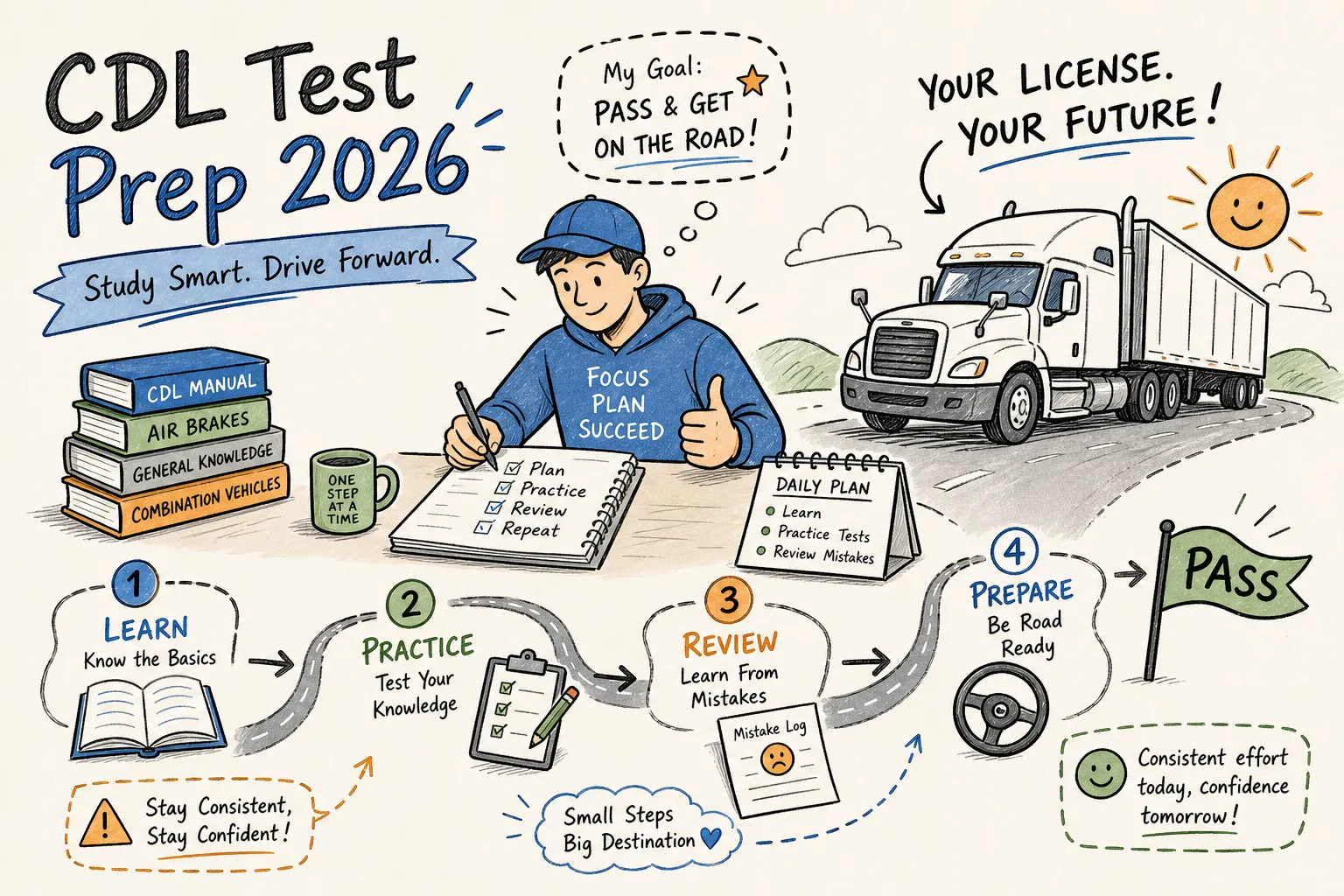
30-day CDL study guide plan
The most common scheduling mistake is spending the entire first three weeks on general knowledge and cramming endorsement sections at the end. Question volume and difficulty don't support that distribution. The plan below allocates time based on what the test actually demands. Forty-five focused minutes working through practice questions will move you further than three hours of passive rereading.
Weeks 1 and 2: build your foundation in general knowledge
Work through Sections 1 through 4 of your state's CDL handbook during the first two weeks. Read each section with a pen in hand, marking anything you don't immediately understand, then go back and reread only those flagged passages. At the end of each week, take a full timed 50-question general knowledge practice test to benchmark where you stand. Use your missed questions as your study list for the next session, not a fresh set of questions you've never seen. Repeating missed material closes gaps; rotating through new questions just measures them.
Weeks 3 and 4: drill the endorsement sections and simulate test day
Shift entirely to endorsement material in week three. Work through air brakes, combination vehicles, and any additional endorsements you're pursuing, using section-specific timed simulations for each. In week four, alternate between full general knowledge simulations and PTI phrase practice every day. If you're not scoring above 85% consistently on every module by the final three days before your exam, a comfortable buffer above the 80% pass threshold, consider rescheduling rather than risking a retake.
CDL endorsements checklist: what extra tests come with your license
Most first-time Class A candidates need at least the air brakes and combination vehicles endorsements by default. Depending on the type of freight or vehicle you'll be operating, additional endorsements may be required before you can legally work. Here's the complete breakdown of common endorsements and their testing requirements:
-
Air Brakes: 25 questions, 20 correct to pass
-
Combination Vehicles: 20 questions, 16 correct to pass
-
Hazardous Materials (H): 30 questions, 24 correct to pass; also requires a TSA background check with fingerprinting
-
Tanker (N): 20 questions, 16 correct to pass
-
Passenger (P): 20 questions, 16 correct to pass
-
Doubles/Triples (T): 20 questions, 16 correct to pass; Class A only
-
School Bus (S): 20 questions, 16 correct to pass; requires Passenger endorsement first
The ELDT requirement you cannot skip
Entry-Level Driver Training (ELDT) is an FMCSA federal mandate that has been in effect since February 2022, it is not a state option. The timing of when ELDT theory must be completed depends on the license class or endorsement you're pursuing. For first-time Class A, Class B, Passenger, and School Bus applicants, ELDT theory must be completed before the skills test. For the Hazmat endorsement specifically, ELDT theory must be completed before the Hazmat knowledge test. Check FMCSA's ELDT guidance and Training Provider Registry for the requirements that apply to your situation.
Confirm your ELDT completion is recorded in FMCSA's Training Provider Registry before your test date. States verify completion through that registry before administering the skills exam, and showing up without that record in the system means your appointment gets cancelled on the spot. For a concise summary of the curriculum expectations, see the TPR curriculum summary (PDF).
How CDLTest360 makes this study guide interactive
A CDL handbook gives you knowledge. A timed practice test against that knowledge shows you what you actually retained and what you'll miss when the clock is running at the DMV. The Complete CDL Study Guide (2026) on CDLTest360 covers every major section of the FMCSA-aligned curriculum with tools designed specifically to move you from reading to exam-ready performance.
Topic-specific quiz modules cover general knowledge, air brakes, combination vehicles, hazmat, and more. Each module is available in both practice mode and a 50-question timed exam simulation that mirrors the real test format. The missed-question review system isolates only the questions you answered incorrectly and re-drills them in a focused loop, so your study time targets your actual gaps instead of material you already know. No account is required to start; the free trial is available immediately with no registration.
The pre-trip inspection phrase trainer is CDLTest360's standout feature, and the one most CDL prep platforms skip entirely. It prompts you to recall the inspection language for each vehicle component, mirrors, tires, lights, brakes, fifth wheel, the same categories an examiner works through during your skills test demonstration. If your state requires a verbal PTI walkthrough, this trainer is among the most direct preparation available outside of an actual vehicle. A 90-day pass is $39.99; monthly access is $19.99 with no long-term commitment.
Test-day strategy: how to clear the 80% mark with confidence
Covering the material is one challenge. Walking into the testing center and executing efficiently under pressure is another. The CDL knowledge exam is multiple choice, and most states do not penalize wrong answers, which means leaving a question blank is almost always worse than an educated guess. Flag any question you're unsure about, complete the rest of the section first, then return to the flagged questions with fresh eyes. Your first instinct on recall-based questions is usually correct; second-guessing costs more points than it saves.
Candidates who fail the CDL written exam typically share one of three problems: they studied general knowledge only and neglected endorsement sections; they read the manual without ever taking a timed practice test; or they skipped PTI preparation because they assumed it was only a skills test concern. Addressing all three before your exam date is straightforward with structured practice. Arrive rested, bring your ELDT confirmation if required and your state-mandated ID, and eliminate every avoidable variable before the test begins. For additional study tactics and short drills, visit our CDL study tips page.
Use this CDL study guide to pass the test
The CDL knowledge exam is genuinely passable when you use the right manual, study the right sections in order, and test yourself consistently instead of reading passively. The five major test areas, general knowledge, air brakes, combination vehicles, hazmat, and pre-trip inspection, each have their own logic, their own vocabulary, and their own question style. Treating them as separate disciplines instead of one blended subject is what separates first-time passers from retakers.
The 80% standard doesn't change across sections or states, but your preparation strategy absolutely should change based on the section. Use this CDL study guide as your framework: get your state's official manual from your DMV or from the driving-tests.org portal, and turn that reading into active practice at CDLTest360. Whether you're working through a Class A CDL study guide for the first time or using this as a CDL permit study guide before your initial knowledge test, the approach is the same, read the manual, drill the sections, and don't walk in without timed practice behind you. If you're a first-time candidate, start with the free trial today, no registration required. If you've already failed the knowledge exam once, load up the missed-question drill and the PTI phrase trainer and go directly after the gaps that cost you the first time. For broader news, updates, and DMV guidance, check the CDL Knowledge Center.
{ "@type": "Article", "datePublished": "2026-07-14T11:00:54.376Z", "dateModified": "2026-07-14T11:00:54.376Z", "headline": "Complete CDL study guide: master every knowledge section", "description": "Your complete CDL study guide covering every major test section, a 30-day plan, and endorsement checklist. Take free practice tests at CDLTest360 today.", "publisher": { "@type": "Organization", "name": "CDLTest360" }, "image": [ ] }