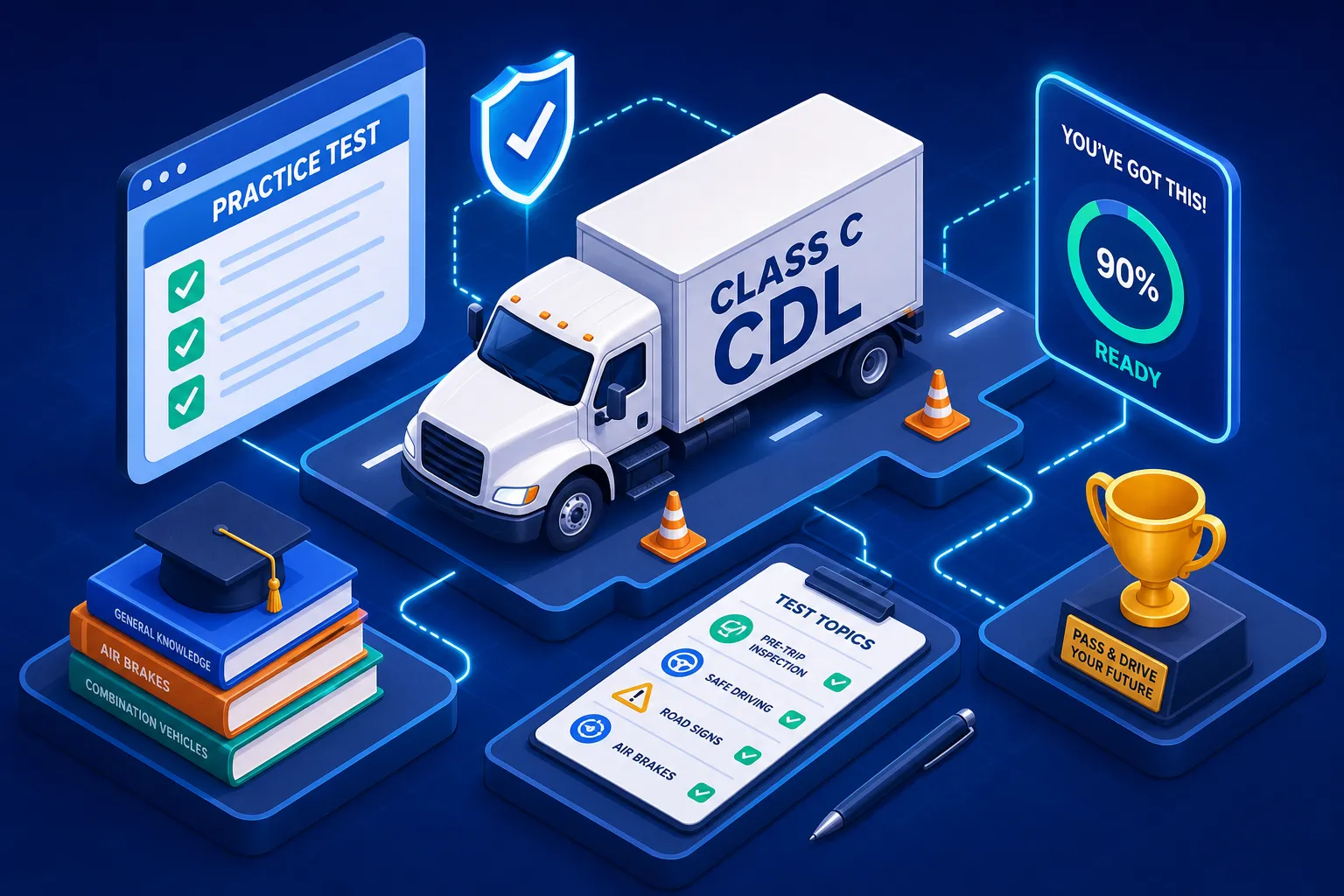
If you need to pass a class C CDL practice test quickly, this guide covers exactly what to study and how to score 80% or higher. A lot of drivers find out they need a CDL only after they've already accepted a position driving a charter bus, airport shuttle, or hazmat delivery route. By that point, the test is weeks away and the prep time is short. The Class C CDL written exam isn't something you can pass by skimming the manual the night before. It has a specific structure, defined passing thresholds, and endorsement tests that go beyond general driving knowledge.
This guide covers exactly who needs a Class C CDL, what both the general knowledge exam and the passenger endorsement test require, how scoring works across states, and a 7-day study plan you can start immediately. Candidates using CDLTest360 can access FMCSA-aligned practice modules and timed simulations on any device, with no account required to start. Start by confirming the Class C is actually what your job requires.
Who actually needs a Class C CDL
The Class C classification trips up a lot of people because it isn't defined purely by vehicle size. The federal standard is built around what you're carrying, not just how big the truck is. Two specific triggers make a Class C CDL necessary, and understanding them upfront saves you from confusion at the DMV.
The two triggers: passenger count and hazmat transport
Under FMCSA regulations, you need a Class C CDL if you operate a vehicle designed to transport 16 or more occupants including the driver, or if you transport hazardous materials in quantities requiring a placard. Most people associate CDLs with long-haul semis, but a shuttle van running 16 employees from a parking lot to an office campus falls squarely under this requirement.
Vehicles that fall under Class C
Coach buses, airport passenger vans, paratransit vehicles, and certain hazmat delivery trucks with a gross vehicle weight rating under 26,001 lbs all qualify. If you're driving any of these and carrying the threshold number of passengers or placarded materials, a Class C CDL is the legal requirement before you turn the key.
How Class C differs from Class A and B
Class A covers combination vehicles with a GCWR of 26,001 lbs or more where the towed vehicle weighs more than 10,000 lbs. Class B applies to a single vehicle with a GVWR of 26,001 lbs or more. Class C covers everything else that still triggers a CDL requirement because of passenger count or hazmat, while staying under that 26,001 lb GVWR threshold. The class doesn't mean it's easier to get; it means the vehicle is smaller but the cargo or passenger responsibility still demands federal oversight. For drivers interested in how testing and preparation differ for heavier vehicles, see the Class B CDL Practice Test: What to Expect in 2026.
What the Class C CDL practice test covers
The Class C CDL written exam has two layers: the general knowledge test every CDL applicant must pass, and the endorsement tests specific to what you're transporting. Knowing both layers before you open a study guide prevents gaps in your preparation and keeps you from spending time on content you won't be tested on.
General knowledge: the foundation every CDL requires
The general knowledge exam is 50 multiple-choice questions covering vehicle inspection, basic vehicle control, gear shifting, space management, night driving, adverse weather operation, emergency procedures, cargo handling, accident and fire response, fatigue awareness, and basic hazmat regulations. Every CDL candidate sits this exam regardless of vehicle class. Vehicle inspection and emergency procedures are heavily emphasized and commonly tested topics, and both require more than surface-level familiarity to answer correctly under time pressure. For a deeper breakdown of every written-test section and how they're scored, review the CDL Written Test Guide (2026), Every Section Explained.
Passenger endorsement: what those 20 questions cover
The passenger (P) endorsement is required any time you transport 16 or more people including yourself. The endorsement exam is 20 questions focused on six areas: loading and unloading safely, emergency exit procedures, passenger communication, accessibility compliance, managing disruptive passengers, and railroad crossing rules specific to passenger vehicles. Railroad crossing procedures are specific and worth focused study. Passenger vehicles must stop between 15 and 50 feet from the nearest rail, open the door or windows to look and listen for trains, and keep four-way flashers on through the entire crossing procedure.
Hazmat endorsement: when it applies and what it covers
Not every Class C driver needs a hazmat endorsement. If you're transporting placarded materials, you do. The hazmat test focuses on hazmat classifications, placarding requirements, shipping papers, loading and unloading procedures, and emergency response basics. One critical timeline detail: the hazmat endorsement requires TSA vetting and a background check before it's added to your license. That process is handled through state agencies and can take several weeks, so factor it into your schedule well before your target start date.
Exam format, question counts, and passing scores
The general knowledge exam is 50 multiple-choice questions. You need at least 40 correct answers to meet the 80% federal passing standard. The passenger endorsement is a separate 20-question test with its own 80% threshold, meaning 16 correct answers minimum. Texas follows these federal standards exactly: 40 out of 50 for general knowledge, 16 out of 20 for the passenger endorsement.
California's CDL written test passing score is higher than the federal floor, confirm the exact threshold with the California DMV before you schedule your exam, and build in a larger buffer during your preparation. Most states align with the federal 80% floor, but verify your state's exact requirement directly with your DMV before test day. Studying to exactly 80% leaves no margin for a harder question set or a state with a stricter standard.
On retakes, California allows up to three attempts per permit. After three failures, the application becomes invalid and you restart the process. There's no mandatory waiting period between attempts; you can retest the next business day. Rules vary by state, which is another reason targeted prep with a missed-question review system beats general re-reading. You want to walk in knowing the material, not hoping the same question doesn't show up again.
State differences that affect your preparation
FMCSA regulations set the minimum standard for Class C CDL requirements across the country, but states layer additional rules on top. Knowing your state's specific requirements before you schedule the exam prevents avoidable surprises. For an overview of how commercial driver license testing is administered across jurisdictions, see AAMVA's commercial driver license testing overview.
On age requirements, the federal standard is 18 for intrastate commercial driving and 21 for interstate. Pennsylvania issues a non-CDL Class C at 16 for general vehicles but requires 18 for a commercial CDL. New York allows a CDL Class C at 18 but bars interstate commerce until 21. Always check your state's DMV directly rather than assuming the federal minimums apply in full.
Vehicle weight classifications have their own state-level variations. New York allows Class C holders to tow over 10,000 lbs if the gross combined weight rating stays at or below 26,000 lbs. South Carolina includes vehicles with a GVWR at or above 26,001 lbs in Class C if towing stays under 10,000 lbs and Class A or B thresholds aren't met; confirm the specifics with your state DMV (for example, see the South Carolina DMV testing information). These distinctions matter if you're operating near the borderline of the weight definitions.
For endorsements, the passenger endorsement has no background check requirement, though some states and employers may consider driving record history alongside testing requirements. The hazmat endorsement requires TSA vetting and a background check; the process is administered through state agencies and timelines can vary. Plan for the background check timeline first if hazmat transport is part of your role. You cannot legally transport placarded materials until that clearance is in hand. Also review federal guidance on entry-level training and related requirements to ensure you're meeting both training and testing rules: FMCSA Entry-Level Driver Training (ELDT) requirements.
7-day Class C CDL practice test study plan
Seven focused days can be enough to go from zero to test-ready for the Class C written exam, depending on your prior knowledge and study intensity, but only if you structure your time around what the exam actually tests and where candidates most commonly fall short. Think of this Complete CDL Study Guide (2026) as a framework you adapt to your own diagnostic results.
Days 1 and 2: general knowledge fundamentals. Read the relevant sections of your state CDL manual and immediately follow each section with practice quizzes. CDLTest360's general knowledge module is built from FMCSA source content and you can start without creating an account. Prioritize vehicle inspection, space management, and emergency procedures since these are the most tested areas and the ones candidates most often underestimate.
Days 3 and 4: passenger endorsement content. The endorsement exam has a narrow scope and a defined list of topics. Work through each of the six areas systematically: loading and unloading, emergency exits, passenger communication, accessibility, disruptive passenger handling, and railroad crossing procedures. Most candidates underestimate the railroad crossing requirements. Drill those specifically.
Days 5 through 7: timed simulations and targeted remediation. Switch to full 50-question timed exam simulations to replicate real test pressure. After each simulation, review only the questions you missed. CDLTest360's missed-question review system re-drills incorrect answers in isolation rather than cycling through content you already know, which is a more efficient use of limited study time.
If you're also preparing for the hazmat endorsement, CDLTest360's hazmat module covers the placarding rules, shipping papers, and emergency response content specific to Class C hazmat requirements. Finish your final session with one clean timed simulation focused on your two or three weakest areas.
Sample Class C DMV sample test questions to benchmark where you stand
Take these before committing to a study schedule to identify which topic areas need the most work.
5 general knowledge questions
-
What is the maximum legal blood alcohol concentration (BAC) for operating a commercial motor vehicle? A) 0.02% B) 0.04% C) 0.06% D) 0.08% Answer: B. Federal law sets the CMV BAC limit at 0.04%.
-
How often must a driver perform a pre-trip inspection? A) Once a week B) Only after an accident C) Before each day's operation D) Monthly Answer: C. Pre-trip inspections are required before starting each day's operation.
-
Under FMCSA cargo securement rules, what is the minimum number of tie-downs required for a 30-foot cargo load? A) 2 B) 3 C) 4 D) 5 Answer: B. FMCSA cargo securement standards (49 CFR 393 Subpart I) require at least one tie-down for every 10 feet of cargo length; verify the exact rule in your state CDL manual before your exam.
-
What should you do if you notice a tire is overheating during a trip? A) Slow down and continue B) Add water to the tire C) Stop immediately and inspect D) Ignore it unless smoke is visible Answer: C. An overheating tire can fail without warning; stop and inspect immediately.
-
What is the minimum number of occupants (including the driver) that requires a Class C CDL? A) 9 B) 12 C) 16 D) 20 Answer: C. A Class C CDL is required for vehicles transporting 16 or more occupants including the driver.
5 passenger endorsement questions
-
How far from the nearest rail must a passenger bus stop at a railroad crossing? A) 5 to 15 feet B) 10 to 30 feet C) 15 to 50 feet D) 25 to 75 feet Answer: C. Passenger vehicles must stop between 15 and 50 feet from the nearest rail.
-
What must you do once stopped at a railroad crossing in a passenger vehicle? A) Honk your horn B) Open the door or windows and listen for trains C) Call dispatch for clearance D) Keep moving slowly Answer: B. Opening the door or windows to look and listen for trains is required before proceeding.
-
When may you allow passengers to stand in the aisle of a bus? A) Only on city routes B) When all seats are full C) Never while the bus is moving on a highway D) With driver permission only Answer: C. Passengers may not stand forward of the rear axle or in unsafe positions while the vehicle is in motion on a highway.
-
How should you handle a passenger who becomes disruptive? A) Immediately call 911 while driving B) Stop the vehicle at a safe location before addressing the situation C) Ask other passengers to restrain the person D) Continue driving and ignore the behavior Answer: B. Stop at a safe location first. Attempting to manage a disruption while the vehicle is moving creates additional hazards.
-
What must passenger vehicles be equipped with at all emergency exits? A) Fire extinguishers B) Clear signage and functioning hardware that allows exit from both inside and outside C) Seat belts D) Reflective tape only Answer: B. Emergency exits must be clearly marked and operable from both inside and outside the vehicle.
If you answered 8 or more out of 10 correctly, a focused 5-day plan may be enough. If you scored 6 or below, use the full 7 days and concentrate your study time on the specific topic areas where you missed questions. The goal isn't to barely clear 80%. It's to know the material well enough that 80% feels like a floor, not a finish line.
You're more prepared than you think, now make it official
The written test stops being intimidating the moment you've taken enough realistic class C CDL practice test simulations to know what a passing score actually feels like. Take a free class C CDL practice test on CDLTest360 to benchmark your knowledge today, no account needed. Run the general knowledge module, check your results, and build your study plan around what the gaps actually show. That's the most efficient path from where you are now to walking out of the DMV with your Class C CDL in hand.