Most Class B candidates make one expensive mistake before they even open a study guide: they prep like a Class A driver. They wade through Combination Vehicles content, fifth-wheel coupling diagrams, and trailer coupling procedures that have zero presence on the Class B written exam. That's wasted hours on a test that only covers two knowledge areas.
This class B CDL practice test guide breaks down exactly what the Class B CDL written exam looks like in 2026, how each test is scored, where state differences actually matter, and what a focused seven-step study plan looks like when you're only studying what counts. The most efficient prep tools let you load only the quiz modules relevant to your license class so you're not grinding through irrelevant content.
How Class B Differs from Class A on Test Day
The one written test Class B candidates skip entirely
The Combination Vehicles test is exclusive to Class A. Class B drivers operate straight trucks, buses, and dump trucks. None of those vehicles involve tractor-trailer coupling, fifth-wheel inspections, or combination vehicle braking mechanics. Skipping Combination Vehicles content isn't cutting corners, it's the correct call based on how the FMCSA structures the CDL knowledge exam.
What stays on the plate for both license classes
General Knowledge is identical for Class A and Class B applicants: same question bank, same format, same passing threshold. Air Brakes applies to both classes when the vehicle is equipped with air brakes, which covers most commercial Class B vehicles including transit buses and dump trucks. For the majority of Class B candidates, the written test path comes down to two exams. That focused scope is an advantage if you use it correctly.
Class B CDL Practice Test: The Two Written Exams You Need to Pass
General Knowledge: the bigger of the two tests
The General Knowledge test runs 50 questions with an 80% passing threshold, meaning you need 40 correct answers. Texas confirms this structure explicitly, and because the CDL knowledge exam is federally standardized under FMCSA, California follows the same format. (Florida applicants should verify exact question counts with the Florida DHSMV, as state implementations can vary slightly despite the federal baseline.) The main topic clusters include vehicle inspection, cargo securement schedules, first check within 25 miles, then every 150 miles, hazard perception, emergency situations, traffic laws, and drug and alcohol awareness.
One number worth memorizing early: stopping distance math is counterintuitive. Double your speed, and stopping distance increases four times, not two. That's exactly the kind of Class B written test question that catches candidates who studied casually.
Air Brakes: the test that removes a license restriction
The Air Brakes test runs 25 questions. Skip it or fail it, and you receive an "L" restriction that bars you from operating any air brake-equipped vehicle. That covers most Class B commercial trucks and virtually all transit buses. The key content areas are how the air compressor builds pressure, dual air brake system operation, failure modes, low-pressure warning activation, and leakage standards. For a single vehicle, the maximum allowable leakage is 2 psi per minute with brakes released. The low-pressure warning must activate at or before 55 psi. Those are not ballpark numbers, the exam asks for exact thresholds.
Exam Scoring, Question Format, and What Varies by State
The federal baseline that applies in every state
The FMCSA sets the knowledge test standard nationally: 50 questions for General Knowledge, 80% passing score. That said, state implementations can vary in question count, so confirm exact figures in your state CDL manual. The 80% benchmark, however, is consistent nationwide, and that consistency works in your favor when building a study plan. You don't need to memorize different passing thresholds per state.
Where state differences actually show up
State-specific CDL manuals contain minor variations in traffic laws, sign recognition, and local road regulations. California's permit tests historically include visual sign identification questions. Process differences also exist at the administrative level, some states have different sequencing for when you take the knowledge test relative to obtaining your Commercial Learner's Permit. Check your state DMV for current procedures. Use your state CDL manual as a supplement to core FMCSA content, not a replacement for it. A state-specific CDL Class B test preparation approach means using both sources together. For additional study strategies tailored to each state, see the CDL Study Tips, CDLTest360 Blog.
Class B CDL Practice Test Questions That Sink Candidates on Test Day
The air brake PSI numbers most people guess at
Exact numbers matter on the Air Brakes test, and the Class B written test questions are written to catch guessers. The low-pressure warning activates at or before 55 psi. The single-vehicle leakage standard is 2 psi per minute with brakes released, and 3 psi per minute with brakes applied. Combination vehicles allow 3 psi and 4 psi respectively, but Class B candidates only need the single-vehicle numbers. Candidates who rely on general understanding instead of memorized thresholds consistently miss these questions. Write those numbers on a reference sheet and review them daily.
The mechanical rules that trip up Class B candidates
Several counterintuitive mechanical concepts show up repeatedly on failed Class B exams. Stopping distance is the most common trap: doubling your speed quadruples your stopping distance, not doubles it. Hill parking direction catches candidates who think visually rather than mechanically, parked uphill, turn wheels to roll back into the curb; parked downhill, turn wheels toward the curb so the vehicle rolls forward into it. The curb acts as the failsafe if your brakes give out.
Tailgating response is the third concept worth drilling separately. If someone is following you too closely, the correct action is to increase your following distance, not decrease it. Reading these rules once won't lock them in. Write them down while you study; active recall during note-taking builds retention faster than passive re-reading.
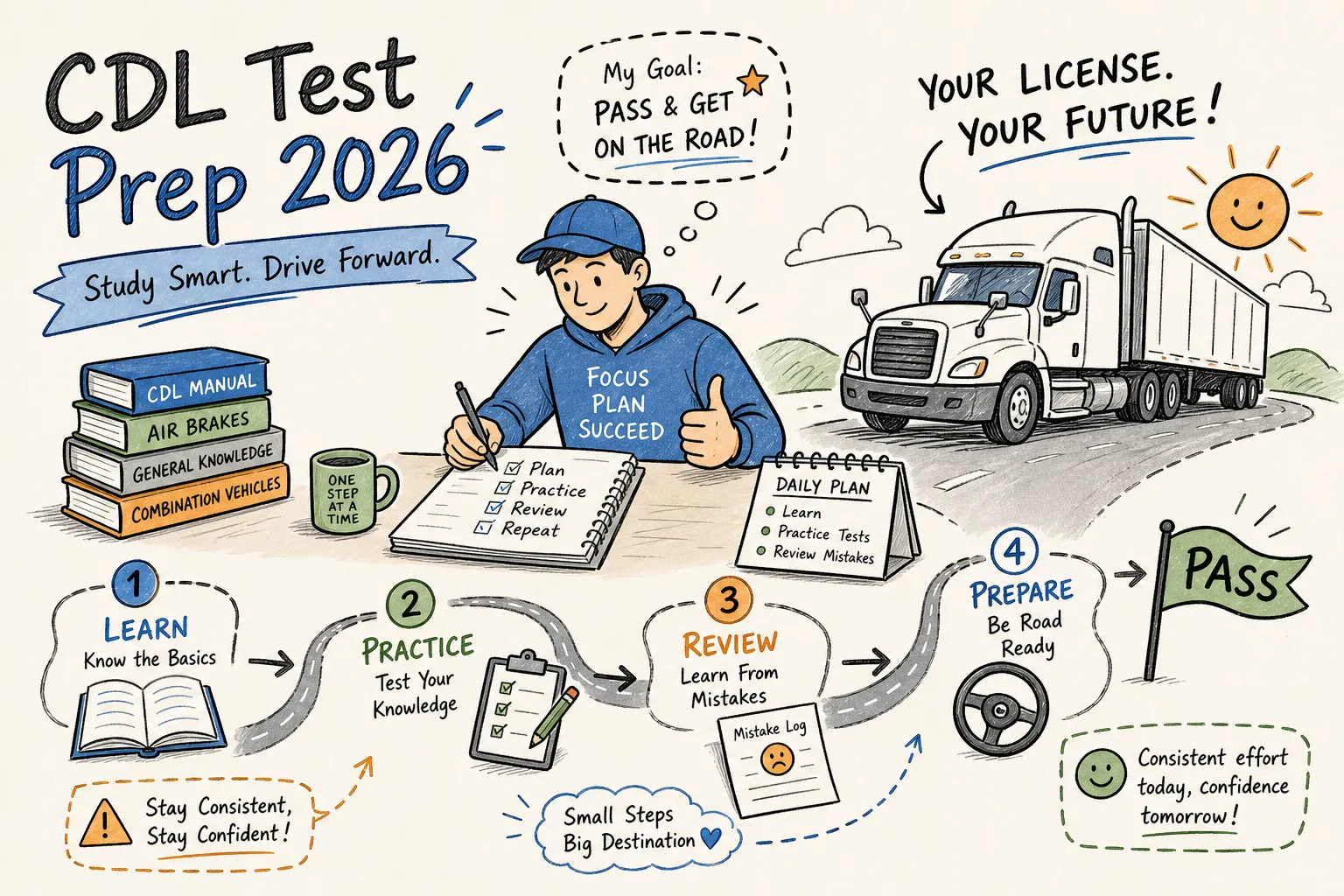
A 7-Step Study Plan for the Class B Written Test
Steps 1 through 4: building a solid knowledge base
-
Read the General Knowledge section of your state's CDL manual from cover to cover once, without quizzing yet. Get the full picture before you start drilling gaps.
-
Read the Air Brakes supplement and write down every PSI number, leakage standard, and warning threshold on a single reference sheet. That sheet becomes your daily review card.
-
Take one untimed General Knowledge quiz to establish a baseline score. Don't review answers yet, just identify where you're starting from.
-
Take one untimed Air Brakes quiz for the same baseline purpose. Two numbers are now on paper: your starting scores on both tests.
Steps 5 through 7: drilling gaps and simulating the real test
-
Use a missed-question loop to re-drill only the questions you got wrong. A good CDL exam prep platform for Class B will isolate missed questions automatically so you're not wasting reps on content you already know. Most candidates waste time retaking full tests when they only need to fix five or six weak spots.
-
Switch to timed 50-question exam simulation, a CDL Class B mock exam, once your untimed score clears 85, 90% consistently. The timer replicates real test pressure and surfaces hesitation on topics you thought you had locked down.
-
Repeat the Air Brakes simulation in timed mode until you hit 90% or above consistently before your test date. Look for a Class B permit practice test tool that lets you load only General Knowledge and Air Brakes, skipping the Combination Vehicles content bundled into most generic prep platforms. For tips on how to structure daily study sessions and stay consistent through the permit process, this how to study for the CDL permit guide is a helpful supplement.
Best Class B CDL Practice Test Resources Worth Your Time in 2026
Free practice test options that hold up in 2026
Two free platforms stand out for Class B prep this year. Driving-Tests.org's Class B practice area offers over 968 exam-like questions across General Knowledge, Air Brakes, and Pre-Trip for Class B, organized into 24 practice tests with built-in explanations and no account required. CristCDL pulls questions directly from 2026 state CDL manuals, offers unlimited attempts, and distinguishes Class B from Class A question banks explicitly. Both are updated for 2026 content and make solid starting points for your baseline assessment before you commit to a full study schedule. If you want a focused set of sample items to practice recall, this curated list of 50 CDL test questions is a quick way to surface common question types.
Why topic-specific modules outperform full-test bundles for Class B prep
Generic CDL prep platforms bundle every endorsement together. Class B candidates end up paying for Combination Vehicles, Hazmat, and Class A-specific content they'll never use on test day. CDL General Knowledge Practice Test, Free | CDLTest360 takes a different approach: you select only the quiz modules relevant to your license class, General Knowledge and Air Brakes for Class B, nothing else unless you want it. Timed exam simulation and missed-question drill modes are built into both modules, and the platform works across all 50 states.
For Class B candidates who want an efficient, targeted class B CDL practice test routine rather than a content dump, that focused structure is the practical difference between passing on your first attempt and scheduling a retake. Visit CDL Written Test Guide (2026), Every Section Explained | CDLTest360 to explore the free trial and see how the topic-specific modules work before committing to a full plan.
What to Take Away Before You Start Studying
The Class B CDL written exam path is narrower than most candidates assume, and that's an advantage. Two written tests, a clearly defined set of topics, and a seven-step plan that moves from passive reading to active simulation. Know the Air Brakes PSI numbers cold. Understand why stopping distance math defies intuition. Use a class B CDL practice test platform built for Class B prep, not one selling Class A content you'll never need.
CDLTest360 offers topic-specific quiz modules for General Knowledge and Air Brakes, plus timed exam simulation when you're ready to pressure-test your knowledge. The path to your Class B CDL is shorter than you think when you're only studying what's actually on the test. Start focused, stay disciplined, and pass it the first time.
{ "@type": "Article", "datePublished": "2026-07-07T00:38:34.033Z", "dateModified": "2026-07-07T00:38:34.033Z", "headline": "Class B CDL Practice Test: What to Expect in 2026", "description": "Class B CDL practice test breakdown for 2026: exam structure, key topics, passing scores, and a 7-step study plan to help you pass the written test first try.", "publisher": { "@type": "Organization", "name": "CDLTest360" }, "image": [ ] }