If you're asking "what tests do I need for a Class A CDL permit," the answer is longer than most candidates expect. The checklist includes three required written knowledge tests before the permit is even issued, a three-part skills evaluation after it, endorsement tests depending on what you plan to haul, federal ELDT theory requirements if you're applying for the first time, and, in most states, a DOT medical certificate that needs to be on file before permit issuance. Showing up to the DMV without knowing the full sequence wastes time you don't have.
The good news is that the sequence is completely predictable. Federal FMCSA regulations define the core structure, and once you see the full picture laid out in order, the process stops feeling overwhelming and starts feeling manageable. Candidates who pass on their first attempt tend to study all three required Class A knowledge tests together, complete their ELDT requirements before walking into the DMV, and know exactly what comes next at every stage. This article walks through each test in the order you'll encounter it, so you know what's on your checklist before you start checking things off.
What tests do I need for a Class A CDL permit, written knowledge overview
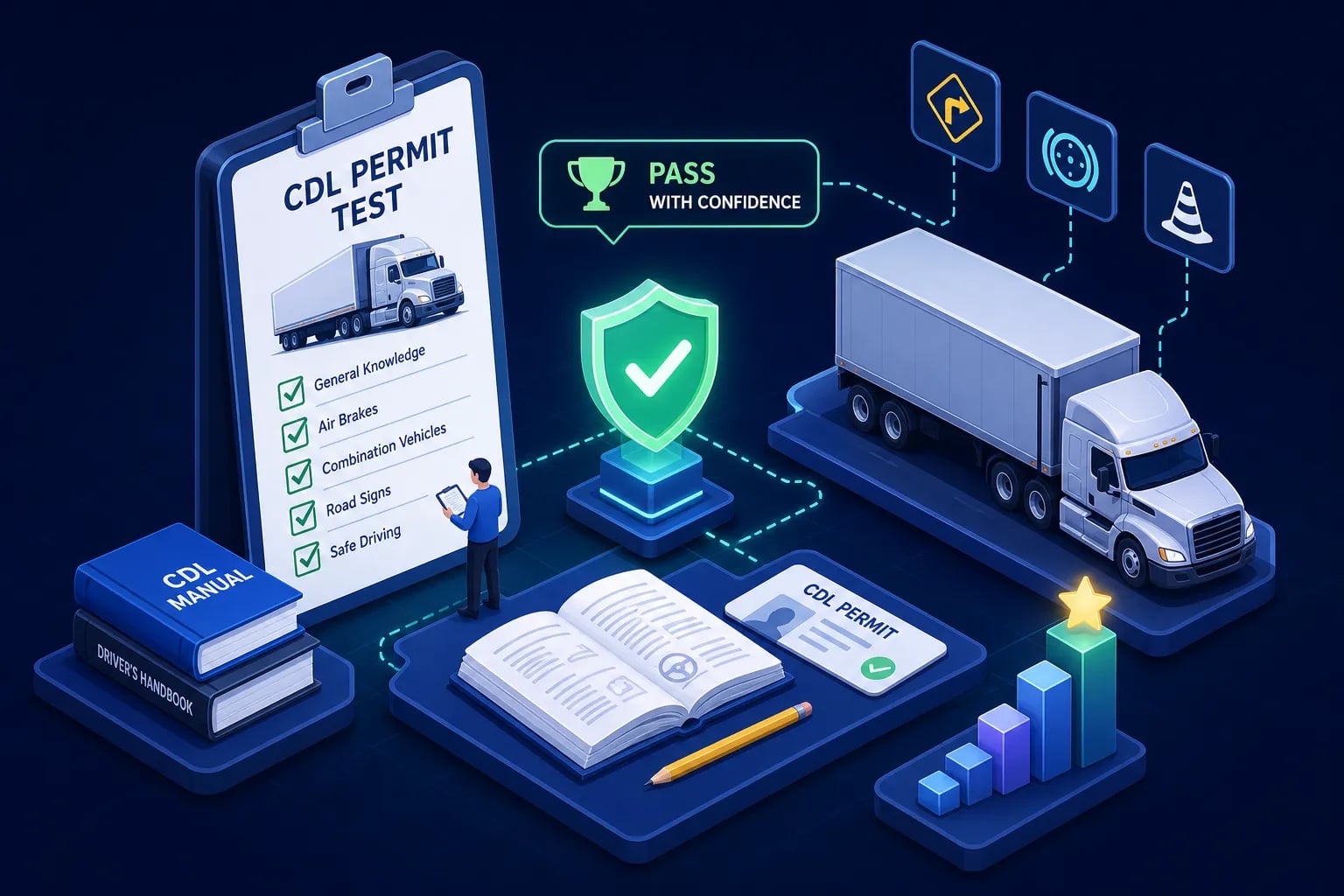
To receive a Class A Commercial Learner's Permit (CLP), you must pass written knowledge tests at the DMV before you're allowed behind the wheel for any supervised practice driving. General Knowledge and Combination Vehicles are required for all Class A applicants; Air Brakes is required if you intend to operate air-brake-equipped vehicles (skipping it places a restriction on your license). Understanding why these tests exist for Class A specifically, and not just for any CDL class, helps you approach them with the right mindset.
General knowledge: the entry point for every CDL applicant
The General Knowledge test is mandatory for every CDL applicant regardless of which license class they're pursuing. It covers the foundational skills of commercial vehicle operation: traffic laws specific to commercial drivers, cargo securement principles, vehicle inspection basics, and safe driving practices on public roads. No permit gets issued without passing it first. Question counts vary by state, but the passing threshold is 80% across all states, and content is drawn directly from the FMCSA CDL manual.
Combination vehicles: why Class A has its own required test
Class A covers vehicles with a gross combined weight rating over 26,001 lbs towing a trailer over 10,000 lbs, tractor-trailers, doubles, and triples. Things like off-tracking, rearward amplification, jackknife risk, and trailer swing make a coupled combination vehicle behave fundamentally differently than a single commercial unit. The Combination Vehicles knowledge test addresses those differences directly. FMCSA's CDL manual dedicates an entire section to it, covering safe turns, backing, trailer skids, coupling and uncoupling procedures, glad hands, fifth-wheel and kingpin connections, and pre-trip inspection of the full combination. Class B and Class C applicants don't take this test. Class A applicants do, and it's not negotiable.
Air brakes: pass it or accept the restriction
The Air Brakes test is required if you want to operate any vehicle equipped with air brakes. Skip it, and the state places an air brakes restriction on your license, limiting you legally to vehicles with hydraulic brakes only. For a Class A candidate planning to drive tractor-trailers in commercial freight, that restriction is a serious problem. Most Class A commercial vehicles rely on air brakes, so skipping this test is a mistake you'll pay for when your first employer runs a license check. Take it before your permit is issued and eliminate the restriction from the start.
What the CDL skills test evaluates after you hold your permit
Here's where the timeline shifts: the skills test happens after the CLP is issued, not before. Once you have the permit, you drive with a licensed CDL holder for a required holding period, practice the maneuvers, and then schedule the three-part skills evaluation with your state's testing agency. These three parts assess operational skill, not knowledge, and each one evaluates a distinctly different competency.
Pre-trip vehicle inspection: showing you can spot problems before they happen
The pre-trip inspection portion requires you to walk around the vehicle, identify unsafe equipment or defects, and describe what you're checking for each component in precise, specific language. Examiners aren't just watching to see if you touch the right parts; they're listening to what you say. Verbalization matters during the walkaround inspection. Candidates who know what to look at but can't produce the correct inspection phrases for components like the air lines, fifth wheel, brake drums, or steering components lose points fast. You can read about the pre-trip in the manual and still struggle to produce the right language under pressure, that's the portion that trips up the most unprepared candidates.
Basic vehicle control and the road test: two final hurdles
The basic vehicle control portion takes place in a closed test area and evaluates your ability to maneuver the truck through exercises like straight-line backing, alley docking, and offset backing. Precision and vehicle awareness matter here, not speed. The road test that follows puts you in real traffic under real conditions, where examiners evaluate your judgment at intersections, lane changes, railroad crossings, curves, and during normal highway driving. Both parts must be passed in the same vehicle type you intend to be licensed for, and both assess whether you can operate the equipment safely, not just describe how.
CDL endorsements that add written tests (and sometimes more) to your checklist
Endorsements expand what you can legally haul or transport as a Class A driver. If you plan to drive tankers or haul hazardous materials from day one, plan for additional tests beyond the three core exams. Some endorsements add only a written test. Others add a background check, a skills test, or both. Knowing which category each endorsement falls into before you go to the DMV lets you stack everything into fewer visits.
Hazmat and tanker: the endorsements most freight drivers eventually need
The H endorsement (hazmat) requires a separate written knowledge test and a TSA Security Threat Assessment. That background check involves fingerprinting, identity verification, criminal history screening, and an intelligence-related review. TSA notifies the state when you're cleared, a process that commonly takes 30 to 60 days, though some states report faster or slower processing depending on application volume. Factor that timeline into your endorsement schedule from the beginning, since you can't receive the hazmat endorsement until clearance is confirmed. The N endorsement (tanker) requires an additional written knowledge test only. No background check, no skills test, no standalone ELDT requirement. The X endorsement combines H and N into one, covering both tanker and hazmat operations, and carries the hazmat background check requirement because hazmat is part of the package.
Passenger and school bus: when the skills test comes back around
The P endorsement (passenger) and S endorsement (school bus) both require an additional written knowledge test and an additional skills and road test. That means first-time applicants for either endorsement go through a second round of skills testing on top of the core Class A evaluation. Both endorsements also typically trigger ELDT requirements for first-time applicants. If you're pursuing P or S, build the extra time and testing steps into your timeline from the beginning, these are not quick additions.
ELDT theory requirements and who has to complete them
Entry-Level Driver Training, or ELDT, is a federal mandate established under FMCSA regulations. First-time CDL applicants are required to complete ELDT theory training from an FMCSA-registered provider as part of the licensing process. This isn't optional, and it isn't something you can complete after the fact. Understanding where it fits in the timeline is critical to avoiding delays.
What ELDT theory covers and when it must be completed
ELDT theory must be completed before your CLP is issued for most first-time Class A applicants. The curriculum covers vehicle systems, operating procedures, cargo handling, hazard recognition, non-driving activities, and several other topic areas defined by FMCSA. The federal regulation doesn't set a minimum number of theory hours; instead, it requires that all curriculum topics are covered and that the trainee scores at least 80% on the theory assessment. Your ELDT provider reports your completion to the FMCSA Training Provider Registry, and the state can verify it before issuing the permit.
Which endorsements require separate ELDT completion
Hazmat, passenger, and school bus endorsements each carry their own ELDT theory requirement for first-time applicants pursuing those endorsements. Tanker does not. ELDT doesn't apply retroactively to CDL holders who were licensed before February 7, 2022, so if you already hold a CDL from before that date, the rules are different. First-time applicants in 2026 should confirm their state's current ELDT requirements and verify their provider is listed on the FMCSA Training Provider Registry before starting any coursework. Completing ELDT with an unregistered provider doesn't count, and that's a delay no one wants to deal with.
DOT medical certification and age eligibility: what you need before you test
The DOT physical is one of the most commonly overlooked prerequisites in the CDL process. Candidates sometimes walk into the DMV ready to take their knowledge tests and discover that their medical certification isn't on file. That stops the process cold. Handle the medical requirement before you schedule your DMV visit, and confirm your state's exact requirement, since the point at which certification must be on file can vary.
The DOT physical: who performs it and how to submit it
The DOT medical exam must be performed by a medical examiner listed on the FMCSA National Registry of Certified Medical Examiners. Any physician not on that registry cannot issue a valid DOT Medical Examiner's Certificate (Form MCSA-5876) for CDL purposes. Once you receive the certificate, it's generally valid for up to 24 months, though examiners can issue shorter terms if a medical condition warrants closer monitoring. You then complete the self-certification process with your state DMV, selecting the correct category (such as non-excepted interstate or non-excepted intrastate) and submitting a copy of the certificate. Some states now require electronic submission rather than paper; Oklahoma, for example, moved to this requirement in early 2026. Check your state's current process before you go.
Age minimums for intrastate vs. interstate Class A driving
The minimum age for a Class A CDL is 18 for intrastate commercial driving, operating entirely within your home state. For interstate driving, crossing state lines in commercial vehicles, federal law requires you to be 21 or older. This distinction matters because it affects the self-certification category you select with the DMV and determines what work you can legally take on once you're licensed. Decide which category applies to your situation before testing so you certify correctly from the start.
How test formats, passing scores, and state rules vary across the country
After seeing the full test list, the natural question is whether all of this looks the same in every state. The answer is: mostly yes on the content, but no on the details. FMCSA regulations set the core structure, and the 80% passing threshold applies to CDL knowledge tests in all 50 states. The written test requirements for Class A are federally mandated. What states control is everything around that structure.
What stays consistent in every state
The 80% passing threshold is uniform. The required written tests for Class A, General Knowledge, Combination Vehicles, and Air Brakes (for those operating air-brake-equipped vehicles), follow a federally mandated framework everywhere. The content on those tests is drawn from the FMCSA CDL manual, which means studying FMCSA-aligned material prepares you correctly regardless of which state you test in. That consistency is why a solid, FMCSA-sourced study program transfers directly to the actual exam in any state.
What changes from state to state: fees, retest windows, and question counts
General Knowledge question counts vary noticeably by state. Pennsylvania uses 70 questions for Class A applicants; Illinois uses 30; most other states, including Texas, Florida, New York, California, Iowa, and Maryland, use 50. Combination Vehicles is typically 20 questions in most states, while Air Brakes runs 25 questions in most states; California uses 25 for Combination Vehicles as well.
Retest and administrative rules also differ significantly by state. For example, New Jersey allows a knowledge test retest after 7 days following a failure. New York administers written tests only in English, Spanish, Chinese, and Russian. California requires 15 hours of behind-the-wheel training as an additional step beyond the federal CDL requirements. Fees are set entirely at the state level and change regularly, so check your state DMV's current fee schedule directly rather than relying on any third-party source.
The recommended order to take your Class A CDL tests
Everything covered above has a specific place in a defined sequence. The order isn't a suggestion; it's built into the FMCSA licensing structure. Trying to skip steps or reorder them creates real delays, for example, ELDT completion not yet reported to the Training Provider Registry will block CLP issuance, and TSA hazmat processing alone can push your timeline back by weeks. Here's the sequence as it actually unfolds.
Step-by-step sequence from application to full Class A CDL
Follow this order and you avoid the most common scheduling problems:
-
Complete ELDT theory with an FMCSA-registered provider (required before CLP issuance for first-time applicants).
-
Get your DOT physical done with an FMCSA National Registry examiner and submit the Medical Examiner's Certificate to your state DMV with the correct self-certification category.
-
Pass all required written knowledge tests at the DMV: General Knowledge, Combination Vehicles, and Air Brakes. Add any endorsement written tests you plan to pursue (Tanker, Hazmat, Passenger, School Bus) in the same DMV visit if possible.
-
Receive the Commercial Learner's Permit (CLP).
-
Hold the CLP for your state's required period, minimums vary by state, so check your DMV directly, and practice driving with a licensed CDL holder.
-
Schedule and pass the three-part CDL skills test: pre-trip inspection, basic vehicle control, and road test.
-
Receive the full Class A CDL.
Common mistakes that push the timeline back
Three mistakes show up repeatedly. First, candidates arrive at the DMV to take their knowledge tests before confirming their ELDT completion has been reported to the Training Provider Registry, that stops the permit issuance process immediately. Second, candidates skip the Air Brakes test thinking they can add it later, then discover the restriction creates problems with their first employer. Third, candidates plan to add endorsements after getting the CDL, which means a return trip to the DMV for each additional written test. Stack the written tests in one DMV visit whenever possible. Every endorsement written test you take on the same day as your core exams saves a separate appointment later.
How to prepare for every required Class A knowledge test without jumping between resources
Knowing what tests you need is the first step. The second step is preparing for all of them efficiently without bouncing between a state CDL manual, random flashcard apps, and YouTube videos that may or may not be current. The most effective candidates use a single platform that covers all required Class A tests plus endorsements in one place, with content built directly from FMCSA regulations.
Why studying all three core tests together saves time
General Knowledge, Combination Vehicles, and Air Brakes share overlapping content in several areas: vehicle inspection procedures, air brake system operation, and vehicle systems all appear across all three tests from different angles. Studying them together with a structured platform reduces total study time compared to treating them as three completely separate subjects. It also reinforces the connections between concepts, which is exactly how the tests are written. Approaching the three as a connected system, rather than isolated modules, is a more efficient preparation strategy.
What CDLTest360 covers for Class A candidates
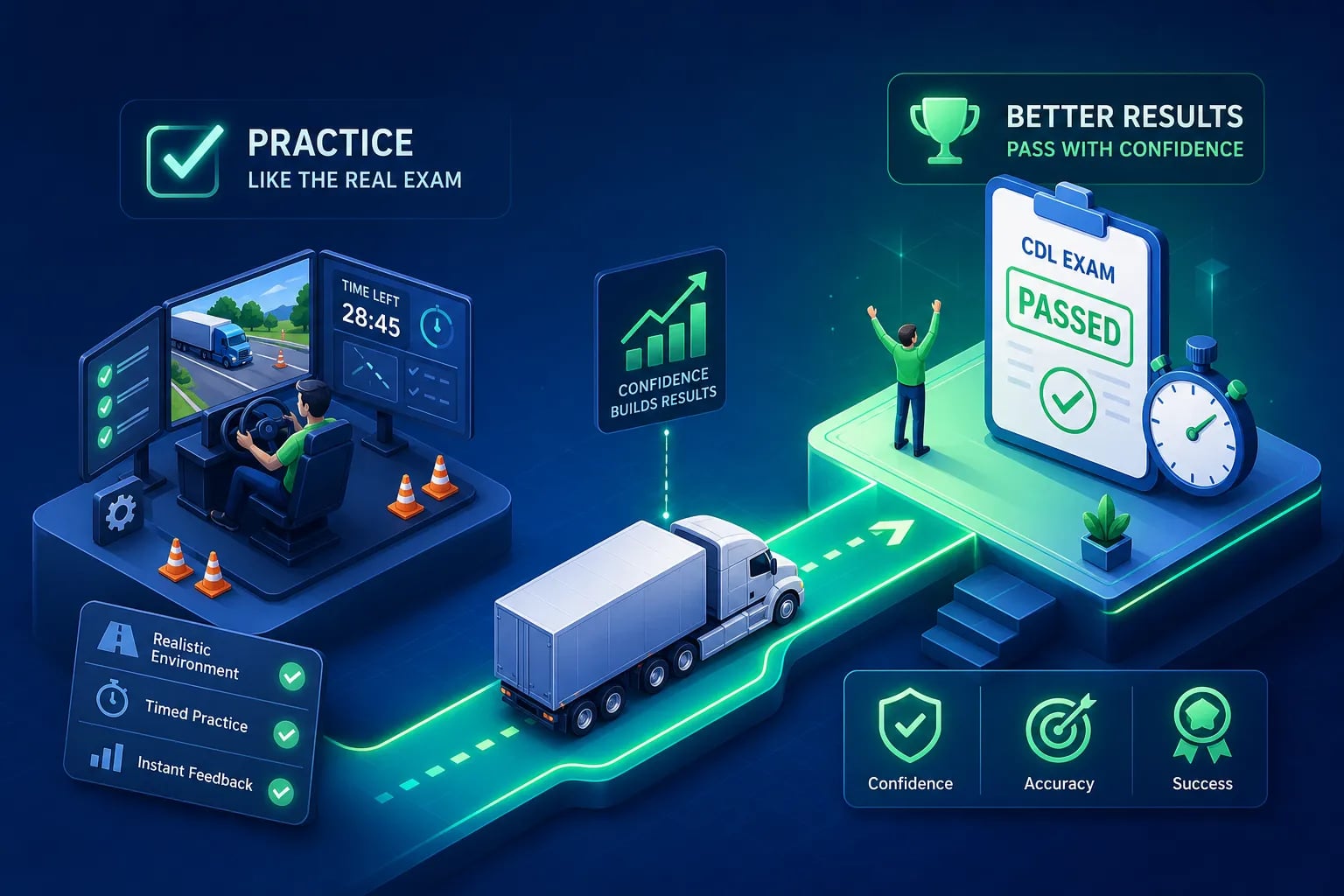
CDLTest360 is built for Class A applicants and covers every required test in one platform: General Knowledge, Combination Vehicles, Air Brakes, and all major endorsements including Hazmat, Tanker, Passenger, and School Bus. Topic-specific quiz modules let you focus on one area at a time, while timed exam simulation mode replicates DMV test conditions with a 50-question format and 80% passing threshold. The missed-question review loop isolates questions you answered incorrectly and re-drills them, so your study sessions target actual weak spots instead of covering material you already know. For the skills test, the PTI phrase trainer drills the exact inspection wording for each vehicle component, the part of the pre-trip evaluation that catches the most unprepared candidates off guard.
You can start practicing without creating an account. Full access to all modules is available as a 90-day pass or on a month-to-month basis with no long-term commitment. CDL school instructors can also access a school dashboard to assign tests, manage question banks, and track individual student progress across the full platform. The free trial loads the moment you open the platform, so you can see exactly where your knowledge gaps are before you schedule your DMV visit.
Your complete Class A CDL test checklist, summarized
Now that you know what tests you need for a Class A CDL permit, here's the full picture: written knowledge tests before the permit (General Knowledge, Combination Vehicles, and Air Brakes for those operating air-brake-equipped vehicles), a three-part skills test after it (pre-trip inspection, basic vehicle control, road test), endorsement-specific written tests and sometimes skills tests depending on what you'll haul, ELDT theory completion if you're a first-time applicant, and a DOT medical certificate with the correct self-certification before any of it. Every item on that checklist has a defined place in the sequence, and skipping or reordering any step creates delays the state won't waive.
The material itself is manageable. Most candidates who fail do so not because the content is too hard, but because they didn't know what was on their checklist until they were already at the DMV. Now you do. The next step is getting your practice reps in before that appointment. Head to CDLTest360, start with the General Knowledge module, and work through Combination Vehicles and Air Brakes at your own pace. The free trial starts the moment you load the platform.
{ "@type": "Article", "datePublished": "2026-09-28T11:02:07.625Z", "dateModified": "2026-09-28T11:02:07.625Z", "headline": "Class A CDL Permit Tests: The Complete Exam Checklist", "description": "Find out exactly what tests you need for a Class A CDL permit — written, skills, endorsements, ELDT, and medical. Start preparing with confidence.", "publisher": { "@type": "Organization", "name": "CDLTest360" }, "image": [ ] }