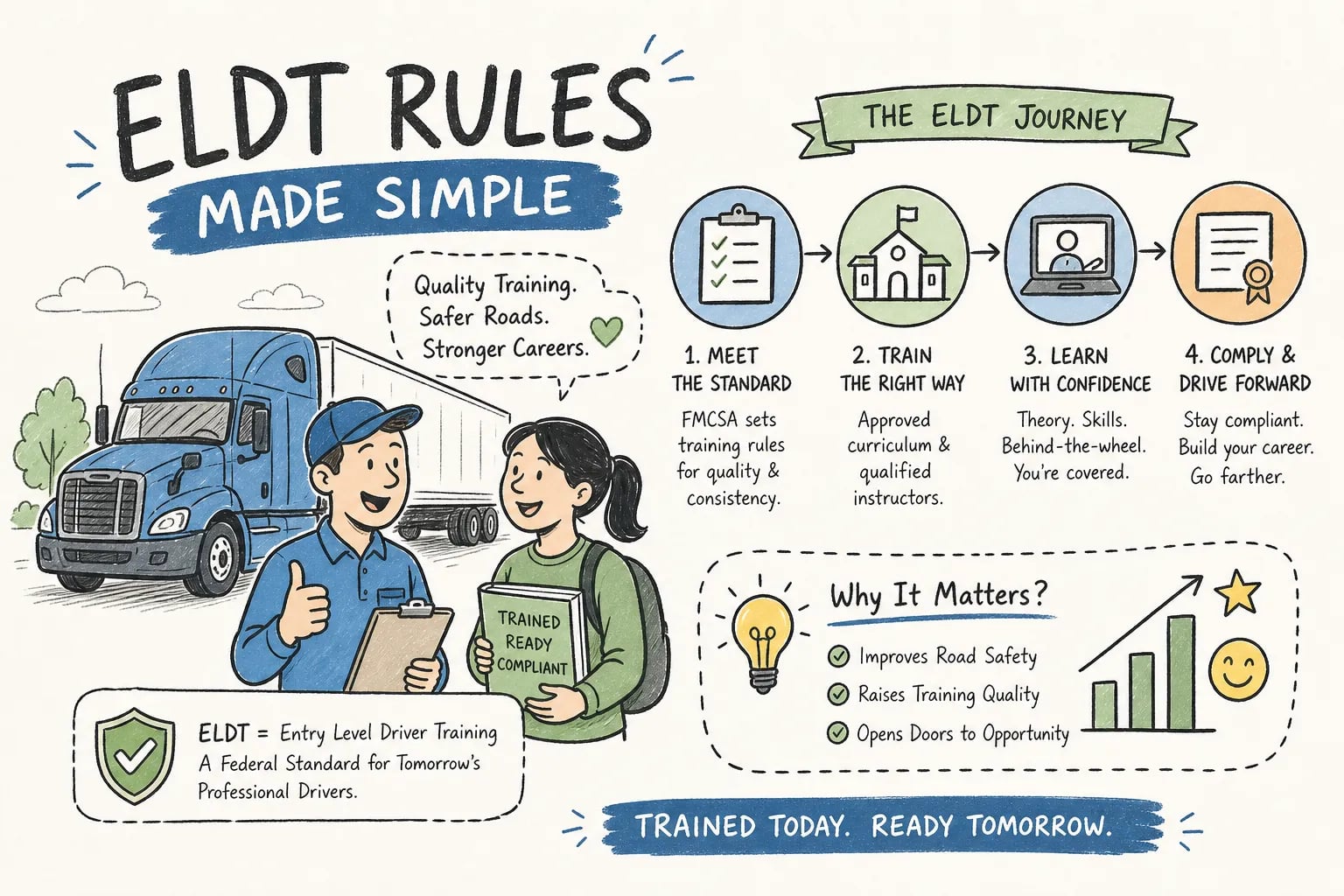
Since February 7, 2022, FMCSA ELDT rules require new CDL applicants to complete federally mandated training from a provider listed on the FMCSA Training Provider Registry before any applicable test can be scheduled. Before that date, a candidate could study the state manual, pass the written knowledge test, and schedule the skills test without any federal training requirement standing in between. That changed when FMCSA's Entry-Level Driver Training regulation took full effect. The process now has an additional step that neither drivers nor training providers can skip.
This article walks through everything that matters about ELDT: who the rules apply to, what the training actually requires, how providers get authorized, and what happens when someone misses a step. Whether you're a CDL candidate trying to understand your obligations, an ELDT student preparing for the theory assessment, or a school administrator navigating the registration process, this is the full picture in plain language. CDLTest360's platform was built around FMCSA ELDT regulations, which means the content here is grounded in the same curriculum framework your training is measured against.
What the FMCSA ELDT rule is and where it came from
FMCSA published the Entry-Level Driver Training rule to create a consistent federal baseline for CDL preparation across all 50 states. Before the rule existed, CDL training quality varied significantly depending on where a driver lived and which school they attended. Some programs were thorough; others were minimal. For vehicles that can weigh up to 80,000 pounds on public roads shared with passenger cars and pedestrians, that inconsistency created safety risks the agency addressed with a uniform minimum curriculum.
The rule's compliance date was originally set for February 7, 2020. FMCSA later extended that deadline to February 7, 2022, giving states and providers more time to build out the Training Provider Registry infrastructure and registration processes. The second date held. Since then, states are required to verify ELDT completion through the TPR before administering the relevant knowledge or skills tests.
Why FMCSA created a federal training standard
The core problem the rule addresses is straightforward: without a federal standard, two drivers in different states could both hold a Class A CDL but have gone through entirely different training experiences. One driver may have received comprehensive behind-the-wheel time and thorough theory instruction. Another may have done the bare minimum required by their state at the time. FMCSA's answer was to define the minimum curriculum content that every new commercial driver must complete, regardless of state or school, so that "CDL holder" means something consistent across the country. A commercial motor vehicle traveling at highway speed requires a specific set of skills and knowledge to operate safely, and the ELDT rule is FMCSA's mechanism for ensuring every first-time CDL holder has that foundation verified before they take the wheel professionally.
What changed when February 7, 2022 arrived
Before that date, no federal training curriculum was required for CDL applicants. State requirements existed, but they varied. After February 7, 2022, any driver who obtained a Commercial Learner's Permit on or after that date must complete ELDT from a registered provider before taking the CDL skills test or, in the case of the Hazardous Materials endorsement, before taking the relevant knowledge test. The rule is not retroactive, meaning drivers who already held a CDL before that date don't need to go back and redo anything to remain licensed.
Which drivers and endorsements fall under ELDT requirements
Not every CDL holder needs to complete ELDT, and the specific training required depends on the credential being sought. Understanding which category you fall into determines the exact training components you must complete and which test the TPR verification gates.
CDL classes that require both theory and behind-the-wheel training
Three groups must complete both the theory and behind-the-wheel components before taking the CDL skills test. First-time Class A CDL applicants, first-time Class B CDL applicants, and Class B holders upgrading to Class A all fall into this category. For all three, the TPR verification happens before the skills test, meaning the state DMV won't schedule that test until the provider has submitted a completed training record to the registry.
Endorsements covered by the ELDT rule
Three endorsements trigger ELDT requirements: Passenger (P), School Bus (S), and Hazardous Materials (H). The P and S endorsements require both theory and behind-the-wheel training, similar to the Class A and B CDL requirements. The H endorsement differs in one important way: it requires theory training only, with no behind-the-wheel component. Some drivers miss this distinction and either over-prepare for BTW requirements that don't apply to them or, more problematically, assume the process works the same way it does for their CDL class.
Which credentials are tied to a knowledge test vs. a skills test
For Class A, Class B, Passenger, and School Bus credentials, ELDT must be completed before the skills test. The state verifies TPR completion status at that point in the process. For the Hazardous Materials endorsement, ELDT theory must be completed before the knowledge test. This is a meaningful difference: the TPR check happens earlier in the process for H than it does for the other covered credentials, so ELDT students pursuing Hazmat need to account for that timing when planning their schedule.
ELDT vs. ELD: what's the difference?
ELDT and ELD are two separate federal requirements that are easy to confuse because both abbreviations appear in trucking regulations. ELDT stands for Entry-Level Driver Training and refers to the federally mandated curriculum new CDL applicants must complete before testing. ELD stands for Electronic Logging Device, the hardware commercial carriers use to automatically record hours of service. One is a training standard for new drivers; the other is a compliance tool for active carriers. They operate under different regulatory frameworks and have no direct connection to each other.
Who is exempt from ELDT and what "not retroactive" actually means
A significant portion of people who read about ELDT are trying to figure out whether it applies to their specific situation, especially if they already hold a CDL or had a CLP in process when the rule took effect. For most of those readers, the short answer is that they are not affected.
The pre-2022 CLP exemption explained
Drivers who received a CLP before February 7, 2022, and complete the CDL process before that CLP (or any renewal of it) expires are not subject to ELDT for that credential. To make this concrete: a driver who received their CLP in November 2021 and passed their CDL skills test in March 2022 does not need ELDT, because the CLP predates the compliance date. The rule attaches to when the CLP was issued, not when the skills test was taken.
Other categories that don't need ELDT
Military personnel who qualify under applicable federal exemptions may not be required to complete ELDT for their CDL. Individuals who qualify for a skills test exception under 49 CFR Part 383, such as certain experienced drivers with documented professional backgrounds, are also exempt. Drivers who are not required to hold a CDL under Part 383 at all fall outside the rule's scope entirely. Certain restricted CDL applicants under specific regulatory subsections may also have different requirements. If you're in any of these categories, checking your state's DMV guidance alongside the FMCSA regulations is the right move.
What ELDT theory training actually requires
Theory training under ELDT is one of the most misunderstood parts of the regulation, largely because of what it doesn't have: a minimum hour requirement. FMCSA does not mandate a specific number of classroom or online hours for theory. What it does require is that providers cover all required curriculum topics and that trainees pass a provider-administered assessment with a score of at least 80%. The emphasis is on demonstrated knowledge, not seat time.
The five required theory curriculum areas
The ELDT theory curriculum organizes required content into five major areas:
-
Basic Operation, control systems, pre-trip and post-trip inspections, basic vehicle control, shifting, and backing and docking
-
Safe Operating Procedures, visual search, communication, distracted driving, and space and speed management
-
Advanced Operating Practices, night driving, extreme weather conditions, hazard perception, and skid control and recovery
-
Vehicle Systems and Reporting Malfunctions, engine systems, brake systems, malfunction diagnosis, and roadside inspection procedures
-
Non-Driving Activities, cargo handling, hours of service, fatigue management, environmental compliance, and post-crash procedures
This is a broad and specific curriculum. Students who walk into the theory assessment without structured preparation are likely to find gaps in areas they assumed they understood, particularly around detailed inspection procedures, hours-of-service rules, and emergency response protocols.
The 80% passing threshold and what happens if you don't reach it
The theory assessment is administered by the training provider, not by the state DMV. Trainees must score 80% or higher overall before the provider can submit a certification record to the TPR. If a student doesn't reach that threshold, the provider cannot certify completion, and the path to the skills or knowledge test stays blocked until the student retests and passes. This makes the theory assessment a meaningful gate, not a formality.
How CDLTest360 maps directly to ELDT theory requirements
CDLTest360's quiz modules and question bank are designed to align with the five FMCSA ELDT curriculum areas, so students using the platform are drilling the same subject matter the theory assessment covers. The missed-question review system identifies knowledge gaps and loops students back through only the topics they got wrong, making study time more targeted than reviewing an entire manual from scratch. For ELDT students who want to walk into their provider's assessment fully prepared, CDLTest360 functions as an FMCSA-aligned study companion built around the same curriculum areas the assessment tests. The content tracks the regulation's structure, which means practice sessions are focused on what the assessment actually measures rather than general trucking trivia.
Behind-the-wheel training: what "proficiency" really means
Like the theory component, BTW training under ELDT has no federally mandated minimum hours. FMCSA requires that instructors cover all required BTW topics and document that the trainee demonstrated proficiency in each one. Training duration varies by student because the standard is performance-based, not time-based. A student who picks up skills quickly may complete BTW training sooner than one who needs additional practice, and both paths are compliant as long as proficiency is documented for every required element.
Range training vs. public road requirements
BTW training happens in two distinct environments, and both are required for most CDL credentials. Range training takes place in a controlled area and covers maneuvers like backing, docking, coupling and uncoupling, and other off-road skills. Public road training puts the student in actual highway and street driving conditions. The training provider determines when a student is ready to move from the range environment to public roads, and that progression is based on demonstrated skill, not a fixed timeline.
Why simulators alone cannot satisfy BTW requirements
FMCSA is explicit on this point: simulator use cannot satisfy the behind-the-wheel requirements for ELDT compliance. Trainees must operate an actual commercial motor vehicle in the required vehicle type on an actual range or public road. Simulators may supplement instruction and are permitted as part of theory training, but they cannot replace the required BTW component for ELDT purposes. This is a practical detail that matters for both students evaluating programs and schools designing curriculum. A program that relies heavily on simulation for BTW competency is not meeting the federal standard.
How instructors document and certify BTW proficiency
Instructors assess each required BTW element individually. There is no single test score for the behind-the-wheel component the way there is for the theory assessment. Instead, the instructor must document that the trainee achieved proficiency in every required topic before the provider can submit the certification record to the TPR. This proficiency-based documentation is what states are relying on when they verify ELDT completion. It places real accountability on both the instructor's judgment and the training provider's recordkeeping.
How training providers register on the FMCSA Training Provider Registry
A provider must be listed on the Training Provider Registry before it can certify any ELDT completion. Registration is a two-step process, and both steps must be completed before any student's training record can be submitted. Providers operating outside the TPR cannot legally function as ELDT training providers, meaning any training completed with an unregistered provider is uncertifiable.
Step 1: Company-level registration through Login.gov
One representative from the organization creates or uses an existing Login.gov account to register the company with FMCSA. During this step, the provider self-certifies that it meets ELDT eligibility requirements covering curriculum, instructors, facilities, and applicable state licensing. FMCSA reviews the submission and sends an email once the review is complete. The agency does not publish a fixed turnaround time for this approval, so providers planning to launch a program should factor in an open-ended review window and not assume same-day or next-day approval.
Step 2: Registering each training location separately
After company-level approval, the provider logs back into the TPR portal to register each physical training location individually. A completion record for a student cannot be submitted until the specific location where that training was conducted is registered and approved. Providers operating multiple locations must complete this step for every site. Skipping location registration for even one facility means students trained there cannot have their completions certified, regardless of how thorough the training was.
What the self-certification requirement actually covers
The self-certification isn't a passive checkbox. Providers attest that they meet the requirements in 49 CFR 380.703, which includes maintaining qualified instructors, having adequate facilities for the vehicle type being trained, and delivering a curriculum that complies with FMCSA's ELDT standards. Misrepresenting qualifications during self-certification carries real consequences. FMCSA's primary enforcement mechanism is removal from the Training Provider Registry, which effectively shuts down a provider's ability to operate as a federally recognized training program. That outcome makes the self-certification process one that schools should treat seriously from day one.
Certifying completed training and what happens when providers don't comply
Once training is complete, the provider has a narrow window to act. Certification records must be submitted to the TPR by midnight of the second business day after the student completes training. Until that record appears in the registry, states cannot verify ELDT completion, and the driver cannot move forward with scheduling their test.
The two-business-day submission deadline
The two-business-day window is not a guideline. It's a regulatory requirement. If a student completes training on a Friday, the provider must submit the certification record by midnight on Tuesday of the following week. The submitted record must include:
-
Driver's name and date of birth
-
License number and issuing state
-
CDL class or endorsement sought
-
Type of training completed
-
Total BTW clock hours, if applicable
-
Date of successful completion
Every field matters because the state DMV queries the TPR electronically to verify the record before scheduling the test.
Consequences for drivers when providers lag on submissions
FMCSA's regulations do not impose a penalty on the driver if the provider fails to submit on time, but the practical consequence is the same as if the driver hadn't completed training at all: the test cannot be scheduled. That delay can cost a driver a job start date, push back enrollment timelines at a CDL school, or cause them to miss a DMV appointment they've already waited weeks to secure. Before enrolling in any ELDT program, ask the provider directly how they handle TPR submissions and how quickly they submit records after a student finishes. A provider that can't answer that question clearly is worth reconsidering.
Consequences for providers who repeatedly miss deadlines
Providers who routinely fail to submit completion records on time may be removed from the Training Provider Registry. Removal means the provider can no longer certify ELDT completions and can no longer operate as a recognized federal training program. This is FMCSA's primary compliance enforcement tool, and it's a significant consequence for any school that treats submission deadlines casually. For CDL schools building out their programs, establishing a reliable submission workflow from the start is not optional. It's part of what it means to operate on the TPR.
ELDT compliance checklist by credential type
Everything covered above comes down to a specific sequence of steps that varies depending on which credential or endorsement you're pursuing. Knowing the sequence in advance prevents the most common mistakes, including enrolling with an unregistered provider, misjudging when TPR verification is required, or underestimating the theory assessment.
Class A and Class B CDL compliance steps
The sequence for a first-time Class A or Class B CDL applicant is straightforward once you see it laid out:
-
Obtain your CLP on or after February 7, 2022.
-
Enroll with a provider listed and approved on the FMCSA Training Provider Registry.
-
Complete all required theory training and pass the provider's assessment with a score of 80% or higher.
-
Complete all required behind-the-wheel training on both a range and public road, demonstrating proficiency in every required element.
-
Wait for the provider to submit your certification record to the TPR within two business days of completion.
-
Schedule your CDL skills test only after the TPR record is confirmed.
Each step depends on the one before it. The most common pitfall is discovering a provider registration gap at step two, after a driver has already committed time and money, which is exactly why verifying TPR status before enrolling is worth the few minutes it takes.
Hazardous materials, passenger, and school bus endorsement steps
The H endorsement path differs meaningfully from the P and S paths. For Hazardous Materials, only theory training is required, and the TPR verification happens before the knowledge test, not the skills test. For Passenger and School Bus endorsements, both theory and BTW training are required, and the TPR verification gates the skills test. Drivers pursuing the H endorsement sometimes assume the process mirrors their CDL experience, but the timeline is different because the check happens at an earlier stage in the licensing process.
How to verify your provider is listed on the TPR before you enroll
Before committing to any ELDT program, search the FMCSA Training Provider Registry online to confirm the provider is listed and that the specific training location where you'll receive instruction is registered. The search typically takes only a few minutes. If the provider isn't listed, any training completed there cannot be certified, and you'll have to start the process over with a registered provider. Protecting weeks of training time and tuition cost starts with that one verification step before you ever sign an enrollment agreement.
Before you enroll: three things that keep your path clear
Following the FMCSA ELDT rules comes down to getting three things right before training begins, not after. First, confirm your provider is listed on the Training Provider Registry and that the specific training location is registered. Second, complete both required theory and BTW components in order, and don't underestimate the 80% theory threshold. Third, ask your provider directly about their TPR submission timeline before you start, a provider that can't give you a clear answer is worth reconsidering before you invest your time and money.
For the theory portion, preparation makes a measurable difference. The curriculum is specific, and walking into the provider assessment without targeted practice is a risk that's easy to avoid. CDLTest360's quiz modules are structured around the same five FMCSA ELDT curriculum areas the assessment tests, so every practice session reinforces what actually matters. You can start practicing without creating an account, and the missed-question drill system keeps study time focused on real gaps rather than content you've already mastered. Get the provider verification right, follow the sequence, and the path to your CDL stays clear.
{ "@type": "Article", "datePublished": "2026-09-29T11:02:10.940Z", "dateModified": "2026-09-29T11:02:10.940Z", "headline": "FMCSA ELDT Rules Explained for Drivers and Schools", "description": "FMCSA ELDT rules apply to every new CDL applicant since Feb 2022. Learn who's covered, what training requires, and how to verify your provider. Start here.", "publisher": { "@type": "Organization", "name": "CDLTest360" }, "image": [ ] }