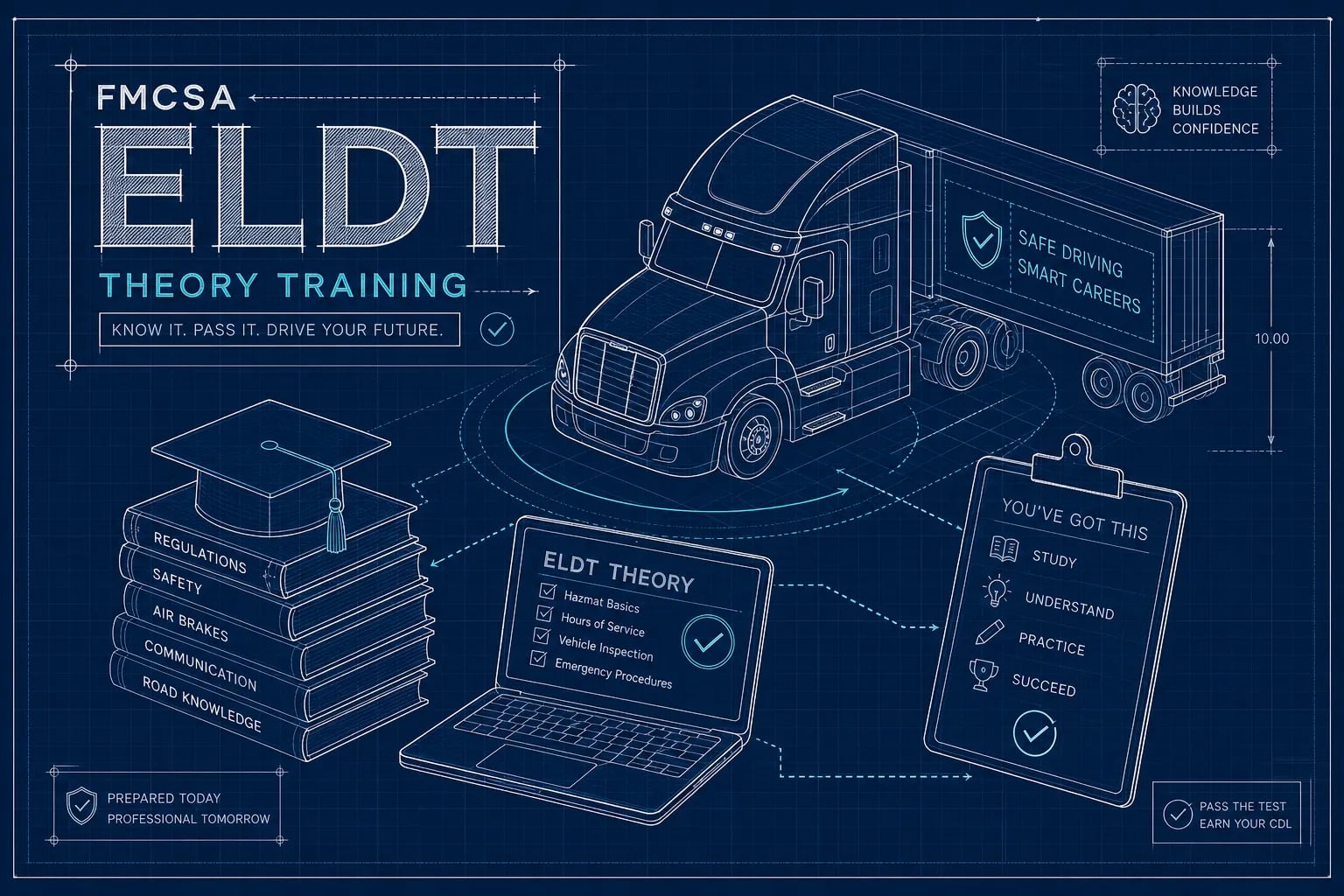
Most new CDL candidates hear "you need ELDT theory" and immediately run into a wall of federal regulation language that explains the rule but never tells them what to do next. If you're trying to get FMCSA entry level driver training theory explained in plain terms, you're in the right place. The Entry-Level Driver Training theory requirement is a real, federally mandated step you cannot skip, but it's far more manageable than it sounds once someone breaks it down clearly.
Below you'll find who needs ELDT theory training, what the five federal curriculum areas actually include, how the assessment works, why there's no minimum hour requirement (and what actually matters instead), and how to find and verify a compliant training provider. You'll also see how CDLTest360 was built around these FMCSA theory topics, giving you a structured way to build mastery before you sit for that provider assessment.
Who actually needs to complete FMCSA entry level driver training theory (and who's already exempt)
The CDL classes and endorsements that require theory training
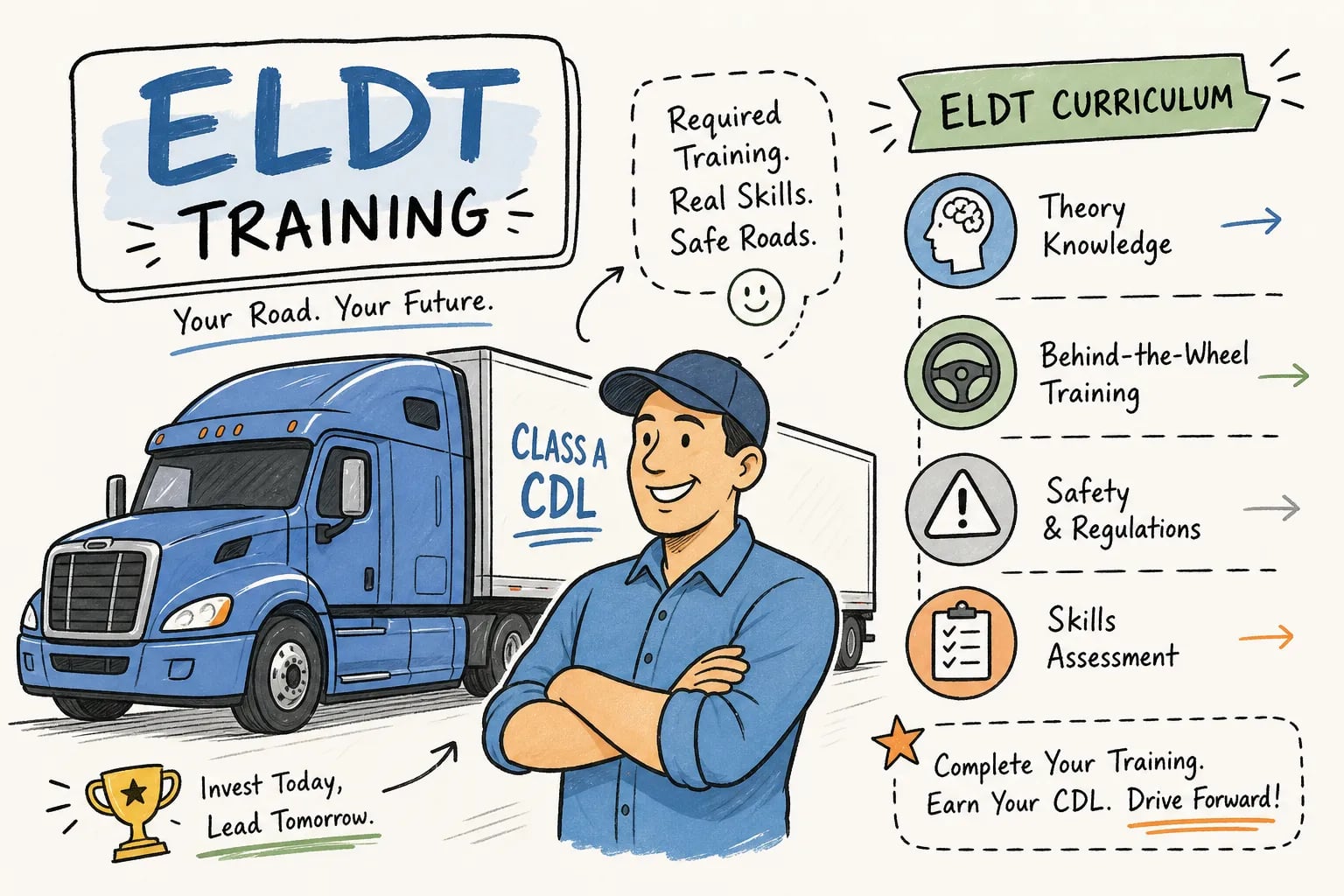
FMCSA's ELDT requirement applies to anyone seeking a Class A CDL, Class B CDL, or a Class B to Class A upgrade for the first time. It also covers drivers adding a Passenger endorsement, a School Bus endorsement, or a Hazardous Materials endorsement. Each of these categories requires theory training because they involve operating vehicles in conditions that carry significant public safety risk, and FMCSA determined that a standardized knowledge baseline was non-negotiable before candidates ever get near the skills test.
The Hazmat endorsement works differently from the rest: it requires theory only, with no behind-the-wheel training component. Every other CDL class and endorsement on that list requires both theory and behind-the-wheel instruction from a TPR-listed provider. Understanding which bucket you fall into matters because it affects how much time and cost your full ELDT requirement will take.
The February 7, 2022 cutoff and skills-test exemptions
ELDT is not retroactive. If you already held the relevant CDL or endorsement before February 7, 2022, you are not required to go back and complete ELDT for that category. The rule only applies to drivers obtaining that license class or endorsement for the first time after the effective date. This is a common source of confusion for experienced drivers upgrading to a different class or adding an endorsement they didn't previously hold.
There's also a skills-test exemption under 49 CFR Part 383 that waives the ELDT requirement for qualifying drivers. If you fall under one of those specific exemption categories, you're not subject to the training mandate. If you're not sure whether either exemption applies to you, check directly with your state's driver licensing agency before enrolling in any course.
The five topic areas FMCSA requires you to cover in theory training
Basic operation and safe operating procedures
The first two major curriculum areas cover what most people picture when they think about driver training. Basic operation includes vehicle orientation, control systems and dashboard functions, pre- and post-trip inspections, fundamental vehicle control, shifting and transmission operation, backing and docking maneuvers, and coupling and uncoupling procedures. These aren't optional topics a provider can trim to save time; every item in the curriculum must be covered for ELDT training to count.
Safe operating procedures build directly on that foundation. This block covers visual search techniques, communication with other road users, distracted driving awareness, speed management, space management, night operation, and driving in extreme weather or road conditions. Together, these two topic areas represent the core of what it means to operate a commercial vehicle safely on public roads, which is exactly why FMCSA made them the first two pillars of the curriculum.
Advanced practices and vehicle systems
Advanced operating practices move into higher-stakes scenarios: hazard perception, skid control and recovery, jackknifing prevention and response, other emergency procedures, and railroad-highway grade crossing protocols. Commercial vehicle crashes often hinge on whether a driver recognized a developing hazard in time to respond correctly. Understanding these concepts at the knowledge level is what the theory curriculum tests, even before a driver faces them on the road.
Vehicle systems and reporting malfunctions covers the mechanical side: identifying vehicle systems, recognizing malfunction indicators, understanding what happens during a roadside inspection, and basic maintenance awareness. This area is sometimes underestimated by candidates who think it's just "knowing where things are," but inspectors and examiners expect drivers to demonstrate a practical understanding of how their vehicle functions and what warning signs demand attention.
Non-driving activities: HOS, fatigue, cargo, and more
The non-driving activities block is where a lot of first-time candidates are surprised by the depth of what's covered. Hours of service and fatigue management are emphasized throughout this section per FMCSA's curriculum requirements under 49 CFR Part 380, and they carry serious compliance weight in real trucking careers. An HOS violation isn't just a test question; it's an enforcement matter under 49 CFR Part 395 that can affect a carrier's safety rating and a driver's record.
Beyond HOS, this topic area includes:
-
Cargo handling and documentation
-
Environmental compliance
-
Post-crash procedures
-
External communications
-
Whistleblower and coercion protections
-
Trip planning
-
Drug and alcohol awareness
-
Medical requirements
FMCSA built this section to make clear that commercial driving responsibilities start before the truck moves and end well after it stops.
Why FMCSA sets no minimum hour requirement (and what the real standard is)
The 80% assessment threshold is the actual benchmark
Here's something that surprises most new CDL candidates: FMCSA does not set a minimum number of training hours for the theory portion of ELDT. Per 49 CFR Part 380 and the FMCSA ELDT final rule, the federal standard requires that all required topics are covered and that the trainee passes the theory assessment with a minimum score of 80%. The focus is on topic-level competency, not time served in a classroom or in front of a screen.
This reframes how you should approach ELDT theory preparation. The question isn't "how many hours do I need to log?" It's "do I actually understand the material well enough to score 80% or above on the assessment?" Some providers set their internal cutoff higher than 80%, which only raises the bar further. Either way, demonstrated knowledge is what unlocks the next step in your CDL process.
What determines how long theory training realistically takes
Without a federal hour floor, training timelines vary by provider format and individual pace. In practice, most candidates complete the theory portion in somewhere between 10 and 31 hours of focused study, typically about two to seven days working full-time or one to three weeks fitting it around an existing job. Online, self-paced formats tend to be more efficient for students who are disciplined and self-directed.
A student who uses targeted practice tools alongside the course content can move through the five topic areas faster than one who relies on passive reading alone. The absence of a minimum hour requirement is actually an opportunity: if you study smart and can demonstrate competency, you're not penalized for being efficient. That said, don't mistake "no hour minimum" for "no effort required." The five topic areas are substantial, and the 80% threshold is a real standard.
How the ELDT theory assessment works before you hit the DMV
Provider-administered assessment vs. the state CDL knowledge test
One of the most common points of confusion is the relationship between the ELDT theory assessment and the CDL knowledge test at the state testing center. These are two separate steps. The ELDT theory assessment is administered by your registered training provider, not by the DMV or state licensing agency. Providers submit your completion record to the Training Provider Registry, and states verify that record before granting access to the applicable test.
For Class A and Class B CDLs and the Passenger and School Bus endorsements, ELDT completion must be verified before the state administers your skills test. For the Hazmat endorsement, ELDT completion must be verified before the state administers the hazmat knowledge test. These are sequential requirements, not parallel ones, ELDT completion comes first.
When ELDT completion unlocks your next step
Once your provider submits your completion to the Training Provider Registry, that record links to your CDLIS driver record, which is what state licensing agencies check before granting you access to the applicable test. The process is designed to be seamless when providers follow through on their reporting obligations. ELDT certification carries no federal expiration date, making it a one-time requirement per category. You complete it once, it's on your record, and you don't repeat it for the same license class or endorsement.
Online ELDT theory courses: what FMCSA allows and what it doesn't
Online delivery is federally accepted for theory
FMCSA explicitly permits the theory portion of ELDT to be completed online. Registered providers can deliver the full theory curriculum digitally as long as the content is developed and delivered by instructors who meet the FMCSA definition under 49 CFR 380.605. This makes online ELDT theory a legitimate, compliant option for candidates who need flexibility around work schedules or geography. You don't have to be sitting in a physical classroom to meet the federal requirement for the theory portion.
For career changers who are still working another job while they prepare for their CDL, this is particularly useful. Self-paced online theory training means you can study in the evenings or on weekends without waiting for the next available classroom cohort to form at a local school. As long as the provider is listed on the TPR and the content meets FMCSA curriculum standards, online delivery is fully compliant.
What must still happen in person
The firm line is this: behind-the-wheel training cannot be completed online, period. The practical, range, and public road components require in-person instruction from a TPR-listed provider regardless of how theory was delivered. An online theory course handles the knowledge portion of ELDT, and that's it. You still need a registered provider with a physical location and qualified range and road instructors to fulfill the behind-the-wheel requirement for Class A, Class B, and the P and S endorsements.
Understanding this distinction up front prevents a common and costly mistake: assuming an online course covers everything. It covers theory. For Hazmat, that's the full ELDT requirement. For everything else, you still need to show up in person for the hands-on portion.
The Training Provider Registry: the list that controls your CDL eligibility
What the TPR is and why your provider must be on it
The Training Provider Registry is FMCSA's official federal database of ELDT-compliant training providers. If a provider is not listed there, their training does not count toward CDL eligibility. That's not a technicality or a small risk; completing a course with an unlisted provider is the same as not completing ELDT at all, from the state licensing agency's perspective. Before you enroll in any theory course, online or in-person, confirm the provider is on the TPR.
You can search the TPR directly on FMCSA's website using the "Find a Provider" tool. Search by the provider's name, state, or location, and confirm they're listed for the specific training type you need.
A provider may appear in the registry for some curricula but not others, so verify the exact category. If the provider doesn't appear, don't enroll. Contact the TPR Team through FMCSA if you're already enrolled with a provider who isn't showing up in the registry.
The 48-hour reporting rule and how completion flows to your record
Once you complete ELDT theory training, your provider is required to submit your completion data to the TPR by midnight of the second business day after training ends. That record then links to your CDLIS driver record, which state licensing agencies use to verify your eligibility before allowing you to sit for the applicable test. The process is designed to be fast and automated when it works correctly.
When a provider is slow or disorganized about reporting, it can delay your test appointment. The candidate isn't penalized for the provider's failure to report on time, but you may find yourself waiting to schedule a test because your record hasn't been updated yet. This is one practical reason why choosing an active, reliable TPR-listed provider matters beyond just checking a box. Look for providers with a demonstrated track record of timely reporting, not just active TPR registration.
How to prepare for ELDT theory topics without wasting study time
Align your study directly to the five curriculum areas
The most efficient approach to entry-level CDL theory training is to map your study sessions directly to the five FMCSA curriculum areas rather than reading the full state CDL manual cover to cover and hoping the right information sticks. Each topic area has specific concepts the assessment draws from, and targeted practice consistently outperforms passive review. Students who drill topic by topic identify weak spots faster, which means they can correct knowledge gaps before they show up as wrong answers on the assessment.
This is especially important for candidates managing preparation around an existing work schedule. If you only have 45 minutes on a Tuesday evening, spending that time on focused practice in a specific topic area beats skimming a broad chapter of the manual. Time is the resource most CDL candidates have the least of, and how you spend it determines whether you hit that 80% threshold on the first attempt or end up needing a retake.
How CDLTest360 maps to these exact FMCSA theory topics
CDLTest360 is built around the ELDT curriculum, topic-specific quiz modules map directly to each of the five required theory areas, so you're always drilling content that actually appears on provider assessments. The missed-question review system automatically isolates every question you answered incorrectly and re-drills only those, directing your study time toward real knowledge gaps rather than material you already know.
The platform includes a timed exam simulation mode, a 50-question practice format with an 80% passing threshold, designed to replicate the pressure of a real assessment environment. Facing a clock during practice means the actual provider assessment isn't the first time you've worked under those conditions. CDLTest360 also makes state-specific CDL manuals available inside the platform, which helps you reconcile any differences between federal ELDT curriculum standards and your state's specific requirements. A free trial is available so you can get into the material right away and see where your knowledge actually stands.
Using practice tools alongside a registered provider's course
CDLTest360 is a study and preparation platform. That distinction matters: building mastery of ELDT theory topics through targeted practice is valuable, but it doesn't fulfill the federal ELDT requirement on its own. You still need to enroll with and complete training through a TPR-listed provider to meet the regulatory standard and have your completion submitted to FMCSA.
The combination approach is where candidates tend to see the strongest results. Your registered provider delivers the structured ELDT curriculum and submits your completion to the TPR. CDLTest360 runs alongside that process as your targeted practice layer, helping you drill the specific topic areas where you need the most work. Many students report feeling significantly more prepared going into the provider assessment after working through realistic practice simulations and identifying gaps ahead of time, rather than discovering those gaps during the real thing.
You now have a clear path through ELDT theory
FMCSA's ELDT theory requirement is federally mandated, well-defined, and completely manageable once you understand its structure. Five topic areas, no minimum hour requirement, an 80% assessment threshold, and a TPR-listed provider: those four elements define whether you've met the standard. Everything else is preparation strategy.
Start by confirming whether you need ELDT theory based on the CDL class or endorsement you're pursuing and when you're applying. Then search the Training Provider Registry to find and verify a listed provider for your specific training category. Once you know which provider you're working with, start building familiarity with the five FMCSA theory curriculum areas now, not the week before your assessment.
Now that FMCSA entry level driver training theory is explained, the next move is targeted practice. CDLTest360 is where to start drilling those topics today. The free trial gets you into the material immediately so you know exactly where your knowledge stands before you sit for the real thing. Strong preparation up front is what turns a compliance hurdle into a box you check on your way to a CDL.
{ "@type": "Article", "datePublished": "2026-09-13T11:01:50.837Z", "dateModified": "2026-09-13T11:01:50.837Z", "headline": "FMCSA ELDT Theory: What Every New CDL Driver Must Know", "description": "Confused by FMCSA ELDT theory requirements? Learn what topics are covered, who must complete training, how the assessment works, and how to study smart with CDLTest360.", "publisher": { "@type": "Organization", "name": "CDLTest360" }, "image": [ ] }