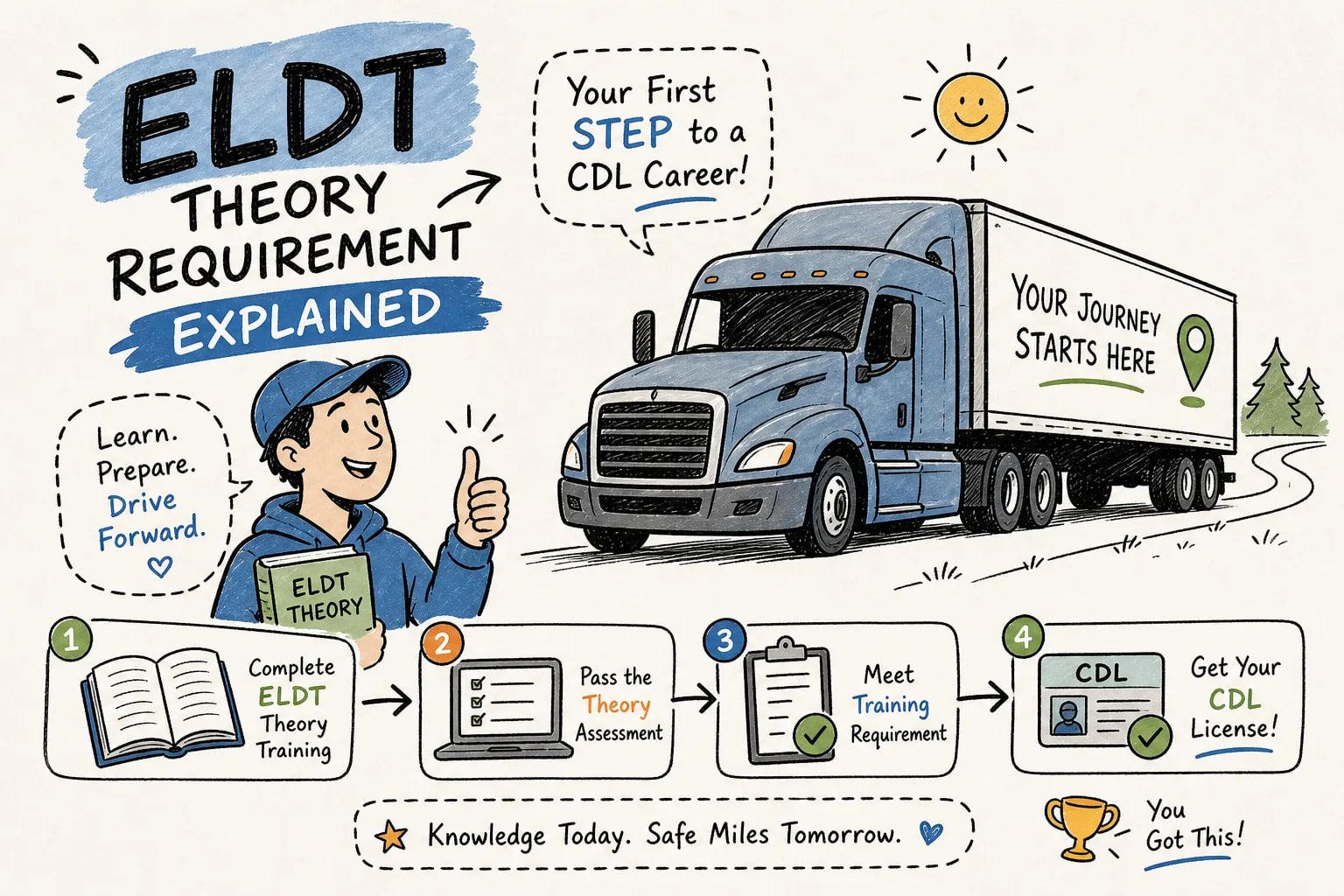
You've decided to get your CDL. You've read about the written test, the skills test, the CLP process, the fees. Then someone at the DMV counter or in a Facebook trucking group mentions "ELDT theory," and suddenly there's a whole federal regulation to untangle before you can move forward. This article gives you a plain-language breakdown of exactly what the ELDT theory requirement is, who has to complete it, what the curriculum covers, and how the documentation process connects to your actual CDL skills test.
It also helps to walk into your first class already familiar with the material. CDLTest360 covers the same subject areas outlined in 49 CFR Part 380, the same topics you'll encounter in any registered ELDT theory course. Using it to study before or alongside your official training gives you a real head start.
Who the ELDT theory requirement applies to
New CDL applicants after February 7, 2022
The Entry-Level Driver Training rule under 49 CFR Part 380 took effect on February 7, 2022. If you're applying for a Class A CDL, a Class B CDL, or any of the covered endorsements for the first time after that date, the ELDT theory requirement applies to you. This is a federal rule, which means it applies in all 50 states regardless of where you test or where your home state DMV is located.
Which licenses and endorsements trigger ELDT training
Five categories of CDL credentials require completion of ELDT theory training:
-
Class A CDL
-
Class B CDL
-
Passenger (P) endorsement
-
School Bus (S) endorsement
-
Hazardous Materials (H) endorsement
The H endorsement requires theory training only. The P and S endorsements require both theory and behind-the-wheel components. Class A and Class B require both components as well. Knowing this distinction matters when you're evaluating what a particular training provider's course actually includes.
Who is exempt
If you already held a CDL or the applicable endorsement before February 7, 2022, ELDT is not retroactive, you are not required to go back and complete it. This eliminates a lot of unnecessary confusion for experienced drivers who are adding an endorsement they held prior to that date.
ELDT theory requirement: official curriculum
The five core subject areas
The 49 CFR Part 380 appendices organize ELDT theory into five required subject areas. Every registered training provider must cover all of them. A course that skips even one area does not satisfy the federal requirement, so this list matters when you're evaluating your options:
-
Basic Operation
-
Safe Operating Procedures
-
Advanced Operating Practices
-
Vehicle Systems and Reporting Malfunctions
-
Non-Driving Activities
What's inside each subject area
Basic Operation covers the fundamentals: pre-trip and post-trip inspection, control systems, shifting, backing and docking, and for Class A applicants, coupling and uncoupling. Safe Operating Procedures moves into on-road judgment: visual search, speed and space management, distracted driving, night operation, and handling extreme conditions. Advanced Operating Practices covers hazard perception, skid control and recovery, jackknifing, and railroad-highway grade crossings.
Non-Driving Activities is the broadest area and the one that surprises most candidates. It includes hours of service requirements, fatigue and wellness awareness, drug and alcohol rules, cargo handling and documentation, post-crash procedures, trip planning, whistleblower and coercion rules, and medical requirements. This section covers the regulatory framework that governs a commercial driver's daily working life. Vehicle Systems and Reporting Malfunctions rounds out the curriculum with malfunction identification, roadside inspections, and basic maintenance awareness.
Class A vs. Class B differences
Coupling and uncoupling is a Class A-only theory topic because it applies specifically to combination vehicles. Class B applicants cover the same five subject areas but without that unit. When you compare courses from different providers, confirm the course matches your CDL class. A generic "CDL theory" course that isn't scoped to your specific Class A or Class B application may not satisfy the requirement for the license you're actually pursuing.
How the ELDT theory requirement assessment works
The 80% passing threshold
The federal standard is clear: you must score at least 80% overall on the theory assessment to satisfy the ELDT theory requirement. This is not a guideline or a suggestion. Training providers are required by federal regulation to use written or electronic assessments to verify proficiency before certifying a trainee's completion. There is no federal minimum number of training hours, which means the 80% score and complete curriculum coverage are the two non-negotiable benchmarks every trainee must meet.
What the assessment format looks like
FMCSA permits the theory assessment to be written or electronic, which is why many providers offer fully online theory courses. The assessment must cover all required topic areas, not a condensed version. Before enrolling, ask the provider directly whether their assessment covers every required curriculum unit. If they can't confirm that, look for another provider.
Retesting if you don't pass
Federal regulations do not specify a mandatory waiting period between attempts or a maximum number of retakes. Those policies are set at the provider level. Many providers allow additional attempts, but policies vary by provider, confirm the retake policy before you enroll, especially if your skills test is already on the calendar. There is one timing rule worth knowing: for Class A, Class B, Passenger, and School Bus ELDT, the theory and behind-the-wheel portions must both be completed within one year of whichever portion you started first.
How to find a legitimate registered provider
What the FMCSA Training Provider Registry is
The Training Provider Registry, known as the TPR, is the FMCSA-maintained database of all schools and programs approved to deliver ELDT training. Only providers listed in the TPR can legally certify that a driver has completed the required training. Enrolling with an unregistered provider means your training will not count, and your state DMV will not allow you to take the skills test. This is one of the most common and costly mistakes new CDL candidates make.
How to search and verify before you enroll
The TPR includes a public search tool on the FMCSA website. You can search by state, CDL class, or endorsement type to locate registered providers offering in-person or online delivery. Verify that the provider is listed for the specific training you need, not just listed in the registry in a general capacity. One important note: some online ELDT courses are not accepted in certain states due to state-level restrictions, Virginia and Washington are two examples that have come up in this context. Always cross-check with your state DMV before paying for a course, regardless of what the provider's website says.
Online theory training and state-level variations
FMCSA permits theory training to be completed online across all 50 states. The federal standard is the same everywhere: cover all required curriculum topics and pass with 80%. However, individual states can impose additional administrative requirements or acceptance rules on top of the federal baseline, Virginia and Washington are examples where state-level restrictions have affected certain online course options. Confirm your state's process before scheduling anything, and verify that any online provider's TPR listing explicitly covers your state and your CDL class or endorsement.
Getting documented after you finish: TPR submission and next steps
How providers report your completion
After you pass the theory assessment, your training provider is required to submit your completion record to the TPR no later than midnight of the second business day following your completion date. The record must include your name, CDL or CLP number, the class or endorsement you completed training for, the provider's TPR ID, and your completion date. You do not receive a paper certificate that you hand to the DMV. The electronic TPR record is what counts. Make sure you understand this before you finish your course, so you know exactly what to check afterward. Under FMCSA requirements, providers are also required to retain trainee assessment and completion records for at least three years (per 49 CFR Part 380).
How to check your own record in the TPR
The FMCSA TPR includes a "Check Your Record" tool. Enter your information exactly as it appears on your driver's license, CLP, or CDL. If your training provider submitted your record correctly, your completion will appear within the provider's two-business-day window. Check this before you attempt to schedule your CDL skills test. If the record is missing after that window has passed, contact your provider first to confirm submission. If problems persist, reach out to your state DMV or contact FMCSA directly for assistance.
Scheduling the CDL skills test
Your state driver licensing agency verifies ELDT completion through the TPR before allowing you to sit for the applicable skills test. Confirm your completion record is posted, verify your state's scheduling process, and then book your test. One clarification that confuses many candidates: for Class A and Class B, ELDT theory does not have to be completed before you obtain your CLP. However, both the theory and behind-the-wheel components must be fully completed before your skills test date. Knowing this timeline gives you flexibility in how you structure your preparation.
What to do right now
Here's the short version of what every new CDL driver needs to know about the ELDT theory requirement: confirm whether it applies to you based on your application date and the credential you're pursuing. Understand what the five curriculum areas require. Know that 80% is the pass threshold, with no federal limit on retakes. And verify your completion record in the TPR before scheduling your skills test.
Before you enroll in any course, use the TPR to confirm the provider is registered for your specific CDL class or endorsement in your state. Then use a study tool aligned to the ELDT curriculum to get familiar with the material before your first class session. CDLTest360's content is built around the 49 CFR Part 380 subject areas, general knowledge, air brakes, combination vehicles, pre-trip inspection, hazmat, and the regulatory framework that ties it all together. You can start practicing without creating an account.
In short, satisfying the ELDT theory requirement means completing all five required curriculum areas and passing the theory assessment at 80% or better before your CDL skills test. Getting familiar with that material early builds the knowledge that makes you a more confident, safer driver from your first day behind the wheel.
{ "@type": "Article", "datePublished": "2026-08-06T11:01:15.194Z", "dateModified": "2026-08-06T11:01:15.194Z", "headline": "ELDT Theory Requirement Explained: What Every New CDL Driver Must Know", "description": "ELDT theory requirement explained: who it applies to, the 5 curriculum topics, the 80% pass rule, how to verify providers, and document completion for your CDL skills test.", "publisher": { "@type": "Organization", "name": "CDLTest360" }, "image": [ ] }