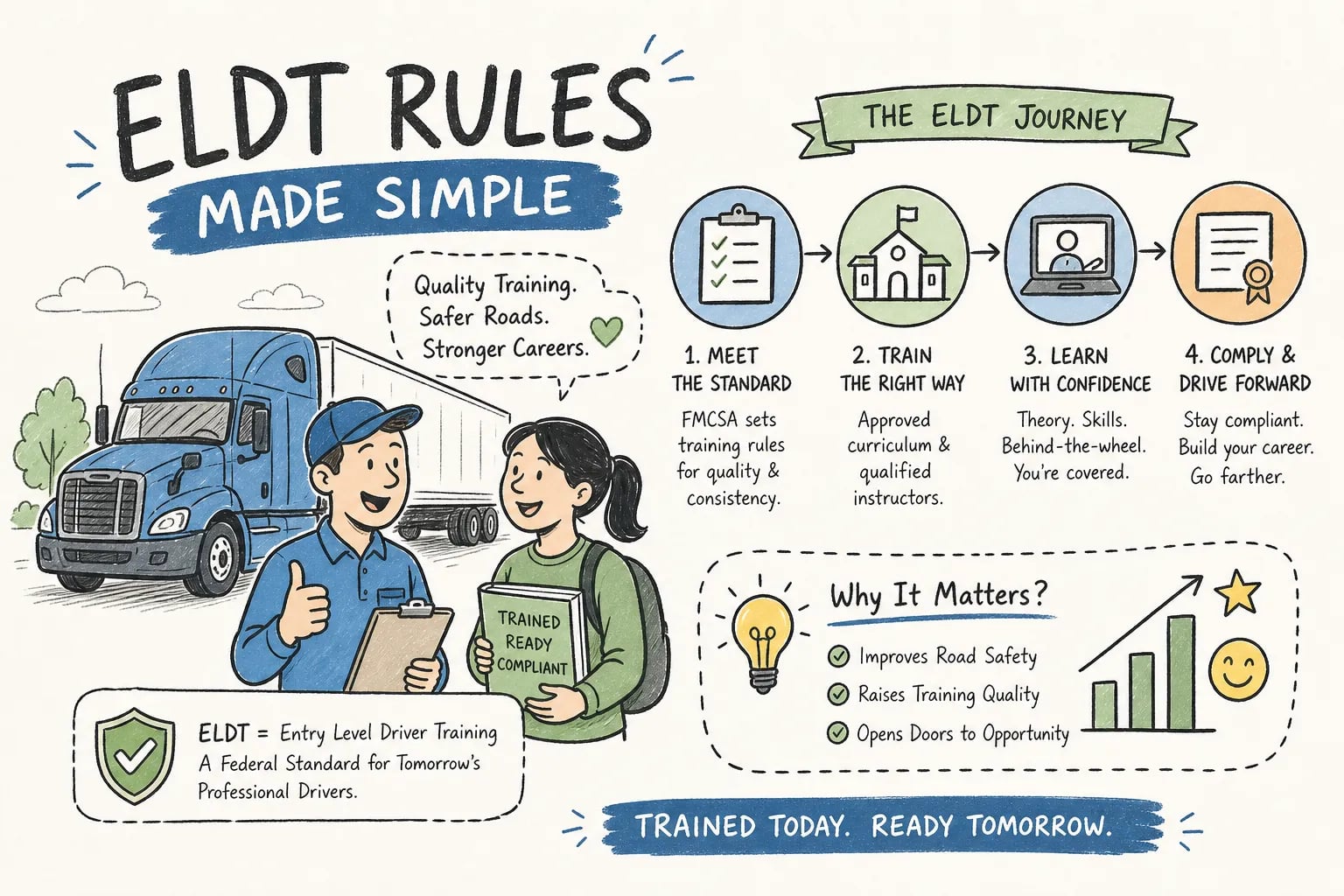
Since February 7, 2022, any driver applying for a Class A or Class B CDL for the first time must complete federally mandated entry-level driver training before scheduling a skills test. This is not a formality you can work around. If your training provider is not listed on a federal registry, the state DMV will not authorize your skills test appointment, regardless of how prepared you feel.
This article covers everything you need to get through the process without surprises: what the training actually requires, how the theory assessment works, what range and road driving looks like, how to verify a legitimate provider, what to expect to pay, and how to confirm your completion record before you show up at the testing lane.
What ELDT Is and Why FMCSA Created the Requirement
Before February 2022, there were no federal curriculum standards for first-time CDL applicants. A new driver could complete minimal formal instruction, walk into a testing facility, and attempt a skills test. FMCSA's entry-level driver training rule changed that by establishing a standardized minimum curriculum and requiring all training to come from providers listed on a federal registry called the Training Provider Registry (TPR). The stated goal was straightforward: reduce crashes caused by undertrained commercial drivers entering the workforce.
The requirement applies to first-time Class A and Class B CDL applicants, drivers upgrading from Class B to Class A, and anyone adding a school bus, passenger, or hazardous materials endorsement for the first time. If you already hold a CDL and are not adding one of those endorsements, you are generally exempt. If you are new to commercial driving entirely, completing your ELDT is the mandatory first step before any skills test can happen.
Entry-Level Driver Training: Theory Curriculum and Assessment
FMCSA's theory curriculum is organized into five required categories that every approved provider must cover: Basic Operation, Safe Operating Procedures, Advanced Operating Practices, Vehicle Systems and Reporting Malfunctions, and Non-Driving Activities. The specific topics within each category differ slightly between Class A and Class B, but the framework is the same for both.
Inside those five categories, you will work through material covering pre-trip inspections, shifting and backing, coupling and uncoupling (for Class A), hazard perception, speed and space management, hours of service, post-crash procedures, and cargo handling documentation, among other areas. It is a wide scope, and candidates who try to absorb it during formal training sessions often find themselves scrambling.
How the 80% Assessment Threshold Works
There is no federal minimum number of classroom hours for the theory portion. What FMCSA requires is that your provider covers every topic on the curriculum and that you score at least 80% on the theory assessment before the program is considered complete. Your provider cannot certify your completion until you clear that threshold, so showing up unprepared has a direct financial consequence: you either fail the assessment or burn additional time before you can retest.
Arriving already familiar with the FMCSA curriculum gives you a real advantage. CDLTest360 builds its content directly around FMCSA's ELDT theory topics, so you can work through the subject areas before or during formal training. Hitting 80% is far less stressful when the material is not brand new on assessment day. The platform's topic-specific quiz modules and missed-question review system let you target weak spots methodically, and you can start without creating an account.
Entry-Level Driver Training: Behind-the-Wheel Requirements
The behind-the-wheel portion of ELDT splits into two components. Range training covers controlled maneuvers in a yard or lot: straight-line backing, turns, parking, pre-trip inspection exercises, and, for Class A, coupling and uncoupling. Public road training puts you in actual traffic to practice lane changes, merging, speed adjustment, following distance, and navigating real conditions like intersections and highway entry ramps.
Both components must be completed in a vehicle that matches the group and type you plan to use for your CDL skills test. Training in one vehicle class and testing in another does not satisfy the requirement, and simulation devices cannot be substituted for actual range or road time.
How Instructors Determine When You're Ready
FMCSA does not set a federal minimum number of driving hours for behind-the-wheel training. The final rule removed hour minimums from the BTW component entirely. What matters is whether your instructor assesses you as proficient in all required tasks before certifying completion. In practice, some candidates finish in less time and others need more, depending on prior experience and skill level.
A reputable training provider will give you an honest read on where you stand before submitting your completion record. If an instructor is rushing you through sign-off before you are genuinely ready, treat that as a red flag. Skills test examiners are trained to find the gaps, and an incomplete foundation will show up under pressure.
How to Find and Verify a Training Provider Registry Listing
The FMCSA Training Provider Registry has a public search tool where you can look up providers by name, state, or location. Every provider that can legally certify ELDT completion must appear in this registry. If a school or online course is not listed, your completion record cannot be submitted to the state, and the DMV will not allow you to schedule a skills test. There are no exceptions.
Finding a provider in the TPR search results is not enough on its own. Before you enroll or pay anything, confirm three specific details:
-
The provider's legal name in the registry matches exactly what appears on their website and enrollment materials.
-
The training location you plan to attend is the location listed in the registry, not just the company's headquarters address.
-
The specific course type you need (Class A theory, Class B behind-the-wheel, etc.) is listed for that provider, since approval for one course type does not automatically extend to all of them.
Registry status can change. A provider that was listed six months ago may have lost approved status since then. Check the TPR directly and verify everything before you sign an enrollment agreement.
What ELDT Courses Cost in 2026
Online ELDT theory courses range from roughly $20 to $300 across TPR-listed providers, with most mainstream options clustering between $50 and $150. Some platforms are priced as low as $23, while school-branded online courses often run $99 to $250. Price variation reflects differences in course depth, platform quality, and provider reputation. A low price does not automatically mean a low-quality course, but read reviews and confirm the TPR listing before assuming any course will work for your state and CDL class.
Behind-the-wheel training is the larger financial commitment. Most CDL training programs charge between $2,500 and $6,000 for the driving component, and full school packages that bundle classroom and road time can run up to $8,000 depending on what is included. Before signing anything, confirm exactly what the quoted price covers: how many range hours, how many road hours, what happens if you need additional instruction time, and whether the skills test fee is included. Those details vary significantly across programs.
Completion Documentation and Scheduling Your CDL Skills Test
When you finish ELDT, your training provider submits an electronic completion record directly to the FMCSA Training Provider Registry. You do not mail paperwork to the DMV yourself. The state licensing agency accesses your record through the TPR when you request a skills test appointment, and if the record is accurate, they authorize the test. If it is missing or contains an error, the test does not happen that day.
Errors happen more often than they should. A provider may submit the record with a typo in your license number, a mismatched name, or the wrong course type. None of that is your fault, but it becomes your problem if you do not catch it before your test date. The TPR includes a "Check Your Record" page where you can look up your own completion status. Use it a few days after finishing your training, not the morning of your appointment. If there is a discrepancy, contact your provider immediately so they can correct the submission while you still have time to reschedule if needed.
Keep your enrollment confirmation and any certificate your provider issues until your CDL is in hand. If a dispute arises over what was submitted, that documentation supports your case.
Your Action Plan for Getting Through ELDT
The process has a clear sequence. Complete your theory training with a TPR-listed provider and score 80% or better on the assessment. Finish your behind-the-wheel training in the vehicle type you will use for your skills test. Then verify your completion record in the TPR registry before you book your test appointment. Each step depends on the previous one, and skipping the verification step is the most common avoidable mistake candidates make.
The 80% theory threshold catches people who assume they can wing the assessment. Knowing the material before training starts is a practical advantage, not extra work. CDLTest360 covers the full FMCSA ELDT theory curriculum through topic-specific quizzes, timed exam simulations, and a missed-question drill system that targets the areas where you actually need more work. Start building that foundation at CDLTest360.com, no account required.
Completing your entry-level driver training requirements opens the door to scheduling your skills test. The federal rules exist for a reason, and working through them in order is the most straightforward path from applicant to licensed CDL driver. Understand the process, use the right resources, and verify your record before you show up, that is how you avoid surprises at the testing lane.
{ "@type": "Article", "datePublished": "2026-08-06T11:01:21.229Z", "dateModified": "2026-08-06T11:01:21.229Z", "headline": "Entry-Level Driver Training (ELDT): What New CDL Drivers Need to Know", "description": "Learn what entry-level driver training requires, how FMCSA's ELDT rules work, and how to find a TPR-approved provider and complete your CDL training. Start here.", "publisher": { "@type": "Organization", "name": "CDLTest360" }, "image": [ ] }