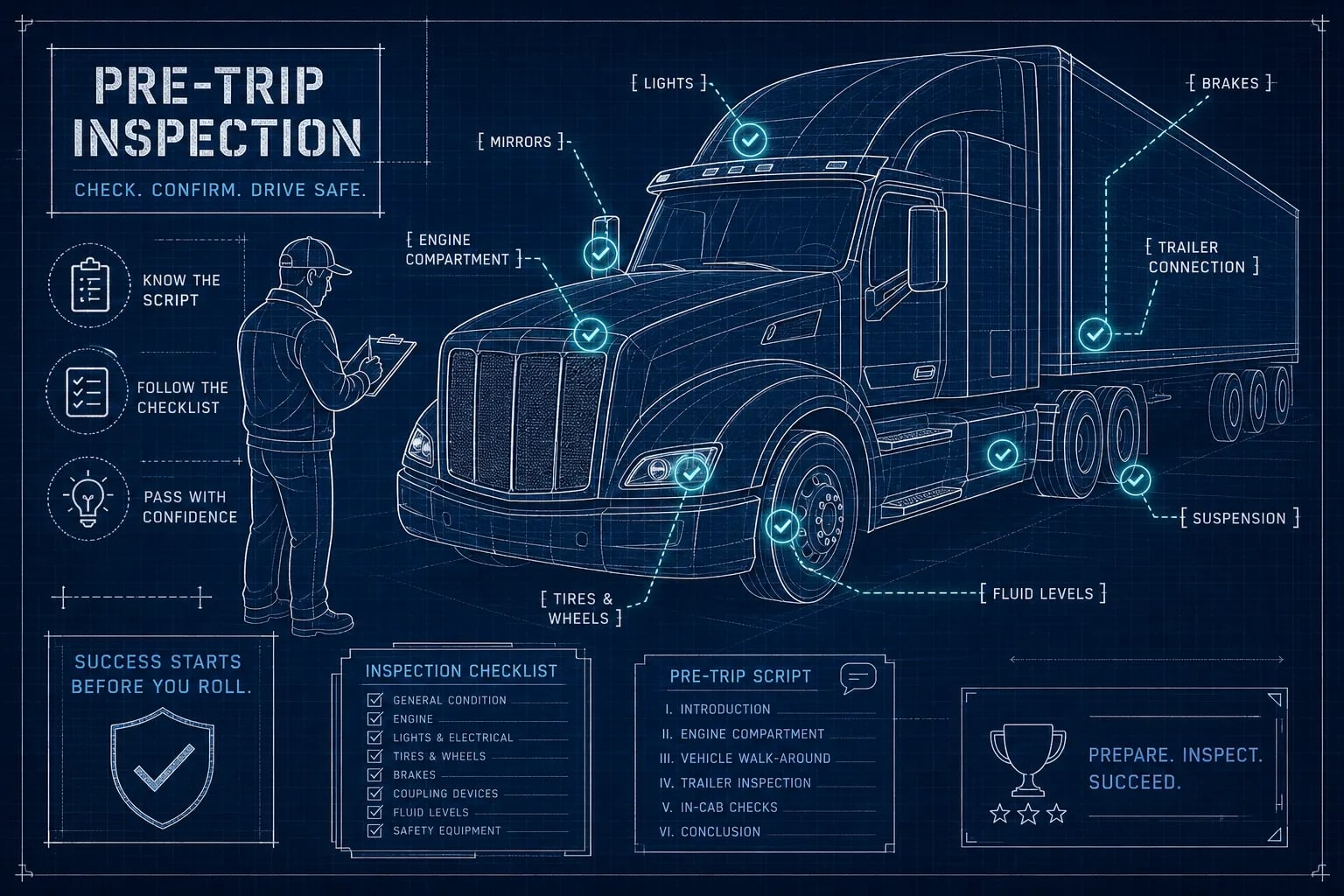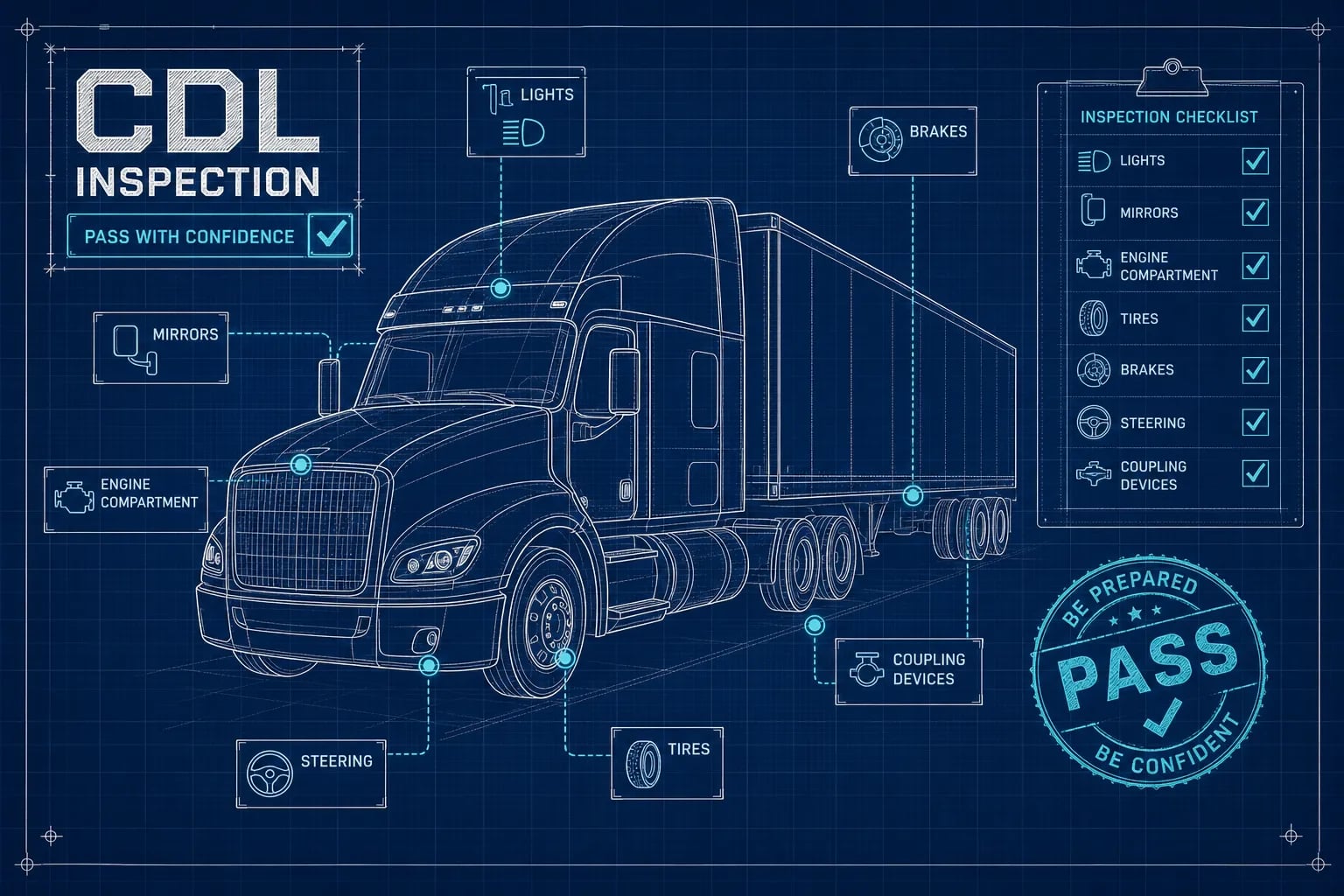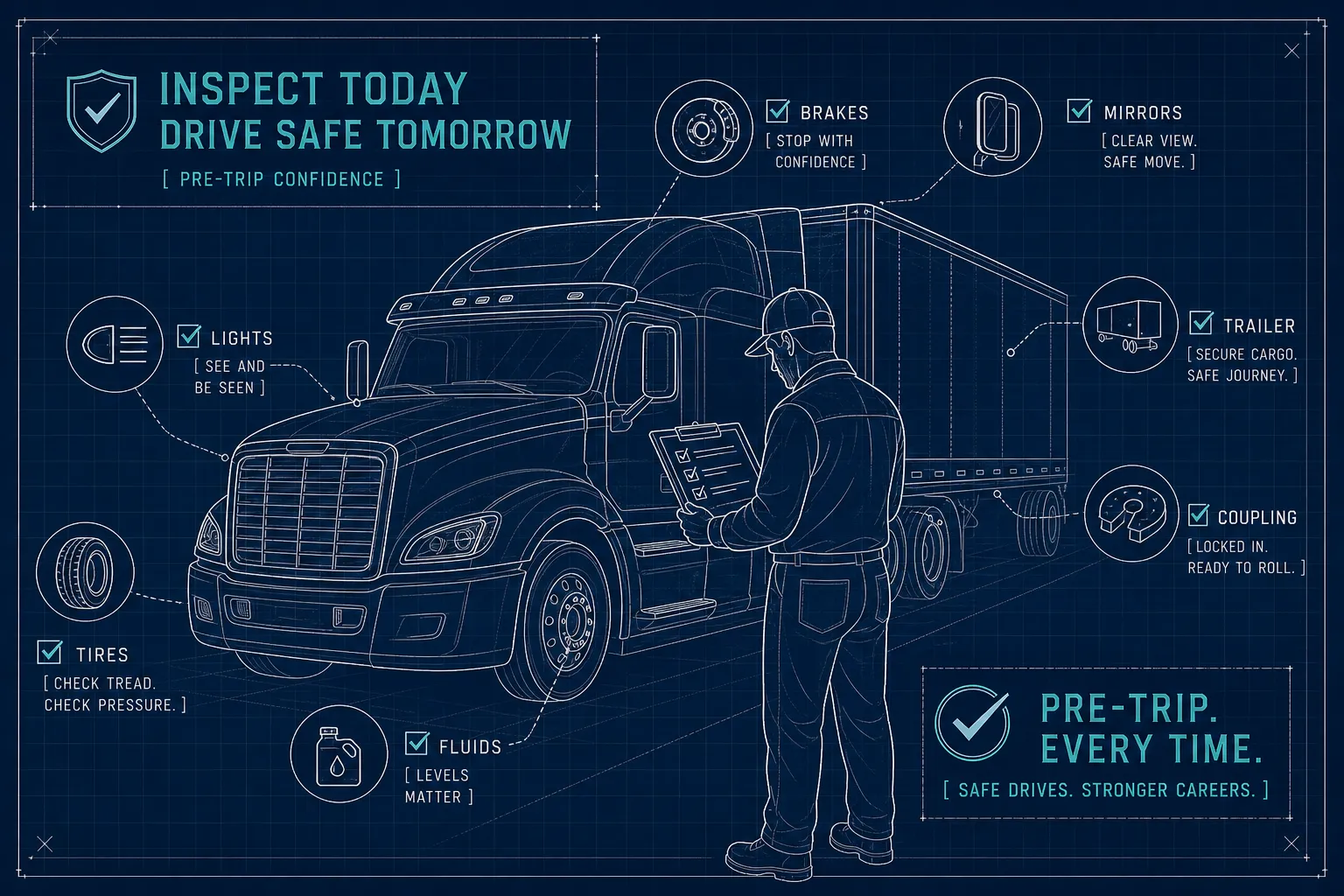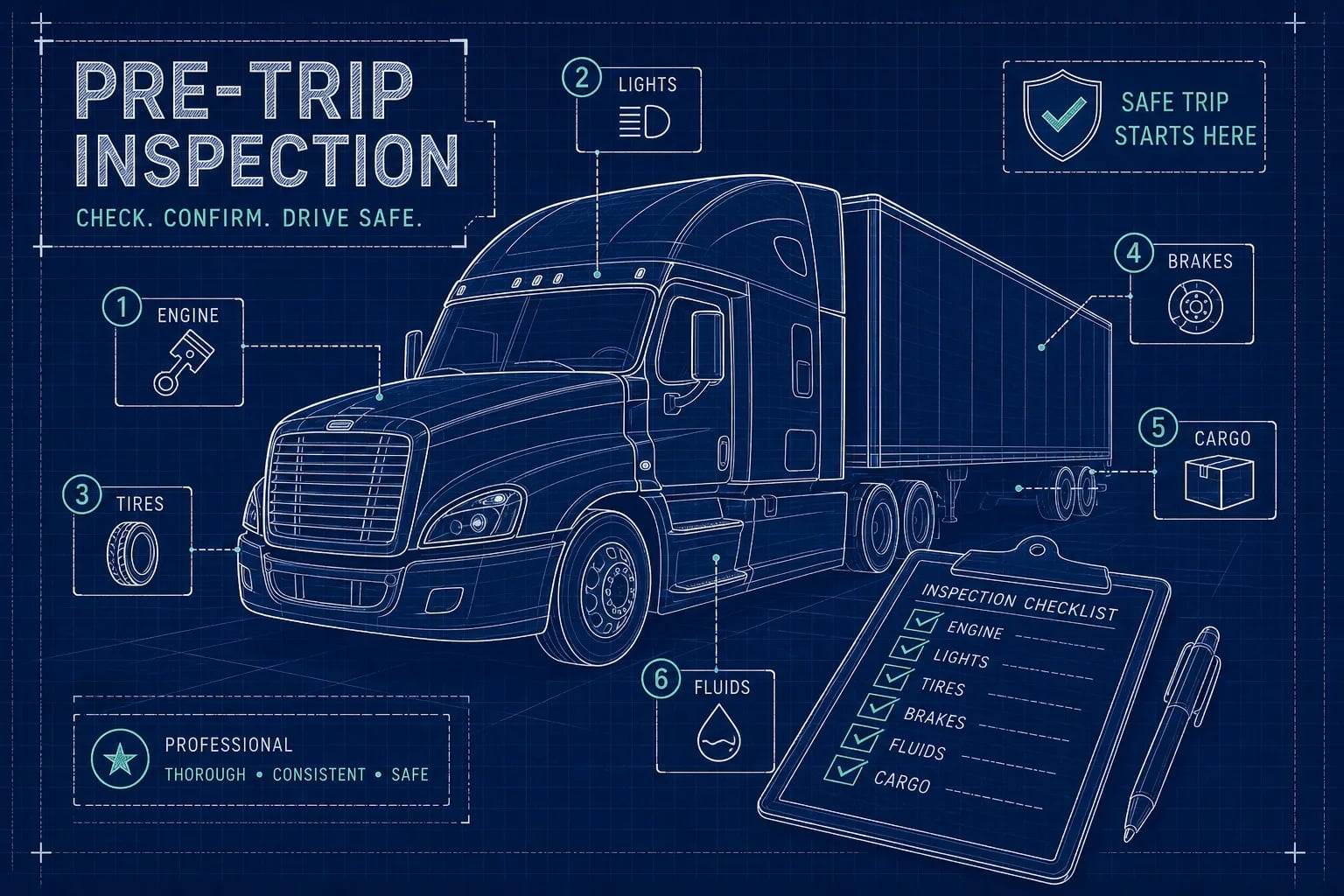
Most CDL candidates can identify a brake chamber. Very few can verbalize what they're checking for when the examiner is standing right behind them. Instructors and test examiners commonly report this gap between recognition and recall as the point where the pre-trip inspection portion of the CDL skills test is won or lost. This guide gives you the complete CDL pre-trip inspection script in the order inspectors expect, with language aligned to common examiner expectations for every major vehicle component.
Read it, print it, and then practice it out loud. Reading a script once builds familiarity. Producing the right words cold, in a parking lot, with an examiner watching is a different skill entirely. CDLTest360's interactive PTI phrase trainer was built to close exactly that gap, more on that at the end.
What Examiners Actually Listen For During the Pre-Trip Inspection
Examiners don't score you on memorized paragraphs. They listen for a three-part pattern on every single component: name the part, state its condition, and identify the defect you'd be looking for. That's the complete formula. For a metal component, it sounds like this: "This bracket is securely mounted, not cracked, bent, or broken, with no missing hardware." For a rubber component, the defect list changes: "This hose has no abrasions, bulges, cuts, or leaks at the connections." For a light: "This light is clean, the correct color, securely mounted, and functioning properly." The formula stays the same. Only the defect keywords shift based on the material.
Touching or pointing to each component while you speak is expected, not optional. An examiner won't give you credit for gesturing generally toward an axle while saying "brakes look good." You need to physically indicate the specific part and produce the correct language for it.
Two verbal mistakes cost the most points before a walkaround ends: being vague and skipping a major system entirely. Saying "the brakes look fine" is vague. Skipping tires, lights, or the air brake check altogether often results in automatic failure, and in most testing situations the examiner will not prompt you to circle back. Check your state's CDL manual and follow your examiner's instructions for specifics on scoring in your jurisdiction.
Pre-Trip Inspection Script: Approach and Engine Compartment
Start before you touch the vehicle. As you walk toward it, you're already checking for obvious leaks, visible damage, and whether the vehicle is safely parked and chocked. Your opening verbalization should sound like: "I am checking that the vehicle is safely parked, wheels chocked, and I see no obvious leaks, damage, or unsafe conditions on approach." Before moving to the engine compartment, verbalize that you've reviewed the prior trip inspection report and confirmed any noted defects were corrected. Examiners expect this step, and it's easy to skip when you're nervous.
Engine Compartment Items
Under the hood, engine off, work through each item in sequence. Oil: "This engine oil is at the proper level with no signs of contamination or leaks." Coolant: "Coolant level is adequate with no leaks at the hoses or reservoir." Power steering fluid: "Power steering fluid is at the correct level."
For belts, use: "This belt is not frayed, cracked, or slipping off the pulleys." For hoses: "This hose has no abrasions, bulges, or leaks at the connections." The battery gets: "The battery is securely mounted, terminals are tight, and I see no corrosion or cracks in the casing." Keep the language short and consistent. Verbosity doesn't earn extra points.
Exterior Walkaround Pre-Trip Inspection Script: Tires, Brakes, Suspension, and Lights
Tires
Tires require three specific verbalizations: inflation, tread depth, and condition. A complete tire call sounds like this: "This tire is properly inflated, has adequate tread depth, and shows no sidewall damage, bulges, or cuts." Per FMCSA regulations, steer tire tread depth must be at least 4/32 of an inch; all other tires require a minimum of 2/32. State rules may vary, so confirm with your state's CDL manual. You don't need to cite the numbers out loud, but you do need to verbalize that tread depth appears adequate. Also cover: "The rim is not bent or cracked and shows no illegal welds or drill holes. All lug nuts are present and secure. The valve stem shows no damage. The hub seal shows no leaks."
Brakes and Suspension
For brakes, be specific about each component. Brake chamber: "This brake chamber is securely mounted, not damaged, and not leaking." Slack adjuster: "This slack adjuster appears properly adjusted and is not bent or damaged." Brake hoses and lines: "These brake lines have no abrasions, bulges, or leaks at any connection point." Brake drum: "This drum shows no cracks and is free of heavy scoring or contamination."
Move directly into suspension without pausing. For springs and steering linkage: "This steering linkage is not loose, bent, or broken. The springs are intact, not shifted or broken." Point to each component as you name it.
Lights
Every light gets a four-point check: clean, correct color, securely mounted, and working. Walk through headlights, taillights, turn signals, brake lights, hazard lights, clearance lights, and reflective tape using the same repeatable line: "This light is clean, the correct color, securely mounted, and functioning properly."
Some examiners require brake lights to be activated and verified from outside the cab. If that applies to your test, plan for a helper or confirm the sequence with your examiner before starting, requirements vary by state, so check your local CDL examiner procedures and state manual. Missing a non-functioning light is a common and avoidable deduction.
Cab Interior and Air Brake Check, Pre-Trip Inspection Script
Cab Interior
Inside the cab, work front to back and state each item as you confirm it. Seat and belt: "Seat is properly adjusted and secured. Seat belt is functional with no fraying or damage." Mirrors: "Mirrors are properly adjusted, clean, and free of cracks." Horn, wipers, defroster: "Horn is operational. Wipers function properly with no torn blades. Defroster works." For gauges, name each one and confirm the reading is within normal range: oil pressure, water temperature, voltmeter or ammeter. Emergency equipment: "Fire extinguisher is charged and secured. Three reflective triangles are present. Spare fuses are on hand." Keep the pace steady. The cab interior portion tends to go fast, which is where small items get skipped.
Air Brake Check Sequence
The air brake check is the most fail-prone part of the entire pre-trip inspection. Perform and verbalize every step in order, examiners know exactly when a step is missing.
-
Build pressure. Start the engine. Say: "Air pressure is building. Governor cut-out occurs at approximately 120 to 140 psi." Confirm that number when the compressor cuts out.
-
Static leak test. Turn the engine off and set the key to the on position. Apply the foot brake fully and hold. Say: "I am performing a static leak test. Air loss must not exceed 3 psi per minute for a single vehicle, or 4 psi per minute for a combination vehicle."
-
Low-air warning. Fan the brakes to drop pressure. Say: "Low-air warning activates. This must occur before pressure drops too low, check your state manual for the exact threshold, typically around 55 to 60 psi."
-
Spring brakes. Continue fanning. Say: "Spring brakes apply at approximately 20 to 45 psi."
-
Pressure rebuild. Rebuild pressure and confirm the compressor cuts back in at approximately 100 to 110 psi. (Exact cut-in ranges vary by vehicle manufacturer and state; consult your state CDL manual or FMCSA guidance for your jurisdiction.)
Do not abbreviate this sequence. Each step is scored individually.
Automatic-Fail Items and the Class A Coupling Check
The contrast between a passing answer and a failing one almost always comes down to specificity. "The tire looks okay" fails. "This tire is properly inflated, has no sidewall damage or bulges, and tread depth appears adequate" passes. Use the correct part name every time. Say "brake chamber," not "that brake part." Say "slack adjuster," not "the arm thing." Correct terminology signals competence. Vague language signals guessing, and examiners score accordingly.
For Class A candidates, the fifth wheel and coupling system inspection is one of the most common automatic-fail points, and it's entirely preventable. Work through each item and touch it as you name it:
-
Fifth wheel mounting: "The fifth wheel is securely mounted, all bolts are present and tight, with no broken welds."
-
Locking jaws: "The locking jaws are fully wrapped around the kingpin with no visible gap between the apron and the tractor frame."
-
Release arm: "The release arm is in the locked position and properly secured."
-
Glad hands: "The glad hands are connected and sealed with no audible air leak. Air lines are not kinked, chafed, or dragging."
-
Electrical cable: "The electrical cable is fully seated, locked, and secured with no damaged wiring."
Skipping the coupling check is a guaranteed deduction on a Class A test.
From Reading to Recalling: Making This Pre-Trip Script Automatic
Reading this guide builds familiarity with the language. That's useful, but it's not the same as being able to produce the correct phrase for a slack adjuster while standing outside in the cold with an examiner watching. Active recall, pulling the right words out of memory without looking at notes, is the skill that actually passes the pre-trip. Most candidates struggle not because they don't know what to check, but because they've only practiced passive recognition. They read the CDL pre-trip inspection checklist. They never drilled the verbalization.
CDLTest360's PTI phrase trainer was built to close exactly that gap. The tool presents each vehicle component in the order inspectors expect and prompts you to recall the correct inspection phrase for it. Every session forces active retrieval rather than passive reading. The content is built from FMCSA-aligned material that applies across all 50 states, and it runs on mobile so you can drill between shifts or during short study windows. If you've worked through this pre-trip inspection script and want to lock in the language before test day, the PTI trainer is the next logical step.
Carry This Script All the Way to Test Day
The pre-trip inspection isn't about memorizing paragraphs. It's about owning a three-part formula, name the part, state the condition, call the defect, and applying it consistently to every component in the correct order. Candidates who fail this portion almost always know what to look for. They just can't produce the right words on demand when it counts.
Print this guide and use it during your next practice walkaround. Say every line out loud. Point to every component. Then close the paper and try again from memory. When you can run the full sequence, from approach through air brake rebuild, without prompting, you're ready. If you hit a wall on specific phrases like the slack adjuster call or the fifth wheel check, that's precisely what CDLTest360's PTI phrase trainer is designed to fix. Practice this pre-trip inspection script until the phrasing is automatic, and you'll walk into your skills test having already done it before.
{ "@type": "Article", "datePublished": "2026-08-06T11:01:26.955Z", "dateModified": "2026-08-06T11:01:26.955Z", "headline": "The Complete CDL Pre-Trip Inspection Script (Word-for-Word)", "description": "Master the CDL pre-trip inspection script with exact phrases for every vehicle component, in order. Know what to say, avoid auto-fails, and pass with confidence.", "publisher": { "@type": "Organization", "name": "CDLTest360" }, "image": [ ] }