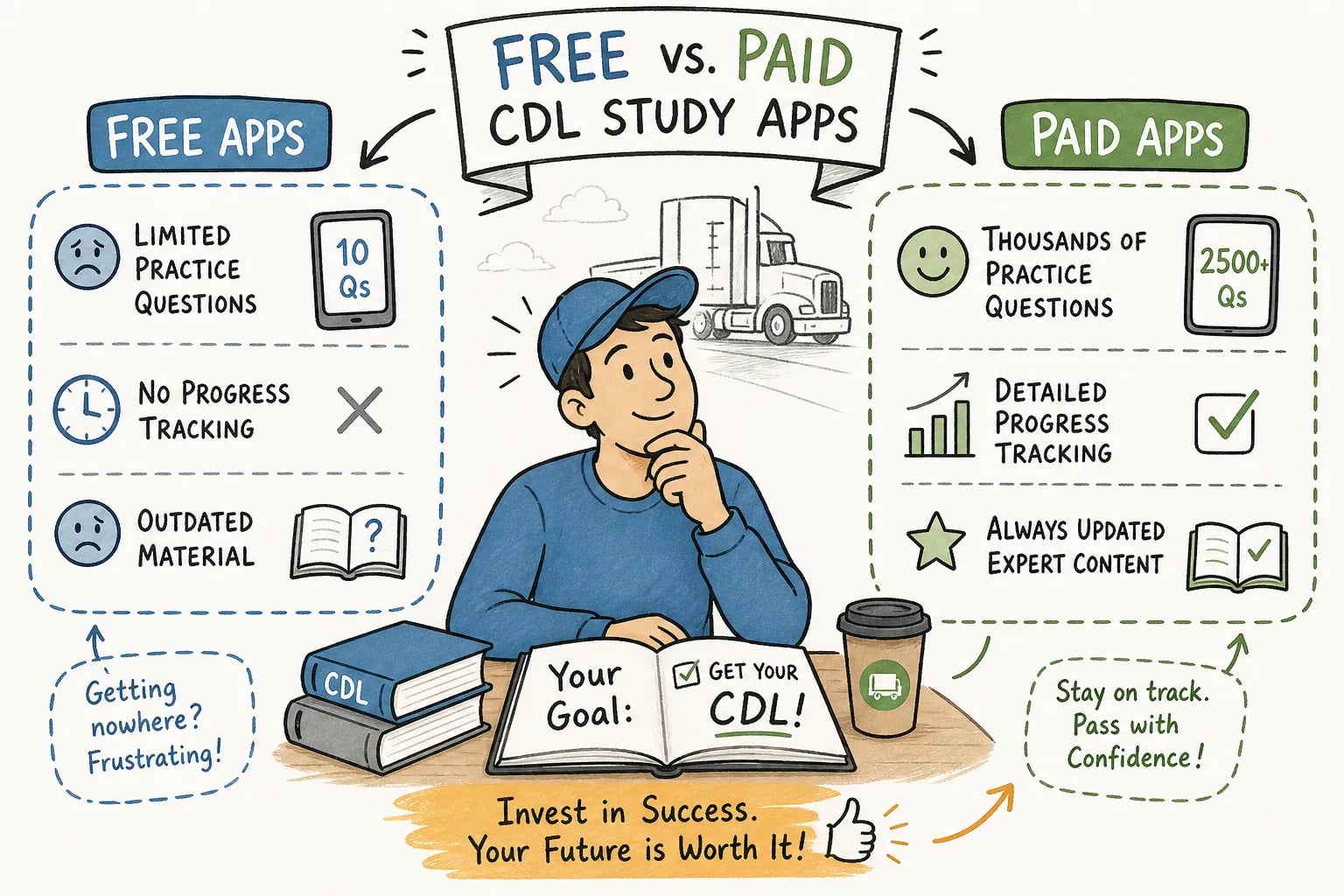
You search "CDL practice test app," and within seconds you're looking at two columns: free apps with four-star ratings and paid apps promising 99% pass rates. The natural question is whether the paid ones are actually worth it or just the same question bank wrapped in a nicer interface with a paywall in front of it. That skepticism is healthy. Understanding the real difference between free and paid CDL study apps, and which is worth it for your situation, starts with cutting through the marketing and looking at what the features actually do. Free CDL study apps are genuinely useful for some candidates and a genuine waste of time for others. The same goes for paid ones.
This breakdown focuses on the features that actually matter: question volume, answer explanations, exam simulation, missed-question review, and tools like pre-trip inspection trainers that most app comparisons completely ignore. By the end, you'll have a clear picture of which type of app fits your situation, your budget, and your timeline to test day.
What free CDL study apps actually give you (and what they hold back)
Free CDL apps do something genuinely useful: they give you first contact with the material at zero cost and zero friction. If you're not sure whether CDL prep feels manageable, or you want a rough sense of what general knowledge questions look like before committing to a study schedule, a free app delivers real value. Most free tiers cover basic general knowledge questions well enough for that initial scan of the content.
The ceiling hits fast once you're past the exploration phase. Many free apps cap users at around 10 to 20 questions before prompting a paid upgrade, enough to sample the content, not enough to build readiness. Beyond the question count, free apps less commonly include full timed exam simulation. That gap matters more than it sounds. Knowing the material in a low-pressure environment and performing at 80% or above under timed test conditions are two different skills, and free apps rarely give you the tools to build the second one.
One useful way to evaluate any free app is to treat it as a preview of the full product. An app that gives you 20 to 30 solid questions with clear explanations in its free tier is showing you the quality of what you'd be paying for. An app that gives you a handful of vague questions with no explanations is also showing you something important before you spend a dollar. The freemium model, used by nearly every CDL prep app on the market, is actually a reasonable filter if you know how to read it.
Free vs. paid CDL study apps: the feature gap that actually matters
The clearest difference between free and paid CDL apps isn't price. It's the combination of question volume, explanation quality, and exam realism. More questions mean more exposure; explanations make them stick; timed simulation proves you can perform under pressure. The gap between "I've read through some questions" and "I'm actually ready for this test" lives in that compound effect.
Question volume: why total questions matter more than people expect
The CDL knowledge exam draws from a standardized pool of questions, and exposure to a wide range of phrasings is one of the strongest predictors of test-day readiness. Free CDL practice test app tiers vary widely, many offer only around 10 to 20 questions before hitting a paywall, and even more generous free tiers tend to top out well short of comprehensive coverage. Paid apps with complete question banks often include several hundred questions across General Knowledge, Air Brakes, Combination Vehicles, Hazmat, and endorsement-specific content. That's not just more of the same questions; it's the difference between recognizing a concept when it's phrased one way and recognizing it in any form the exam might use.
Air brakes and pre-trip inspection are consistently the highest-failure sections for first-time CDL test takers. Combination vehicles and Hazmat follow closely. These are also the areas where question-bank depth matters most, because the material is technical and the exam tests it from multiple angles. A thin free bank in these categories won't get you there.
Answer explanations and content accuracy
One of the sharpest dividing lines between free and paid apps is what happens after you answer a question incorrectly. Free apps often show you the correct answer with no context at all. Some lock explanations behind the paywall entirely. Many paid apps provide plain-English explanations, and the better ones reference FMCSA or regulatory sources, so you understand the rule behind the answer rather than just memorizing the response. That distinction determines whether you're actually learning or just pattern-matching your way through a question set.
State-specific content and FMCSA alignment
Because CDL knowledge tests are federally standardized under FMCSA regulations, any solid commercial driver license study app is technically usable in all 50 states. State CDL manuals do include minor variations, though, and candidates in states with unique requirements benefit from apps that incorporate state-specific content alongside the FMCSA core. This matters especially for ELDT students, whose curriculum must align with federal entry-level driver training standards. Free apps rarely verify or guarantee that alignment. Paid apps built specifically for CDL prep, like CDLTest360, include state-specific manuals inside the platform to account for those differences.
Missed-question review and PTI tools: the features that actually move the needle
Most CDL app comparisons focus entirely on question counts and pricing. They skip the two features that do the most to close the gap between studying and actually passing: missed-question drills and pre-trip inspection trainers. These are where paid apps earn their cost most clearly.
Why missed-question drills outperform general practice
A standard practice test cycles through questions regardless of whether you already know the answers cold. A missed-question review system isolates only the questions you got wrong and re-drills them until you answer correctly. That's a fundamentally different approach to study. It compounds over time: each session gets more targeted, your weak spots shrink, and you stop wasting time on material you've already mastered.
For CDL retakers specifically, this feature alone can close the knowledge gap that caused the first failure. Roughly one in four CDL candidates fails the knowledge test on the first attempt, and failure commonly traces back to a specific cluster of weak topics rather than total unfamiliarity with the content. A missed-question loop addresses that directly.
CDLTest360 builds missed-question review into the core of the platform rather than treating it as a premium add-on. The difference in study efficiency compared to generic rotation practice is meaningful, you spend time on what you don't know, not on what you've already locked in.
Pre-trip inspection tools: the feature most apps completely skip
The pre-trip inspection is one of the most underestimated parts of the CDL test. Candidates must recall exact wording for each vehicle component, not just identify what needs to be inspected. Most CDL study apps, free and paid, provide little or no structured help with PTI wording. That's a meaningful gap because flashcards and multiple-choice questions don't train recall of precise inspection language. A dedicated PTI phrase trainer that prompts you to recall the correct inspection wording for each component is rare among mainstream apps, and it addresses a preparation gap that no amount of general-knowledge practice will close. For candidates working toward the skills test, this type of tool is in a different category from everything else available.
Progress tracking and school dashboards: nice-to-have or must-have?
Progress tracking sounds like a standard feature until you look at what most apps actually deliver. A percentage score after each quiz is not the same as tracking improvement over time, identifying weak topic areas, or knowing whether you're consistently hitting the 80% threshold required on most CDL knowledge tests. Meaningful progress tracking shows you a trajectory across multiple sessions. For self-directed candidates, that kind of dashboard is what distinguishes "I feel ready" from "I can demonstrate readiness."
For ELDT students and candidates enrolled through a CDL school, progress tracking shifts from a personal tool to an institutional requirement. Instructors need to see where each student stands, identify who needs extra remediation, and confirm readiness before a student walks into the DMV. A school dashboard that lets instructors manage student accounts, assign custom question banks, and monitor individual performance is a fundamentally different product than a personal CDL permit test study tool. CDLTest360 offers that kind of institutional capability, which is one reason it serves both solo candidates and CDL school programs. Free apps rarely replicate this functionality, and not all paid apps prioritize it.
Pricing breakdown: what you're really paying for
The CDL app market uses three main pricing models: one-time purchases ranging from about $9.99 to $60, monthly subscriptions typically between $7.99 and $29.99, and 90-day or lifetime access passes that sit between those two extremes. CDLTest360 is priced at $19.99 per month or $39.99 for a full 90-day study window (pricing per the vendor's current listing), which puts it at the accessible end of the paid CDL prep market without cutting corners on features.
The more useful frame for evaluating cost is this: the real comparison isn't free versus $39.99. It's a full-featured prep tool versus the DMV retake fee, the time cost of a second or third test attempt, and the delayed start date on a commercial driving job. CDL schools often charge $100 to $300 or more for supplemental study materials. A quality digital prep app at under $40 for three months of access, covering every knowledge area and endorsement you need, is a straightforward trade-off once you put it in those terms.
-
One-time unlock: $9.99 to $60 for full question bank access
-
Monthly subscription: $7.99 to $29.99 per month for ongoing access
-
90-day pass: typically $39.99 to $49.99, covering the full study period most candidates need
Which CDL student profiles actually need a paid app
The honest answer to "should I pay?" depends almost entirely on where you are in the preparation process and what your specific knowledge gaps look like.
First-time candidates and ELDT students
First-time CDL candidates benefit most from paid apps because they need comprehensive coverage across all knowledge areas before they have any baseline. They also need realistic exam simulation to understand what test-day conditions actually feel like, the gap between casual practice and timed performance is something most first-timers underestimate. ELDT students have the added requirement of FMCSA-aligned curriculum that free apps rarely guarantee or verify. For this group, a free app makes sense as a starting point to calibrate comfort with the material, but genuine test readiness requires a more complete tool.
CDL retakers and exam-anxious candidates
This is the profile where paid features deliver the clearest return. A retaker's problem usually isn't total unfamiliarity with CDL content; it's a specific knowledge gap or a performance-under-pressure issue. Missed-question review, timed exam simulation, and multi-session progress tracking directly address both problems. Free apps don't have the infrastructure to support that kind of targeted remediation. For candidates who have already paid a retake fee once, spending under $40 for a platform that closes specific knowledge gaps is easy math.
Endorsement seekers and school-enrolled students
Candidates adding Air Brakes, Combination Vehicles, Hazmat, or Tanker endorsements need question banks specific to those modules. Free apps rarely cover endorsement content comprehensively, and when they do, the question counts are too thin to prepare you for the actual exam. CDL school students whose instructors use a school management dashboard benefit from institutional features that paid platforms with school tools can provide. The ability for an instructor to assign specific modules, monitor individual student progress, and manage a custom question bank is a feature set that's rarely present in free tiers of CDL prep products, and only a handful of paid platforms offer it in a way that genuinely serves classroom programs.
How to trial a paid CDL prep app before committing
The most reliable way to evaluate any paid CDL app before spending money is a store-managed free trial through the App Store or Google Play. These trials show you the billing terms, renewal timing, and cancellation deadline clearly before you commit, and they're governed by the store's subscription rules rather than the developer's own policies. Demo modes and free tiers are useful for evaluating quality, but they rarely unlock enough of the platform to give you a real picture of exam readiness.
CDLTest360 takes a different approach: no account required to start practicing (per the platform's stated access model). You can work through real questions before entering any billing information. That removes the most common friction point in evaluating any CDL app. Most apps require payment details before you've seen what you're paying for. CDLTest360 skips that entirely.
When you're in a trial window, use this checklist to make your decision:
-
Confirm exactly what's unlocked versus gated in the trial version
-
Run at least one full timed exam simulation at the 80% passing threshold
-
Test the missed-question review feature after getting answers wrong
-
Confirm state and endorsement coverage for your specific test
-
Check recent reviews for billing surprises or content accuracy complaints
-
Verify there's a real support contact if you need cancellation help
The deciding question at the end of your 24 to 48-hour trial is simple: can you run a realistic timed exam, see your score against the 80% threshold, and know exactly what you got wrong and why? If yes, you've found a tool worth paying for.
Which CDL study app is worth it: a practical decision framework
A platform like CDLTest360 illustrates what a well-designed paid CDL prep tool looks like in practice. It offers meaningful free access with no account required, a full question bank across all FMCSA knowledge areas, a missed-question review loop that targets weak spots specifically, timed exam simulation set at the 80% passing threshold, and a PTI phrase trainer, a feature that's rare among major CDL prep platforms. For CDL schools, the instructor dashboard handles student invitations, custom question bank management, and individual progress monitoring at a price point that's more accessible than most traditional supplemental materials.
The decision framework for free vs. paid CDL study apps comes down to where you are in the process. If you're casually curious about CDL prep or working with an extremely tight budget, start with a free app and use it to get familiar with the content areas. If you're actively preparing for a test date, have failed the written test before, need endorsement-specific content, or are enrolled through a CDL school program, a paid CDL practice test app will give you a materially better shot at passing on the first attempt. At under $40 for a 90-day study window, a full-featured platform pays for itself the first time it helps you avoid a retake fee and a delayed hiring date.
The bottom line on free vs. paid CDL apps
The difference between free and paid CDL study apps isn't just about price. It's about what stage of preparation you're in, what your knowledge gaps actually are, and whether the tool you're using can tell you the difference between "I've seen this material" and "I'm ready to pass." Free apps work for exploration and early exposure. Paid apps with missed-question review, timed exam simulation, PTI trainers, and progress tracking are built for candidates who need to pass with confidence, and who can't afford the time or money of a retake.
Start with whatever platform offers genuine free access to the real product, not just a teaser. Use that trial window seriously: run a timed exam, get some questions wrong on purpose, and see how the app helps you understand and correct those mistakes. If the platform delivers on that, it's worth the cost. CDLTest360 lets you do exactly that without creating an account, so you can evaluate the real experience from the first question.
Most candidates who prepare seriously with the right offline CDL study app or online prep tool clear the knowledge test on the first try. The CDL permit test study tool you choose determines whether your study time builds genuine readiness or just a false sense of familiarity with the content. Choose the one that closes the gap between those two things, and make that choice based on what you actually see during the trial, not what the marketing copy promises.
{ "@type": "Article", "datePublished": "2026-09-14T11:01:52.314Z", "dateModified": "2026-09-14T11:01:52.314Z", "headline": "Free vs. Paid CDL Study Apps: What's the Real Difference?", "description": "Compare free vs. paid CDL study apps by features that actually matter: question banks, exam simulation, PTI tools, and missed-question review. Find your best fit.", "publisher": { "@type": "Organization", "name": "CDLTest360" }, "image": [ ] }