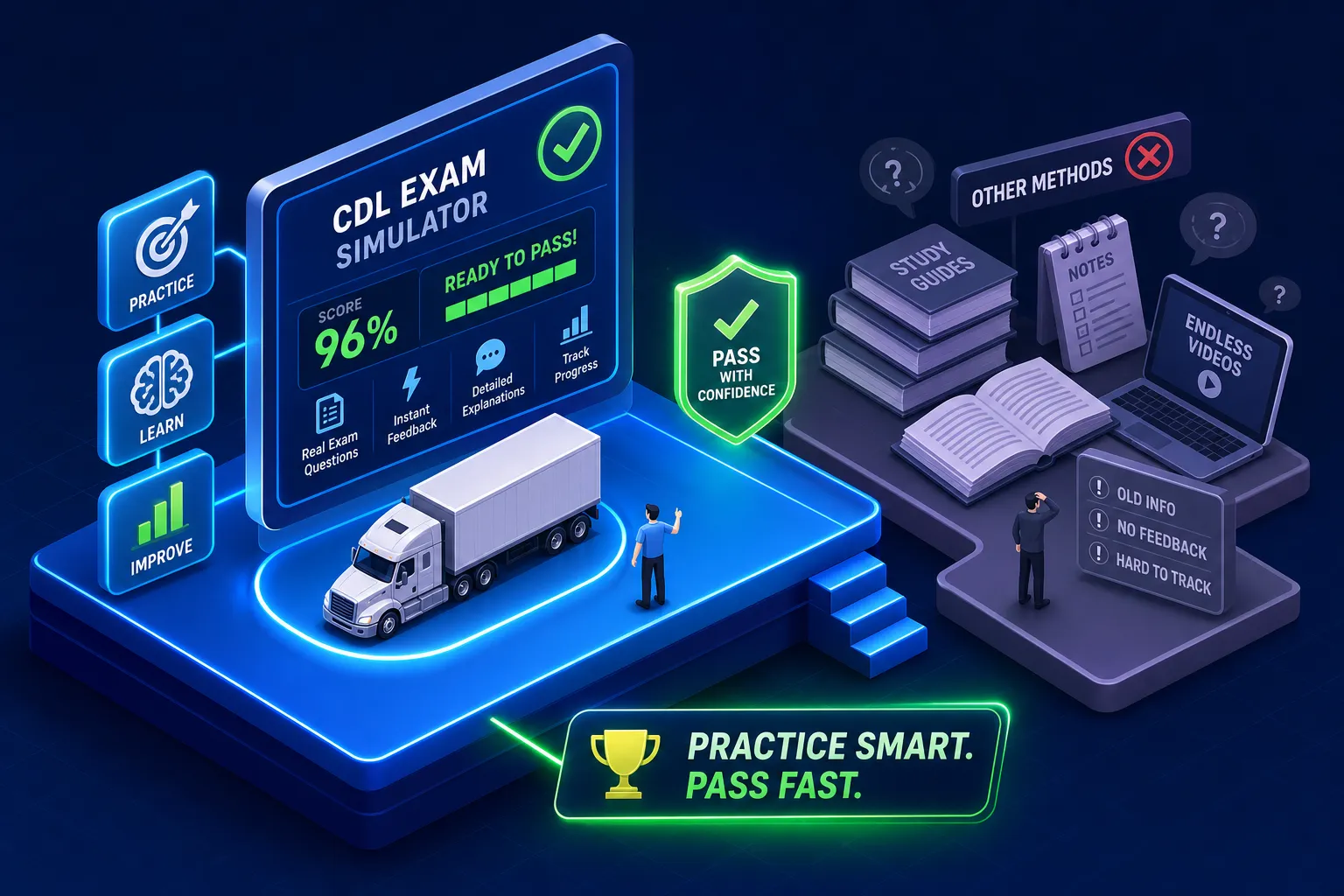
A CDL exam simulator replicates real test conditions so you stop studying and start performing. Most CDL candidates spend weeks going through their state manual, page by page. They read the air brakes section twice. They highlight key rules in combination vehicles. They feel ready. Then they walk into the DMV, the clock starts, and everything gets harder. It's not that they didn't know the material, it's that they never practiced producing it under pressure. That's a different skill entirely, and it's the one that decides whether you leave with a passing score or a retake date.
The CDL written test is a timed performance under unfamiliar conditions. Fifty questions, randomized across topic areas, with an 80% passing threshold standing between you and your commercial driver license. The testing effect, the well-documented finding in cognitive science that active retrieval practice outperforms re-reading for long-term retention, is the principle behind every serious CDL practice test tool on the market. The most effective CDL preparation platforms are built around that exact idea: replicate the real exam so the real exam feels familiar. CDLTest360 is built around that principle, designing every session around the same 80% threshold and format you'll face at the DMV.
Why reading your CDL manual alone won't get you to passing day
Reading your state CDL manual builds familiarity with the material. It does not build fluency. When you study by reading, your brain processes information in sequence, in context, with visual anchors from the page layout. On test day, questions arrive in random order, stripped of all that context, and you have a fixed window to retrieve the answer from memory. Those are completely different cognitive tasks, and confusing them helps explain why first-time CDL pass rates are commonly reported at only 50% to 60%, meaning roughly four in ten candidates don't pass on their first try.
The difference between recognizing an answer and recalling it
Recognizing a correct answer when you see it in a multiple-choice format is much easier than retrieving the right information when no cues are present. Reading creates recognition memory. Testing creates retrieval memory. The CDL written exam demands retrieval: you see a scenario-based question, you pull the relevant rule from memory, you pick the correct answer, and you move on. If your only study method involved reading the manual, you've been training the wrong kind of memory the entire time.
Why the timed element changes everything
For many CDL candidates, the first time they experience real time pressure on a knowledge exam is at the actual DMV. That's a problem. Timed pressure changes how your brain processes questions. Repeated exposure to timed, exam-like conditions during practice gradually desensitizes your stress response, so the real test feels manageable rather than threatening. When you've already sat through 10 timed simulations, the clock at the testing station isn't a shock to your system. It's just the clock you've been practicing against all week.
What a quality CDL exam simulator must include
The phrase "exam simulator" gets applied loosely to a lot of CDL prep tools. Some are really just topic quizzes with a timer slapped on. A genuine CDL exam simulator needs to replicate three specific elements of the real test to be useful for actual exam preparation.
Timed mode with a fixed question count
The real CDL general knowledge exam is 50 questions. A quality simulator matches that format exactly and enforces a time limit that mirrors actual testing conditions. Open-ended quizzes where you can take your time, second-guess yourself, and flip back to previous answers aren't training exam performance, they're training casual review. Timed mode with a fixed count forces you to build the pacing instinct you'll need when the clock is running for real.
Randomized questions that pull across topic areas
The actual CDL written test draws questions randomly from the full content area bank, which means you need to switch cognitive gears rapidly throughout the session. A simulator that lets you choose your topic, or that consistently delivers the same questions in the same order, is not actually simulating the exam. Real randomization forces your brain to transition between vehicle inspection rules, traffic law, shifting and backing procedures, and hazardous conditions without any warm-up time between them. That context-switching is a skill you have to practice.
Passing threshold feedback after every attempt
After every simulated exam, you need to know one specific thing: did you pass or fail relative to the actual 80% threshold? A vague percentage score doesn't answer that question clearly enough. Seeing "76%" tells you how many questions you got right. It doesn't tell you that you would have failed the real test by four questions. Pass/fail feedback calibrated to the actual threshold gives you an honest signal about where you actually stand, which is the only metric that matters when you're deciding whether to schedule your DMV appointment.
CDLTest360's simulation mode: what effective practice actually looks like
CDLTest360's exam simulation mode puts all three of those features to work in a CDL-specific context. It's worth walking through how it works, not just as a product overview, but as a concrete benchmark for evaluating any other tool you're considering.
The 50-question format and the 80% passing threshold
Each simulation session on CDLTest360 delivers 50 questions drawn randomly from an FMCSA-aligned question bank covering the knowledge area you're studying: General Knowledge, Air Brakes, Combination Vehicles, Hazmat, and others. The session is calibrated to the 80% passing standard, 40 correct answers to pass, which mirrors what you'll face at the DMV. When you finish, the platform immediately shows whether you passed or failed and by how much, so there's no ambiguity about your readiness level.
The missed-question review loop: where real learning happens
After each simulated exam, CDLTest360 isolates every question you answered incorrectly and queues those for focused re-drill in a separate review session. Rather than reviewing all 50 questions, including the 40 you already know, you spend your limited study time exclusively on the material that's costing you points. Many free CDL practice tools don't offer this targeted missed-question loop, opting instead for general question banks without session-specific tracking. For retakers and exam-anxious candidates, drilling only your wrong answers is the fastest path to closing knowledge gaps before the next attempt.
How this mirrors the actual DMV test experience
CDLTest360's format closely parallels what you'll encounter at an actual testing station: a fixed question count, randomized draws from the full content area, a binary pass/fail result against a defined threshold, and no ability to reference any material mid-session. Practicing inside an environment that looks and feels like the real test reduces anxiety because the format is no longer unfamiliar when it counts. By the time you sit down at the DMV, you've already been through the same structure dozens of times.
How to use a CDL exam simulator in your study routine
Running a simulated exam before you've built foundational knowledge is discouraging and counterproductive. A two-phase approach works far better and produces more consistent results for first-time candidates and retakers alike.
Start with topic quizzes, then switch to full simulation
Phase one is topic-focused practice. Use quiz modules to build solid knowledge in each content area individually: General Knowledge, Air Brakes, Combination Vehicles, and any endorsements you're pursuing. Stay in this phase until you're consistently scoring above 75% on topic-specific quizzes, a commonly used instructor benchmark for moving into full-length simulation. Once you're hitting that mark across each area, shift to phase two and begin running full simulation sessions. Jumping straight to a CDL test simulator before you've built foundational knowledge in each area just produces discouraging scores that don't tell you much beyond "you need more studying."
What consistent simulation practice actually looks like
In phase two, run one full simulated exam per study session, then complete the missed-question review loop before you close the app. Full simulation first, targeted drill on wrong answers second, that's the complete study session. As a practical readiness benchmark, many CDL instructors recommend reaching three consecutive passing simulations before scheduling your DMV test; five gives you a stronger confidence margin. If you can hit 80% or higher consistently in a randomized, timed environment, the real test is unlikely to produce a result that surprises you.
Free CDL simulators vs. paid tools: what you're actually getting
Several free CDL simulators offer real value, particularly in the early stages of preparation. It would be unfair to dismiss them entirely. But when you're within two weeks of your test date and trying to gauge actual readiness, the gaps in free tools start to matter.
What most free simulators do well (and where they stop short)
Many free CDL practice tools provide unlimited question attempts, broad topic coverage, and immediate right/wrong feedback, genuinely useful features for building initial familiarity with the material. Some free options, including sites like Driving-Tests.org and similar DMV CDL practice test platforms, do offer full-length practice exams. Where free tools more commonly fall short is in strict timed enforcement, clear pass/fail feedback calibrated to the 80% threshold, and a missed-question-only drill loop tied to your specific session results. For casual early practice, those omissions are acceptable. For gauging whether you're actually ready to walk into the DMV, they're significant blind spots.
Why targeted analytics justify a paid plan
When you're close to your test date, every study session needs to be efficient. A tool that surfaces your specific weak areas and drills only those questions saves time and directs your effort to where it actually produces results. CDLTest360's 90-day pass is advertised at $39.99, and a monthly plan runs $19.99 with no long-term commitment. Compare that to a CDL knowledge test retake fee, missed work time, or additional hours at a driving school, the math favors the paid tool quickly. No account is required to start; you can run a free trial session immediately to see how the platform feels before committing to anything.
CDL exam simulator FAQs
How realistic is a CDL exam simulator?
A quality CDL exam simulator replicates the core conditions of the actual test: 50 randomized questions, a timed session, and pass/fail feedback based on the 80% threshold. The closer those elements match the real DMV CDL practice test format, the more useful the tool is for genuine readiness assessment.
Is a CDL test simulator app enough to pass on its own?
Simulation alone works best after you've built topic-level knowledge through quizzes and manual review. Think of the CDL exam simulator as the final preparation stage, not the starting point. Combine it with topic quizzes and a missed-question review loop for the strongest results.
What's the difference between a CDL practice test and a CDL exam simulator?
A CDL practice test can be any set of questions covering exam content. A CDL exam simulator specifically replicates real test conditions, fixed question count, timed format, randomized draws, and threshold-based pass/fail scoring. Not every practice test qualifies as a true simulator.
Get yourself to the real test already knowing the result
The CDL written exam is a performance under pressure, and pressure is something you can prepare for. The three features that define genuinely effective CDL exam simulation are timed mode with a fixed question count, randomized draws from the full content area, and pass/fail threshold feedback calibrated to the actual 80% standard. CDLTest360's simulation mode is built around those exact standards because that's what the real test demands.
The goal of this kind of simulation practice isn't to feel more confident in a vague, motivational sense. It's to make the real test feel like one more practice run, because you've already been through the same format, the same pressure, and the same stakes enough times that nothing about the DMV experience is unfamiliar. Start with a free trial session on CDLTest360, run a full simulated exam today, and see exactly where you stand before you schedule your appointment. That number tells you everything you need to know.