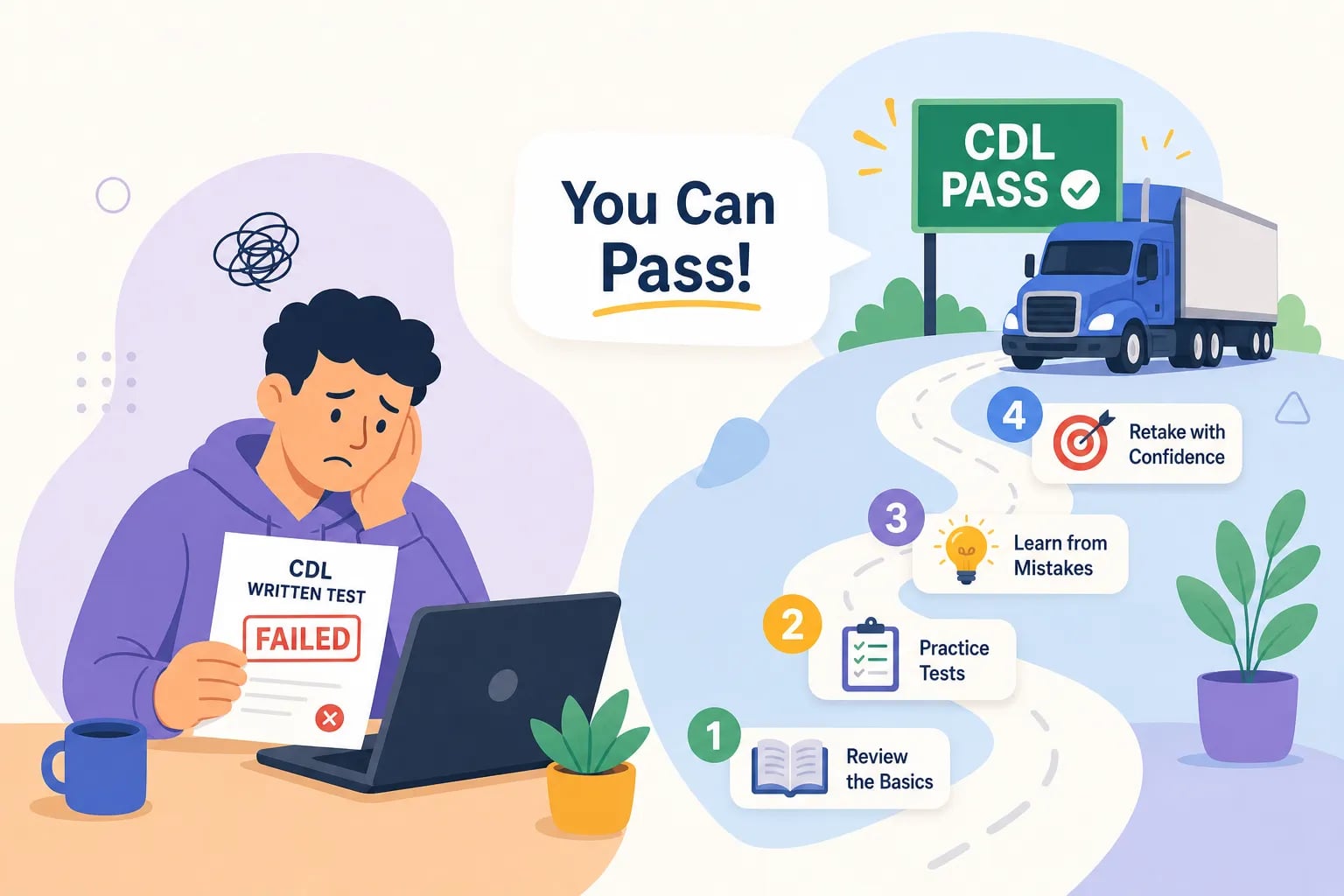
If you failed the CDL written test, you already know how frustrating that moment feels. You put in time, you thought you were ready, and the score sheet said otherwise. That stings. But one failed CDL written test doesn't tell you anything about whether you'll pass next time, and it says nothing about your ability to do this job.
At CDLTest360, we've worked with many CDL candidates across every state and experience level, and the pattern is nearly always the same. Failing the CDL knowledge exam almost never comes down to intelligence or aptitude. Research consistently shows that study method, especially active practice testing and targeted review, is a far stronger driver of pass-rate improvement than raw study hours. A targeted plan changes the outcome. Re-reading the manual for a second time usually doesn't.
This guide covers what you need to move forward: why the failure likely happened, how to read your score report so it actually helps you, what the retake rules look like in your state, which knowledge areas cause the most failures, and a concrete two-to-three week study plan built for people who don't have time to waste on the wrong material.
Why a failed CDL written test is more common than you'd think
The first-attempt failure rate is high across all experience levels
Research from the GAO found that between 20% and 50% of CDL applicants fail the knowledge test on their first attempt, depending on the state. A California DMV evaluation found a 39.5% first-attempt fail rate for the General Knowledge test alone. That's not a fringe outcome, failing on the first try is statistically normal. The research doesn't show that experienced drivers fail at the same rate as newcomers, but the numbers make clear that prior road experience doesn't automatically translate into exam success.
The reason isn't a lack of ability. It's a mismatch between how most people study and how the exam actually tests. Reading the CDL manual twice feels like preparation. The test reveals that it isn't.
The study approach that sets most candidates up to fail
Most CDL candidates treat the knowledge test like a reading quiz. They go through the state manual, recognize the information, feel confident, and walk into the DMV. Then the questions hit. The phrasing is different from what they read. The answers look similar. Scenario-based questions present competing risk cues and expect you to know which one takes priority. Exception-based rules, especially in hours-of-service, turn on single words that didn't stand out during passive reading.
The manual exists to inform you. It's not designed to prepare you for the way the exam frames its questions, and that disconnect is where most failures happen.
Why retakers are actually in a better position
If you've already sat for the exam, you have information most first-timers don't. You know what the format feels like, you have a rough sense of which topics tripped you up, and you know how your nerves respond under test conditions. That self-awareness is a genuine advantage, the only way to waste it is to go back and study the same way you did the first time.
What your score report is actually showing you
How to decode the section-by-section breakdown
When you fail the CDL general knowledge test or any endorsement section, the DMV typically provides a score sheet or topic breakdown showing which areas you missed. Most candidates fold it up and forget about it. That breakdown is the single most valuable document you have for your retake prep. It tells you, without guessing, where to focus your next study session.
Each flagged topic corresponds to a specific chapter in the FMCSA manual and, more importantly, to a specific question pool in any serious practice-test platform. Knowing which sections dragged your score down means you can skip the sections you already passed and concentrate your time where it counts.
Matching your weak areas to the right study material
Different CDL knowledge domains have different rule sets, different thresholds, and different question logic. If your score report flags Air Brakes, you're looking at PSI thresholds, component behavior, and cause-and-effect scenarios that require understanding, not just memorization. If General Knowledge pulled your score down, the problem may be spread across several sub-topics: stopping distance, hazard perception, hours-of-service wording, or vehicle inspection sequence. Knowing which sub-topics cost you points determines which chapters you actually need.
What to do if you don't have your score breakdown
If you didn't receive detailed scoring or you misplaced the paper, call your DMV and ask which sections were flagged. Some states note the failed section on the testing receipt. Going back in to retest without this information means you're guessing at what to study, and guessing is what created the problem in the first place.
State retake rules after a failed CDL written test: wait times, fees, and what to expect
The federal standard and why states still vary
Under 49 CFR §383.135, the passing score for all CDL knowledge tests is 80%. That's the only standard the federal government sets. Waiting periods, retake fees, and attempt limits are entirely controlled by each state, which is why the CDL written retake rules can look dramatically different depending on where you're testing.
Common wait periods and fees across most states
Most states require a CDL test wait period of one to seven days between attempts and charge a retake fee of roughly $10 to $25 per attempt. In most cases, you only need to retake the specific section you failed, not every CDL knowledge test you've already passed. A few states use escalating rules for repeated failures. Illinois, for example, allows three attempts before triggering a mandatory 30-day wait, with further failures extending that wait to 90 days and eventually one year. Georgia requires a 2-day wait after the first failure, then a 7-day wait after subsequent ones, and mandates reapplication after a fourth failure. Always confirm current rules directly with your state agency, since these policies can change.
Texas, Florida, and many other states run online scheduling systems through their DPS or HSMV portals and typically allow retesting within a few days, though exact timelines vary by location and should be verified before you schedule.
Documents to bring when you go back to the DMV
For most states, plan on bringing a valid photo ID, your Commercial Learner's Permit (CLP) if applicable, proof of residency, your DOT medical card, and your ELDT theory completion certificate if your CDL class requires it. California requires an appointment for all CDL testing and won't allow walk-in retests.
Before you schedule anything, confirm your CLP's expiration date. A CLP is valid for up to one year federally, but several states issue them initially for 180 days with one renewal. If it expires before your retake, you'll likely need to reapply and retest from the beginning, so sort that out before you book anything.
The knowledge areas that cause the most CDL written failures
Air brakes: the section that trips up nearly everyone
Air Brakes is consistently the most failed CDL written section. The content is technical, the PSI thresholds are specific, and the questions frequently test whether you understand how the braking system actually works, not just what each component is called. Common failure points include confusing allowable pressure loss rates when brakes are released versus applied, misunderstanding when spring brakes engage, missing the pressure at which the low-air warning activates, and assuming ABS reduces stopping distance when it actually preserves steering control.
Memorizing Air Brakes terminology isn't enough. You need to understand the cause-and-effect logic: what happens when pressure drops, why the governor controls air compressor cycling, and how pre-trip inspection procedures connect to operational safety. Questions testing this kind of applied understanding are where surface-level studying falls apart.
General knowledge sub-topics that catch candidates off guard
Within General Knowledge, the hardest question clusters tend to appear in a few consistent areas. Stopping distance and speed management questions are especially tricky when they factor in weather, road grade, or load conditions. Hazard perception scenarios present multiple competing risk cues and expect you to rank them correctly. Vehicle inspection sequence questions require knowing the order, not just the components. Emergency procedures for brake failure, tire blowouts, and fire response are frequently missed because candidates recognize the topic but don't know the specific steps the manual prescribes. Hours-of-service questions are particularly punishing because small wording differences completely change the correct answer.
Endorsement-specific tests that have high failure rates
Among endorsement tests, Hazmat and Combination Vehicles produce the most failures. Hazmat covers placard rules, shipping paper requirements, and emergency response procedures. Combination Vehicles tests coupling and uncoupling sequences, air brake connections on multi-trailer configurations, and handling dynamics specific to longer rigs. Both are content-heavy, and both reward candidates who practiced with real exam-style questions rather than those who only read the relevant chapters.
The fastest way to find your exact knowledge gaps after a failed CDL written test
Why re-reading the manual wastes your retake prep time
Going back to the CDL manual and re-reading every chapter from the beginning is the least efficient thing a retaker can do. If you passed General Knowledge and failed Air Brakes, spending two hours reviewing General Knowledge is wasted prep time. Retake preparation isn't about reviewing everything, it's about identifying and closing the specific gaps that cost you points the first time. Specific beats general, every time.
How CDLTest360's missed-question review system supports retakers
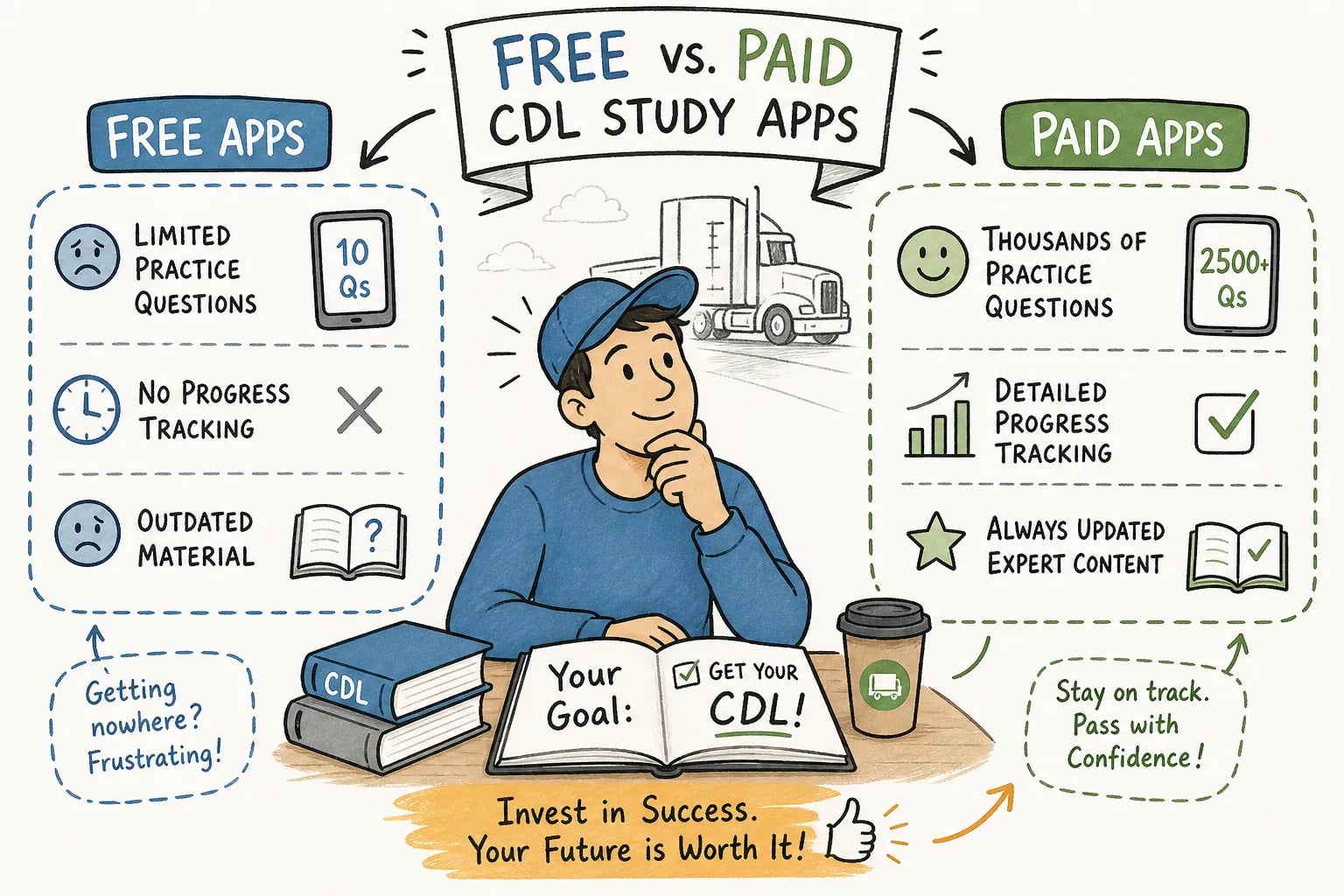
CDLTest360 built its missed-question review system for exactly this kind of situation. When you take a practice test inside CDLTest360, the platform automatically isolates every question you answered incorrectly and places them in a separate drill queue. You're not re-doing the full test from scratch. You're re-drilling only the questions that exposed a gap, and each one includes an explanation so you understand why the correct answer is right, not just what it is.
That distinction matters more than it might seem. Knowing the correct answer gets you one question right. Understanding why it's correct builds the pattern recognition that carries across multiple questions on the same topic. That's what moves scores on the actual exam.
Using the review loop to drill until the pattern sticks
The real power of this system is repetition within a narrow, targeted set. Run through CDLTest360's Air Brakes quiz module, review every missed question with the explanation, then run the quiz again the following day. That cycle, test, identify misses, re-drill, re-test, compresses the time it takes to close a knowledge gap. You're not guessing what to study. The platform directs you based on your actual performance, not a generic study schedule built for someone else.
A focused 2-3 week study plan built for CDL retakers
Week 1: lock in on the failed sections only
Pull your score report and spend the entire first week exclusively on the areas that failed. Use CDLTest360's topic-specific quiz modules to test yourself at the start of each session, review every missed question using the explanation feature, and run the quiz again before you close out. Don't touch material you already passed. You're not rebuilding from zero, you're patching specific holes, and that requires focused attention, not broad review.
A reasonable target for the end of Week 1 is consistently scoring 80% or higher on your weakest sections in practice mode. Under 49 CFR §383.135, 80% is the federal passing threshold, so hitting that mark in practice means you've closed the gap enough to move into mixed-topic work. It doesn't mean you're ready to retest yet.
Week 2: expand to mixed practice and timed simulations
Once you're hitting consistent scores in your weak areas, bring in mixed-topic quizzes that combine strong and weak sections together. This matters because the actual CDL knowledge exam doesn't organize questions by topic, they come in random order, and your ability to shift between subject areas mid-test is part of what the real exam measures. CDLTest360's timed exam simulation mode mirrors this format: 50 questions, 80% passing threshold, no topic labels, and a clock running. Running two or three of these per day during Week 2 builds recall under realistic pressure.
Week 3 (if needed): full mock exams and the 85% benchmark
Don't rebook your retake until you're passing full timed mock exams at 85% or higher, consistently. That five-point buffer above the federal 80% threshold accounts for test-day nerves and question phrasing you haven't seen before. If you're reliably hitting 85% or above across multiple sessions on different days, you're ready to schedule. If you're hovering right around 80%, keep drilling the sections holding your score down before you put money on a DMV appointment.
Getting the administrative side right before your retake
Confirming your CLP status and eligibility to retest
Before you schedule anything, check your CLP's expiration date. Your permit must be valid on the day of your retake, and federal guidance requires it to be held for at least 14 days before your CDL skills test. If your CLP is close to expiring or has already lapsed, address that first. Showing up to a knowledge test retake with an expired permit means you can't test, and any prep time spent before sorting it out is wasted.
Scheduling your retake and a quick pre-retake checklist
Most states handle CDL test scheduling through the DMV or DPS online portal. California requires an appointment and does not allow walk-in retesting. Texas, Florida, and most other states use online scheduling systems as well, though specific policies vary by location. If your state issued a failure notice, bring that to your appointment since some states require it to confirm eligibility for retesting.
Before your appointment date, confirm these five things are handled:
-
Your CLP is valid and won't expire before your test date
-
You've scheduled through the correct state DMV or DPS portal and have all required documents organized: valid photo ID, CLP, proof of residency, DOT medical card, and any ELDT completion certificate your CDL class requires
-
You know the retake fee amount and the accepted payment method at your testing location
-
You understand your state's CDL written retake rules, including any wait period requirements
-
You've been passing full timed mock exams at 85% or higher on multiple occasions before booking your date
Walking into your retake with confidence
How to approach the test differently this time
The biggest shift between your first attempt and your retake isn't the material. It's how you engage with each question. Read every question completely before you look at the answer choices. CDL knowledge test questions, especially in air brakes and hours-of-service, use precise wording where a single word changes the correct answer. Questions that look familiar are exactly where retakers rush, and rushing on a question you think you know is how you lose a point you should have earned.
Slow down on scenario-based questions. These are the ones where multiple answers seem reasonable. Work through what each answer choice actually says before committing. The exam rewards careful reading more than fast reading, and you have time to use that to your advantage.
Managing the anxiety of a second attempt
It's normal to feel more pressure on a retake. The stakes feel higher because they are. But anxiety tends to spike when you don't fully trust your preparation, and the fix for that isn't encouragement. It's a track record. If you've been running timed simulations in CDLTest360 and consistently passing at 85% or above, those scores are documented evidence that you're ready. Trust that record when nerves try to tell you otherwise.
What to do if you fail again
Some states apply escalating CDL written retake rules after multiple failures, including longer wait periods and, eventually, mandatory reapplication. If you're facing a third or fourth attempt, the answer isn't to read more material, it's to drill more precisely. CDLTest360's missed-question system becomes more valuable the more you use it, because it continuously narrows your drill queue to what you still don't know rather than repeating content you've already mastered. A second or third failure is not a ceiling. It's data about what still needs work, and that data points directly to a plan.
Your next move starts here
A failed CDL written test doesn't define your outcome. It identifies a gap in your preparation strategy, and that's something you can fix. You now know why most CDL written exam failures happen, how to extract useful information from your score report, what the CDL test wait period and retake rules look like in your state, which knowledge areas are most likely responsible for your score, and how to build a study plan that targets what went wrong instead of reviewing everything from scratch.
The path from a failed CDL knowledge exam to a passing score isn't complicated. Pull your score report, identify your weak sections, and start drilling them using CDLTest360's topic-specific quiz modules. Use the missed-question review loop every session. Move into timed simulations when your scores climb, and don't book your DMV appointment until you're consistently hitting 85% or above. That sequence works because it's specific, and specific beats general every time.
The CDL is within reach. You've already done the harder part by recognizing what needs to change. Start a free practice session on CDLTest360 today and get to work on the sections that matter most for your retake.
{ "@type": "Article", "datePublished": "2026-09-15T11:01:54.807Z", "dateModified": "2026-09-15T11:01:54.807Z", "headline": "Failed Your CDL Written Test? A Step-by-Step Retake Plan", "description": "Failed your CDL written test? Learn exactly why it happens, how to diagnose weak spots fast, and what a 2-week retake study plan looks like. Start fixing it now.", "publisher": { "@type": "Organization", "name": "CDLTest360" }, "image": [ ] }