Many CDL candidates who fail the written test don't lack the ability to pass. A common cause appears to be studying the wrong material with the wrong tools, then walking into the exam with a false sense of readiness. If you're preparing for your commercial driver license exam, using a reliable CDL permit practice test alongside a structured study plan is one of the most direct paths to passing the written exam on your first attempt. Two major factors that strongly influence your outcome are the quality of the content you study and the quality of the CDL written test practice you use to drill it.
This guide breaks down exactly what the CDL permit test covers, how the format varies by state, what separates a useful commercial driver license practice quiz from a waste of your time, and how to evaluate CDL permit prep resources before committing to one. The 7-day study plan at the end of this article is built around CDLTest360, a CDL permit study guide platform that structures practice the way exam research says it should work: topic-specific, missed-question focused, and scalable from untimed learning to timed simulation.
What the CDL permit written test actually looks like
The CDL permit test is a federally standardized knowledge exam governed by FMCSA regulations, specifically 49 CFR Part 383, Subparts G and H. That federal framework is why the 80% passing threshold applies in every U.S. state without exception. What varies by state is the number of questions on the exam, and that's where candidates get caught off guard if they haven't checked their state's CDL manual before sitting down to test.
The 80% rule and why every state shares it
Under 49 CFR § 383.135, applicants must correctly answer at least 80% of the questions on each required knowledge test. With a 50-question exam, that means you can miss no more than 10 questions and still pass. With a 40-question exam, your margin shrinks to 8. This isn't a forgiving threshold, and it doesn't reward candidates who guess their way through topics they haven't studied. Consistent preparation across every tested topic is the only reliable strategy.
Question counts by state: what the numbers show
California administers 55 questions, New York and Florida each use 50, and Washington tests at 40 questions, all at the same 80% passing mark. A 5-question difference between states can shift how much risk you carry into the exam room. Before you schedule your test, verify the exact question count in your state's official CDL manual or DMV resource. State-level variation is real, and your state's official source is the only authoritative one.
How the CDL permit test differs from a regular driver's license exam
Candidates who sailed through a standard driver's license exam often underestimate the CDL knowledge test. The content is more technical, more precise, and draws directly from FMCSA regulatory language rather than general road awareness. You'll encounter specific numbers, specific procedures, and specific federal thresholds that require actual memorization. General familiarity with driving won't carry you to 80% here; deliberate, topic-by-topic CDL permit prep is what does.
Every section you can be tested on (and how many questions each has)
The CDL permit test is not a single monolithic exam. It's the General Knowledge test combined with additional endorsement knowledge tests based on the vehicle class and equipment you'll operate. Knowing which tests apply to your license class changes your entire study approach, because preparing for the wrong sections or ignoring required ones is a direct path to a failed attempt.
The General Knowledge test: the core every candidate takes
General Knowledge is required for all CDL applicants, regardless of vehicle class or endorsement. It's the widest exam in scope, covering vehicle inspection, safe driving space management, cargo securement, shifting and backing, hazardous driving conditions, and federal regulations including the 0.04% BAC limit for commercial drivers. With 50 questions drawn from the knowledge areas defined by FMCSA under 49 CFR § 383.111, General Knowledge demands the most study time of any section. CDL permit sample questions in this section typically target things like why space management matters (to give you time to react), what to do during a trip (inspect at every stop), and how to secure cargo properly (to prevent shifting and accidents).
Endorsement knowledge tests: Air Brakes, Combination Vehicles, Hazmat, and more
Each endorsement test is scored separately and must clear 80% on its own. Air Brakes runs 25 questions and covers pressure checks, low-pressure warning signals, brake fade, and ABS function. Two specifics to know: air pressure should build from 85 to 100 psi within about 45 seconds, and ABS prevents wheel lockup so you can steer during hard braking. Combination Vehicles uses 20 questions and focuses on coupling and uncoupling procedures, trailer push during braking, jackknife prevention, and stopping distance differences compared to a single unit. Hazmat uses 30 questions; Passenger, School Bus, Tanker, and Doubles/Triples each use 20. Class A applicants almost always need General Knowledge, Air Brakes, and Combination Vehicles at minimum, so those three sections form the core of most candidates' study plans.
What separates a quality CDL permit practice test from wasted study time
Not all CDL permit practice tests are built from the same foundation. Some pull questions from outdated or inaccurate third-party sources. Some skip entire endorsement sections. Some show you a final score and nothing else, leaving you no smarter about why you got questions wrong. A bad practice test doesn't just waste your time, it can actively hurt your score by building false confidence or reinforcing wrong answers. Four features define a practice tool worth using.
FMCSA alignment: the non-negotiable starting point
Under 49 CFR § 383.133, states must construct CDL knowledge tests using FMCSA pre-approved questions that cover the knowledge areas required by Subpart G. Any practice test worth your time pulls its content from those same regulations and state CDL manuals, not from third-party interpretations that may be outdated or inaccurate. If a platform doesn't explicitly reference FMCSA sourcing in its content, you're preparing for a version of the exam that doesn't exist at the DMV.
Accurate answer explanations: the difference between memorizing and understanding
A correct answer without an explanation teaches you the answer to one question but nothing about the five adjacent questions that test the same concept from a different angle. Quality platforms show you why an answer is correct, which builds the reasoning that transfers to unfamiliar questions on test day. CDLTest360 is designed to tie every answer explanation to FMCSA-sourced content, so you're building real regulatory understanding rather than clicking through and guessing which option looks right.
Topic-specific quiz modules vs. random question pools
Random question pools mix topics together, which feels productive but often masks serious gaps. If you're scoring 95% on General Knowledge questions and 62% on Air Brakes questions, a mixed pool will average those out and give you a score that looks acceptable while hiding a section that will fail you on test day. Section-by-section drilling lets you work Air Brakes separately from Combination Vehicles, identify exactly where you're losing points, and focus your time accordingly. CDLTest360 is structured around topic-specific modules so your remediation is targeted, not random.
The missed-question review system: the fastest way to close knowledge gaps
Spaced retrieval practice consistently produces stronger retention than restarting a full test bank from zero. When you restart a 50-question exam, you spend equal time on questions you already know and questions you don't, the opposite of efficient study. CDLTest360's missed-question review feature is designed to isolate the questions you answered incorrectly after each session and re-drill them in a separate review loop, compressing your remediation time and directing your attention to the content that's actually costing you points.
Timed vs. untimed modes: the right approach at the right stage
Using only one practice mode throughout your study period is one of the most common CDL permit prep mistakes. Candidates who never practice under time pressure reach test day with solid knowledge but panic when the clock is running. Candidates who jump straight into timed simulations before they've built foundational knowledge score poorly, get discouraged, and often develop bad guessing habits that carry into the real exam. The correct approach uses both modes, sequenced deliberately.
Building knowledge with untimed practice first
In the early phase of your study week, untimed practice lets you read answer explanations fully, look up unfamiliar regulations in your state CDL manual, and understand the material rather than just react to it. When you're practicing under a timer before you know the content, you're reinforcing guessing, not knowledge. Spend at least the first half of your study period working through each topic section in untimed mode, targeting 80% or better before moving to the next section.
CDL permit mock exam: switching to timed simulation to build exam confidence
Once you're consistently clearing 80% on untimed topic quizzes, shift to timed exam simulation. A realistic CDL permit mock exam replicates actual test conditions: no answer explanations during the session, a time limit, and a final score at the end. Question count varies by state, commonly 50 in many states, but check your state DMV for the exact number before test day. CDLTest360's timed simulation mode mirrors this format, scored at the 80% threshold, so the environment you practice in matches what you'll face at the DMV. When the real test feels familiar, your performance reflects your preparation rather than your anxiety.
Where to find CDL permit practice tests that actually prepare you
CDL practice resources range from state DMV sample tests to comprehensive third-party platforms. Not all of them serve the same purpose, and knowing what each category is useful for helps you build a complete prep strategy rather than relying on one source that covers only part of what you need.
Official state DMV practice tests: a starting point, not a full study plan
Several states publish free CDL practice tests directly through their official agencies. California's DMV offers a sample commercial drivers written test. Washington State's Department of Licensing provides a 20-question CDL practice set. Georgia's Department of Driver Services offers practice tests and guides for CDL prep. These are legitimate resources anchored to FMCSA-aligned content, and they're worth using as a baseline check of your general knowledge. The limitation is practical: they're short, they cover a narrow slice of the full exam content, and they don't include missed-question review, endorsement-specific drilling, or timed simulation. Use them to calibrate your starting point, not to carry your entire preparation.
CDLTest360: topic-specific modules and missed-question review in one platform
CDLTest360 is built specifically for CDL candidates who need comprehensive FMCSA-aligned practice across all major knowledge areas: General Knowledge, Air Brakes, Combination Vehicles, Hazmat, ELDT Theory, and Pre-Trip Inspection. The module-based practice lets you target weak endorsement sections instead of repeating content you've already mastered. The missed-question review system re-drills only the items you answered incorrectly, which is a more efficient use of study time than restarting a full question bank. CDLTest360 allows you to start exploring practice questions right away, making it easy to verify content quality before committing to full access.
A 7-day CDL permit study plan built around practice tests
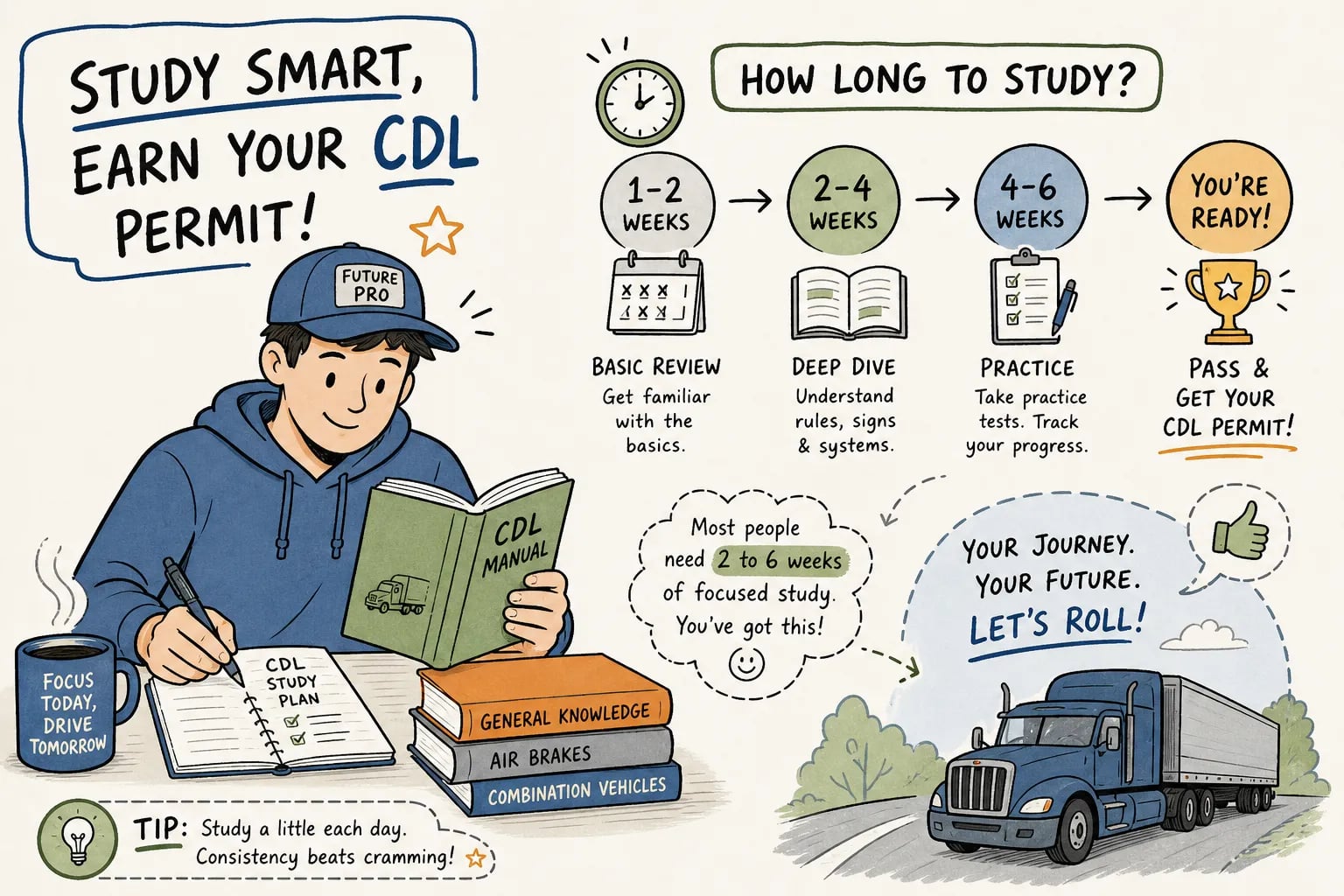
This plan is designed for Class A candidates pursuing General Knowledge, Air Brakes, and Combination Vehicles. Candidates seeking only a Class B license or a single endorsement can compress the timeline. The core principle stays the same regardless of your license class: start untimed and topic-specific, transition to full simulation by Day 5, and run missed-question review every single day without exception.
Days 1 through 4: build topic by topic with untimed practice
-
Day 1: General Knowledge (untimed). Focus on vehicle inspection, cargo securement, space management, and federal regulations. Don't move on until you're hitting 80% or better consistently.
-
Day 2: Air Brakes (untimed). Work through pressure checks, low-pressure warning signals, brake fade, and ABS function. Review every missed question with its explanation before finishing your session.
-
Day 3: Combination Vehicles (untimed). Cover coupling and uncoupling procedures, trailer tracking during turns, jackknife prevention, and added stopping distance compared to a single-unit vehicle.
-
Day 4: Weak topic day. Pull up your lowest-scoring section from Days 1 through 3 and run missed-question-only mode on it. Don't start new material on Day 4; tighten what you've already covered so you carry solid fundamentals into simulation week.
Days 5 through 7: simulate, refine, and confirm readiness
-
Day 5: Full timed simulation. Run a full timed CDL permit practice test at the 80% threshold. Treat it exactly like test day: no looking things up, no pausing. Review all missed questions after the session is complete.
-
Day 6: Second timed simulation plus targeted topic drill. If you're above 85% on the simulation, focus your additional time only on missed questions from the session. If you're still below 85%, run a short untimed drill on the section where you're losing the most points.
-
Day 7: Light review only. No new material, no full exam restarts. Work through missed questions from Days 5 and 6 once, then stop. Rest before your exam. Fatigue on test day costs points that preparation already earned you.
2026 CDL changes that affect your permit prep
Preparing with outdated information is a real risk in 2026. Several regulatory and curriculum changes have taken effect this year that directly affect what's on the test, who qualifies to test, and how certain states administer the exam. These aren't minor procedural updates; some of them change the question content you'll face on test day.
ELDT curriculum updates effective September 22, 2026
FMCSA's updated Entry-Level Driver Training curriculum became effective September 22, 2026, and it affects both Class A theory sequencing and the Hazmat endorsement theory module. The updated H-endorsement content adds security awareness, incident reporting, and refreshed placard requirements tied to 49 CFR Part 172, reflecting closer alignment with TSA threat-assessment standards. States have a 90-day window to phase out the older Hazmat question pool after the updated curriculum takes effect. If you're pursuing a Hazmat endorsement in late 2026, check directly with your state DMV to confirm whether testing has transitioned to the updated question bank before you sit for that section.
English-only testing and non-domiciled CDL rule changes
Florida ended translated CDL knowledge exams on February 6, 2026, and Texas followed with an English-only policy for CDL and commercial learner permit knowledge tests effective June 1, 2026. Candidates who previously relied on translated exams in those states need to account for this change in their preparation. Separately, FMCSA's 2026 final rule tightened non-domiciled CLP/CDL eligibility requirements significantly. Qualifying applicants now need an unexpired foreign passport plus an unexpired I-94 showing an approved employment-based immigration status; credentials expire on the I-94 date or after one year, whichever comes first, and employment authorization documents alone no longer qualify. If you're a non-domiciled applicant, verify your eligibility through your state DMV before scheduling your written test, since ineligibility discovered after scheduling costs you time and fees.
Passing the CDL permit test is a preparation problem, not a talent problem
The candidates who pass on their first attempt aren't unusually gifted. They used FMCSA-aligned practice questions, drilled topic by topic until their weakest sections cleared 80%, and transitioned to timed simulation before test day so the real exam felt familiar. Done consistently over a focused study week, those steps are strongly associated with better outcomes. Guessing your way through a generic question bank and hoping the material overlaps with the actual exam is not a preparation strategy.
A quality CDL permit practice test is a tool with specific, evaluable features: FMCSA-aligned content, accurate answer explanations, targeted topic-specific modules, and a missed-question review system that works on your actual weak points rather than recycling questions you already know. Before you commit to any platform, check for those four things.
CDLTest360 is built around exactly those features, and you can verify that firsthand before committing to full access. The 7-day plan in this article is ready to use today, structured around the same FMCSA-aligned content you'll face at the DMV. Start with the topic that feels weakest, run every missed question through review, and don't move to timed simulation until you're clearing 80% consistently on untimed quizzes. That sequence turns CDL permit prep from a stressful guessing game into a predictable path to passing.
{ "@type": "Article", "datePublished": "2026-09-04T11:01:45.231Z", "dateModified": "2026-09-04T11:01:45.231Z", "headline": "CDL Permit Practice Test: How to Study and Pass in 2026", "description": "Find the best CDL permit practice test resources, learn what makes a quality quiz, and follow a 7-day study plan to pass your CDL written test in 2026.", "publisher": { "@type": "Organization", "name": "CDLTest360" }, "image": [ ] }