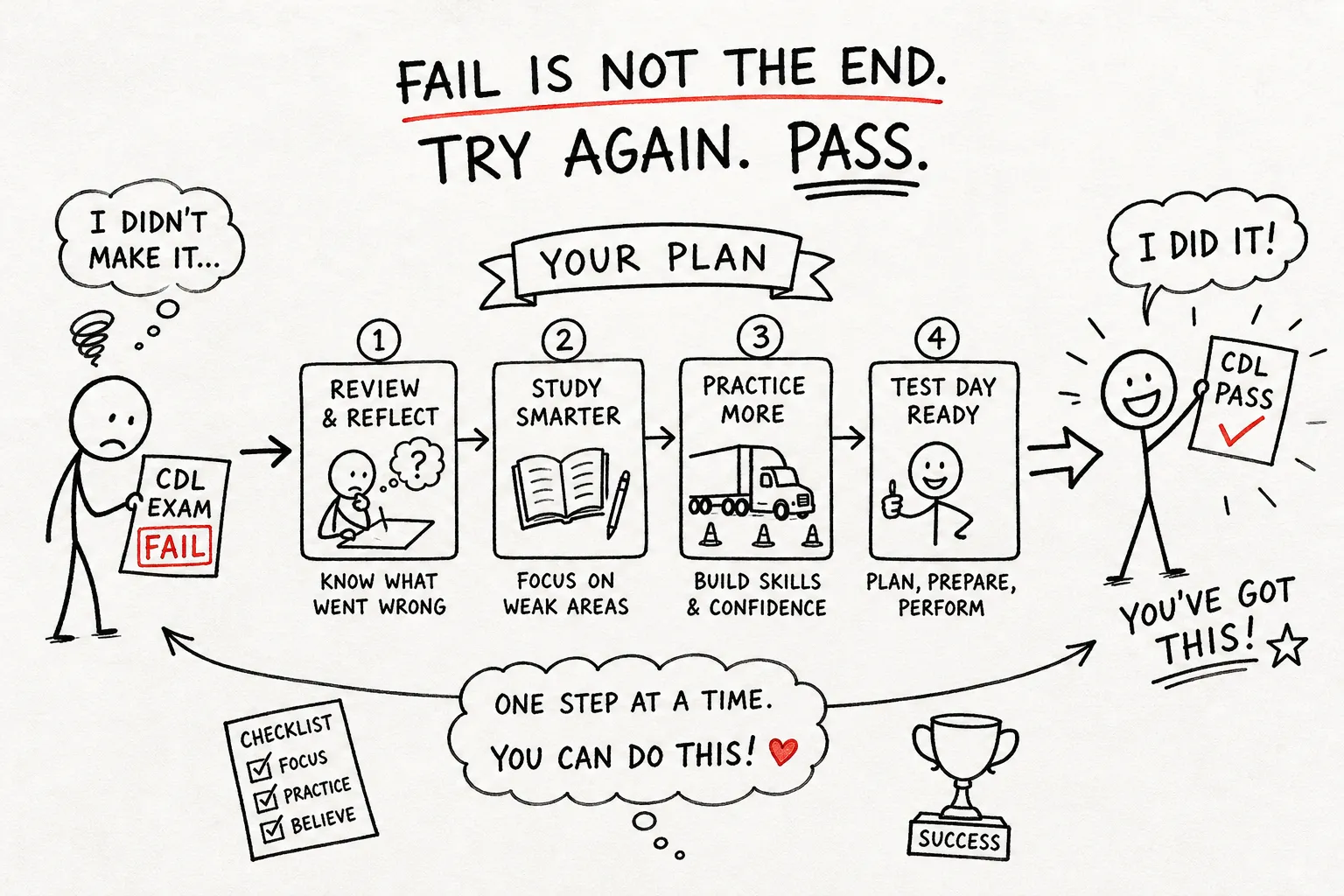
Retaking the CDL exam after a failure is not the end of your road to a commercial license. It's a data point. It tells you exactly where your preparation fell short, and that information is more useful than another week of re-reading the same manual pages you already covered. Twenty years inside CDL test prep has shown me the same pattern over and over: candidates who treat a failed attempt as diagnostic information pass on their next try. Candidates who just book the retest faster fail again.
This guide covers everything you need to move forward after a failed attempt. You'll learn what happens to your application status, how long you have to wait before you can retest, what retakes cost in different states, and why most candidates fail the same sections twice when they don't change their approach. More importantly, you'll walk away with a study plan built specifically for retakers.
The candidates I've watched come back and pass on their second attempt share one common trait: they treated the failure as useful information and acted on it. The ones who failed a third time usually booked their retest too fast and studied the wrong material. This guide is built to put you in the first group.
What actually happens to your CDL application after a failed test
The first thing most failed candidates assume is that they're starting over completely. That assumption causes unnecessary panic and, worse, inaction. In many states, a failed knowledge test keeps your application active. You are not disqualified. You are not banned. You are scheduled for a retest, subject to a waiting period and your state's attempt limit. Because rules vary by jurisdiction, it's worth checking with your state DMV to confirm how your application is treated after a failure.
That said, your application does have a shelf life. California invalidates an application if all requirements aren't completed within 12 months. New Jersey's CDL test receipt is valid for 180 days. Texas closes an application after three failures or 90 days, whichever comes first. The clock is running, but it's not a stopwatch. You almost certainly have more time than you think.
Knowledge test fail vs. skills test fail: different rules apply
These two test types operate on completely different timelines, and confusing them leads to bad planning. A failed knowledge test is generally faster and cheaper to reschedule. Most states require a waiting period of one to a few days before you can retake the CDL test, and the fee is typically modest. A failed skills test carries different consequences because the stakes at that stage are higher and examiner time is more expensive.
A failed pre-trip inspection, backing maneuver, or road segment may or may not require you to repeat the entire skills test, depending on your state. Some states allow you to retest only the failed segment. Others require a full restart of the skills evaluation. Knowing which rule applies to you before you schedule is essential, because the answer affects both how you prepare and how much the retest costs.
What "application invalid" actually means
If you hit your state's attempt cap without passing, your application is typically closed or invalidated. This is the scenario that does require a real restart: new paperwork, new application fees, and in many states, a new knowledge test even if you passed it previously. California and Texas are the most common examples. In California, three failed attempts on any required knowledge test invalidate the application. In Texas, three failures or 90 days from the original application date closes the file, whichever milestone arrives first.
Hitting this wall doesn't mean your CDL is out of reach. It means the path gets slightly longer and a bit more expensive. File the new application, pay the fee, and come back this time with a smarter study approach and genuinely prepared to pass. Thousands of drivers have restarted and earned their license. The paperwork is annoying, but it's not complicated.
How long you have to wait before retaking the CDL exam
Wait periods for CDL retesting are controlled by each state, not by the federal government. FMCSA sets the rules for what the CDL knowledge and skills tests must cover, but the retesting schedule is entirely up to your state DMV. This matters because the commonly cited "one-day wait" is not universal, and assuming it is can lead to a failed scheduling attempt.
For knowledge test retakes, most states require at least one full day before another attempt. Some states escalate the wait after multiple failures. For skills test retakes, mandatory waiting periods commonly fall between one and fourteen days, and some states impose a longer cooling-off period after a road test failure that involved an accident or traffic violation.
Scheduling and wait periods when retaking the CDL exam: what the data shows
State wait periods vary more than most candidates expect. California has no mandatory wait after a first knowledge test failure but imposes a 7-day wait after a second attempt. Texas uses a 24-hour window between attempts but closes the application after three failures or 90 days. Georgia's CDL reexamination rules allow no more than three failures under a current application; standard waiting periods are two days after the first failure and seven days after the second and third. For current wait-period rules in your state, confirm directly with your state DMV or CDL unit before you schedule, since policies do get updated.
First-failure retakes are usually accessible within a day or two in most states. The mandatory wait is rarely what slows candidates down. Appointment availability is typically the bigger obstacle, which leads directly to the next point.
Skills test wait periods and scheduling lead time
There's an important distinction between the state's mandatory waiting period and the actual availability of appointments. A 3-day mandatory wait means nothing if the next open slot at your DMV is three weeks out. Washington State, for example, requires a 3-day wait after a failed skills test, but if the nearest testing site has a 2-week backlog, the mandatory wait is irrelevant to your real timeline.
This is where authorized third-party testers become worth checking immediately. Third-party examiners often have shorter scheduling lead times than state-run facilities. Federal rules require them to notify the state at least two business days before administering the test, but that notice period doesn't affect your appointment date. After your mandatory wait clears, check both your state DMV and third-party testers in your area before you commit to a date. The difference in availability can sometimes be measured in weeks.
State CDL retake policies and attempt limits you need to know
There is no federal cap on how many times you can fail the CDL knowledge or skills test. Every number you've heard, including the commonly repeated "three attempts" rule, comes from individual state policy. Three attempts is common enough to be a reasonable working assumption, but it is not a federal rule, and several states operate differently.
States with a defined attempt cap
California limits applicants to three attempts on each required knowledge test. After a third failure, the application is invalidated and the candidate must reapply, pay again, and start the process over. Texas uses a different structure: the application remains valid for 90 days or three examination attempts, whichever milestone arrives first. If you fail twice and your 90-day window expires before a third attempt, the application closes regardless. Georgia allows no more than three failures under a current application; a fourth failure requires reapplying through the CDL Unit, with waiting periods of two days after the first failure and seven days after the second and third.
These three states represent the most documented high-population examples, but many other states follow similar frameworks. If you're not in California, Texas, or Georgia, the safest move is to call your state DMV directly and ask for the current attempt limit and application validity window before you assume you have more runway than you do.
States with more flexible retake structures
Michigan and New York don't appear to have a fixed knowledge-test attempt cap. In both states, retakes are allowed as long as the application remains valid and fees are paid. New York operates similarly for knowledge tests, though an expired permit cannot be renewed without a new application, which would require taking the knowledge test again from scratch. Pennsylvania takes a mixed approach: no apparent cap on knowledge-test retakes, but a strict three-attempt limit on the road skills test. Because Michigan's policies have been reported inconsistently across sources, verify the current wait period and attempt rules directly with the Michigan SOS before you schedule.
When failing triggers a full restart
A full restart becomes necessary when you exhaust your state's attempt limit, allow your CLP to expire without renewal, or let the application validity window close. When any of these happens, you file a new application, pay the application fee again, and in most states retake the knowledge test even if you had previously passed it. Passed components don't always carry over indefinitely. Washington, for example, specifies that skills-test scores are valid for 180 days; if your CLP expires before you complete all components, you may have to retake even the segments you already passed.
The practical takeaway is simple: don't let your application expire waiting for a perfect moment to retest. Retake as soon as you're genuinely ready, not as soon as the mandatory wait clears.
CDL retest fees, paperwork, and how to schedule your appointment
Retest costs vary significantly depending on your state and whether you test at a state DMV facility or through an approved third-party examiner. Knowledge test retakes tend to be lower-cost, often in the $10 to $30 range per attempt. Skills test retakes involve examiner fees that climb considerably, particularly through third-party testers where vehicle rental and examiner time are factored in separately.
Ohio's state facility charges $10 for the pre-trip segment, $10 for basic controls, and $30 for the road test, making a full skills retest $50 at the DMV. A comparable retest through an Ohio third-party tester can run $80 to $120 or more, with vehicle rental potentially adding another $125 to $175 on top of that.
Washington charges $175 for truck or passenger testing at both state and third-party sites, but that fee covers two attempts with the same examiner, so a single retest after a first failure effectively costs nothing extra if you stay with the same examiner. Kentucky charges $50 for applicants with a Kentucky license held at least 30 days, or $150 for newer or out-of-state applicants. Fee schedules change, so confirm current amounts with your testing site before you show up.
What you'll need to bring to your retest
The documentation requirements vary by state, but the core checklist is consistent across most: a valid CLP, your underlying driver's license, proof of ELDT completion if the endorsement requires it, and payment. For skills test retakes, you also need the test vehicle with current registration, proof of insurance, and a valid inspection sticker. Some states require the previous fail or denial form to be presented at the retest window. New Jersey specifically requires the prior skills-test fail/denial form to book the retest appointment.
Missing a single document can cancel your appointment on the spot. Confirm your state's specific checklist by checking your DMV's CDL testing page before you show up. The appointment notice often lists requirements, but the DMV website is the authoritative source for the current list.
State DMV vs. third-party tester: which gets you in faster
The tradeoff is straightforward. State DMV facilities tend to have lower fees but longer scheduling backlogs. Authorized third-party testers typically offer faster availability and more flexible scheduling windows, which matters if you're trying to retest within a tight timeline. For skills tests in particular, third-party testers are worth checking first. Getting in two weeks earlier is worth a modest fee difference for most candidates who need to move forward quickly.
Why most CDL candidates fail and what actually needs to change
The most expensive mistake retakers make is treating the first failure as bad luck. A knowledge gap causes candidates to miss the same cluster of air brake questions repeatedly, not bad luck. And a knowledge gap is fixable, but only if you identify the right gap and address it directly before the next appointment.
Knowledge test failures: what the exam actually exposes
The CDL knowledge test covers a lot of ground: general knowledge, air brakes, combination vehicles, hazmat, hours-of-service rules, cargo securement, stopping distance calculations, and emergency procedures. In my experience, air brakes trip up more candidates than any other section, because the questions require understanding how the system works, not just memorizing component names. Hours-of-service rules catch candidates who grasp the concept but can't recall the specific numerical limits. Cargo securement questions trip up candidates who know the general idea but haven't studied the tie-down requirements precisely.
The two most reliable predictors of a second failure are guessing on edge-case questions and skimming the state CDL manual instead of reading it carefully. Generic flashcard apps cover the popular questions but leave real gaps on FMCSA-specific wording and numerical details. The exam is built from the state CDL manual, not from popular practice questions. If your prep material isn't sourced from the same document the exam draws from, you're leaving points on the table.
Skills test failures: the segments where candidates break down
Pre-trip inspection is the most commonly failed skills test segment, and the errors are predictable. Candidates skip required components, use vague descriptions instead of specific language, or lose the inspection sequence partway through without explaining what a defect would look like and why it matters. The fix is equally predictable: one repeatable route, practiced aloud on the actual test vehicle, until you can complete it from memory without a prompt or pause.
Backing maneuver failures cluster around poor setup and overcorrection. Candidates enter the maneuver at a bad angle, then try to save it with large steering inputs instead of pulling up and resetting. Road test failures are dominated by rolling stops, infrequent mirror scans, poor lane positioning on turns, late signals, and following distances that are too short. Every one of these is a trainable behavior. They show up because the candidate hasn't practiced them under test conditions until they're automatic. That's the part you fix before you rebook.
A focused study plan for retaking the CDL exam
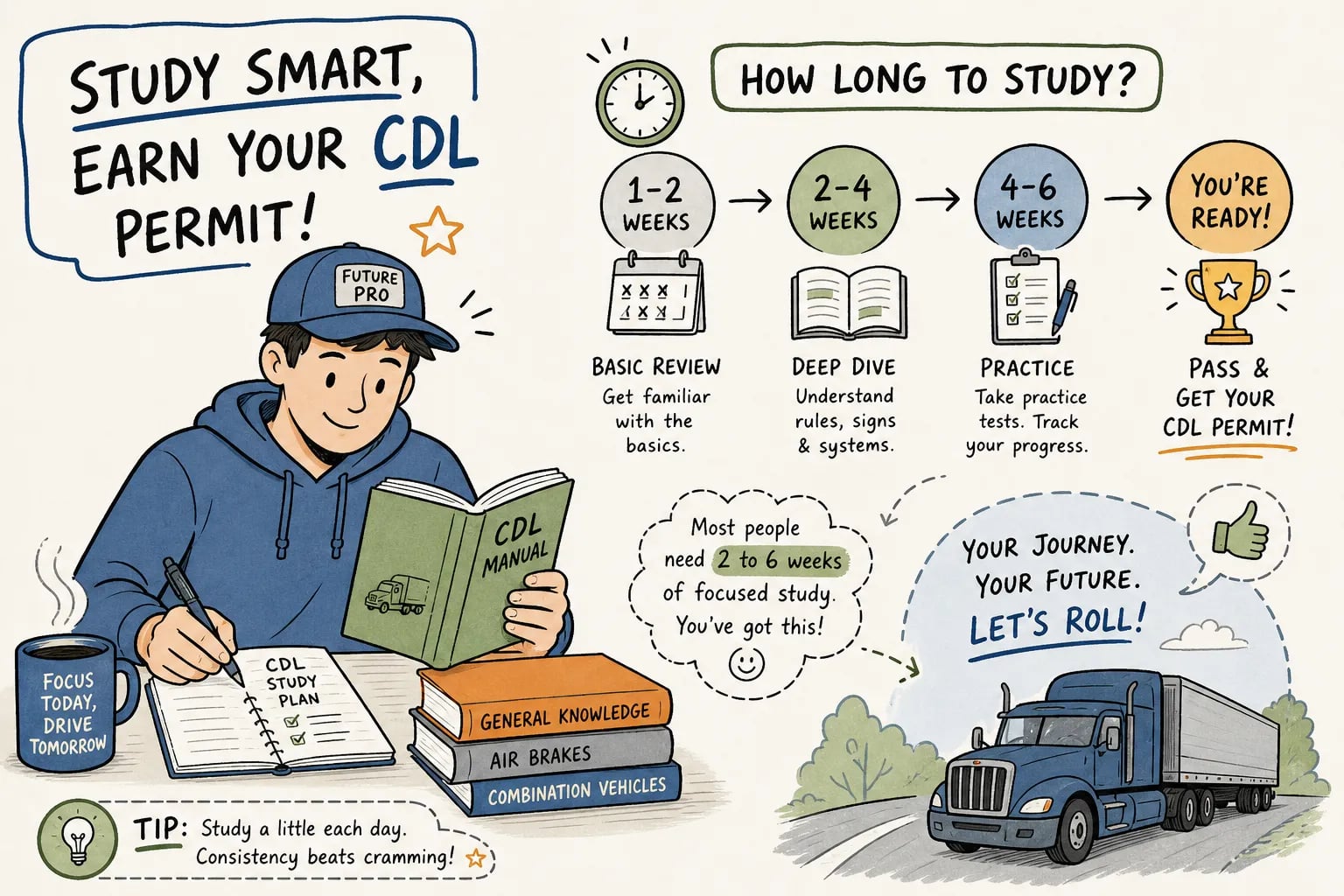
Retake prep is fundamentally different from first-attempt prep. You've already gone through the material. You've already sat in the test environment. Going back to page one of the CDL manual and re-reading everything equally is the slowest possible path to a passing score. The goal now is targeted remediation: find what you missed, drill it until it's solid, and confirm readiness before you schedule.
Start with what you got wrong, not what you already know
When most candidates get their score sheet back from a failed test, the instinct is to start studying from the beginning. That instinct is wrong. The score sheet tells you which domains you missed. Those domains are where your study time should go, not the sections you already passed. Spending three hours reviewing general knowledge rules you got right is wasted time you could be using to master air brake pressure thresholds and the pre-trip inspection sequence.
CDLTest360 is built around exactly this workflow. Instead of running through a full question bank again from the start, the platform isolates only the questions you answered incorrectly and drills them in a focused loop. Your study session goes toward actual gaps, not confirmed strengths. That specificity is what shortens the distance between your first attempt and a passing score on the second.
Simulate the real test before you book the retest
Feeling ready and being ready are two different things. The only way to know the difference before you spend money on another testing appointment is to simulate the actual exam under real conditions. CDLTest360's exam simulation mode runs 50 questions in a timed format that mirrors the structure and difficulty of the actual CDL knowledge test. Note that passing thresholds vary by state, so check your state's specific requirement. If you're passing the simulation consistently, you're ready to book. If you're hitting 74% on timed runs, you're not, and booking anyway is how candidates end up on their third attempt.
Pair the simulation with the state-specific CDL manual content available inside the platform to make sure what you're practicing actually matches the source material your exam draws from. The manual is the test's foundation. Practice built on anything else has gaps.
How to know you're actually ready before you rebook
This is where candidates who pass the second time separate from candidates who end up taking it a third time. Waiting out the mandatory period while feeling impatient is a real phenomenon, and it drives a significant share of second-attempt failures. The mandatory wait is not the green light. Demonstrated performance is the green light.
The practice test threshold that signals real readiness
Scoring 80% on a single practice test is not a reliable indicator that you'll pass. It could mean you got lucky on a familiar set of questions. Passing three consecutive timed exam simulations at or above your state's required threshold, specifically on the modules that caused your original failure, is a much stronger signal. Three consecutive passes at that level means the knowledge is reliable, not situational. That's the benchmark worth waiting for before you schedule and pay for another attempt.
This standard also mirrors what the actual test requires, so you're training at exactly the right difficulty level. Practicing at a lower threshold and expecting to clear the bar on test day is a gap in logic that costs candidates money and time.
Skills test readiness checks before retesting
For candidates who failed the skills test, readiness looks different because the evaluation is performance-based rather than knowledge-based. A clean mock pre-trip inspection completed entirely from memory without prompts is the minimum bar. Successful backing maneuvers completed without boundary violations across multiple consecutive attempts is the standard, not just one good run. At least one full mock road test conducted by an instructor using the actual state scoring sheet, with every error recorded, is how you find out which automatic-fail behaviors you haven't corrected yet.
Booking the retest before hitting these benchmarks is the fastest path to a third failure. The mandatory wait gives you time. Use it to build the performance, not just to count the days.
Moving forward: the path from here to passing
Retaking the CDL exam successfully comes down to a focused plan, not just more study hours. The rules vary by state, but the path forward is the same everywhere: confirm your wait period, verify your state's attempt limits and application validity window, get your paperwork in order, and spend the time between now and your next appointment studying the right material rather than all the material.
Don't re-read the entire manual. Drill what you missed. Simulate the real test under timed conditions. Go back to the testing office only when your practice scores consistently back it up. CDLTest360 is built for this exact workflow, with missed-question drills that isolate your actual gaps and an exam simulation mode that shows you where you stand before you spend money on another appointment.
Many candidates who fail once and study with genuine focus pass on their next attempt. The ones who don't are usually the ones who rebooked too fast without changing their approach. Use the time you have, address the gaps your score sheet identified, and go back ready to pass.
{ "@type": "Article", "datePublished": "2026-10-12T11:02:14.717Z", "dateModified": "2026-10-12T11:02:14.717Z", "headline": "Retaking the CDL Exam After a Fail: Your Step-by-Step Plan", "description": "Retaking the CDL exam doesn't have to feel overwhelming. Learn wait periods, state rules, retest fees, and a smarter study plan to pass your next attempt.", "publisher": { "@type": "Organization", "name": "CDLTest360" }, "image": [ "https://composeo-article-images.s3.us-east-1.amazonaws.com/retaking-the-cdl-exam-after-a-fail-your-step-by-step-plan-1791720441115.webp" ] }