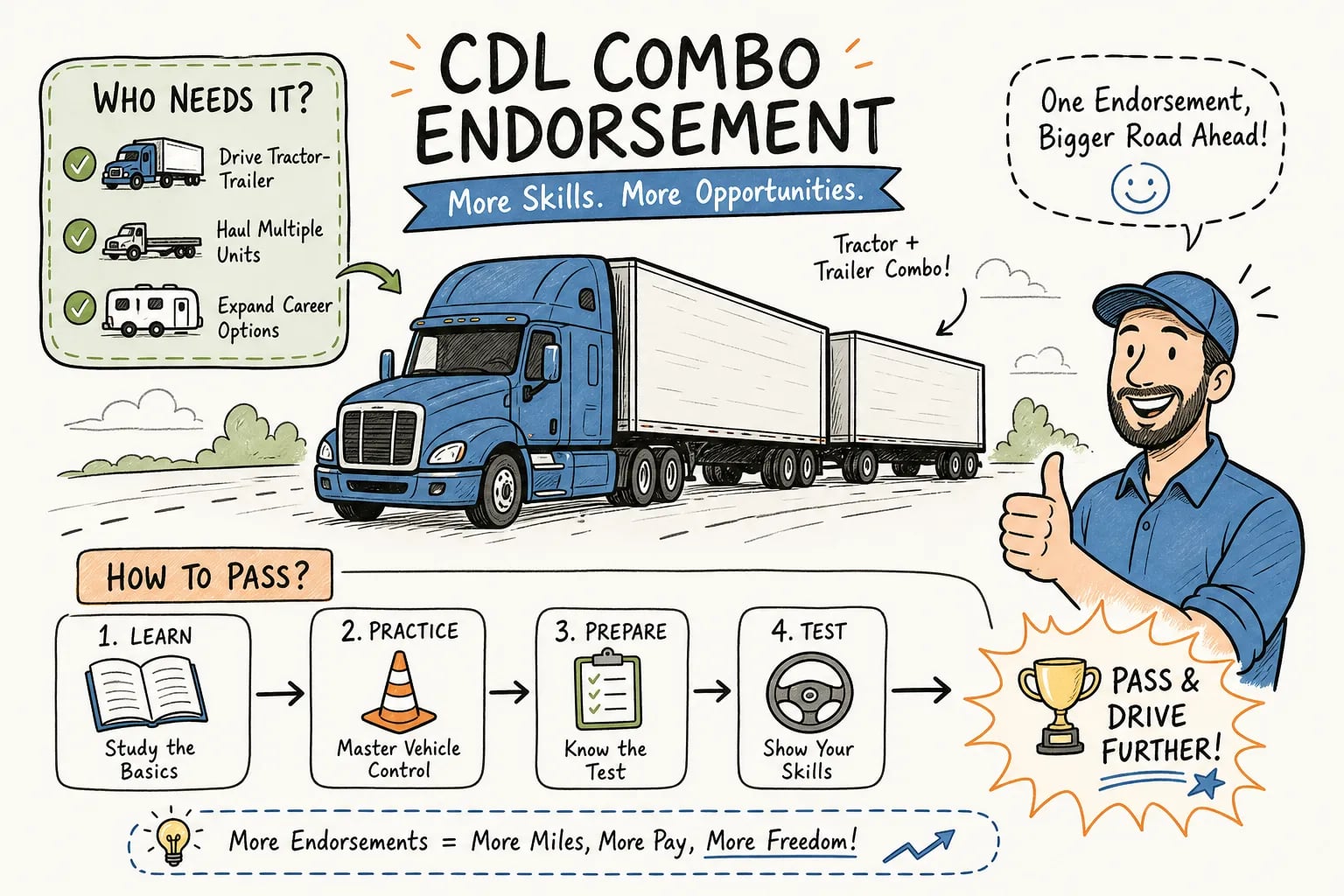
Recruiters throw around the phrase "CDL combo endorsement" like everyone already knows what it means. Classmates at CDL school use it interchangeably with three or four other terms. Candidates end up at the DMV window confused about which test they actually need to take, and that confusion costs real time, real money, and sometimes a failed test that could have been avoided with a clearer picture upfront.
Here's the short answer before we get into the details: the CDL combo endorsement, more precisely, the combination vehicle qualification, is not a separate add-on credential you chase down after earning your Class A CDL. It's built into the Class A itself. Understanding that one fact reframes everything else in this article. This article covers what the combination vehicle qualification means, whether you need additional credentials like the T or X endorsement, what knowledge areas the test pulls from, and how to study in a way that actually sticks.
At CDLTest360, candidates drill the combination vehicles section under timed, exam-like conditions before they ever walk into a DMV. That's the level of preparation this material requires, and the level this guide will help you reach.
What "CDL combo endorsement" really means
The term "combo endorsement" gets used loosely, and that's where the confusion starts. Under the federal CDL framework established by FMCSA, operating a tractor-trailer or other qualifying combination vehicle is authorized by the Class A CDL itself. The combination vehicle knowledge test is a required component of earning Class A, not an optional credential you apply for separately afterward. When most drivers say "CDL combo endorsement," they're describing the combination vehicle qualification that's already baked into Class A.
The weight thresholds that define a combination vehicle are specific: a gross combination weight rating of at least 26,001 pounds when the towed vehicle exceeds 10,000 pounds. If your operation meets those thresholds, you need Class A, and passing the combination vehicles knowledge test is part of getting there. There's no separate application for this qualification, and no additional waiting period beyond what Class A requires, though administrative fees and test scheduling details vary by state, so check your state DMV for exact requirements.
The combination vehicle qualification inside Class A
The combination vehicle knowledge test is required as a component of Class A, not layered on separately the way HazMat or Tanker credentials are. Those endorsements require their own applications, their own knowledge tests, and in the case of HazMat, a federal background check. The combination vehicle section works differently. You pass the written test, you pass the skills test in a qualifying combination vehicle, and the authorization to operate that class of equipment is part of your Class A license. The federal CDL framework standardizes these class requirements across states, though individual states may vary in how they administer and schedule the tests, so confirm the specifics with your state DMV.
Where the X endorsement fits in (and why it gets confused)
Searching for "CDL combo endorsement" sometimes pulls up results about the X endorsement, and that's a meaningful source of confusion. The X endorsement is not a combination vehicle credential. It represents the combination of two separate endorsements on one CDL: the N endorsement for tank vehicles and the H endorsement for hazardous materials. If you hold both, the state displays X on your CDL instead of listing N and H separately. The X endorsement authorizes transporting hazardous materials in tank vehicles. It has nothing to do with tractor-trailer operation as a vehicle class. Drivers who need X must pass both the HazMat and Tank knowledge tests and complete the TSA security threat assessment, which is required because HazMat transport involves a federal background check.
Who needs the CDL combo endorsement qualification
If you're pursuing a Class A CDL, the combination vehicle knowledge test applies to you, every Class A candidate must pass it as part of the written test sequence. The question of "do I need this?" is really a Class A vs. Class B question, and the answer hinges on what you'll be driving professionally.
Class B drivers operate single vehicles over 26,001 pounds, or they tow a vehicle under 10,000 pounds. They don't pull tractor-trailers in the Class A sense, so the combination vehicle knowledge section generally doesn't apply to them. If your career plan involves tractor-trailers, flatbeds, dry vans, refrigerated units, or any multi-trailer freight setup, Class A is your license, and the combination vehicle test is part of the package.
When you need more than just Class A
Class A covers the standard tractor-single-trailer operation that defines most long-haul and regional freight routes. But certain operations require endorsements stacked on top of Class A. The T endorsement is required for doubles and triples endorsement operations, any setup where you pull two or three trailers. Standard Class A does not cover that. The N endorsement is required for tank vehicles. The H endorsement is required for hazardous materials transport, and it triggers the TSA security threat assessment. A driver running tanker doubles, for example, needs Class A plus T plus N at minimum. Each of those endorsements has its own knowledge test, and they're genuinely separate from the combination vehicle qualification.
What the combination vehicle knowledge test actually covers
Many candidates underestimate this section because they assume "truck stuff" is intuitive after spending time around equipment. The knowledge test doesn't care what you've seen in a yard or a truck stop. It tests specific concepts drawn from Section 6 of the FMCSA CDL manual, and several of those concepts require precise understanding, not general familiarity.
Coupling and uncoupling procedures
The test places heavy emphasis on the exact sequence for connecting and disconnecting a tractor from a trailer. That means fifth-wheel inspection, kingpin checks, confirming the locking jaws are properly seated, and verifying air and electrical line connections. Questions in this area often describe a step out of order or ask what happens if a specific check is skipped. Knowing vaguely that "you hook things up carefully" won't cut it here. You need to know the specific sequence and why each step matters. The combination vehicle inspection component ties directly into the pre-trip inspection content you'll also need for the skills test.
Handling, braking, and rollover prevention
The crack-the-whip effect is one of the most tested concepts in this section. It describes how the rear of a longer combination vehicle swings wider and faster than the front during sudden movements, which increases rollover and trailer-swing risk. Off-tracking on turns is another high-frequency topic: when a combination vehicle turns, the rear axles follow a shorter path than the front, which means the vehicle sweeps more road space than it appears to. Examiners test this conceptually because a driver who understands off-tracking makes better decisions about lane position and turning radius before executing the turn. Braking behavior also changes between a loaded and empty combination vehicle, and the test expects you to know why.
Air brakes on combination vehicles
Air brake knowledge is deeply intertwined with the combination vehicle section. The trailer air supply valve, emergency braking scenarios, glad hands, and what happens when an air line separates while driving are all fair game. Some of this content overlaps with the separate Air Brakes knowledge test, which is why studying both sections together makes more sense than treating them as completely separate subjects. If you're operating a combination vehicle with air brakes, which describes most Class A operations, you'll be tested on both. The content reinforces itself when studied properly.
How the CDL written test sequence is structured
One of the most common ways candidates lose time is showing up to the DMV without understanding the correct order for taking their written tests. The sequence matters, and your state DMV will have specific requirements about how tests are scheduled and administered, check their website before you go.
The three tests every Class A candidate must pass
General Knowledge comes first. This test covers the foundational rules of commercial vehicle operation, and most states require it before any other written tests can be administered. After General Knowledge, you take the Combination Vehicles test, which covers all the content described above from Section 6. The Air Brakes test comes next, and it's required unless you're willing to accept an air brake restriction on your CDL, which would prevent you from operating any commercial vehicle equipped with air brakes. For Class A operation, accepting that restriction is essentially a career limiter, so virtually all Class A candidates take the Air Brakes test.
Passing thresholds and retake rules
The federal passing threshold for all CDL knowledge tests is 80%. On the Combination Vehicles test, which typically runs 20 questions, that means you need at least 16 correct answers. Some states administer up to 30 questions, but the 80% requirement holds regardless of question count. If you pass General Knowledge but fail Combination Vehicles, you generally only need to retake the failed test, not start over, though retake rules and waiting periods between attempts vary by state.
Once all written tests are cleared, the state issues a CDL learner's permit. That permit authorizes behind-the-wheel practice in a qualifying vehicle with a licensed CDL holder present, the stage that prepares you for the skills test.
What the skills test requires after you pass the written exams
Clearing the written tests gets you a permit. The permit gets you behind the wheel for practice. What finishes the job is the skills test, which has three parts and must be performed in a representative combination vehicle.
Pre-trip vehicle inspection for combination vehicles
The pre-trip inspection (PTI) phase asks you to walk around the vehicle and verbalize what you're inspecting and what you're looking for. For a combination unit, that includes the coupling system, fifth wheel, kingpin, locking jaws, air lines, electrical connections, landing gear, trailer frame, suspension, and tires. Examiners expect specific language. Saying "I'm checking the tires" isn't enough. You need to articulate what you're looking for: proper inflation, no cuts or bulges, valve stems intact, no exposed cord. The PTI phrase trainer inside CDLTest360 is built specifically for this. It prompts you to recall exact inspection wording for each vehicle component, a skill that passive reading from the manual never actually develops.
Basic vehicle control and the on-road evaluation
Basic vehicle control covers off-road maneuvers: straight-line backing, offset backing, and in some states, parallel parking or dock-position backing in a combination vehicle. These maneuvers test spatial awareness and control in a setting where the examiner can watch your technique closely. The on-road evaluation that follows tests your ability to apply all the conceptual knowledge from the written tests to actual driving: lane positioning, turning technique, following distance, speed management, and intersection handling. The vehicle you use for the skills test must be a representative combination vehicle, you can't take the Class A skills test in a straight truck. If you're going through a CDL school, they typically provide the vehicle. If you're self-sponsored, you need to arrange one.
How the T, N, H, and X endorsements interact with your Class A
Endorsement stacking is normal in the trucking industry. A driver with five or six years of experience often holds multiple endorsements on one CDL. Understanding how they relate to each other helps you plan your career path without unnecessary confusion.
The T endorsement: doubles and triples operations
The T endorsement authorizes pulling two or three trailers behind a single tractor. It requires a separate written knowledge test covering Section 7 of the FMCSA CDL manual, which addresses the additional handling, coupling, and braking considerations specific to longer combinations. T is independent of the standard Class A combination vehicle qualification. Holding Class A gets you to single-trailer operations. Adding T opens doubles and triples routes. In the LTL freight industry and certain regional distribution networks, T is a common and valuable add-on.
The X endorsement: when HazMat and Tanker combine
When a driver qualifies for both the H and N endorsements, the state displays X on the CDL instead of listing both separately. The X endorsement authorizes hazardous material transport in tank vehicles. Because it includes the HazMat component, it requires the TSA security threat assessment, which involves fingerprinting, a criminal history check through the FBI, and an intelligence-related background check. TSA approval has to come through before the state can issue the endorsement. A driver pulling tanker doubles carrying hazardous materials would need Class A plus T plus X, with each component earned through its own process.
What a CDL with multiple endorsements looks like
Multiple endorsements appear as a string of letters in the endorsements field on the physical CDL credential. A driver holding T, N, and H might display X and T. States generally allow drivers to hold multiple endorsements with no conflict between them, each one requires its own knowledge test, and some, like H and P, require additional skills evaluations or background checks. The combination vehicle qualification never appears as a letter endorsement because it's part of Class A itself, not a separate credential. That's the cleanest way to remember the distinction.
How to pass the CDL combo endorsement knowledge test
Most candidates who fail the combination vehicle knowledge test didn't fail because the material is obscure. Based on what CDL instructors consistently report, the pattern looks like this: they read the manual once or twice, felt familiar with the concepts, and walked in without ever testing themselves under conditions that mirror the actual exam. Familiarity and readiness are not the same thing.
Why reading the manual alone isn't enough
Section 6 of the FMCSA CDL manual is the source material for the knowledge test, and you absolutely need to read it. But passive reading builds recognition, not recall. The combination vehicle test uses scenario-based questions that ask you to apply what you know, not just identify it. A question might describe a driver pulling doubles who takes a highway ramp too fast and ask what the primary risk factor is. Recognizing "rollover" when you see it isn't the same as being able to retrieve that answer under time pressure when the question is phrased differently than anything you've seen before. Drivers who "studied hard but still failed" almost always studied by reading rather than by testing themselves.
How CDLTest360's timed exam simulation builds real readiness
CDLTest360's combination vehicle module is designed to match the actual format of the knowledge test: question sets targeting the 80% pass threshold, delivered under timed conditions. The timed simulation mode matters because the DMV experience has pressure built into it. Candidates who have only practiced at their own pace, stopping to look things up, often find that time pressure alone changes how they perform. Practicing under timed conditions removes that variable before test day.
The missed-question drill loop is one of the most efficient features for combination vehicle prep specifically. Instead of making you repeat an entire practice session to see the questions you got wrong, it isolates only those questions and re-drills them until you demonstrate consistent mastery. For a section like Combination Vehicles, where coupling procedures and air brake system interactions require precise recall, that targeted repetition closes knowledge gaps faster than re-reading the same pages. You can start a free CDL combination practice test session without creating an account.
Building a study routine that covers the right material
Sequence your study the same way you'll take the tests: General Knowledge first, then Combination Vehicles, then Air Brakes. This isn't just a scheduling preference, the General Knowledge content provides the foundation that makes the Combination Vehicles material easier to absorb. Trying to learn combination vehicle air brake systems before you understand basic CDL air brake concepts is working against yourself.
Use the state-specific CDL manual available inside CDLTest360 alongside your practice sessions to catch any state-level variations that might affect how questions are phrased. Then set a clear benchmark before scheduling your DMV appointment: consistent 85% or higher on timed practice simulations means you're ready. Anything below that means you still have specific gaps to close, and the missed-question drill will show you exactly where they are.
The clearest path from confused to credentialed
The CDL combo endorsement is not a mystery credential to track down. It's the combination vehicle knowledge requirement built into Class A, and understanding exactly what it covers puts you ahead of most candidates who show up to the DMV guessing. The test is specific, the content is learnable, and the path through it is well-defined.
If your career path extends beyond standard tractor-single-trailer work, the T and X endorsements each have their own clear requirements. T gets you to doubles and triples. X covers HazMat plus Tanker operations. None of them conflict with each other, and all of them stack cleanly on a Class A CDL. Knowing which credentials actually apply to your situation before you start studying saves time, reduces costs, and keeps your focus where it belongs.
Practicing under timed, exam-like conditions with questions drawn from the same FMCSA content the actual test uses is the most direct way to close the gap between "studied" and "ready." Run a free CDL combo endorsement practice session on CDLTest360 today and find out exactly where you stand before you ever step up to the DMV window.
{ "@type": "Article", "datePublished": "2026-10-10T11:02:11.884Z", "dateModified": "2026-10-10T11:02:11.884Z", "headline": "CDL Combo Endorsement: Who Needs It and How to Pass", "description": "Learn what the CDL combo endorsement actually covers, who needs it, and how to pass the combination vehicle knowledge test. Practice free today.", "publisher": { "@type": "Organization", "name": "CDLTest360" }, "image": [ ] }


