The CDL air brakes test catches more candidates off guard than almost any other endorsement exam, and the reason is straightforward: it doesn't just ask you to understand how air brake systems work. It asks you to know specific numbers. Exact pressure thresholds. Allowable leak rates to the decimal. Warning device activation points. If you walk in without those numbers locked in your head, you'll recognize the concepts but miss the answers.
That's a frustrating position to be in, especially if you've never worked with air brake systems before. The terminology alone, governors, slack adjusters, S-cams, dual circuits, feels like a foreign language the first time you read through the manual. But here's what experienced CDL candidates know: the commercial driver air brake exam is one of the most predictable tests you'll ever take. The same concepts, the same pressure values, and the same inspection sequence show up on every administration.
By the end of this guide, you'll know exactly what's on the test, which numbers you absolutely must have memorized, how the seven-step inspection sequence is tested in written form, and what types of questions cause the most missed answers. Start with what the test actually covers.
What the CDL air brakes endorsement test actually covers
How many questions, and what score do you need to pass?
Across most U.S. states, the air brakes knowledge test runs 25 questions with an 80% passing score required, meaning you need at least 20 correct answers to pass. Texas and California, for example, both commonly use this 25-question, 80% format. A handful of states use slightly different question counts, and while 80% is the most widely applied passing threshold, FMCSA does not mandate a single nationwide numeric pass rate for every state. Always confirm the exact format with your state DMV before test day, because question count and passing score can vary.
Who needs to take this test, and what happens if you skip it?
Any CDL candidate whose vehicle is equipped with air brakes must pass the air brake knowledge test. If you skip it or fail it and still receive a CDL, the state places an L restriction on your license. That restriction prohibits you from operating any commercial vehicle with an air brake system, which eliminates the vast majority of Class A vehicles and many Class B vehicles from your driving eligibility.
Removing the L restriction requires two things: passing the air brake knowledge test and retaking your CDL skills test in a vehicle equipped with a full air brake system, not a quick paperwork process. Class A candidates almost always need this endorsement; Class B candidates depend on the specific vehicle type their employer uses. If you're pursuing a career in trucking, skipping this test is not an option.
The core system components every air brakes question draws from
The supply side: compressor, governor, and tanks
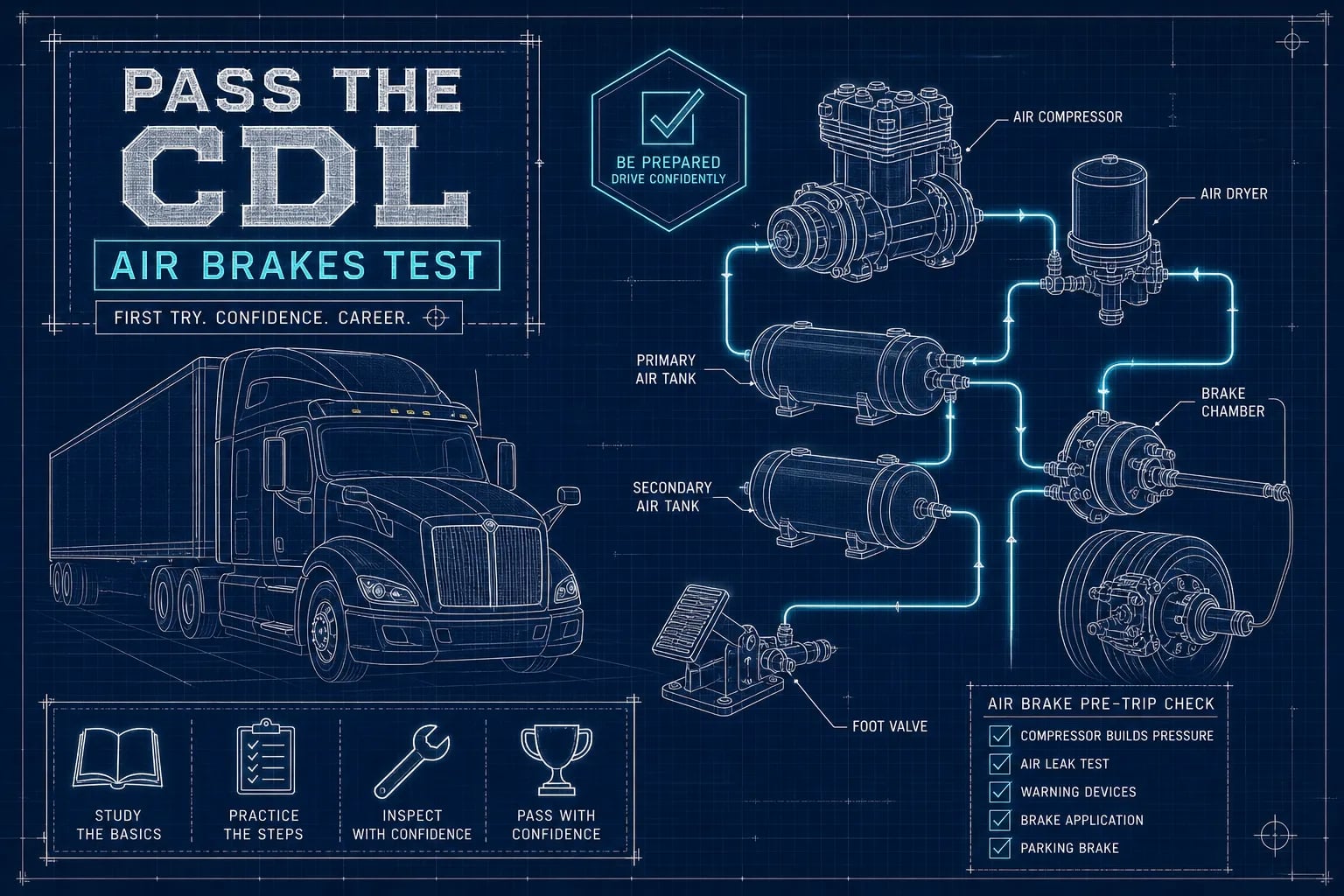
The air compressor builds the pressure that makes your brakes work. The governor controls when the compressor cycles. It cuts in at approximately 100 psi when pressure drops too low, and cuts out at 120 to 140 psi when the system reaches its upper limit. Reservoirs store the compressed air, and an air dryer removes moisture before it reaches the tanks. A large share of CDL air brake test questions are built around what happens when these components fail or operate outside their normal range, so understanding the flow from compressor to tank to brake is the base layer everything else builds on.
The delivery side: brake chambers, S-cam, and slack adjusters
When you press the brake pedal, air travels from the tanks through lines to the brake chambers. Inside the chamber, air pressure pushes a pushrod outward. That pushrod moves the slack adjuster, which rotates the S-cam, which spreads the brake shoes against the drum to create friction and slow the vehicle. Many modern commercial vehicles use automatic slack adjusters. The exam tests whether candidates understand this cause-and-effect chain, not just what each component is named.
Dual air brake systems: why redundancy is built in
A dual air brake system runs two separate circuits that charge from the same compressor but store air independently. In a common configuration, the primary circuit handles rear axle braking while the secondary circuit handles front axle braking, though exact arrangements vary by vehicle design. If one circuit loses pressure, the other still provides braking capability. Dual gauges (or one gauge with two needles) must both read in the acceptable operating range before you move the vehicle. The written exam tests this redundancy concept directly, usually by asking what happens when one circuit fails.
Pressure numbers and leak thresholds on the air brakes test
This section is where most candidates either win or lose the CDL air brake knowledge test. The exam is built around exact numbers, and guessing on pressure thresholds costs points. Read these carefully and commit them to memory before you sit down for the test.
Governor cut-in, cut-out, and normal operating range
The governor cuts out at 120 to 140 psi; most CDL practice tests use 125 psi as the benchmark answer in multiple-choice format, so that's the number to anchor in your memory. The governor cuts back in at approximately 100 psi, which signals the compressor to resume pumping. Normal operating pressure sits between 100 and 125 psi. Air brakes practice questions will ask you what falls outside that range and what it indicates, so understanding both the values and their meaning is necessary.
Low-air warning and spring brake activation thresholds
The low-air warning device must activate at or before 60 psi according to FMVSS No. 121, the standard most CDL handbooks reference. Some federal regulations (FMCSA §393.51) specify activation at or below 55 psi, or one-half of governor cutout pressure, whichever is lower. Check your state's CDL manual for the exact wording used in your exam, since questions are drawn from handbook language. Spring brakes engage automatically between 20 and 45 psi, depending on the vehicle. Pressure build-up time is also tested: a dual air system should build from 85 to 100 psi within approximately 45 seconds, per commonly cited training standards. A longer build time indicates a compressor problem.
Allowable leak rates for static and applied tests
The static leakage test runs with the engine off and brakes released. For a single vehicle, pressure loss must not exceed 2 psi per minute; for a combination vehicle, the limit is 3 psi per minute. The applied leakage test runs with the foot brake held down. For a single vehicle, the limit is 3 psi per minute; for a combination vehicle, it's 4 psi per minute. These figures are drawn from FMCSA guidance and state CDL handbooks, confirm the exact numbers in your state's manual, as some training materials vary slightly. These numbers appear directly in CDL air brakes practice questions, and knowing them cold eliminates any need to guess between similar-sounding answer choices.
The seven-step air brake check: what the written exam asks about it
Steps 1 through 4: building pressure and checking for leaks
Step one is straightforward: start the engine and let air pressure build to governor cut-out, between 120 and 140 psi. Step two begins the static test. Shut the engine off, turn the key to the on position, release the parking brakes, and watch the gauges for one full minute. Pressure loss must not exceed the allowable static rate. Step three is the applied test: press and hold the service brake pedal for one minute and watch for pressure loss within the applied tolerance.
Step four isn't a physical action, it's the conceptual trap the written exam sets repeatedly. Questions about steps two and three are usually phrased as "what exceeds acceptable limits" scenarios, and candidates who don't know the specific psi-per-minute numbers get them wrong every time.
Steps 5 through 7: warning devices, spring brakes, and service brake
Step five tests your low-air warning device. Fan the brake pedal repeatedly to drop system pressure, and confirm that the low-air warning light and buzzer activate at or before the threshold specified in your state's CDL handbook (commonly 60 psi). Step six continues that fanning process until the spring brakes pop out automatically, which should happen somewhere in the 20 to 45 psi range. Step seven wraps the sequence: rebuild air pressure, set the parking brake, and perform a low-gear tug test to confirm it holds. Then perform a slow-roll stop at about 5 mph to verify the service brakes bring the vehicle to a straight, clean stop.
Many handbooks and practice exams present this inspection sequence in order rather than scattered by topic. Candidates who memorize the steps as a sequence, rather than isolated facts, tend to answer these questions faster and more accurately. Practice the sequence start to finish, not as individual trivia items.
The types of questions that trip most candidates up
Questions about brake lag, brake fade, and stopping distance
Brake lag is the delay between when you press the pedal and when the brakes actually engage. Because air must travel through the lines before the wheel brakes engage, air brake systems have a longer lag than hydraulic systems, a gap that matters at highway speeds. Brake fade happens when prolonged or repeated braking overheats the drums and reduces friction effectiveness, a common hazard on long downgrades. Stopping distance questions combine brake lag, vehicle speed, and driver reaction time into calculation-style scenarios that many candidates find the most stressful on the exam.
Questions about emergency procedures and spring brake logic
The most common wrong answer on spring brake questions is confusing when they engage with why they engage. Spring brakes engage when air pressure drops too low; they exist as a fail-safe design, not as a parking or service brake substitute. Emergency procedure questions typically present a scenario where the low-air warning activates while the vehicle is moving. The correct answer is always the same: stop safely and check the system. Candidates who second-guess that answer and choose something more elaborate consistently get it wrong.
Questions about dual systems, ABS, and parking brakes
Dual system questions focus on what happens when one circuit loses pressure. The key point: one failed circuit reduces braking capability but does not eliminate it. ABS questions are frequently misunderstood. ABS prevents wheel lockup; it does not shorten stopping distance. That distinction shows up as a wrong answer choice designed to catch candidates who assume ABS makes a vehicle stop faster. Parking brake questions test the distinction between holding a stationary vehicle and slowing a moving one. The parking brake is not a stopping device while in motion, it holds the vehicle in place when parked.
How to practice for the CDL air brakes test the smart way
Why random flashcards don't build real test readiness
Flashcards help with definitions, but the CDL air brakes endorsement test presents questions with deliberately similar wrong answers designed to catch candidates who half-know a concept. Knowing that the governor cuts out somewhere between 100 and 145 psi isn't enough; the exam will offer you 120 to 140 psi and 130 to 150 psi as competing choices, and only a candidate who has seen that question format repeatedly will instinctively choose correctly. Timed exam simulation is the closest preparation you can get to actual test conditions. It forces decision-making under pressure rather than leisurely review.
CDLTest360's air brakes quiz module: built for this specific test
CDLTest360 includes a dedicated air brakes quiz module with both a practice mode and a 25-question timed exam simulation set at the 80% passing threshold, designed to mirror the commercial driver air brake exam format. The platform pulls questions from FMCSA-aligned content, so the pressure values, inspection steps, and system concepts you practice reflect what state tests cover in Texas, California, and across all 50 states. Confirm alignment with your state's CDL handbook for any local phrasing differences. You can start your first timed simulation without creating an account, two minutes to your first score.
Using the missed-question drill to close specific knowledge gaps
After each practice session, CDLTest360 isolates only the questions you answered incorrectly and re-drills you on those specific concepts until they stick. This is how candidates who consistently miss pressure threshold questions or dual-system logic questions get those topics squared away before the real exam. Walking in hoping your weak spots don't come up is not a strategy. Identifying them through timed practice and then targeting them with focused repetition is.
-
Run at least three full timed simulations before your test date
-
Track which question categories produce the most wrong answers
-
Drill missed questions separately until you score 100% on them in isolation
-
Take one final full simulation the day before to confirm readiness
What changes by state and what stays the same
The FMCSA baseline keeps the core content consistent nationwide
Air brake regulations are governed by federal FMCSA standards, which means the core content of the CDL air brakes knowledge test is consistent across every U.S. state. The pressure values in this guide, the inspection procedures, the component definitions, and the emergency protocols are all rooted in federal requirements. Core topics don't deviate significantly from state to state, but exact phrasing and minor numeric emphases can differ depending on how each state's CDL handbook is written. Verify your state DMV's handbook for any local variations before test day.
Where state-specific CDL manuals still matter
Some states frame questions slightly differently or emphasize certain inspection routines based on the exact wording in their CDL handbook. A question about the static leak test might be phrased one way in Texas and slightly differently in California, and candidates who haven't read their state's specific manual occasionally miss a question not because they didn't know the concept, but because the wording caught them off guard. CDLTest360 includes state-specific CDL manuals inside the platform, so you can cross-reference the exact phrasing your state uses without searching for it separately. Reading your state manual alongside running CDL air brakes practice questions is the safest approach to eliminating phrasing-based mistakes.
Test-day strategy: how to approach the exam and protect your score
How to read air brake questions without overthinking them
Most wrong answers on the air brakes endorsement exam happen because candidates overthink a straightforward question or confuse two similar-sounding numbers. Read each question once. Identify the exact topic being asked: is it a pressure value, an inspection step, or a component function? Then eliminate the answers that are clearly wrong before committing to your choice. When a question uses the word "must" or "should," that's almost always a regulation question, and the correct answer is the conservative, by-the-book option rather than the situational one.
Managing time and handling questions you're uncertain about
Twenty-five questions in a timed sitting isn't a lot, but test anxiety makes it feel compressed. Allocate roughly one minute per question and move on if you're genuinely stuck. Flag uncertain questions and return to them after you've answered everything you're confident about. Going back with fresh eyes, after you've worked through the rest of the exam, often clarifies an answer that felt ambiguous the first time through. Walk in having already completed at least three full timed air brakes practice simulations. By that point, the question patterns feel familiar rather than threatening, and familiar is exactly how you want to feel when the clock starts.
One more practical note: don't underestimate the parking brake tug test and service brake check questions. Candidates focused on memorizing pressure numbers often overlook procedural questions. The exam tests both, and the procedural ones are usually the easiest points available if you've practiced the seven-step sequence in order.
You know more than you think. Now close the gaps.
The CDL air brakes test comes down to components, numbers, and procedure. Know how the system components interact, have the specific pressure values and leak thresholds memorized cold, and understand the inspection sequence and how it's tested in written format. None of this is mysterious. The same concepts, the same values, and the same procedural questions appear on every administration of this exam. That predictability is your advantage.
The candidates who fail this test aren't failing because it's hard. They're failing because they studied concepts without drilling the specifics under timed conditions. They knew the governor cuts out "somewhere around 120 psi," but the exam offered them four options that all sound close. The candidates who pass have seen those question formats enough times that the right answer stands out immediately.
CDLTest360's air brakes quiz module is the fastest way to find out what you actually know before you show up at the DMV. Run a free timed simulation today and see your score. Find your weak spots now, close them with the missed-question drill, and walk into that exam room knowing you've already passed it on paper.
Frequently asked questions about the CDL air brakes test
How many questions are on the CDL air brakes test?
Most states use a 25-question format, though question counts can vary. Check your state DMV's CDL handbook for the exact number before you test.
What pressure triggers the low-air warning device?
Most CDL handbooks reference 60 psi as the activation threshold, based on FMVSS No. 121. Some federal regulations set the threshold at 55 psi or one-half of governor cutout pressure, whichever is lower. Learn the wording in your state's specific CDL manual, since exam questions are drawn from that source.
What are the allowable leak rates on the air brake static test?
For a single vehicle, pressure loss must not exceed 2 psi per minute with brakes released. For a combination vehicle, the limit is 3 psi per minute. These figures are among the most frequently tested numbers on the exam.
Do I need the air brakes endorsement if I already have a CDL?
If your CDL carries an L restriction, you cannot legally operate a commercial vehicle equipped with air brakes. Removing that restriction requires passing both the air brake knowledge test and a CDL skills test in an air brake-equipped vehicle.
What is the best way to prepare for the CDL air brakes knowledge test?
Read your state's CDL manual, memorize the key pressure thresholds and leak rates, and run timed practice simulations, not just flashcards. Timed practice builds familiarity with the question format and forces you to recall exact numbers under pressure, which is exactly what the exam requires.
{ "@type": "Article", "datePublished": "2026-09-17T11:01:56.484Z", "dateModified": "2026-09-17T11:01:56.484Z", "headline": "How to Pass the CDL Air Brakes Test on Your First Try", "description": "Learn what's on the CDL air brakes test, the pressure numbers to memorize, inspection steps, and practice strategies. Start drilling free with CDLTest360.", "publisher": { "@type": "Organization", "name": "CDLTest360" }, "image": [ ] }