The best way to study for the CDL permit test isn't to open a 400-page state handbook at page one and read until your eyes blur. Most CDL candidates take exactly that approach, and most of them feel behind before they've finished the first chapter. The problem isn't the material. The problem is the method. The CDL permit test doesn't reward general comprehension, it tests specific rules, numeric thresholds, and exact procedures, and that distinction completely changes how you should prepare.
This article gives you a practical, structured path to your Commercial Learner's Permit. You'll get a clear topic priority list, study timelines built for real schedules, and a practice method that closes knowledge gaps efficiently rather than just building false confidence. Platforms like CDLTest360 let candidates jump straight into topic-specific quizzes and exam simulation without creating an account, which means your first real study session can start in the next five minutes. But tools only work if you know how to use them. Start here.
What the CDL Permit Test Actually Covers
Many candidates either underestimate the test or bury themselves in sections that don't apply to their license class. Getting clear on the structure before you start studying saves hours of wasted effort.
The Three Core Knowledge Sections and Question Counts
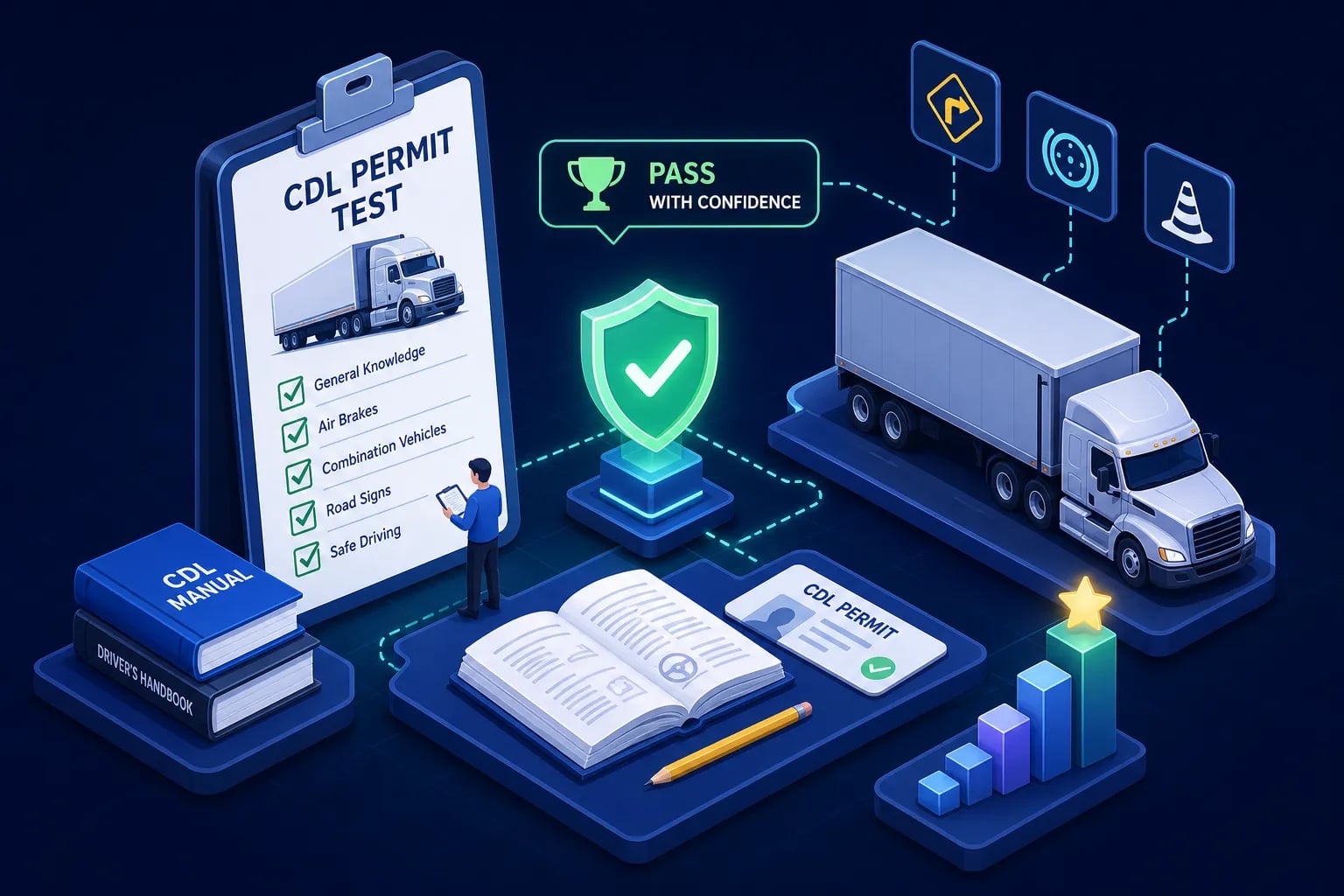
Virtually every CDL permit applicant takes the General Knowledge section, which covers 50 questions. Class A applicants also take Combination Vehicles, typically 20 to 25 questions depending on the state. Candidates who plan to operate air-brake-equipped vehicles take the Air Brakes section, which runs 25 questions. These are separate scored modules, not one combined test. Each one has its own passing requirement, and failing one doesn't automatically cancel the others.
Passing Score: What 80% Looks Like in Practice
The federal minimum passing score is 80% on every CDL knowledge section. In real numbers, that means 40 correct out of 50 on General Knowledge, 20 out of 25 on Air Brakes, and roughly 16 to 20 correct on Combination Vehicles depending on your state's exact question count. There's no curve and no partial credit. Knowing exactly how many questions you can miss reframes how seriously you need to treat borderline topics. Getting comfortable with a 70% on practice tests isn't preparation, it's wishful thinking.
How Your State CDL Handbook Fits Into This
The federal FMCSA regulations drive most of the test content, but every state administers its own version of the knowledge exam. State handbooks include local procedures and sometimes format questions differently than you'd expect from federal source material alone. Download your state-specific handbook before you study anything else and treat it as your primary reference. CDLTest360 includes state-specific CDL manuals inside the platform, so you won't have to track them down across multiple DMV websites before you can get started.
Best Way to Study for the CDL Permit Test: Prioritize Before You Open the Handbook
Reading a handbook from page one to the last page is the slowest path to a passing score. Effective CDL permit preparation starts with knowing which topics carry the most weight and which sections apply to your specific situation. Candidates who skip this step often spend their first two weeks studying sections that won't appear on their test at all.
General Knowledge Is the Non-Negotiable Foundation
Every applicant takes General Knowledge, regardless of class or target vehicle. This section covers traffic laws, pre-trip inspection basics, shifting and backing, skid control, space management, and emergency procedures. Candidates who skip this foundation and jump straight to endorsements often fail on fundamentals, the kind of questions that show up regardless of what you plan to haul. Prioritize General Knowledge first, every time.
Which Sections Apply to Your CDL Class and Vehicle
A Class B applicant operating a straight truck doesn't need to study Combination Vehicles. A candidate testing in a non-air-brake vehicle can skip the Air Brakes section entirely. The decision logic is straightforward: identify your license class, determine your target vehicle type, then add any required endorsement sections. This creates a focused, personalized CDL permit study plan instead of an overwhelming one. Studying sections you'll never be tested on isn't preparation, it's procrastination with extra steps.
Building a Topic Priority Order Before You Study
Once you know which sections apply, rank topics by question volume and difficulty. Higher-question-count sections deserve proportionally more of your time. Topics that hinge on specific thresholds, numeric values, or procedural sequences, things like HazMat placarding weights, air pressure gauge readings, or cargo securement rules, require repetition, not just a single read-through. Writing a short priority list before each week of study gives every session a clear objective and prevents the "I'll just review everything" spiral that eats time without raising scores.
Building a Study Timeline That Fits Your Life
The best CDL permit study plan is one you'll actually follow. Consistency and structure matter more than the number of hours you log in a single session. Map a realistic schedule based on how much time you have before your test date, then commit to it before day one.
The 4-Week Plan: Steady and Sustainable
At 3 to 5 focused hours per day, four weeks gives you enough time to read your handbook, run topic quizzes, work through missed-question drills, and finish with several full timed simulations before test day. Use week one for General Knowledge, week two for your required supplemental sections, week three for practice-test-heavy review loops, and week four for exam simulation and light reinforcement. This pace works well for candidates studying alongside a current job or family schedule. It's not slow; it's sustainable, and sustainable beats sprinting until you burn out.
The 2-Week Plan: Focused Daily Sessions Required
Compress to 7 to 10 hours per day across two weeks. Read each handbook section once, immediately follow it with a topic quiz, and track every missed question from day one. Don't re-read sections where you're already scoring above 85%, redirect that time to weak areas. Start timed exam simulation no later than day nine, so you have at least four to five simulation sessions before you walk into the DMV.
The 1-Week Intensive: Possible With Structure
Candidates who pass in a week at 10 or more focused hours per day typically skip passive reading entirely. They go straight to CDL permit sample questions, use wrong answers to identify which handbook sections to read, and treat every session as a diagnostic. This method only works with a platform that supports topic-specific quizzes and rapid missed-question review, generic flashcard tools don't move fast enough to support this approach. If your test date is this week, this is your playbook.
Why Practice Tests Should Anchor Every Study Session
Reading the handbook builds familiarity. Practice tests build retention and reveal exactly where your knowledge breaks down. Candidates who pass on their first attempt almost universally report that they practiced answering questions, not just reading material. Those two activities are not the same thing, and treating them as equivalent is one of the most common preparation mistakes.
How Practice Tests Beat Re-Reading Every Time
Active recall, the act of trying to retrieve an answer before looking it up, strengthens memory more than passive review. A practice question that stumps you creates a specific, addressable gap. Re-reading a section you already understand is time that doesn't move your score. Cognitive science has documented this as the testing effect for decades, and any experienced test-prep instructor will tell you the same thing: answering questions is the work; reading is just the context for understanding what you got wrong.
Free vs. Paid CDL Practice Tests: What You Actually Need
Free CDL practice resources vary widely in accuracy. The strongest free options pull questions directly from state CDL handbooks and the FMCSA federal question set, and they list a specific update date so you know the content reflects current regulations. Paid platforms add features that matter more as your test date closes in: timed simulation, missed-question isolation, and student progress tracking. The math here is straightforward. A 90-day access pass to CDLTest360 costs $39.99. A single CDL knowledge test retake in most states runs $10 to $25 per attempt. Three failed retakes and you've spent more on fees than on preparation. Investing in structured prep before your first attempt is the more economical choice by a significant margin.
CDLTest360: One Platform That Combines Everything
CDLTest360 combines topic-specific quizzes, timed exam simulation, and a missed-question drill system in a single platform. No account is required to start. You can take your first practice quiz in under a minute. The question bank is FMCSA-aligned and organized by section, so General Knowledge, Air Brakes, and Combination Vehicles each have their own focused module rather than a single undifferentiated question pile that doesn't tell you where your actual weaknesses are.
Best Way to Study for the CDL Permit Test: Timed Simulation
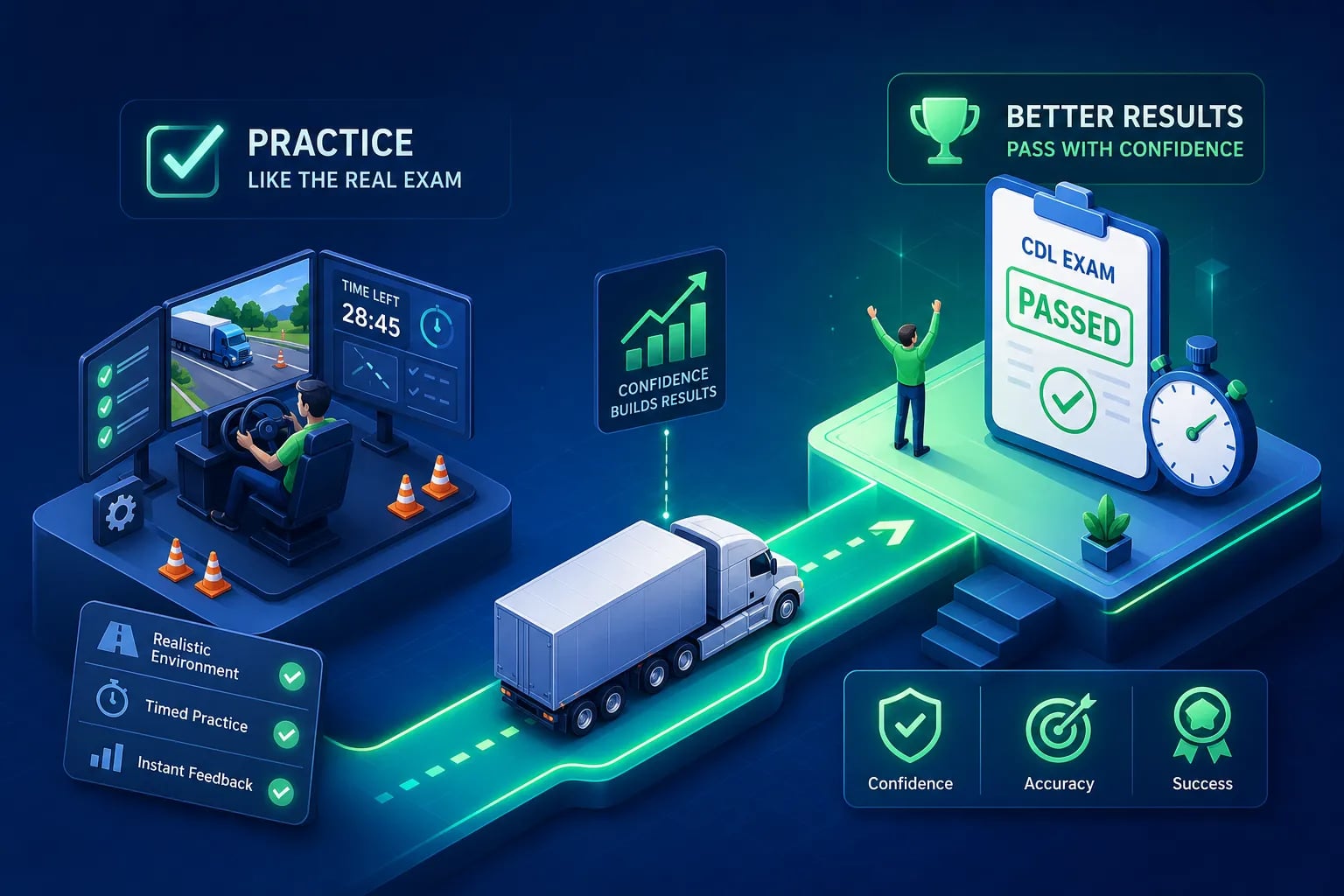
Most candidates practice in an untimed, low-pressure environment and then walk into a DMV testing room where the clock counts down on a screen in front of them. That gap between how you practiced and how you're tested costs more first-attempt passes than any single knowledge gap does. Anxiety under time pressure is a real performance factor, and the only way to reduce it is to practice under the same conditions you'll face on test day.
Why Pacing Under Pressure Separates Passers From Retakers
The actual CDL knowledge test has a time limit, and reading every question twice or spending too long on a single item leaves candidates rushing through the final stretch. The questions you rush are the ones you miss. Exam anxiety amplifies this effect: you second-guess answers you knew, skip questions you should have answered, and lose track of time until there's none left. Practicing with a real clock eliminates the surprise of that pressure and trains you to pace naturally.
How to Run an Effective Timed Simulation Session
A timed simulation should mirror the real test as closely as possible: full question count, no pausing, no looking things up mid-session, and a strict completion goal. After the session ends, score it before reviewing any answers. That score is your true readiness indicator, not a padded version inflated by hints or reference checks. Write it down and track it across sessions. A rising score across four or five simulations is the most reliable signal that you're ready to sit for the real thing.
When to Shift From Practice Mode to Full Exam Simulation
Don't start timed simulation on day one. Spend the first half of your study plan building foundational knowledge through topic quizzes, then shift to timed simulation once you're consistently scoring above 75% on section-specific practice. From that point forward, alternate between timed exams and targeted missed-question review until you're clearing 85% or better consistently. That 85% buffer gives you room for test-day nerves without dropping below the 80% passing threshold.
The Missed-Question Loop That Actually Closes Knowledge Gaps
Scoring a practice test tells you your percentage. Drilling your wrong answers is what actually raises it. Most candidates glance at missed questions, move on to the next test, and then miss the same questions again. That cycle doesn't close gaps, it just documents them repeatedly until test day arrives.
Why Wrong Answers Are More Valuable Than Correct Ones
Every missed question is a diagnostic data point. It tells you one of three things: you don't know the rule, you misread the question, or you understood the concept but couldn't apply it to a specific scenario. Each of those failure types has a different fix. Wrong answers are your most useful study material. Treating them as anything less than that is leaving points on the table.
How to Structure a Missed-Question Review Session
After any practice test, pull out every question you missed. For each one, find the corresponding section in your handbook and read it. Then re-answer the question without looking at the explanation. If you get it right this time, mark it as reinforced. If you miss it again, flag it for a third review the following day. This active loop forces information into long-term retention rather than short-term recognition that fades before the real exam.
CDLTest360's Missed-Question Drill: How It Isolates Weak Spots
CDLTest360 includes a missed-question review system that automatically isolates every question a student answered incorrectly and re-drills those specific questions in subsequent sessions. This removes the manual tracking burden and ensures no weak area gets overlooked. For CDL retakers and exam-anxious candidates, this feature alone justifies using a structured platform over a generic free question bank. Starting from scratch after a failed attempt is demoralizing; targeting only what you missed and closing those gaps efficiently is the faster path back to the testing room.
Endorsement Prep: Air Brakes, Combination Vehicles, and HazMat
If your CDL goal includes endorsements, prepare for them separately after you've built a strong General Knowledge foundation. Endorsement questions are narrower, more regulation-specific, and frequently test scenario-based compliance rather than broad driving concepts. The same read-once approach that fails for General Knowledge fails even harder for endorsements.
Air Brakes: Components, Pressure Gauges, and Pre-Trip Testing
The Air Brakes knowledge test focuses on how the brake system works, not just what to do when something fails. Prioritize these topics: compressors and governors, air pressure gauge readings, low-air warning thresholds, drain valves, foundation brake types, and the required pre-trip air brake check sequence. The pre-trip check follows a specific order: build air pressure to governor cut-out (typically 120 to 140 PSI), test for air loss over 60 seconds, confirm the low-air warning activates before pressure drops below 60 PSI, and verify spring brakes engage at approximately 20 to 45 PSI. Most Air Brakes questions require knowing specific values, general awareness won't get you to 80%.
Combination Vehicles: Coupling, Uncoupling, and Trailer Dynamics
Class A candidates frequently underestimate the Combination Vehicles section. Key topics include the correct coupling and uncoupling procedure, sequence matters here, not just the individual steps, fifth wheel inspection, trailer brake controls, and the behavioral differences between a loaded and an empty trailer under braking. Scenario questions about trailer swing, off-tracking, and turning clearance are common and require you to apply concepts, not just recall them. Study the why behind each procedure, not just the steps themselves.
HazMat: Placards, Shipping Papers, and Hazard Class Recognition
HazMat questions are regulation-heavy, and memorization is unavoidable. Know the nine hazard classes and their placard requirements. Understand the critical placarding threshold: most hazardous material categories require placards when the combined quantity exceeds 1,001 pounds, but certain materials, Division 1.1, 1.2, and 1.3 explosives; Division 2.3 poison gas; Division 4.3 dangerous when wet, require placards regardless of quantity. Know what goes on shipping papers: proper shipping name, hazard class, UN/NA identification number, and packing group. The test regularly asks for exact values, so studying "approximately" won't carry you through the HazMat section.
Test-Day Tactics to Walk In Confident
You've put in the study time. The last phase is execution. A few specific behaviors the night before and the morning of the exam make a measurable difference in how clearly you perform.
The Night Before and Morning of the Exam
Stop serious studying the evening before your test. A light review of your weakest section is fine, but cramming new material the night before floods short-term memory and raises anxiety without improving retention. Get a full night of sleep. The morning of the test, eat a real meal, arrive early enough to settle in without rushing, and avoid discussing the exam with other candidates in the waiting area. Their anxiety transfers, and you don't need it.
How to Approach Questions You're Unsure About
Read every question completely before looking at the answer options, the specific wording often contains the answer or eliminates wrong choices. Then eliminate the clearly wrong options first and choose from what remains. If you're genuinely stuck after that, flag the question, move forward, and return to it. Don't let a single hard question consume five minutes you need for the rest of the test. Pacing is a skill, and you practiced it during simulation sessions.
If You Don't Pass: How to Regroup and Come Back Stronger
A failed attempt is not the end. Most states allow retakes after a short waiting period, and the most effective retake strategy is targeted, not comprehensive. Identify which section you scored lowest on, drill that section's questions through a missed-question review loop, and retest on topic-specific quizzes until you're consistently hitting 85% before rescheduling. Candidates who use CDLTest360's missed-question system between retakes reduce their prep time for a second attempt significantly compared to candidates who start over from scratch without a structured review tool. You already know most of the material. What you need is a precise tool to close the remaining gaps.
FAQ: Best Way to Study for the CDL Permit Test
How long does it take to study for the CDL permit test?
Most candidates pass with two to four weeks of structured daily study. If you're working full-time, plan for 3 to 5 focused hours per day over four weeks. If you have more flexibility, a two-week intensive at 7 to 10 hours per day is achievable. A one-week sprint is possible but requires skipping passive reading entirely and going straight to CDL permit sample questions from day one.
Is the CDL permit test hard to pass on the first try?
The test is specific, not tricky. The 80% passing threshold means you have limited room for error, 10 missed questions on a 50-question General Knowledge section and you fail. Candidates who struggle typically didn't use timed practice or didn't drill missed questions systematically. Those who use a structured CDL permit study plan that combines topic quizzes, timed simulation, and missed-question review pass at a significantly higher rate on the first attempt.
What is the best way to study for the CDL permit test if I have only a week?
Skip the read-through-the-handbook approach entirely. Go directly to topic-specific CDL practice tests, use every wrong answer to flag which handbook sections need targeted reading, and run at least three to four full timed simulations before your test date. Prioritize General Knowledge first, then any required supplemental sections for your license class. A platform like CDLTest360 that supports rapid topic-switching and missed-question isolation is essential for this timeline.
Do I need to study state-specific content or just the federal rules?
Both. Federal FMCSA regulations form the core of every CDL knowledge exam, but each state administers its own version with state-specific procedures and question formats. Use your state's CDL handbook as your primary reference, don't rely on federal material alone. CDLTest360 includes state-specific manuals inside the platform so you can access the right content without hunting across DMV websites.
You're Closer Than You Think
The best way to study for the CDL permit test is structured, active, and diagnostic. Read your state handbook, prioritize topics based on your license class, and anchor every study session to practice questions rather than passive review. Add timed simulation as your test date approaches, and use missed-question loops to close the specific gaps those practice tests reveal. Whether you have four weeks or four days, the method stays the same, the timeline just adjusts the daily intensity.
CDLTest360 puts all of that in one place: topic-specific quizzes organized by CDL section, timed exam simulation that mirrors the real test environment, and an automated missed-question drill system that targets your weak spots without requiring manual tracking. No account is needed to take your first practice quiz right now, so there's no reason to wait until you feel "ready enough" to start.
Your CDL permit is closer than it feels. The gap between where you are and where you need to be is a specific set of knowledge gaps, and those gaps are measurable, specific, and solvable. Take the first practice test, see your score, and let the data tell you exactly what to study next.
{ "@type": "Article", "datePublished": "2026-09-18T11:01:57.175Z", "dateModified": "2026-09-18T11:01:57.175Z", "headline": "How to Study for the CDL Permit Test and Pass First Try", "description": "Learn the best way to study for the CDL permit test with a proven plan: topic prioritization, timed simulation, and missed-question drills. Start free today.", "publisher": { "@type": "Organization", "name": "CDLTest360" }, "image": [ ] }