
The CDL air brakes or combination vehicles sections of the knowledge exam test specific pressure thresholds, component functions, inspection sequences, coupling procedures, jackknife recovery, trailer dynamics, and off-tracking awareness. You need to know both to drive a Class A tractor-trailer without restrictions, because the knowledge overlaps more than most candidates expect.
Many instructors report that candidates study these two sections in isolation, and that's a mistake. Air brake knowledge feeds directly into combination vehicle procedures: you can't correctly inspect a fifth wheel, recognize a crossed air line, or respond to a trailer skid without understanding how the air system works underneath. This guide walks through both sections in a study order designed to build on itself: regulations first, system knowledge second, pressure numbers third, procedures fourth, failure points fifth, and practice questions last.
Key takeaways
-
No separate endorsement: There is no "air brake endorsement." You either qualify for unrestricted air brake operation or your CDL receives an L or Z restriction.
-
Class A threshold: A combination rated at 26,001+ lbs with a towed unit exceeding 10,000 lbs GVWR requires a Class A CDL, per FMCSA.
-
Pressure numbers matter: The low-air warning activates before pressure drops below 55 psi; spring brakes apply between 20 and 45 psi.
-
Leakage limits differ: A combination vehicle may lose no more than 4 psi per minute during the applied-brake test; a single vehicle allows no more than 3 psi per minute.
-
Coupling has two common scoring failures: Skipping the tug test and skipping the visual inspection of the locking jaws are both common scoring failures on the skills test.
-
Hand valve rule: The trailer hand valve is for testing trailer brakes only, never for driving or parking.
Do you actually need air brake clearance on your CDL?
CDL class is determined by vehicle weight and configuration, not by whether the vehicle has air brakes. According to FMCSA, a Class A CDL is required when the gross combination weight rating reaches at least 26,001 lbs and the towed unit has a GVWR over 10,000 lbs. A Class B CDL applies to a single vehicle at 26,001 lbs or more that tows a vehicle rated at 10,000 lbs or less. A pickup rated at 26,001 lbs towing a light trailer is generally a Class B situation, not Class A, even if both units have air brakes. States may apply additional intrastate exemptions, so cross-check your state CDL manual for anything beyond the federal baseline, the federal thresholds are the floor, not always the ceiling.
What the L and Z restrictions actually mean
There is no separate air brake endorsement. Instead, your CDL is either qualified for unrestricted air brake operation or it carries a restriction. Under 49 CFR Part 383, an L restriction prohibits operation of any CMV equipped with any type of air brakes, including air-over-hydraulic systems. A Z restriction is narrower: it blocks full air brake systems but generally permits air-over-hydraulic operation. The L restriction is the more severe of the two.
You receive an L restriction if you fail the air brake knowledge test or complete the skills test in a vehicle without air brakes. You receive a Z restriction if your skills test vehicle used an air-over-hydraulic system rather than full air brakes. To drive a fully air-equipped tractor-trailer without any restriction, you must pass the air brake knowledge test and complete skills testing in a representative full air brake vehicle. Knowing this before you schedule your test saves you from accidentally locking in a restriction you didn't intend.
How an air brake system actually works
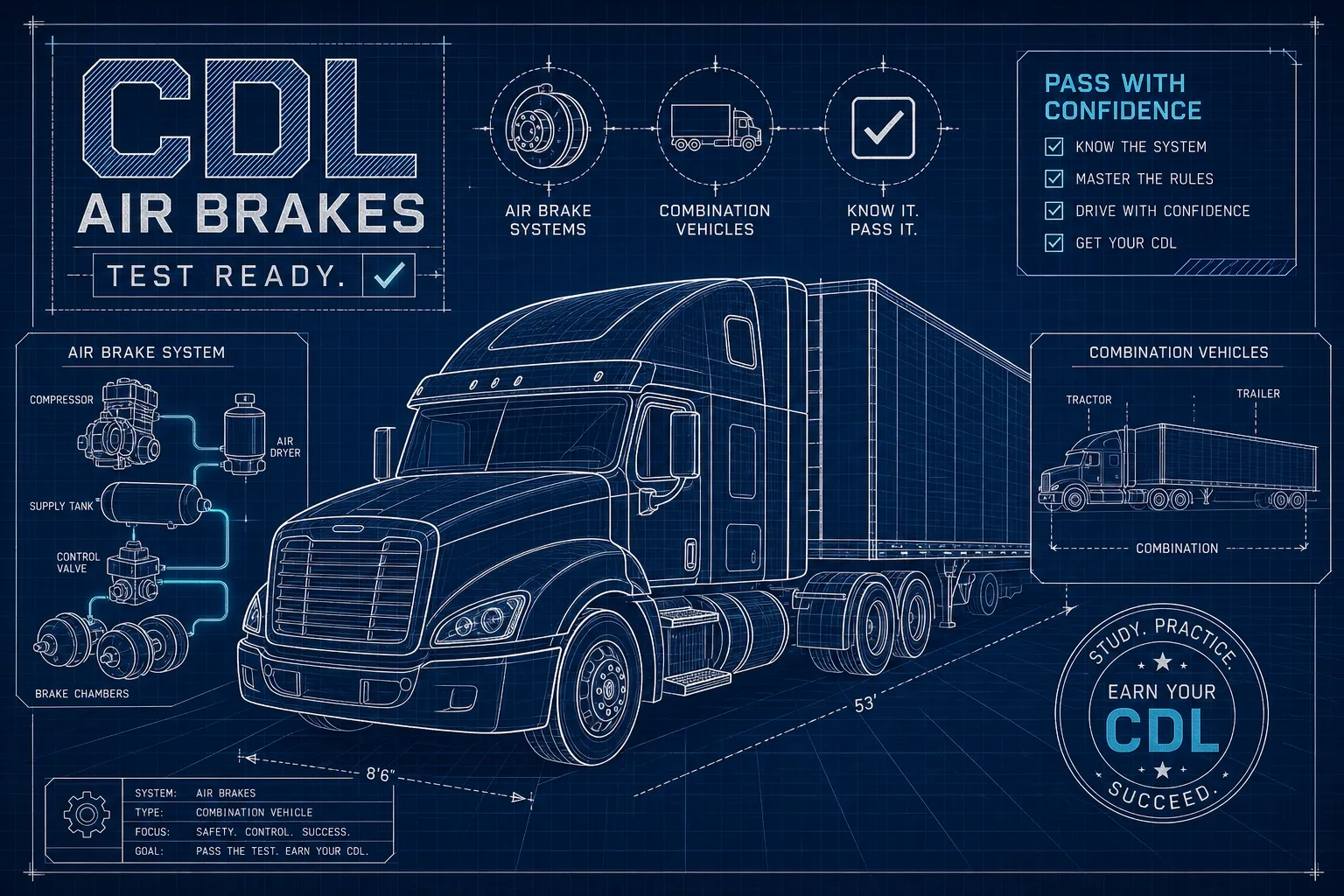
Understanding the sequence from compressor to wheel is what separates candidates who can answer exam questions from those who simply memorize isolated facts. The system follows a logical chain: compress air, store it, control it, then convert it into mechanical friction. Every exam question about air brakes or combination vehicles traces back to one part of that chain.
The main components and what each one does
The compressor pumps and compresses air, driven by the engine. The governor controls when the compressor starts and stops so tank pressure stays within a safe operating range. Reservoirs store the compressed air, the air dryer removes moisture and contaminants, and safety valves protect against excessive pressure. Drain valves let you remove accumulated water and oil from the tanks, a maintenance requirement the written test covers directly.
The foot valve controls how much air flows toward the brakes when you press the pedal. Brake lines and relay valves carry that air to the axles quickly. At each wheel end, the brake chamber converts air pressure into mechanical movement: air pushes a diaphragm, which moves a pushrod, which moves the slack adjuster, which in turn operates either an S-cam drum brake or an air disc brake. The spring brake chamber is a separate but related component. Air pressure holds those springs released during normal driving, and the springs apply braking force when air pressure is lost. That design means a catastrophic air leak causes the vehicle to slow down rather than coast freely.
The sequence from compressor to wheel, and why it matters for test day
The memory chain the exam tests runs from compressor to tanks, foot valve, brake chamber, pushrod, slack adjuster, shoes or pads, and finally drum or rotor. Each link is a potential question. Pressing the pedal allows air into the chamber; the diaphragm moves the pushrod; the pushrod rotates the slack adjuster; the slack adjuster operates the S-cam or disc mechanism. More pedal pressure equals more air pressure equals greater braking force.
One concept students consistently underestimate is brake lag: the small delay between pressing the pedal and the brakes actually engaging, because air must travel through lines before it reaches the chambers. Brake lag can reach up to about half a second, a meaningful distance at highway speed. The exam treats brake lag as a distinct concept, separate from total stopping distance, and it will ask you to identify which is which.
What pressure numbers do you need to know cold?
Exam questions about air brakes are heavily number-dependent. Knowing the concept without the threshold is only half an answer. The three ranges that appear most often are the governor range, the low-air warning point, and the spring brake activation range. The exam expects you to keep them distinct.
Governor range, low-air warning, and spring brake activation
According to the FMCSA model CDL manual, the governor keeps system pressure in approximately the 100 to 125 psi range, cutting the compressor in and out to maintain that band. The low-air warning device must activate before pressure drops below 55 psi. Your state manual may reference 60 psi based on federal vehicle equipment standards for newer vehicles, so confirm the exact figure in your own state's manual before test day. The spring brakes begin applying as pressure drops into the 20 to 45 psi range, with no lower than 20 psi and no higher than 45 psi as the federal specification.
The critical exam trap is applying the wrong number to the wrong threshold. Mixing up the low-air warning point with the spring brake pop-out range is one of the most common wrong answers in this section. Write out all three ranges separately until the distinctions are automatic.
Leakage limits and how the two leakage tests differ
The static test measures pressure loss with the brakes released: engine off, pressure built up, rate of drop monitored. The applied test measures pressure loss with the foot brake fully depressed. These are two separate tests with separate conditions, and the exam will specify which one it is asking about. Mixing them up is the single most common error in this part of the written test.
For the applied-brake leakage test, the FMCSA model CDL manual specifies no more than 3 psi per minute for a single vehicle and no more than 4 psi per minute for a combination vehicle. A rate above those limits indicates a leak requiring correction. Confirm the exact figures and the static-test limits in your state CDL manual, because state manuals can differ in how they present the leakage test sequence.
What the combination vehicles section actually tests
Candidates who focus entirely on coupling procedures are often surprised when trailer dynamics and skid recovery questions appear on the exam. The Combination Vehicles section covers a broader range of concepts than the procedure steps alone, and several of those concepts connect directly to what you already studied in the air brakes section.
Off-tracking, stopping distance, and trailer dynamics
Off-tracking is the tendency of rear trailer wheels to follow a tighter arc than the tractor during a turn. On a right turn, the rear trailer wheels cut across the corner, and candidates consistently underestimate how much additional pavement clearance they need. The exam tests whether you know to account for this space before initiating the turn, not after.
Empty trailer risk is another counterintuitive concept the exam targets directly. A lightly loaded Class A combination vehicle can be harder to stop safely than a loaded one because strong brakes act on poor tire contact: less weight means less traction, which makes wheel lockup easier. The false assumption that lighter always means safer appears as a wrong-answer option on combination vehicle questions more often than most candidates expect. Stopping distance for combination vehicles is also greater than for single units, and speed control on grades and in curves is tested explicitly.
Jackknife types, tractor protection, and the hand valve rule
A tractor jackknife and a trailer skid are two different events with different causes and different recovery actions. In a tractor jackknife, the drive wheels lose traction and the tractor's rear swings toward or past the trailer. The correct response is to release the brakes and the accelerator immediately, then steer to restore traction. In a trailer skid, the trailer wheels lock and the trailer swings sideways; the correct response is to release the service brakes so the trailer wheels roll again, and not to apply the trailer hand brake. A generic "brake harder" answer is wrong for both situations, and the exam distinguishes between them.
The tractor protection valve automatically closes and seals the tractor air supply if trailer air pressure drops dangerously low. This preserves tractor brake function even if the trailer develops a major leak. The hand valve rule is tested more often than candidates expect: the trailer hand valve is for testing trailer brakes only. Using it while driving risks a trailer skid. Using it to park risks releasing the brakes on trailers without spring brakes, because air can drain from the system overnight. Neither situation ends well, and neither is a gray area on the written test.
Coupling and uncoupling: what the CDL test expects you to do
Coupling and uncoupling are sequential procedures, and the exam scores them in order. Knowing the steps in the right sequence is not enough if you skip the two inspection points that examiners specifically watch for. Every step below reflects the order the FMCSA manual and state skills checklists follow, this is also the foundation of any tractor-trailer pre-trip checklist for coupling.
Coupling procedure in correct sequence
-
Inspect the area and chock trailer wheels or confirm spring brakes are applied.
-
Inspect the fifth wheel and confirm it is properly positioned and unlocked.
-
Confirm trailer height: the trailer should be slightly low so the fifth wheel ramps guide the apron without striking the kingpin head.
-
Position the tractor directly in front of the trailer, never at an angle.
-
Back slowly until the fifth wheel contacts the trailer.
-
Set the tractor parking brake and place the transmission in neutral.
-
Check that the kingpin is aligned with the fifth-wheel throat.
-
Back under the trailer until the fifth-wheel jaws lock around the kingpin.
-
Perform the tug test by gently pulling against the locked kingpin with the trailer brakes applied.
-
Visually inspect the coupling: jaws must be fully closed around the shank of the kingpin (not the head), with no gap between the trailer apron and the fifth-wheel skid plate.
-
Connect the air lines and electrical cord; confirm they are secured and have enough slack for turns.
-
Raise the landing gear completely and stow the crank handle.
-
Set the trailer air supply and release trailer brakes as required.
The two steps most commonly skipped are the tug test and the visual inspection of the locking jaws, both are common scoring failures on the skills test. Check that the jaws are closed around the shank of the kingpin rather than the head, that the release arm is fully seated, and that the safety latch is engaged. These are three separate checkpoints within a single visual inspection, and exam questions often specify which one was missed.
Uncoupling sequence and the mistakes that fail students
Position the combination on level, firm ground with the tractor and trailer straight. Apply both parking brakes, then lower the landing gear until the trailer weight is slightly supported by it. Disconnect and secure the electrical cord, then disconnect the air lines and place them on the dummy couplers so they cannot drag or become damaged. Lock the trailer brakes, release pressure from the fifth-wheel jaws, and pull the fifth-wheel release handle. Confirm the jaws are open visually, then slowly pull the tractor forward until the fifth wheel clears the kingpin while keeping the tractor frame under the trailer. Stop, set the brake, inspect landing gear stability, then pull completely clear.
Common scoring failures include connecting air or electrical lines incorrectly during the coupling phase, leaving a gap between the fifth wheel and the apron, forgetting to raise the landing gear, and pulling out at an angle during uncoupling. Incorrectly crossed air lines are a frequent exam question because the vehicle may appear capable of moving while the trailer brakes are completely inoperable. The exam tests whether you know that outcome by name.
Where students consistently lose points on both sections
Both sections share a common failure pattern: candidates memorize definitions without learning the context that makes those definitions useful on a timed exam. When the question changes the wording slightly, the memorized answer stops working. Understanding the procedure behind each fact is the correction.
Air brakes: the mistakes behind most wrong answers
Mixing up the three pressure thresholds is the leading cause of wrong answers in this section. The governor range (100 to 125 psi), the low-air warning (before 55 psi), and the spring brake pop-out range (20 to 45 psi) are three separate numbers for three separate events. Applying any one of them to the wrong question loses the point. Confusing what spring brakes do with what service brakes do is a related mistake: spring brakes are not controlled by the foot pedal under normal conditions, and the exam will ask you to confirm that directly.
Misreading leakage test questions is also common, because the static test and the applied-brake test are different procedures with different limits, and the question will specify which one it means. Forgetting brake lag as a concept separate from total stopping distance costs points on questions that ask why air-brake-equipped vehicles need more following distance. Finally, assuming all state handbooks use identical numbers is a study error, not an exam error: it produces the wrong answer when your state manual presents a threshold differently from a generic study guide.
Combination vehicles: the procedure gaps that cost students points
Using the hand valve for parking or during normal driving is the most commonly tested wrong behavior in this section. The exam presents it as an option in several question formats, and selecting it as acceptable practice is always wrong. Assuming a lighter trailer is always safer is a close second: empty combinations have worse brake-to-traction ratios, and the exam tests whether you know it.
Missing the inspection language for the fifth wheel is a precision problem worth studying carefully. The jaws must close around the shank of the kingpin, not the head; the release arm must be seated; and the safety latch must be engaged. All three pieces of language appear on exam questions, and knowing only one of them isn't enough. Incorrectly connected air lines and forgetting off-tracking on right turns round out the most common combination vehicle failures.
Practice questions that reflect what you'll see on test day
Self-testing with realistic questions is how you find out which concepts you actually own and which ones you only think you know. Work through these without looking back at the sections above, then check your answers.
Air brakes sample questions
Q: What does the governor on an air brake system control?
A: When the compressor pumps air into the tanks. The governor cuts in and cuts out to keep system pressure within the safe operating range of approximately 100 to 125 psi.
Q: Why must air tanks be drained regularly?
A: To remove accumulated water and oil that can cause corrosion or freeze in cold weather, both of which compromise brake system reliability.
Q: What force applies spring brakes when air pressure is lost?
A: Spring pressure. Powerful mechanical springs apply the brakes without any air input when system pressure drops.
Q: What is brake lag and why does it matter?
A: The delay between pressing the pedal and the brakes engaging, which can reach up to about half a second. At speed, that lag adds meaningful distance before braking force arrives.
Q: What is the air leakage limit for a combination vehicle during the applied-brake test?
A: No more than 4 psi per minute, per the FMCSA model CDL manual. Verify the exact figure in your state CDL manual, as the single-vehicle limit of 3 psi per minute is a separate and commonly confused threshold.
Combination vehicles sample questions
Q: When should you use the trailer hand valve?
A: Only to test the trailer brakes. Not while driving, and not to park.
Q: After coupling, what does the tug test confirm?
A: That the fifth-wheel jaws are locked and the coupling is secure before the combination moves.
Q: Why are empty combination vehicles sometimes harder to stop safely than loaded ones?
A: Lighter loads produce less tire traction relative to brake force, making wheel lockup easier and braking less predictable.
Q: What is off-tracking and when is it a hazard?
A: The tendency of rear trailer wheels to follow a tighter arc than the tractor during turns. It is a hazard on right turns and in tight maneuvering areas where the rear wheels can ride over curbs or strike fixed objects.
Q: What happens if air lines are crossed when coupling a trailer?
A: The trailer brakes may not function correctly even though the vehicle appears able to move. This is a direct scoring point on the written exam because the visual sign of the problem is absent while the mechanical failure is real.
If these questions revealed gaps, that's the point of the exercise. At CDLTest360, our air brakes or combination vehicles quiz modules run in exactly this format: 50 questions, timed, at the 80% pass threshold. The missed-question review loop pulls back only the items you got wrong, so your next session focuses on the gaps rather than material you've already locked in. We built the question bank directly from FMCSA content areas, and state-specific CDL manuals are available inside the platform so you can verify the exact pressure thresholds and leakage limits for your state before you walk into the testing center.
Study the procedures, not just the definitions
Passing the CDL air brakes or combination vehicles sections comes down to knowing specific numbers and specific sequences. A candidate who knows what the governor controls, what the L restriction means, at what pressure range spring brakes engage, and how to correctly couple and inspect a Class A combination vehicle is working from a much stronger position than one who read a chapter summary and called it preparation.
Your state CDL manual is the final authority on exact figures. Generic study guides can introduce a number that differs from what your state exam uses, and that difference costs points. The leakage limits, the low-air warning threshold, and the spring brake activation range should all come from the manual your licensing state publishes, not from a universal source that may not match your jurisdiction.
Regular timed practice on exam-style questions is the most reliable way to confirm you're ready. CDLTest360 is built specifically for this kind of targeted, FMCSA-aligned repetition, with a missed-question drill system and exam simulation mode designed to catch exactly the gaps this guide describes. Start with a free practice session without creating an account, run the Air Brakes module under timed conditions, and use your wrong answers as the study list for your next session. That loop, repeated consistently, is how candidates go from uncertain to ready.
Frequently Asked Questions
If I take the skills test in a vehicle without air brakes, will my CDL get restricted for air brakes?
Yes, completing the skills test in a vehicle without air brakes results in an L restriction on your CDL. That restriction prohibits operation of any CMV equipped with any type of air brakes, including air-over-hydraulic systems, until you pass the air brake knowledge test and complete skills testing in a representative full air brake vehicle.
How long can brake lag be, and why does that matter on the exam and on the road?
Brake lag can reach up to about half a second, and that delay matters because it adds meaningful distance before braking force arrives at speed. The exam treats brake lag as a separate concept from total stopping distance and tests whether you can distinguish the two.
If my tow unit's GVWR is under 10,000 lbs but the combination totals over 26,001 lbs, which CDL class applies?
A combination rated at 26,001+ lbs with a towed unit exceeding 10,000 lbs requires a Class A CDL; if the towed unit's GVWR is 10,000 lbs or less, the situation is generally Class B. State manuals can add intrastate exemptions, so you should confirm your exact classification in your state CDL manual.
What is the risk of using the trailer hand valve while driving or parking?
Using the trailer hand valve while driving risks causing a trailer skid, and using it to park can allow air to drain from trailers without spring brakes overnight. The hand valve is intended only to test trailer brakes and should not be used for driving or parking.
{ "@type": "Article", "datePublished": "2026-10-31T11:02:27.231Z", "dateModified": "2026-10-31T11:02:27.231Z", "headline": "Pass the CDL Air Brakes and Combination Vehicles Test", "description": "Master CDL air brakes and combination vehicles with FMCSA-aligned study tips, pressure thresholds, coupling steps, and practice questions. Start drilling today.", "publisher": { "@type": "Organization", "name": "CDLTest360" }, "image": [ "https://composeo-article-images.s3.us-east-1.amazonaws.com/pass-the-cdl-air-brakes-and-combination-vehicles-test-1793362099152.webp" ], "author": { "@type": "Organization", "name": "CDLTest360" } }
{ "@type": "FAQPage", "mainEntity": [ { "@type": "Question", "name": "If I take the skills test in a vehicle without air brakes, will my CDL get restricted for air brakes?", "acceptedAnswer": { "@type": "Answer", "text": "Yes, completing the skills test in a vehicle without air brakes results in an L restriction on your CDL. That restriction prohibits operation of any CMV equipped with any type of air brakes, including air-over-hydraulic systems, until you pass the air brake knowledge test and complete skills testing in a representative full air brake vehicle." } }, { "@type": "Question", "name": "How long can brake lag be, and why does that matter on the exam and on the road?", "acceptedAnswer": { "@type": "Answer", "text": "Brake lag can reach up to about half a second, and that delay matters because it adds meaningful distance before braking force arrives at speed. The exam treats brake lag as a separate concept from total stopping distance and tests whether you can distinguish the two." } }, { "@type": "Question", "name": "If my tow unit's GVWR is under 10,000 lbs but the combination totals over 26,001 lbs, which CDL class applies?", "acceptedAnswer": { "@type": "Answer", "text": "A combination rated at 26,001+ lbs with a towed unit exceeding 10,000 lbs requires a Class A CDL; if the towed unit's GVWR is 10,000 lbs or less, the situation is generally Class B. State manuals can add intrastate exemptions, so you should confirm your exact classification in your state CDL manual." } }, { "@type": "Question", "name": "What is the risk of using the trailer hand valve while driving or parking?", "acceptedAnswer": { "@type": "Answer", "text": "Using the trailer hand valve while driving risks causing a trailer skid, and using it to park can allow air to drain from trailers without spring brakes overnight. The hand valve is intended only to test trailer brakes and should not be used for driving or parking." } } ] }