If you're preparing for the combination vehicles CDL test, know that this section catches a lot of CDL candidates off guard, and it's rarely because they didn't study. It's because they didn't know what the test actually expects them to know. This isn't a short add-on tucked at the end of the written exam. It spans four distinct topic areas, tests procedural knowledge in real depth, and connects tightly to both air brakes and pre-trip inspection content you may have studied separately.
Many candidates treat the combination vehicles CDL section like a longer version of general knowledge. It isn't. It asks you to understand how a tractor-trailer behaves as a system, how its components interact, and what goes wrong when a procedure is skipped or done in the wrong order. That's a different kind of test entirely.
By the end of this article, you'll know exactly what the combination vehicles CDL test covers, which concepts are most heavily tested, and how to structure your study time so you walk in ready. CDLTest360's combination vehicles quiz module targets the four topic areas outlined in Section 6 of the FMCSA Model CDL Manual, so you can focus your drilling on the exact question types that show up rather than working through a mixed bag of unrelated content.
Why this section trips up more candidates than most CDL knowledge tests
The combination vehicles CDL test is genuinely harder than general knowledge or even the standard air brakes test. The difference isn't volume. It's the type of knowledge being tested. You're not just recalling definitions. You're expected to understand sequences, procedures, and how multiple systems interact with one another across a multi-unit vehicle.
Candidates who studied coupling and uncoupling, air brakes, and inspection as separate topics often feel that gap on test day. The exam doesn't present them as separate. A question about the tractor protection valve connects to what happens when air lines are crossed, which connects to what you inspect during the pre-trip walkthrough. If your study sessions kept these topics in separate boxes, the test will expose that.
The breadth of topic areas is wider than most expect
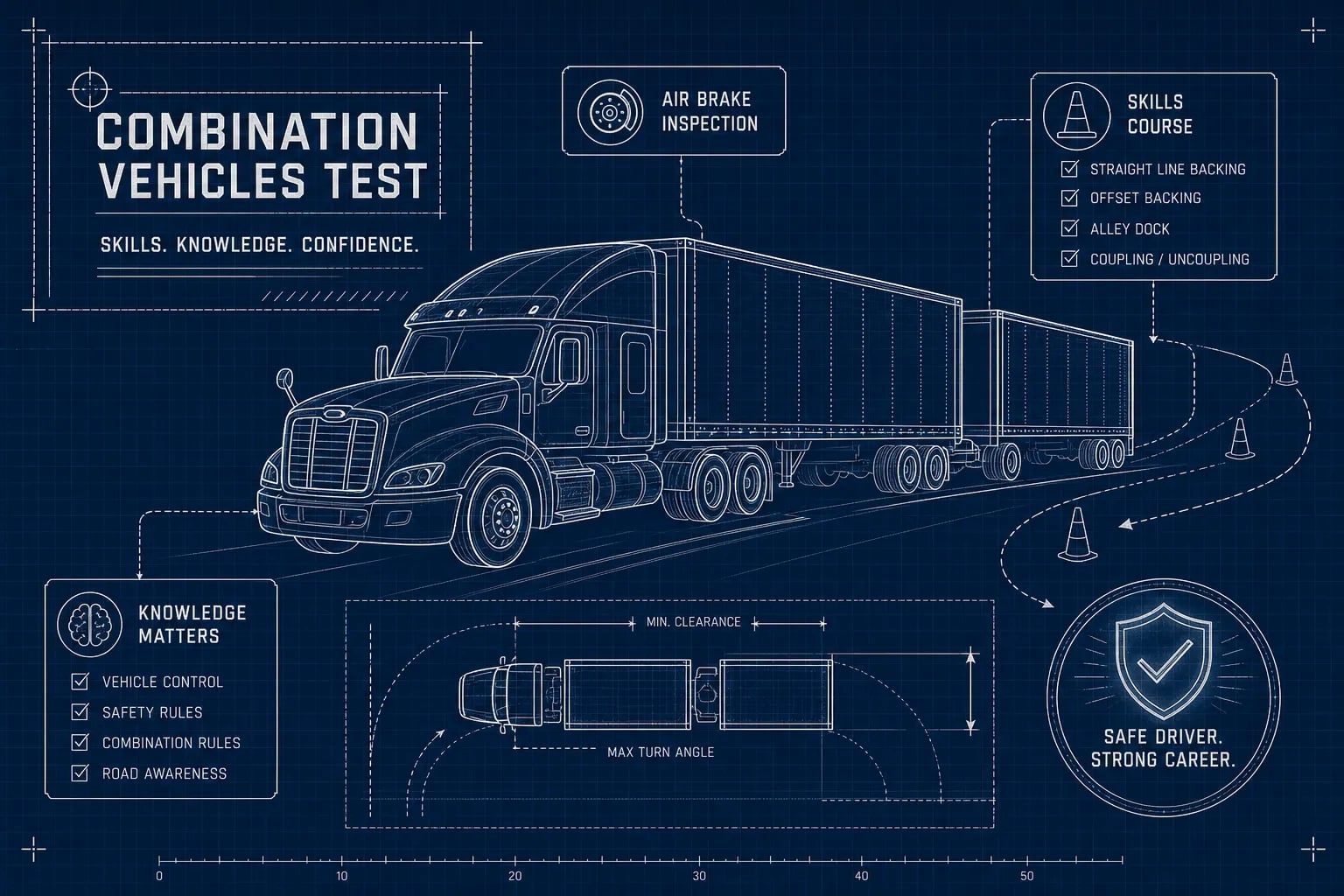
Four major areas appear on the exam: driving combinations, combination-vehicle air brakes, coupling and uncoupling, and inspecting combinations. Each has its own vocabulary, its own mechanics, and its own set of test-ready scenarios. This isn't just a longer test. It's a test that expects you to mentally operate a combination vehicle, not just describe one.
Many candidates underestimate the scope because the exam is relatively short. As of 2026, most states use a 20-question format with an 80% passing threshold, meaning 16 correct answers, though you should verify the current format with your state's CDL manual before test day. A few wrong answers can fail you quickly. That's why understanding the material matters far more than hoping to absorb enough through repetition alone.
Procedural knowledge is tested, not just definitions
The exam tests sequences: correct coupling order, correct uncoupling order, and why each step matters when it's done. Getting the steps out of order isn't just a test failure, it's a real safety hazard, and the test reflects that logic directly. Candidates who memorize terms without understanding the reasoning behind them consistently miss application-style questions. Those are the questions that describe a scenario and ask what should happen next, and they're the ones that separate passing scores from failing ones.
Combination Vehicles CDL: The Four Topic Areas
The exam is based on Section 6 of the FMCSA Model CDL Manual. Understanding its structure gives you a map before you start drilling individual concepts. Most states use 20 questions at an 80% threshold, though some states vary: California uses 25 questions (20 correct needed), Indiana uses 30 questions (24 correct), and New York may use up to 30. Always verify the current format with your state's CDL manual before test day.
Driving combination vehicles
This section covers off-tracking, rollover risk, rearward amplification (the crack-the-whip effect), jackknife prevention, backing procedures, following distance, and emergency maneuvers. It's heavier on judgment-based questions than most candidates expect. You're not just being asked what these terms mean. You're being asked what causes them, what prevents them, and what you do when they happen.
Combination-vehicle air brakes
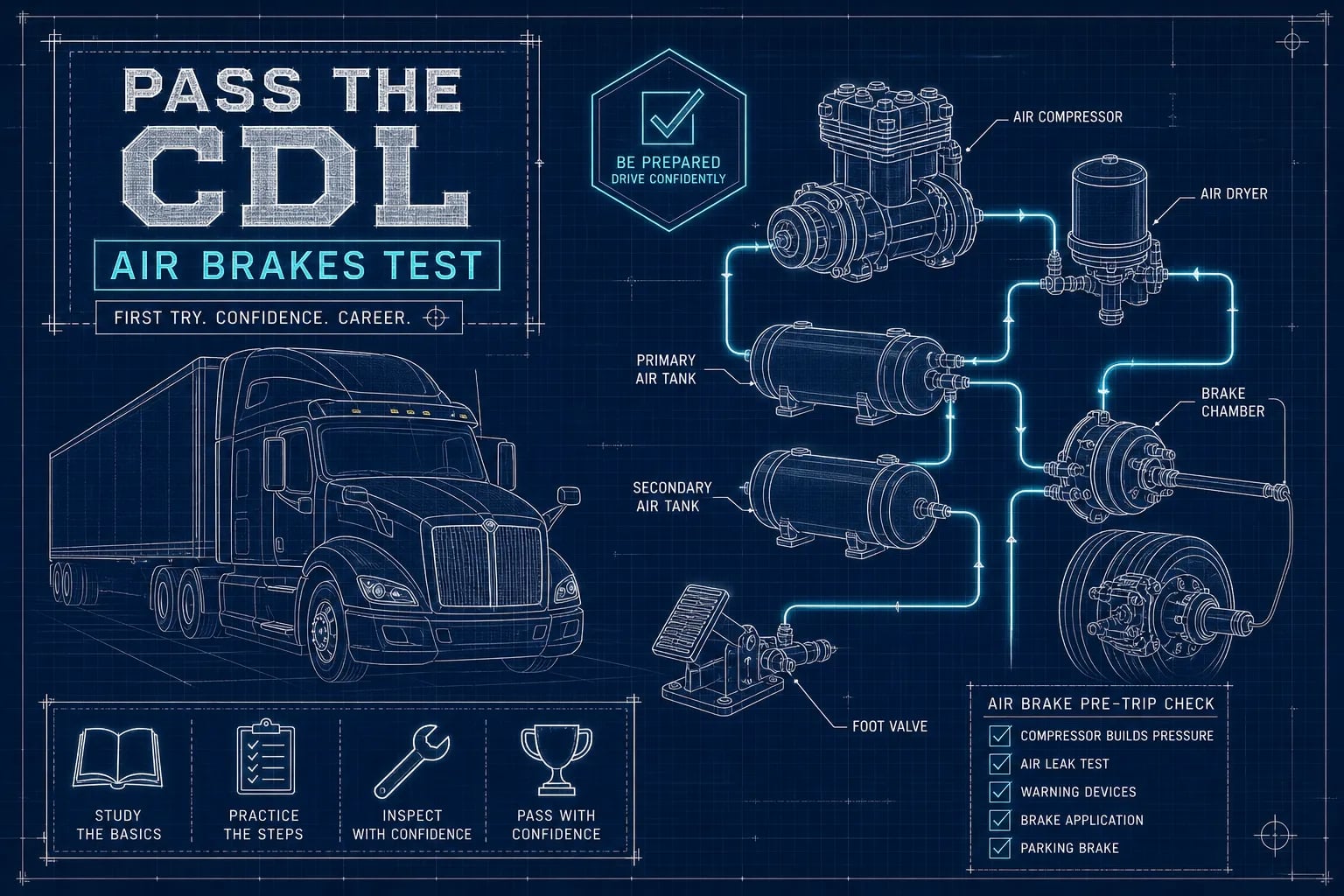
This goes beyond what you covered for the standard air brakes endorsement. The combination-specific content tests your understanding of trailer air lines, the tractor protection valve, trailer air supply control, brake lag in longer vehicles, and ABS on both tractor and trailer separately. Many candidates confuse what happens when individual components fail. The test asks exactly that.
Coupling and uncoupling, and inspecting combinations
Coupling and uncoupling covers the exact sequence of steps and what each component does at each stage. Inspecting combinations focuses on the fifth wheel, landing gear, glad hands, electrical connections, and trailer-specific components that don't appear on straight trucks. These two areas carry the most procedurally specific questions on the Class A combination exam and are where sequence errors cost the most points.
Coupling and Uncoupling, Combination Vehicles CDL Focus
Per Section 6 of the FMCSA Model CDL Manual, coupling and uncoupling is the most procedure-heavy section on the test, and the area where sequence matters most. Knowing what each component is called is not enough. The exam asks what happens when something is done incorrectly, out of order, or skipped entirely. That framing shows up repeatedly across practice questions and on the actual test.
The coupling sequence and its critical checkpoints
The major steps run in this order:
-
Inspect the fifth wheel for damage, adequate grease, and proper tilt.
-
Position the tractor straight and slightly lower than the trailer apron.
-
Back slowly until the kingpin is seated.
-
Perform the tug test.
-
Visually confirm the locking jaws.
-
Connect the air lines and electrical cord.
-
Raise the landing gear fully.
Each step exists for a specific reason, and the test will probe those reasons.
Two checkpoints are commonly emphasized in CDL manuals and frequently appear on practice tests. The tug test confirms that the locking jaws have engaged the kingpin. You set the trailer brakes, release the tractor parking brake, and gently pull forward in low gear. If the tractor strains against the trailer rather than pulling free, the coupling held. The visual jaws inspection confirms that the jaws surround the kingpin shank, not the head. There's a specific difference, and the test knows candidates confuse them.
Uncoupling in the right order
The exam tests whether you know to secure trailer brakes before disconnecting anything, lower the landing gear before unlocking the fifth wheel, and stop with the tractor frame still under the trailer before pulling fully away. Reversing any of those steps creates a real safety hazard. The tractor frame remains under the trailer as a precaution in case the landing gear collapses or the surface gives way.
The crossing-lines mistake that commonly appears on practice tests
Red emergency line goes to the emergency supply connection. Blue service line goes to the service connection. Crossing them disables proper trailer braking. This question is commonly tested in the combination vehicles CDL section and is one of the easiest to get wrong under test pressure. When in doubt, remember: red to red, blue to blue, and if those lines are crossed, the trailer brakes won't work the way they should.
Air brakes and ABS for combination vehicles: what the test expects you to know
Even candidates who already hold an air brakes endorsement need to study combination-specific air brake content. The systems interact differently on a multi-unit vehicle, and the exam tests concepts that belong exclusively to combination territory, not general air brakes principles you already covered.
Trailer air lines, glad hands, and what happens when they fail
The emergency supply line (red) keeps the trailer spring brakes released by maintaining air pressure. If it loses pressure, the trailer brakes apply automatically. That is the most repeated air line question on the combination vehicles CDL test. Glad-hand seals, crossed lines, and leaking connections are all heavily tested failure scenarios. The exam asks what happens when these fail, not just what the parts are named.
Spring brakes, tractor protection valve, and brake lag
The tractor protection valve isolates the tractor air supply if the trailer air lines rupture or the trailer separates. The test asks when it activates and what it prevents. Brake lag is more pronounced on combination vehicles because air must travel farther through longer lines, and this directly affects following distance requirements.
Per FMCSA standards, the air leakage rate limits for a combination vehicle are 3 psi per minute with brakes released and 4 psi per minute with brakes applied. Both numbers appear on practice tests and are among the most commonly missed questions among candidates who studied the wrong threshold. Learn both figures and the condition each applies to.
ABS on tractors and trailers
ABS does not shorten stopping distance. It maintains steering control by preventing wheel lockup during hard braking. The correct technique with ABS is firm, steady brake pressure, never pump the pedal. Tractors and trailers have separate ABS systems, and the trailer ABS warning lamp on the dash is a tested checkpoint during the pre-trip inspection. If it stays on after startup, that's a defect that must be reported.
Pre-trip inspection for combination vehicles: what's different from a straight truck
Candidates who already know the standard CDL pre-trip inspection process still need to learn what's added for combinations. The exam tests both what to inspect and why each item matters for safe operation on a multi-unit vehicle. The inspection scope is larger, and several components simply don't exist on a straight truck.
Fifth wheel and coupling area inspection
Inspect the fifth-wheel mounting, frame, plate, pivot, and release mechanism for damage or missing parts. Confirm adequate grease. Verify that the locking jaws are closed, the release handle is secured, and the safety latch is engaged. Check the kingpin for damage, wear, and alignment. After coupling, confirm there is no visible gap between the upper and lower fifth-wheel plates. A gap there means the connection isn't fully seated.
Air lines, electrical connections, and trailer-specific components
Inspect the glad hands for proper seating and seal condition. Check that air lines are not pinched, not dragging, and not crossed. The electrical cord must be plugged in, latched, and supported with enough slack to handle turns without pulling loose. Trailer-specific items include the landing gear (fully raised and secured), the ABS warning lamp, trailer brakes, suspension, lights, reflectors, and mud flaps. Each of these is fair game for a test question on the combination vehicle endorsement.
The DVIR and en-route inspection responsibilities
The Driver Vehicle Inspection Report documents any defects found before, during, or after a trip. The exam tests when a DVIR must be completed and what happens when a defect is found before departure. En-route and post-trip inspections are also tested content, particularly for multi-unit vehicles where trailer conditions can change over the course of a long haul.
Practice questions that reflect what actually shows up on the test
Working through practice questions with clear explanations builds the kind of understanding that holds up under test conditions. If any of the following feel uncertain, those are the areas to drill harder before test day. This section functions as a diagnostic: your weak spots show up here before they show up at the DMV.
Handling and maneuvering questions
Off-tracking means the rear wheels follow a shorter arc than the front wheels during a turn. The practical implication: allow extra clearance so the trailer doesn't strike curbs or parked vehicles. Rollover risk is the primary danger of a high center of gravity, which is why cargo should always be loaded as low as possible. A jackknife occurs when trailer wheels lock and the trailer swings toward the tractor. Recovery requires releasing the brakes to restore traction, not applying more pressure. Rearward amplification, the crack-the-whip effect, amplifies steering inputs toward the rear trailer in doubles and triples. Smooth, gradual steering prevents rearward amplification.
Air line and braking questions
When the red emergency line fails, the trailer spring brakes apply automatically. The tractor protection valve isolates the tractor air supply if trailer lines rupture. The trailer hand valve is for brake testing only. Using it while moving can cause the trailer wheels to lock, which can trigger a jackknife. With ABS, apply firm and steady pressure and do not pump the pedal. That answer appears repeatedly across combination vehicles CDL practice exams and trips up candidates who instinctively think pumping is safer.
Following distance and stopping distance questions
Combination vehicles use the one-second-per-10-feet rule, plus one additional second above 40 mph. A vehicle that's 60 feet long needs at least 7 seconds of following distance at highway speeds. One of the most commonly missed questions in this section involves stopping distance: an empty or lightly loaded trailer stops less predictably than a fully loaded one because its brakes can lock more easily and its weight isn't pushing it as consistently into the road surface. Most candidates assume fully loaded means harder to stop. The test expects you to know why that logic doesn't hold for trailers.
A 7-day study plan for the combination vehicles section
This plan is built for someone studying between shifts or around other obligations. Each day has a specific, concrete task tied to one of the four official topic areas. The goal is to arrive at the test with all four areas covered and your weak spots already drilled out.
Days 1 through 3: topic-by-topic review
On day 1, focus on driving combinations: off-tracking, rollover, jackknife, rearward amplification, and following distance. Read the relevant section of your state CDL manual, not just a summary. On day 2, move to combination air brakes: trailer air lines, spring brakes, tractor protection valve, brake lag, ABS, and the air leakage test standards, 3 psi per minute with brakes released and 4 psi per minute with brakes applied (per FMCSA standards; confirm these against your state CDL manual). On day 3, cover coupling, uncoupling, and inspecting combinations. Write out the coupling sequence from memory, then check your version against the manual and note every step you missed or reordered.
Days 4 and 5: practice questions and targeted drilling
On day 4, take a full 20-question combination vehicles CDL practice test under timed conditions. Review every wrong answer and read the explanation before moving on. Don't just note what the right answer was. Understand why the other choices were wrong. On day 5, take the test again. Any question you miss for the second time becomes a priority drill item for day 6.
Days 6 and 7: timed simulation and final confidence check
On day 6, run a timed exam simulation. The goal is accuracy under pacing pressure, not just knowing the answers when you have unlimited time. If you finish early, use the remaining time to review flagged questions rather than submitting immediately. On day 7, keep it light. Revisit the coupling sequence, the air line failure scenarios, and the two or three concepts that have given you the most trouble. Going into test day well-rested matters more than a final hour of cramming.
How CDLTest360's combination vehicles quiz module fits into this prep
Generic CDL practice apps mix question types across every endorsement and topic area. That format works for a general review, but it's inefficient when you need to close a specific gap. If you're weak on the tractor protection valve or the coupling sequence, wading through road signs and hours-of-service questions slows you down. Topic-specific practice is faster and more targeted.
Why topic-specific practice closes gaps faster
CDLTest360's combination vehicles quiz module isolates the exact four topic areas covered on the exam: driving combinations, combination air brakes, coupling and uncoupling, and inspecting combinations. Practicing within that scope mirrors how the actual test is structured. The platform includes a timed simulation mode designed to build pacing awareness so the format isn't a surprise on test day. You're not just learning the content. You're learning to produce correct answers under time pressure, the same pressure you'll face at the DMV.
The missed-question drill that makes weak spots disappear
CDLTest360's missed-question review system tracks every question you answered incorrectly and re-drills only those. For a section like combination vehicles, where a handful of procedural topics account for a disproportionate share of the questions, that kind of targeted repetition is more efficient than retaking full practice tests from scratch. You stop burning time on concepts you already know and focus entirely on what's still tripping you up.
CDLTest360 offers a free trial so you can start practicing combination vehicles CDL questions before committing to a plan. Check the platform directly for current pricing options and trial terms, offers can vary. Either way, you can confirm the platform works for your study style before spending anything.
Walk in knowing the system, not just the terms
The combination vehicles CDL test is harder than most because it tests how systems work together, not just what individual components are called. Candidates who understand coupling mechanics, air line behavior, and inspection checkpoints as connected concepts score better than those who memorized isolated facts. The logic of why each step matters is what carries you through the application-style questions that separate passing scores from failing ones.
The four pillars of the test are driving combinations, combination air brakes, coupling and uncoupling, and inspecting combinations. That structure is also your study roadmap. Work through them in order, drill your weak spots with targeted practice, and run combination vehicles CDL simulations on CDLTest360 until those questions stop feeling uncertain. That's not a complicated strategy. It's just the one that works.
{ "@type": "Article", "datePublished": "2026-10-04T11:02:06.811Z", "dateModified": "2026-10-04T11:02:06.811Z", "headline": "CDL Combination Vehicles Test: What Every Driver Must Know", "description": "The CDL combination vehicles test covers more ground than most. Learn what's on it, why it's hard, and how to prep smart. Start practicing today.", "publisher": { "@type": "Organization", "name": "CDLTest360" }, "image": [ ] }