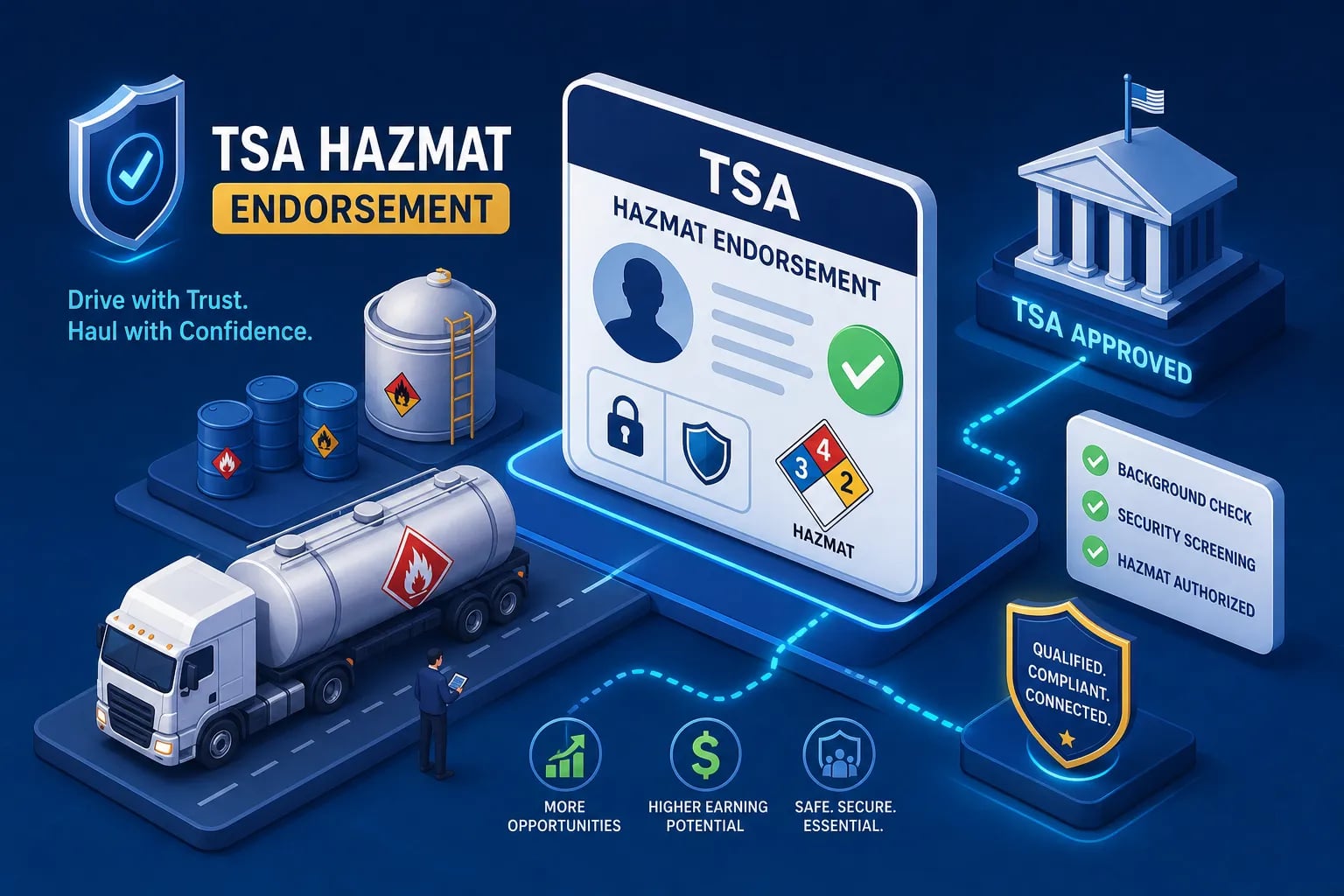
Getting a TSA hazmat endorsement on your CDL is a two-track process, and many candidates underestimate the TSA track entirely. The track most drivers know about is the FMCSA hazmat knowledge test, the written exam covering placarding, handling, and emergency response. CDLTest360 is designed to help drivers clear that hurdle efficiently. The track that catches drivers off guard is the TSA security threat assessment: a federal background check that runs completely parallel to the DMV process, must be initiated separately, and often needs to be started well before you sit for the written exam.
TSA's role is straightforward. The agency determines whether you pose a national security risk before authorizing you to transport hazardous materials on public roads. Without that federal clearance, no state DMV can add the hazardous materials endorsement (HME) to your CDL, full stop. This article walks through exactly how the TSA side of the process works, from your first application to the moment that endorsement is printed on your license.
What the TSA security threat assessment actually covers
Why a federal agency is involved in a trucking credential
TSA's authority over HME screening traces directly back to post-9/11 legislation. Congress recognized that hazardous materials moving on public roads represent a national security risk, not just a workplace safety concern, which is why the screening falls under TSA rather than a standard criminal justice agency. That context matters because it explains why the TSA hazmat endorsement process feels more involved than a typical DMV transaction.
TSA runs what it calls a security threat assessment, a different instrument than the background checks most people have encountered. The assessment cross-references federal terrorism watch lists, immigration records, and a defined list of disqualifying criminal offenses at the federal level. It is designed to answer one question: does this person represent a threat to national security if authorized to move hazardous cargo?
How the HME clearance differs from a standard background check
A state-level criminal background check looks primarily at in-state records and general criminal history. The TSA security threat assessment goes further, pulling from federal databases that a standard check never touches. The scope is narrower in some ways, it uses a defined list of disqualifying offenses rather than flagging all criminal history, but deeper in terms of the databases screened.
The most important thing to understand is that the written exam and the TSA clearance are completely independent outcomes. A driver can ace the hazmat knowledge test and still be denied the endorsement if the background check raises a flag. Conversely, TSA clearance alone does not substitute for passing the knowledge exam. Both results must be in hand before any state can issue the HME.
TSA Hazmat Endorsement: Step-by-Step Application Process
Starting with pre-enrollment and the application form
The TSA HME process typically begins with an optional online pre-enrollment through TSA's enrollment system. During pre-enrollment, you'll enter your personal information, citizenship or immigration status, and other required details. Pre-enrollment speeds up the in-person appointment, but it does not replace it. You still have to show up in person.
Some states also layer their own supplemental forms on top of the federal process. Texas requires CDL-1 and CDL-6 forms in addition to the TSA materials; New York uses its own HAZ-44 or HAZ-44R paperwork. Check your state DMV's HME instructions alongside the federal requirements to make sure you're not missing a state-specific step, and keep in mind that renewal and transfer situations may carry additional state requirements.
Completing your in-person fingerprinting appointment
The in-person enrollment at a TSA enrollment center is mandatory. This is where your fingerprints are collected and your documents are reviewed by an enrollment agent. No online step, however thorough, bypasses the requirement to appear in person. Enrollment centers are located nationwide and searchable directly through the TSA website.
Show up prepared. Bring originals, not photocopies, enrollment agents cannot accept copies in place of original documents. Document issues are a common cause of delays, rescheduled appointments, and longer-than-necessary waits. Arriving with everything in order keeps the appointment short and the timeline on track.
What happens after you submit
Once you leave the enrollment center, TSA takes over. The agency processes the security threat assessment and issues a decision. After TSA clears you, the process shifts back to the state level, where you'll need to complete any remaining requirements, passing the hazmat knowledge test and submitting state CDL paperwork, for example. The state cannot issue the HME until TSA provides its clearance, which is why initiating the federal process early is not just a recommendation; it's a strategic decision that directly affects your total timeline.
Documents, Fees, and What to Bring to Your TSA Hazmat Endorsement Appointment
Accepted identity and citizenship documents
TSA requires two documents at your enrollment appointment: one to establish identity and one to prove U.S. citizenship or lawful permanent residency. For identity, an unexpired CDL, driver's license, U.S. passport, or military ID all qualify. For citizenship or status, accepted documents include a U.S. birth certificate, Certificate of Naturalization, Certificate of Citizenship, Permanent Resident Card (Form I-551), or a U.S. passport that expired within the last 12 months. Note that certain documents, such as a valid U.S. passport, can satisfy both requirements simultaneously, so you may not always need two separate items. TSA's official acceptable documents list, available on the TSA website, is the authoritative reference for your specific situation.
If your name differs across documents because of a marriage or legal name change, bring the supporting paperwork: a marriage certificate or court order is required to bridge the gap. Name mismatches at the enrollment counter are a common and avoidable delay. Resolving this before you arrive keeps the process clean.
What the background check costs
The standard TSA enrollment fee is $86.50 for both new and renewal HME applications in states where TSA serves as the enrollment agent. Applicants who hold a valid TWIC card and are licensed in a state that accepts TWIC comparability qualify for a reduced fee of $41.00, because TSA treats the TWIC's existing vetting as comparable and does not need to run the full assessment from scratch. In non-agent states, where a third-party enrollment provider collects fingerprints rather than TSA directly, fee structures differ, check your state DMV's HME page for the applicable rate before your appointment.
State DMV fees are charged separately and vary by state. Texas runs about $11, Florida around $7, California approximately $28, and Georgia roughly $5. Including typical state DMV fees, total out-of-pocket costs often fall in the $90 to $120 range, though that figure will vary depending on your state and enrollment path. Budget accordingly so the cost doesn't catch you off guard at the window.
Realistic Timeline from Application to Endorsement in Hand
TSA processing window and what affects it
TSA's stated goal is to complete the security threat assessment within 60 days of receiving a complete enrollment. In practice, many applicants see decisions in 30 to 45 days, and TSA's own guidance cites a 30-day target once fingerprints and information are received. Arizona DMV guidance frames the realistic range as 1 to 8 weeks, a useful benchmark, though your state's processing context may differ.
Several factors push processing toward the longer end of that range. Incomplete applications, document mismatches flagged during enrollment, and high application volume can all extend the wait. Submitting a clean, complete enrollment package from the start is the single most effective way to keep your timeline as short as possible.
Running your knowledge test prep in parallel
This is exactly where the two-track framing matters in practice. Since TSA clearance takes weeks, smart candidates use that waiting period to complete their hazmat knowledge test preparation rather than sitting idle. Starting both tracks at the same time compresses your total timeline significantly.
CDLTest360's hazmat quiz module targets the material covered on the FMCSA-aligned knowledge exam, including placarding, classification, handling procedures, and emergency response. A timed exam simulation mode mirrors the real test format, and a missed-question review loop focuses your study on the areas where you're losing points. By the time TSA issues your clearance, you can be ready to walk into the DMV and pass the knowledge test without any additional delay.
Disqualifying Offenses and How to Challenge a Denial
Permanent vs. temporary disqualifiers
Permanent disqualifiers bar a driver from the HME indefinitely, with no lookback window. These include convictions for:
-
Espionage, sedition, or treason
-
Terrorism-related offenses under 18 U.S.C. Chapter 113B
-
Murder
-
Crimes involving a severe transportation security incident
-
Improper transportation of hazardous materials
-
Unlawful possession or use of explosive devices
-
Conspiracy or attempt to commit any of the above
Temporary disqualifiers apply only if the conviction occurred within the last 7 years or the applicant was released from incarceration within the last 5 years, whichever is later. Offenses in this tier include assault with intent to murder, kidnapping, rape or aggravated sexual abuse, arson, robbery, extortion, fraud and identity misrepresentation, bribery, smuggling, immigration violations, and RICO violations not already covered by the permanent list. On controlled substances specifically: distribution, possession with intent to distribute, or importation is disqualifying, while simple possession is treated differently under TSA's current standards.
What to do if TSA issues a preliminary denial
A denial is not necessarily final. TSA issues a Preliminary Determination of Threat Assessment (PDTA) before making any final decision, and that preliminary notice comes with an opportunity to respond. Applicants have 60 days from receipt of the PDTA to request the records TSA used, submit a written appeal with supporting documentation, or request an extension. If no response is submitted within that window, the determination becomes final automatically.
After reviewing an appeal, TSA issues a Final Determination of Threat Assessment (FDTA). If the appeal is denied, further review options exist under TSA's appeal procedures. Any driver who receives a preliminary denial should consult a transportation attorney before concluding that the endorsement is out of reach. Record errors, timing questions on conviction dates, or documentation gaps can sometimes be corrected on appeal, and walking away without reviewing the basis for the denial means leaving a potentially winnable challenge on the table.
Get Both Tracks Moving at the Same Time
The TSA hazmat endorsement requires clearing two completely separate federal processes, and they don't run in sequence. The TSA security threat assessment and the CDL hazmat knowledge test operate on parallel tracks, and both have to be complete before any state can issue the HME. Drivers who initiate the TSA process early, gather their documents in advance, and schedule their fingerprinting appointment without delay put themselves in the strongest position to get the endorsement added to their CDL as quickly as possible.
While the clearance is processing, the knowledge test is entirely within your control. CDLTest360 is built to make that portion of the process efficient, with targeted hazmat quizzes, timed exam simulations aligned to FMCSA standards, and a missed-question review loop that identifies your weakest areas so you can address them before test day. No account is required to start, and the 90-day access plan gives you full coverage across every module you need.
Start your TSA hazmat endorsement process today, and run your knowledge test prep at the same time. Both tracks have to clear before the endorsement is issued, get them both moving now so you're not waiting on yourself when TSA sends its decision.
{ "@type": "Article", "datePublished": "2026-08-10T16:18:08.500Z", "dateModified": "2026-08-10T16:18:08.500Z", "headline": "TSA Hazmat Endorsement: What CDL Drivers Need to Know", "description": "Learn how the TSA hazmat endorsement process works: background check steps, fingerprinting, fees, timelines, and disqualifying offenses. Start your clearance today.", "publisher": { "@type": "Organization", "name": "CDLTest360" }, "image": [ ] }