If you're wondering "what do I need to study for my CDL permit," start here: a Class A Commercial Learner's Permit (CLP) requires you to pass three separate knowledge tests, each scored independently, each with its own 80% passing threshold. Most first-time candidates walk in thinking they're facing one written exam. They're not. Fail one section and you leave empty-handed, regardless of how well you did on the others. That misunderstanding alone accounts for a significant share of first-attempt failures, which, according to a 2014 GAO report on CDL testing outcomes, range from 20% to 50% depending on the state.
This guide maps out every topic covered on the CDL permit knowledge tests, explains exactly how the scoring works, and gives you a concrete four-week study schedule so nothing slips through. CDLTest360 is built around this exact topic structure, with each subject organized into its own quiz module, so your practice time matches the test structure from day one. Follow this plan and the test stops being a mystery.
How the CDL permit test is actually structured
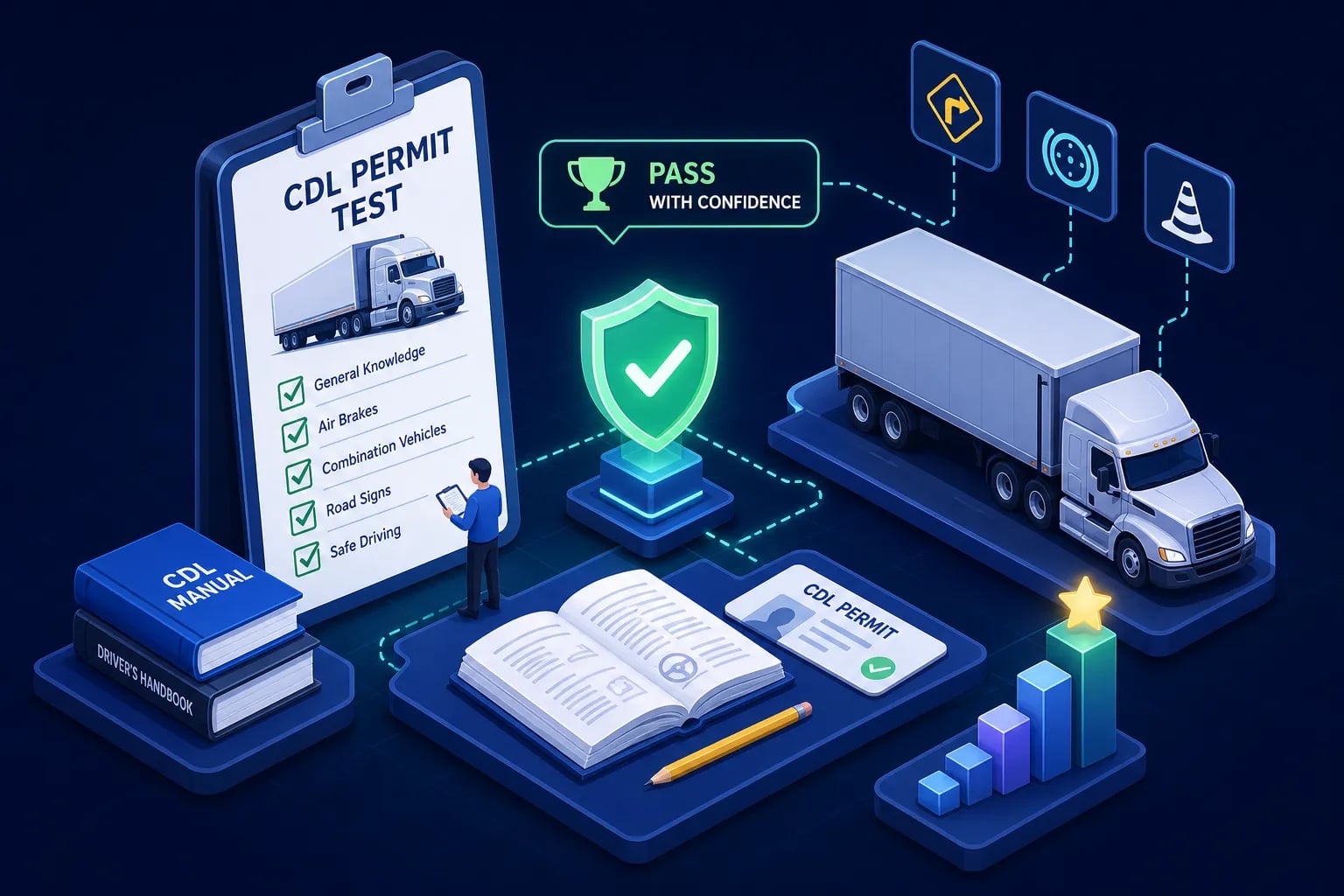
The CDL permit, technically called the Commercial Learner's Permit, is not a single written test. For a Class A CDL, most candidates must pass three separate knowledge tests: General Knowledge, Air Brakes, and Combination Vehicles. Each test is scored independently with no averaging across sections. The federal standard under 49 CFR § 383.135 sets the minimum passing score at 80% on every section, so a 95% on General Knowledge does nothing to offset a 75% on Air Brakes.
The three core tests for a Class A CLP
General Knowledge is required for every CDL candidate, no exceptions. Air Brakes is required if the vehicle you're training on has air brakes, which applies to most Class A trucks on the road. Combination Vehicles is required for tractor-trailer operation. Candidates who skip or fail any one of these sections cannot receive their CLP, regardless of how they performed on the others.
Question counts and the 80% passing rule
National benchmarks give you a useful starting point. General Knowledge typically runs about 50 questions, requiring at least 40 correct. Air Brakes runs about 25 questions, requiring at least 20 correct. Combination Vehicles runs about 20 to 25 questions, requiring 16 to 20 correct. But state counts vary significantly: California tests 55 General Knowledge questions, Texas runs 60, Arizona runs just 30. The practical takeaway is to pull the test-information page from your specific state CDL manual before building your study plan, because the raw number of correct answers required changes with the total question count even though the 80% threshold stays constant.
What do I need to study for my CDL permit, General Knowledge
General Knowledge is the largest and broadest test in the CLP process. It covers everything from traffic laws and cargo securement to emergency procedures and fatigue rules. Most candidates underestimate it because the name sounds basic. It isn't. Among the highest-yield areas are vehicle inspection, safe driving, hazard response, and cargo management, and each of those areas carries its own sub-topics that can show up on test day.
Safe driving, regulations, and cargo
This portion includes hours-of-service rules, drug and alcohol regulations, required documents, and accident procedures. It also covers the full range of defensive driving principles: hazard recognition, following distance, stopping distance, space management, skid control, adverse weather driving, night driving, mountain grades, railroad crossings, and work zones. Cargo questions test weight distribution, load limits, cargo securement requirements, and how to prevent shifting or leaking freight during transit.
Vehicle inspection and basic vehicle control
Inspection questions cover pre-trip, en-route, and post-trip procedures. You need to know which components to check, brakes, tires, lights, mirrors, steering, suspension, fluids, and emergency equipment, how to identify an unsafe defect, and why each defect creates a safety risk. Basic control questions test starting, stopping, steering, shifting, backing, turning, and positioning. Plan six to eight hours on General Knowledge topics spread across the first two weeks of your prep, a reasonable allocation given how much ground the section actually covers.
What do I need to study for my CDL permit, Air Brakes and Combination Vehicles
Air Brakes and Combination Vehicles are widely regarded as the most challenging sections for first-time applicants. Both require conceptual understanding, not just memorization. If you can't explain why brake fade happens on a long downhill grade or why rearward amplification creates a rollover risk on a curve, you'll lose points on application-style questions. These aren't trivia questions about component names; they're judgment questions about what happens when systems behave a certain way.
What the air brakes test actually covers
The Air Brakes section tests your knowledge of every component in the system: air compressor, governor, reservoirs, check valves, brake chambers, slack adjusters, spring brakes, drain valves, safety valves, and the tractor protection valve. You also need to know how to inspect and test the system, including static and applied leakage tests, low-air warning devices, spring brake activation, and draining reservoirs. Safe operation questions cover brake lag, brake fade, proper braking technique on grades, ABS function, and emergency procedures after a low-air warning. Budget four to five hours for Air Brakes, focused on understanding how the components interact rather than just listing their names.
Combination vehicles and why the dynamics matter
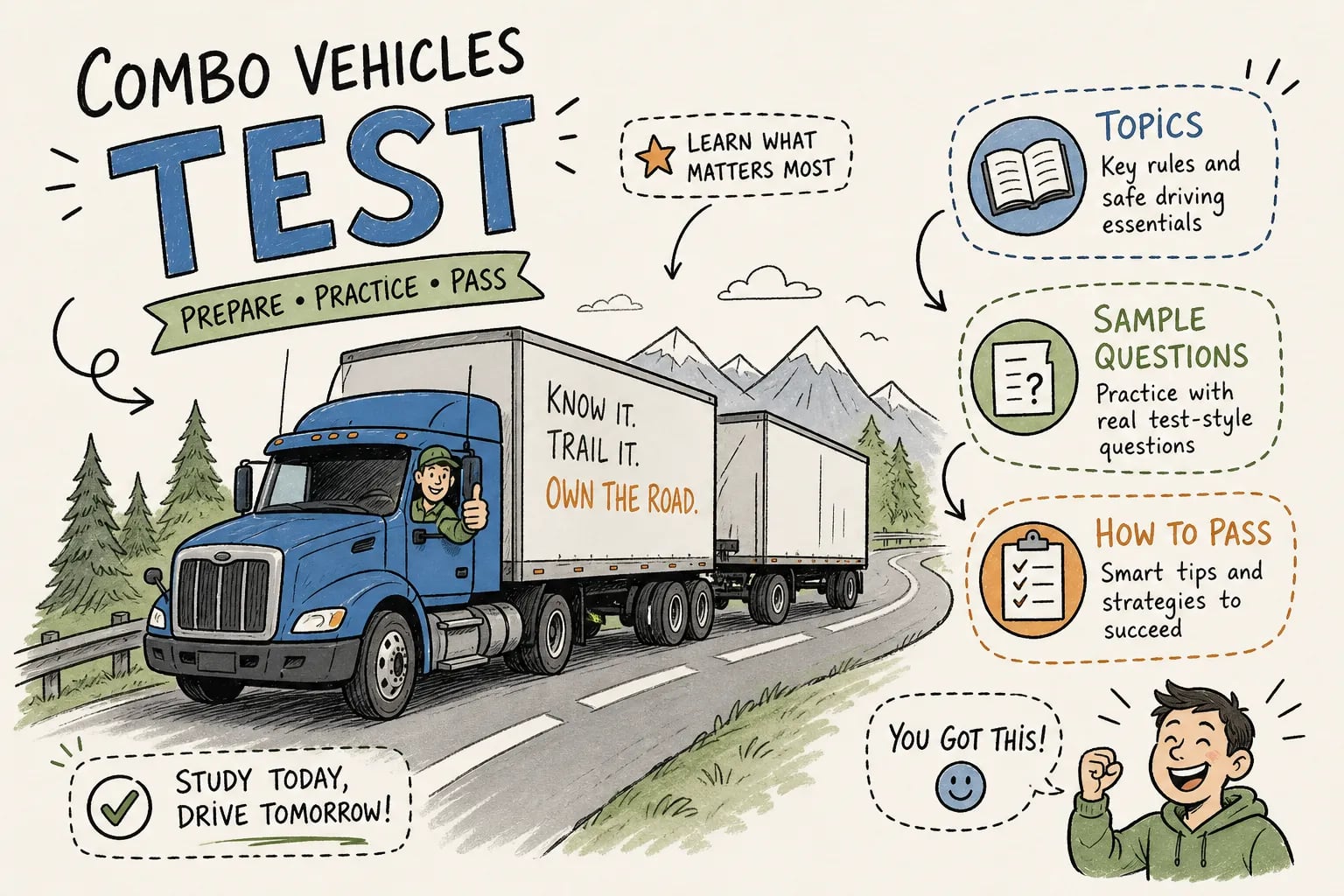
The Combination Vehicles test digs into fifth-wheel coupling and uncoupling, glad-hand and electrical connections, landing gear procedures, and the pull test. The handling questions go beyond mechanics: off-tracking, rearward amplification, rollover risk, jackknifing, trailer swing on curves, and the wider turn radius of longer combinations. Doubles and triples get their own sub-topics covering converter dollies, correct trailer order, and the unique inspection sequence for multi-trailer rigs. Plan four to five hours here as well, with extra attention to coupling procedures and the dynamics questions, those are the areas candidates most consistently miss.
CDL endorsements: which ones you need and what they test
Endorsements are add-on knowledge tests that authorize you to operate specific vehicle types or haul specific cargo. Each one is a separate written test with its own passing requirement. The practical rule: only study and test for the endorsements your job will actually require on day one. Don't pile them all in during CLP prep unless your employer specifically needs them from the start.
HAZMAT, tanker, and doubles/triples
The HAZMAT (H) endorsement is the most detailed of the three. It covers the nine hazard classes, shipping papers, package labels and markings, placards, loading and segregation rules, routing restrictions, emergency response, and TSA security procedures. At roughly 30 questions, it's the longest endorsement test, though exact counts can vary by state, so confirm the total in your state CDL manual.
The Tanker (N) endorsement focuses on liquid surge, high center-of-gravity dynamics, rollover risk, outage, baffles and bulkheads, and emergency procedures for liquid cargo. The Doubles/Triples (T) endorsement covers coupling multiple trailers, converter dollies, correct trailer order, inspection, and the specific handling hazards of longer combinations including the crack-the-whip effect.
Passenger and school bus endorsements
The Passenger (P) endorsement covers boarding and alighting procedures, standees, baggage handling, emergency exits, railroad crossings, and prohibited practices. The School Bus (S) endorsement adds student danger zones, warning lights, stop-arm operation, emergency evacuation procedures, and student-management rules. Both the P and S endorsements require a skills test in the actual vehicle type, not just the written knowledge test, so factor that into your preparation timeline. Budget two to three hours of focused reading per endorsement for the knowledge portion.
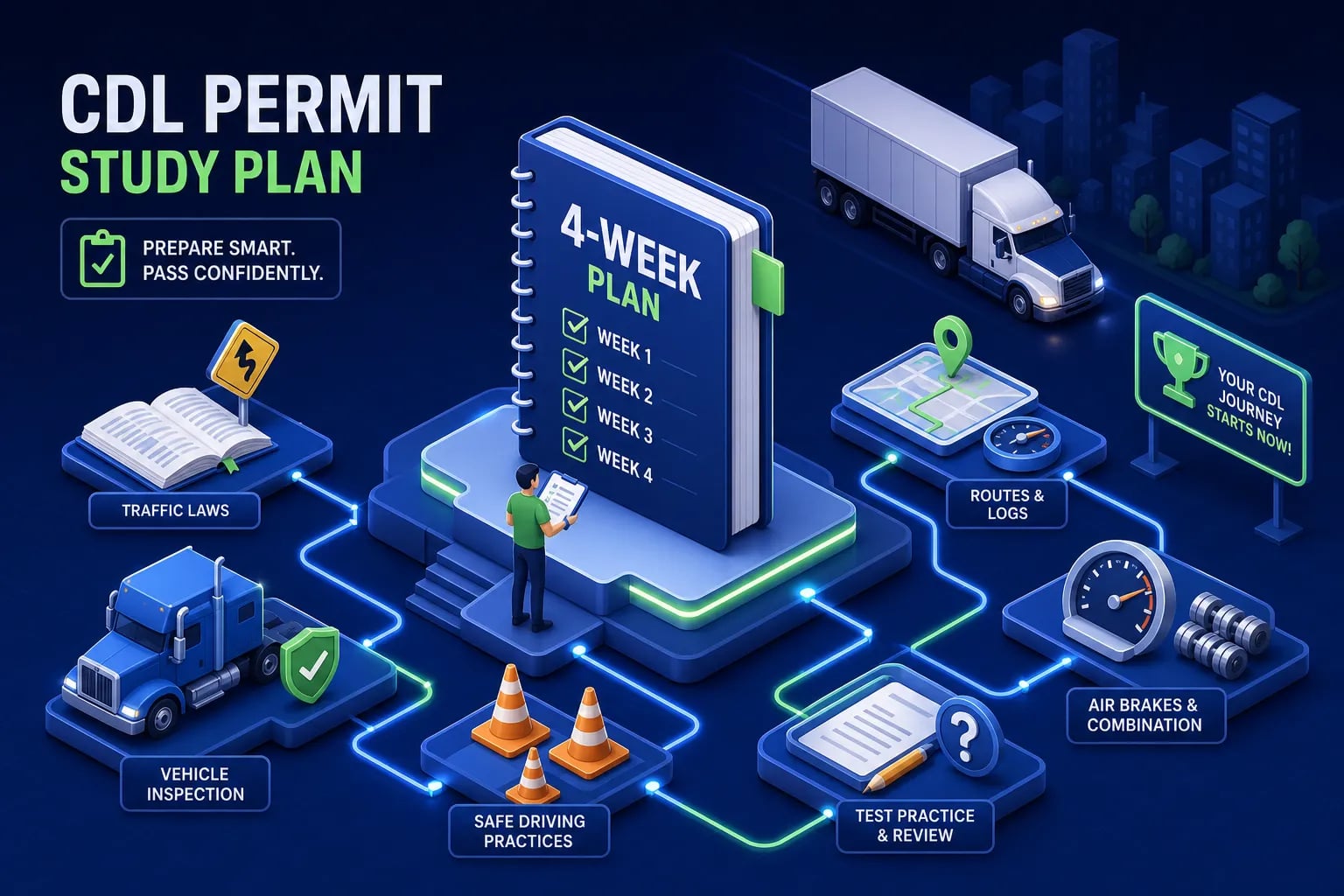
Your 4-week CDL permit study schedule
This schedule assumes 30 to 60 minutes of focused study per day, five days a week. Short daily sessions consistently outperform weekend cramming because spaced repetition locks in the rules and procedures your brain would otherwise lose between sessions. Use CDLTest360's topic-specific quiz modules to test each section right after you read it, so you know immediately whether the concept landed or needs another pass before moving on.
Week 1 and week 2: general knowledge and vehicle inspection
Week 1 covers CDL rules, safe driving fundamentals, traffic laws, hazard recognition, adverse-weather driving, and emergency procedures. Week 2 shifts to cargo securement, vehicle inspection sequences, and basic vehicle control. After each manual section, close the book and take a quiz on that specific topic. CDLTest360's module structure maps directly to these categories, so you can run a timed practice set on General Knowledge and see exactly which subtopics are dragging your score down.
Week 3: air brakes and combination vehicles
Spend the first three days of Week 3 on Air Brakes: read the components section, take a CDL practice test on that material, review every missed question, and read the correct explanation before moving on. CDLTest360's missed-question drill isolates the exact questions you got wrong and re-queues them until you answer them correctly and consistently, a feedback loop that's far more efficient than retaking the same full test and hoping different questions surface. Reserve the final two days for Combination Vehicles, focusing on coupling procedures and the dynamics of longer combinations.
Week 4: endorsements, mixed practice, and readiness testing
Use Week 4 to cover any required endorsements at one per day, then shift into mixed-topic practice mode. Run full timed simulations across all subjects. Your readiness benchmark is consistent scores of 85 to 90% or higher on varied tests, with no single subject dragging below 80%. If a topic keeps surfacing in missed questions, go back to the relevant manual section and re-read before your test date. Walking in at 85% across the board gives you a meaningful buffer above the 80% threshold on test day.
Where to find your state manual and the best CDL practice tests
The single most important study resource is the CDL manual issued by the state where you're testing. The questions on your actual test are written from that manual, so any third-party content that doesn't align with your state's specific wording is a risk you don't need to take.
Official state CDL manuals via FMCSA
FMCSA maintains a state-by-state directory of CDL manuals that links to each state's DMV, DOT, DPS, BMV, or MVD website where the current PDF is hosted. Download your state's manual and confirm which sections correspond to the tests you're taking. The general structure is consistent: Sections 1 through 3 cover General Knowledge material, Section 5 covers Air Brakes, Section 6 covers Combination Vehicles, and Sections 7 through 10 cover endorsements. Section numbering can vary slightly by state, so check the study chart inside your manual to confirm the exact mapping for your license class.
CDLTest360: structured CDL practice tests for every section
CDLTest360 is built specifically around the FMCSA-aligned topic structure described in this article. Every knowledge section has its own quiz module, covering General Knowledge, Air Brakes, Combination Vehicles, HAZMAT, Tanker, Doubles/Triples, Passenger, and School Bus. You can start practicing without creating an account, and each module runs in either standard practice mode or timed exam simulation calibrated to the 80% passing threshold. Pricing is $39.99 for a 90-day pass or $19.99 per month, less than the retest fee in most states.
Study mistakes that guarantee a retest
Most CDL permit failures trace back to a handful of identifiable, avoidable mistakes, not to how smart or hard-working the candidate is. Knowing what those mistakes are before you start studying is worth more than an extra week of reading, because it keeps your time focused on actual preparation instead of reinforcing bad habits.
The passive reading trap
Reading the manual front to back and feeling confident is one of the most dangerous patterns in CDL test prep. Recognition and recall are completely different skills. The test doesn't show you sentences from the manual and ask you to confirm them; it puts you in a scenario and asks what you would do. After each section, close the manual and try to recall the key rules from memory. Write them out or say them aloud. If you can't, that's the gap the test will find.
Ignoring wrong answers and practicing blind
Taking CDL practice tests and only tracking your score is a waste of time. The entire value of a practice test is in the questions you get wrong. Every missed question should trigger the same process: identify the topic, re-read the relevant manual section, write the correct rule in your own words, and understand why the wrong answer felt plausible. Watch for qualifier words like "except," "always," "never," "minimum," and "maximum" in test questions. These words flip the answer, and candidates who read quickly miss them regularly. Slow down on every question that contains an absolute or a threshold value.
Getting to the finish line
Now you know the answer to "what do I need to study for my CDL permit": three separate knowledge tests, specific topics within each, and a fixed 80% passing threshold that doesn't round up. You know which topics appear on each test, how the scoring works, and how to allocate your study time across four weeks without wasting a session.
Get your state's official CDL manual from the FMCSA directory, follow the week-by-week plan above, and use CDLTest360 to turn each chapter into a scored CDL practice test session. The missed-question drill and timed simulation mode give you an honest readiness signal well before you schedule your CLP appointment. When you're consistently hitting 85 to 90% across mixed-topic tests with no weak sections in your missed-question queue, you're ready. Walk in having verified every section your state requires and having drilled each one to passing standard.
CDLTest360's no-account-required free trial lets you take your first practice quiz immediately. Start with General Knowledge, see where you stand, and let the missed-question drill build your study list from there.
{ "@type": "Article", "datePublished": "2026-10-02T11:02:05.384Z", "dateModified": "2026-10-02T11:02:05.384Z", "headline": "What to Study for Your CDL Permit: A 4-Week Plan That Works", "description": "Learn exactly what to study for your CDL permit: every test topic, passing scores, a 4-week schedule, and the best free practice tests to pass on your first try.", "publisher": { "@type": "Organization", "name": "CDLTest360" }, "image": [ ] }