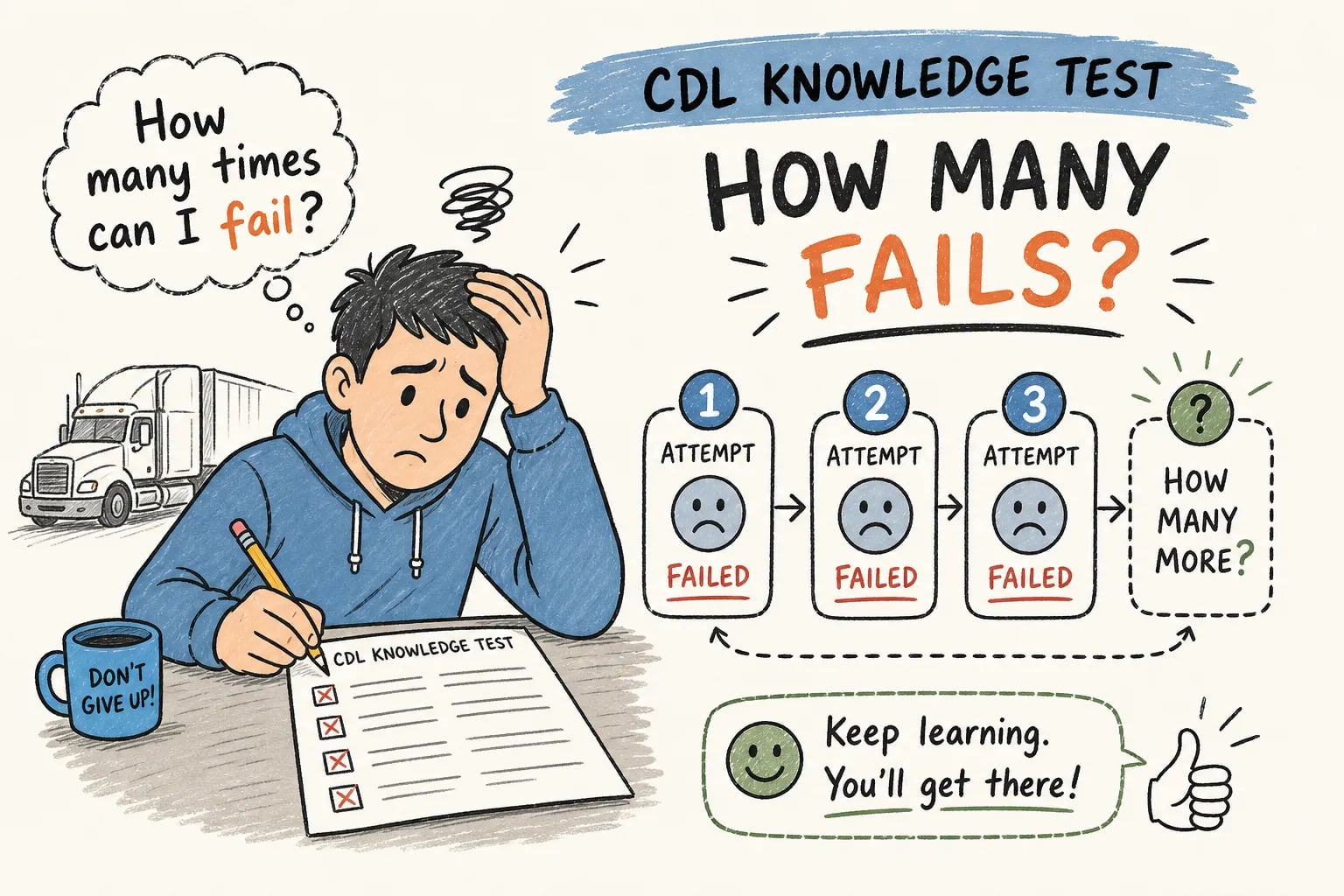
You walked out of the DMV with a failing score, and now you're staring at a question nobody warned you about: how many times can you fail the CDL written knowledge test before you have to restart the process? The anxiety around that question is real. Miss a cutoff you didn't know existed and you could be looking at driving school requirements, a brand-new application, and weeks of lost time you can't afford.
Here's the honest answer: there is no single nationwide number. The FMCSA sets a few non-negotiable minimums, and then every state does exactly what it wants with the rest. That means the consequences of a second or third failure in Texas look completely different from the consequences of the same situation in Illinois or Virginia. Knowing your specific state's CDL knowledge test retake rules isn't optional prep work. It's part of the test itself.
At CDLTest360, we work with CDL candidates navigating this exact situation, from first-time test takers who are one attempt deep to retakers staring down a mandatory restart. This article gives you the clearest available picture of how each state handles CDL written test retries, what triggers a full application reset, and a concrete three-step plan to make your next attempt your last.
What the FMCSA actually controls about CDL test retakes
Most candidates assume there's a federal rule that caps their attempts or dictates their wait time. That assumption is wrong, and it leads people to either panic unnecessarily or miss a state-specific deadline they didn't know existed. FMCSA sets the floor. States build the house.
Federal minimums every state must follow
FMCSA mandates two non-negotiable rules that apply in all 50 states. First, the passing threshold for every CDL knowledge test is 80%. Second, when a candidate retakes a failed knowledge test, the state must administer a different version of the test, not the same question set. Both rules exist to prevent pattern memorization from replacing actual knowledge and to protect the integrity of the CDL testing process across state lines.
Special retake triggers tied to fraud and CLP validity
FMCSA does step in directly under two narrow circumstances. If a state receives credible information that a CLP or CDL was obtained through fraud, it must require the driver to retest. The driver then has 30 days to schedule and complete that retest, or face disqualification. Separately, FMCSA rules allow a commercial learner's permit to remain valid for up to one year without requiring the holder to retake general knowledge or endorsement tests. That one-year CLP validity and your state's retake attempt limit are two separate clocks running simultaneously, and both can expire on you independently.
Where state authority begins
Beyond those federal rules, everything else belongs to the states. The number of allowed attempts before reapplication, the mandatory wait between each attempt, the per-attempt fees, and the specific trigger that forces a full application restart are all determined by your state DMV. Two candidates in neighboring states can fail the same test on the same day and face completely different consequences by the following morning.
State-by-State CDL Knowledge Test Retake Limits: How Many Times Can You Fail the CDL Written Knowledge Test Before You Have to Restart the Process?
No complete 50-state table exists from a single authoritative source, because states don't publish their rules in a standardized format and the policies change. What follows covers the states with the most clearly documented rules, organized by how they structure their retake policies. Use this as a starting point, then verify the current rule directly with your state DMV before your next attempt.
States with unlimited attempts and short waiting periods
Arizona allows unlimited knowledge test attempts with a fee required for each one. Arizona also explicitly credits passed sections of multipart tests: if you pass the general knowledge portion but fail the air brakes section, you don't repeat general knowledge, you pay and retake only the section you failed. New Jersey takes a similar approach, with no cap on attempts within the 180-day test-receipt window and a mandatory 7-day wait between each retake. Once that 180-day window closes, candidates must renew the test receipt for $125 before continuing. "Unlimited" sounds generous, but the cost and scheduling reality adds up fast if you're burning through attempts.
Oregon sits at the other end of the wait spectrum. According to Oregon DMV's official CDL manual, a candidate who fails a knowledge test may retake it as early as the same day, subject to terminal availability. That's one of the shortest retake windows in the country, which makes thorough preparation before each attempt especially important.
States with escalating wait periods after repeated failures
Georgia uses a tiered system: after a first failure, you wait 2 calendar days; after a second or third failure, the wait extends to 7 days; after a fourth failure, you must reapply through the CDL unit entirely. Kentucky allows next-day retesting until you hit six failures, at which point the wait extends to 3 days. Three more failures trigger another 3-day block. Mississippi gives candidates a window of three consecutive days to test; after a third-day failure, a 7-day lockout applies before they can try again.
Illinois runs the most aggressive escalation schedule of any documented state. After the third failure of the same knowledge test, a 30-day block kicks in. After the sixth failure, the block extends to 90 days. After the ninth failure, a one-year lockout applies. The failure count tracks per specific test, not across all CDL tests, but passing that specific test is what resets the count. A candidate who triggers the 90-day block in Illinois has essentially lost an entire training cycle.
How to verify your exact state's current CDL retake policy
Go to your state's official DMV or CDL licensing page directly. Look for the CDL or commercial driver section, not the general driver's license page. State policies change, and third-party summaries are often outdated or mix knowledge-test rules with skills-test rules, which are separate policies. CDLTest360 includes state-specific CDL manuals directly inside the platform, a practical shortcut to understanding what your state actually tests and how the current manual aligns with your DMV's expectations.
When Failing Forces a Full CDL Application Restart
Understanding how long you wait between attempts matters. Understanding when failing erases all your progress and sends you back to square one matters more, and it catches candidates completely off guard.
Hard attempt caps that trigger reapplication
Texas gives candidates a 90-day application window with three knowledge test attempts within that window. Hit three failures or reach the 90-day mark, whichever comes first, and you need a new application. The clock and the attempt count are both working against you simultaneously. Virginia enforces one of the stricter restart policies in the country: three failed CDL knowledge tests require the candidate to complete the knowledge component of driver instruction at a DMV-approved driver training school. The candidate must then present the completion certificate and submit a new learner's permit application with required identity and residency documentation before retesting is allowed. Georgia's fourth-failure reapplication rule, covered in the previous section, follows the same pattern of a hard ceiling that resets everything.
What "restarting the process" actually means
A restart is not just scheduling another test. In Virginia, it means completing a certified driver training program after the third failure, gathering the completion certificate, and filing a new learner's permit application with full identity and residency documents, then waiting for that application to process before a test date can be scheduled. In Texas, it means paying a new application fee and starting the 90-day window over from zero. The reapplication process adds weeks to a timeline that was already under pressure. If you had a job offer contingent on your CDL, a restart can cost you that offer.
How your CLP expiration date interacts with attempt limits
Your commercial learner's permit has its own expiration date, and it doesn't pause during a mandatory hold. If the CLP expires before you pass the knowledge test, you may need to reapply for the permit itself, regardless of how many test attempts remain under the state's retake policy. In Washington, for example, knowledge test scores are valid for 180 days. If the CLP is renewed within the allowed window, scores can carry forward another 180 days. Miss that window and you retest from scratch. The practical rule: you cannot use remaining test attempts to extend an expired permit, and an unexpired permit won't bypass a state's retake cap. Both clocks run independently and both can cut your time short.
Waiting periods and fees: the real cost of each failed attempt
The time cost of repeated failures gets most of the attention, but the financial and scheduling reality compounds quickly and deserves a clear-eyed look before you walk into your next attempt unprepared.
What states typically charge per retake attempt
Most states charge a separate CDL knowledge test fee for each attempt, on top of any application or permit fee already paid. Where fee schedules are documented, per-attempt costs vary considerably, some states bundle the fee into the test receipt rather than itemizing it separately, which makes direct comparison difficult. Some states also tier their fees differently for the base CDL knowledge test versus individual endorsement modules, so a candidate pursuing air brakes and hazmat endorsements alongside a Class A license may be managing multiple fee schedules at once. Check your state DMV's current fee schedule directly, as these figures change.
When escalating time penalties kick in
Kentucky's next-day retake rule sounds forgiving until you realize that a candidate who burns through six attempts is now locked into 3-day windows per attempt. At that pace, the calendar moves faster than most candidates expect. Illinois's situation is more severe. A candidate who triggers the 90-day block hasn't just lost testing time, they've lost the momentum, study rhythm, and often the job opportunity that motivated the CDL pursuit in the first place. Framing this as a planning issue, not just a policy issue, changes how seriously you approach each attempt before it happens.
How multipart test credits reduce your exposure
In states like Arizona that explicitly credit passed sections of multipart knowledge tests, your actual exposure per failed attempt is narrower than it looks. You're not retesting everything, you're retesting the one module that didn't clear 80%. That distinction matters for scheduling, fees, and how you prioritize study time between attempts. This credit practice exists in other states as well, though not all states document it as explicitly as Arizona does; check your state's CDL manual to confirm how partial credits apply.
Why candidates keep failing the CDL knowledge test more than once
Repeat failures aren't random. They follow predictable patterns, and recognizing those patterns is what separates a candidate who passes on the next attempt from one who triggers a state's restart requirement.
Relying on passive study without exam conditions
Reading the CDL manual is necessary. It is not sufficient. Candidates who study by reading and highlighting consistently underestimate how differently their brain performs when they're clicking through 50 questions with a timer running, a retake fee on the line, and a job offer riding on the result. The 80% threshold requires 40 correct answers out of 50. That sounds achievable in a relaxed environment. Under real test pressure, without practice in that environment, the gap between what you know and what you can recall on demand becomes visible in a score report.
Not isolating and drilling missed questions
The most common study mistake among retakers is starting each practice session at question one and working through the full bank again. That approach reinforces what the candidate already knows while leaving the actual knowledge gaps untouched. If you missed questions about air brake system components in your last attempt, running 50 general knowledge questions from the beginning does almost nothing to close that gap. Targeted drilling on specific missed content is what moves the needle between attempts.
Using non-FMCSA-aligned or outdated study materials
Free online resources vary significantly in accuracy. Questions sourced from outdated state manuals or unofficial prep sites can embed incorrect information that actively hurts a candidate's score. The CDL knowledge test is written from FMCSA regulations and state CDL manuals. Study materials that don't track those sources directly aren't just incomplete, they're teaching wrong answers. FMCSA alignment isn't a premium feature. It's the baseline requirement for any study resource worth using.
How CDLTest360 keeps you off the retake treadmill
The three root causes above aren't character flaws. They're the result of using the wrong tools in the wrong sequence. CDLTest360 is built to address each one directly, with features designed around how CDL knowledge testing actually works.
Timed exam simulation mode that mirrors the real test
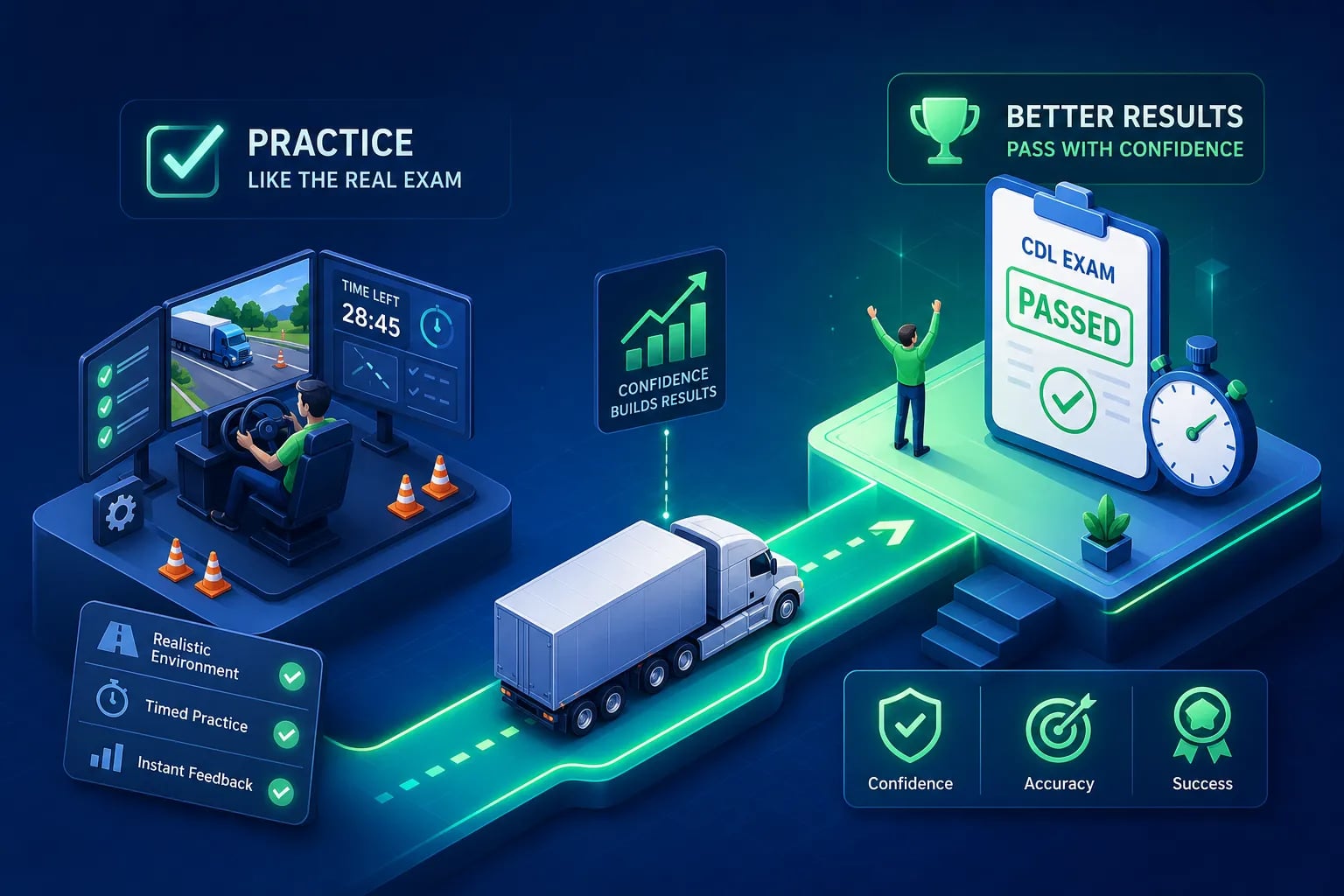
CDLTest360's timed exam simulation runs 50 questions against the 80% passing threshold, structured to reflect the format of the general knowledge CDL test. This is not a casual quiz with unlimited time and a soft score. It's a full rehearsal for the real testing environment. Candidates who can consistently clear 80% in simulation under timed conditions arrive at the DMV having already experienced the pressure of the format. The actual test becomes familiar rather than foreign, and that familiarity directly reduces the performance gap that time pressure creates.
The missed-question drill: closing gaps before they cost you
After every session, CDLTest360 isolates every question the candidate answered incorrectly and re-drills only those items in the next targeted session. Candidates aren't spending time re-answering questions they already know. They're working through exactly the content that would have failed them. For a candidate in their second or third attempt with a state's CDL permit test attempt limit approaching, that specificity is the difference between passing next time and triggering a full restart. The missed-question loop is surgical where reading the manual is broad, and that focus is what closes gaps efficiently between attempts.
State-specific manuals and FMCSA-aligned content inside the platform
CDLTest360 includes state-specific CDL manuals directly in the platform, so candidates aren't hunting for the right version of their state's content or accidentally studying a neighboring state's rules. Questions are aligned to FMCSA regulations and state CDL manuals, which means candidates are studying from sources that reflect what the DMV actually tests. Access options are available to fit different preparation timelines, giving candidates enough runway to complete multiple full study cycles before any state's retake window or application deadline closes on them. For candidates working on a tight schedule between a day job and family responsibilities, that structure removes the friction that causes preparation to stall.
Your action plan after a failed CDL knowledge test
Knowing the rules is the foundation. Having a specific sequence to follow after a failure is what turns that knowledge into a passing score on your next attempt. Run through these three steps before your waiting period is up.
Step 1: Confirm your state's exact retake window and fees
Within 24 hours of your failed test, go to your state DMV's official CDL or commercial license page. Find the specific mandatory wait period between attempts, the fee for each retake attempt, and how many attempts remain before a restart is triggered. Write those numbers down. Put the first available test date on your calendar immediately, because booking that date creates a deadline that structures the rest of your preparation. If your state allows same-day retesting, confirm that the DMV terminal has availability before you assume you can walk back in.
Step 2: Pull your score report and identify the exact topics you missed
Most state DMVs provide a score breakdown by topic area after a failed knowledge test. That breakdown tells you whether your gaps are in general knowledge, air brakes, combination vehicles, hazmat, or another specific module. It doesn't tell you which individual questions you missed, but knowing the topic categories is enough to direct your study. A candidate who failed primarily in the air brakes section doesn't need to spend equal time on combination vehicles. Focus your study time where your score report says the gaps actually are.
Step 3: Use targeted practice during your wait period, not general review
During the mandatory waiting period, every study session should drill the topic areas your score report flagged. Use CDLTest360's timed exam simulation and missed-question loop to structure each session around your specific weak points rather than the full manual. Set a personal benchmark before you book your next real test: you should be clearing 80% consistently in practice simulations, not just occasionally. If you can't pass the simulation reliably, you're not ready to pay the retake fee and sit in the DMV chair again. Your wait period isn't a penalty. It's preparation time that most retakers waste, use it with a plan.
How many times can you fail the CDL written knowledge test before you have to restart the process?
There is no single nationwide answer to how many times you can fail the CDL written knowledge test before you have to restart the process. Every state sets its own CDL knowledge test retake rules, and in several states those rules escalate fast: from a short wait to a mandatory driving school requirement to a full application restart with new paperwork and new fees. Georgia, Texas, Virginia, and Illinois all have consequences that most candidates don't discover until they're already past the point where avoiding them would have been straightforward.
Knowing your state's specific rules is preparation, not paperwork. But knowing the rules doesn't pass the test. The candidates who pass on their next attempt are the ones who spent their wait period closing specific knowledge gaps under real timed conditions, not rereading chapters they already understood. That's exactly what CDLTest360 is built to help you do: targeted simulation, missed-question drilling, and content aligned to what your state DMV actually tests.
Start a free practice session on CDLTest360 today, no account required. Find out where your actual gaps are before you sit back down at that DMV terminal.
{ "@type": "Article", "datePublished": "2026-10-01T11:02:06.451Z", "dateModified": "2026-10-01T11:02:06.451Z", "headline": "How Many Times Can You Fail the CDL Knowledge Test?", "description": "Find out how many times you can fail the CDL knowledge test before restarting. State retake limits, waiting periods, fees, and a plan to pass next time.", "publisher": { "@type": "Organization", "name": "CDLTest360" }, "image": [ ] }