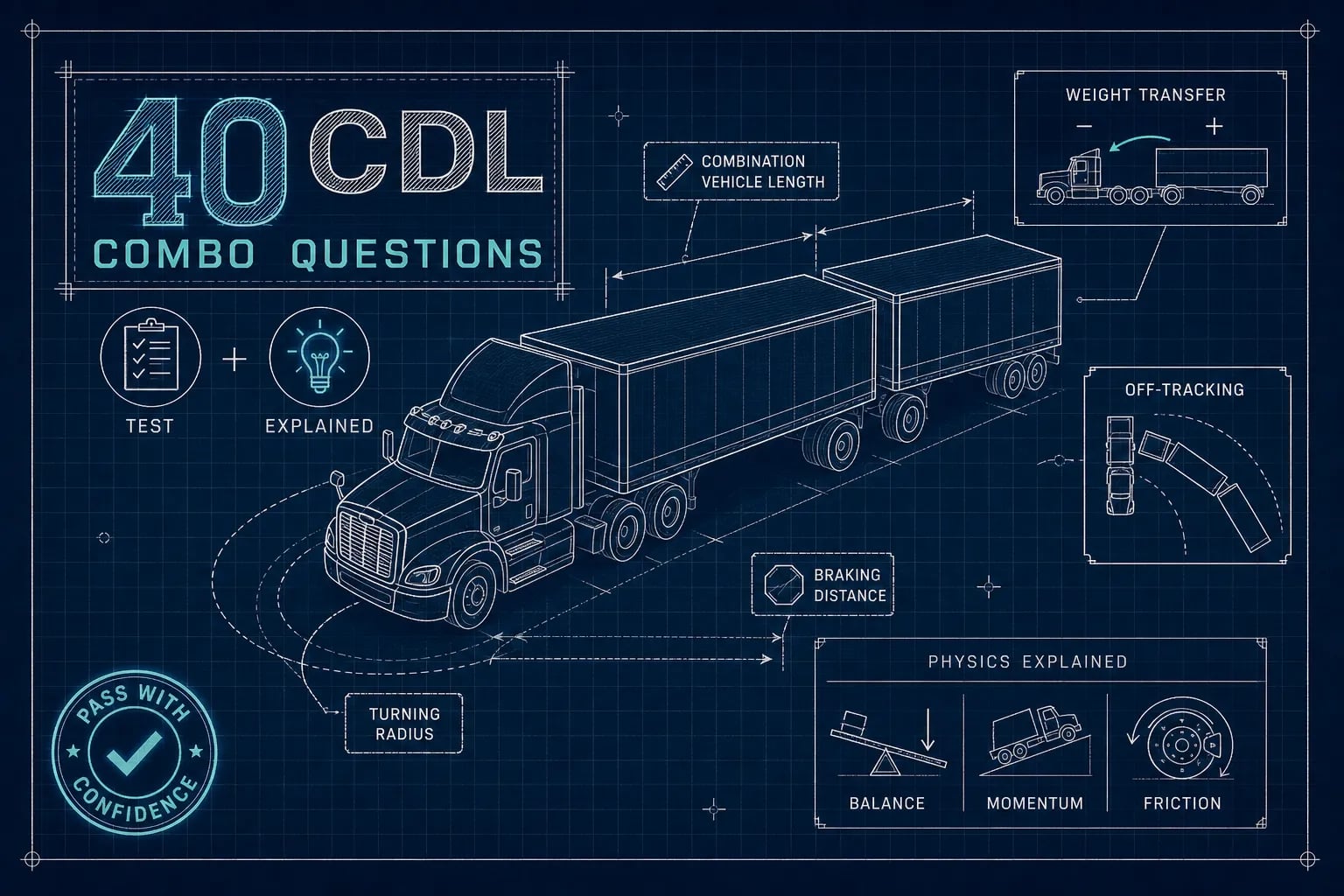
The combination vehicle knowledge test has a reputation, and it's earned. Among all CDL endorsement tests, this is the one candidates most consistently underestimate because it requires understanding systems that interact with each other, not isolated facts you can memorize independently. Drivers who pattern-match from practice tests without grasping the underlying physics routinely miss questions they felt confident about. These 40 CDL combo test questions are drawn from the four core domains where candidates lose the most points, and each one comes with the physics or procedural logic explained, not just the answer.
The questions below are distributed across coupling and uncoupling, air brake system behavior, braking and stability, and pre-trip inspection. Each includes the correct answer and a concise explanation of the physical or procedural logic behind it. Based on our practice-bank experience, the same question clusters trip up new candidates before their exam, which shaped the selection here. Work through these CDL combo practice questions and answers, track which categories give you trouble, and you'll know precisely where to focus your final study sessions.
What the combination vehicle test actually covers
The combination vehicle endorsement knowledge test covers four official domains: driving combination vehicles safely, combination vehicle air brakes, coupling and uncoupling, and inspecting combination vehicles. Topics like rollover risk, off-tracking, and jackknife prevention all sit inside "safe driving" rather than being listed as separate categories. Candidates who skip that domain because it sounds broad miss a significant portion of the exam.
Most states use a 20-question format with an 80% passing threshold, meaning you need 16 correct answers to pass. California uses 25 questions; Indiana may use up to 30. Oregon completed a transition period in mid-2026 where both old and new test materials were accepted, and Pennsylvania has adopted updated inspection language as part of broader skills-testing modernization. The practical takeaway: check your state's current CDL manual before you test, because inspection wording and procedural language vary.
Understanding the mechanical and physical logic behind correct answers lets you handle any phrasing variation on the real exam. Candidates who know why the tug test matters will answer that question correctly regardless of how the exam phrases it. That understanding generally improves the chance of passing on the first attempt, and avoids the waiting period most states impose before a retest.
Questions 1, 10: Coupling and uncoupling
CDL combo test questions, coupling and uncoupling basics
Coupling and uncoupling questions are commonly among the most-missed on the combination vehicle test. The correct answers depend on sequence and mechanical logic, not just terminology. A misaligned kingpin creates a false coupling that appears locked but fails under load stress, which is precisely why the exam tests every step of the procedure.
Q1: When backing under a trailer to couple, what is the correct tractor position?
Answer: Directly in front of the trailer, never at an angle. Backing at an angle can cause the fifth wheel to partially miss the kingpin, creating a connection that holds visually but fails under load.
Q2: What must you do immediately after backing under the trailer?
Answer: Perform a tug test. Pull forward gently in a low gear against the trailer brakes. If the trailer moves with you, the fifth wheel jaws did not lock around the kingpin.
Q3: How do you confirm the fifth wheel jaws are properly locked?
Answer: Verify there is no space between the upper and lower fifth wheel plates and the locking jaws are fully closed around the kingpin. Visual connection alone is not confirmation; the lock must be mechanically secure.
Q4: What is the correct trailer height before coupling?
Answer: The trailer should be low enough that it is raised slightly when the tractor backs under it. Too high and the tractor rides under without engaging; too low and the tractor strikes the trailer frame.
Q5: Before backing under the trailer, what must you do to prevent it from rolling?
Answer: Confirm the trailer spring brakes are set or the wheels are chocked. A loose trailer can roll during coupling, causing misalignment or a collision with the tractor.
Q6: When should you connect the air lines during the coupling sequence?
Answer: Before backing under the trailer. Connect the emergency line first, then the service line, check the glad hand seals, and supply air to the trailer from the cab before completing the coupling. Note that procedural language can vary slightly across state CDL manuals, so confirm the exact sequence in your state's current manual.
Q7: What is the first step when uncoupling a combination vehicle?
Answer: Apply the trailer parking brakes. Disconnecting anything before the trailer is secured allows it to roll freely.
Q8: During uncoupling, when do you lower the landing gear?
Answer: After applying the trailer brakes and before disconnecting air and electrical lines. The landing gear must support the trailer's weight before the tractor is pulled away.
Q9: When is it safe to disconnect the air and electrical lines?
Answer: After the landing gear is lowered to firm ground contact. Disconnecting lines before the trailer is fully supported removes active safety systems prematurely.
Q10: What happens if the service and emergency air lines are crossed during coupling?
Answer: Trailer braking becomes unreliable or non-functional. The emergency line controls the spring brake release; a crossed connection removes that safety layer entirely. The glad hands are color-coded blue for service and red for emergency precisely because this error is so consequential.
Questions 11, 18: Air brake system behavior
Combination vehicle air brake questions, the two-line system
Air brake questions on the combination vehicle exam focus on how the service line and emergency line function as separate systems with different jobs. This is the concept candidates most frequently confuse, and it directly produces a cluster of wrong answers on questions that look simple on the surface. Working through these combination vehicle air brake questions with the underlying logic in mind makes the distinctions stick.
Q11: What is the function of the emergency air line in a combination vehicle?
Answer: The emergency line maintains continuous pressure to keep the trailer spring brakes released. Loss of that pressure for any reason triggers an automatic spring brake application.
Q12: What happens to the trailer brakes if the emergency line loses pressure?
Answer: The trailer spring brakes apply automatically. This is the fail-safe design: the system defaults to braking when air is lost, not to releasing.
Q13: What is the function of the service line?
Answer: The service line carries variable brake-demand air from the foot pedal or hand control. It controls how hard the trailer brakes apply during normal operation, proportional to driver input.
Q14: What is the purpose of the tractor protection valve?
Answer: It protects the tractor's air supply if the trailer develops a major leak. When trailer air pressure drops below the threshold, the valve closes automatically and isolates the tractor system from the failing trailer system.
Q15: Where is the trailer air supply control located, and how is it identified?
Answer: In the cab, as a red octagonal push-pull valve. Pushing it in supplies air to the trailer; pulling it out shuts off air supply and applies the trailer spring brakes.
Q16: What should you do if the trailer air supply control pops out while driving?
Answer: Pull over safely. The trailer brakes have applied in emergency mode due to air loss. Do not attempt to continue driving until the system is repressurized and the source of the pressure loss is identified.
Q17: How do you test the trailer brakes during an air brake check?
Answer: With the vehicle stopped, pull out the trailer air supply control and press the service brake pedal. You should feel brake resistance from the trailer, confirming its service brakes are functioning as a separate system.
Q18: Why is the combination vehicle air brake check separate from a single-vehicle check?
Answer: Because the trailer is an independent air system that must be verified on its own. You're confirming that the trailer charges correctly, brakes apply and release, and there are no leaks at the glad hand connections.
Questions 19, 28: Braking, jackknife, and rollover physics
CDL combo practice questions, braking and stability
This section contains the highest concentration of wrong answers on the combination vehicle exam because the correct physics is frequently the opposite of what new drivers assume. The exam is built around these intuitive-but-wrong assumptions, and knowing that going in changes how you approach every braking question.
Q19: Is an empty trailer easier or harder to stop smoothly than a loaded one?
Answer: Harder. An empty trailer has less weight on its tires, which means less traction. Less traction means wheels lock more easily during braking. The exam exploits the intuitive assumption that lighter always equals safer.
Q20: Why does an empty combination vehicle have higher skid risk than a loaded one?
Answer: Less mass means less downward force on the tire contact patch, which reduces available friction before wheel lockup occurs. The physics is consistent: less weight, less grip, more skid risk.
Q21: What is the primary physics cause of a jackknife?
Answer: Loss of yaw stability at the fifth wheel. When the tractor loses lateral traction during braking, the trailer's inertia continues pushing it forward, increasing the articulation angle until the units fold toward each other.
Q22: What causes a tractor-initiated jackknife specifically?
Answer: Tractor drive-axle wheel lockup. When the rear drives lock, the tractor slides sideways while the trailer keeps pushing straight, rotating the combination around the fifth wheel connection.
Q23: If you feel a jackknife beginning, what is the correct immediate response?
Answer: Release the brakes to restore wheel rotation and traction, then steer in a controlled manner. Locked wheels cannot generate the lateral force needed to correct the yaw instability.
Q24: Why should you never use the trailer hand valve to correct a jackknife?
Answer: Using the hand valve locks only the trailer wheels, which removes lateral grip at the trailer axles and allows the trailer to swing further out of alignment. It accelerates the jackknife rather than correcting it.
Q25: What is the correct purpose of the trailer hand valve?
Answer: Testing trailer brakes and as an emergency backup only. It is not a normal driving control. Using it while moving can initiate a trailer skid immediately.
Q26: What is the primary immediate trigger of rollover in a combination vehicle?
Answer: Excessive speed in curves. Load height and center of gravity determine how little margin exists, but speed is the immediate trigger that pushes the vehicle past its tipping threshold.
Q27: How does a high center of gravity affect rollover risk?
Answer: It lowers the tipping threshold. A fully loaded flatbed with a high load can roll at a speed that would be completely safe for a lower-profile load on the same curve. More height means less lateral margin before rollover.
Q28: What effect does increasing speed have on rollover risk in a curve?
Answer: Rollover risk increases sharply and non-linearly. Lateral force acting on the vehicle increases with the square of speed, so even moderate speed increases in curves significantly raise rollover probability.
Questions 29, 37: Pre-trip inspection for combination rigs
CDL combination vehicle practice test, inspection checkpoints
Inspection questions test sequence and mechanical logic, not just the ability to name components. The wrong answers in this category describe real vehicle parts in the wrong context, or conflate the purpose of one system with another. Knowing what each component does mechanically is what makes the correct answers obvious.
Q29: What must you check on the fifth wheel during a pre-trip inspection?
Answer: Locking jaws fully closed around the kingpin, no visible space between upper and lower fifth wheel plates, secure mounting to the tractor, and proper lubrication of the fifth wheel plate.
Q30: What kingpin condition requires taking the vehicle out of service?
Answer: A bent, cracked, or damaged kingpin. A compromised kingpin can produce a false coupling that appears locked but fails under load stress. This is a serious defect, not a maintenance item to defer.
Q31: What must be true about the landing gear before moving the vehicle?
Answer: Fully raised and the crank handle secured. Partially lowered landing gear can contact the road surface during movement, causing damage or instability.
Q32: What do you check when inspecting the trailer air lines?
Answer: No cracks, kinks, chafing, or deterioration along the hose, and secure connections at both the glad hands and trailer fittings. Damaged air lines compromise braking, which is a safety violation regardless of how minor the damage appears.
Q33: What must you verify when inspecting the electrical connection?
Answer: The cable is securely plugged in, the connection shows no corrosion or physical damage, and the receptacle is not cracked. This connection carries both trailer lighting and brake signal functions, making it a dual-purpose safety component.
Q34: How do you verify that glad hand connections are not crossed?
Answer: Check the color coding: blue for service, red for emergency. Confirm each tractor line connects to its matching trailer glad hand before applying air to the system.
Q35: What should you do if you find a gap between the fifth wheel and the trailer apron plate after coupling?
Answer: Do not move the vehicle. A gap means the kingpin has not fully seated in the fifth wheel jaws. Back out, recheck trailer height and alignment, and recouple before proceeding.
Q36: Why is the apron plate condition included in the coupling inspection?
Answer: A cracked or bent apron plate can prevent the kingpin from seating correctly and compromise load transfer at the coupling point. The apron connects the trailer frame to the coupling area, making its structural integrity a direct coupling safety issue.
Q37: What does a complete landing gear inspection include beyond confirming it is raised?
Answer: Checking that the gear legs are not bent or cracked, the crank handle is stowed and secured, and the mechanism operates without binding. Damaged landing gear can collapse during uncoupling and drop a loaded trailer.
Questions 38, 40: Wrong-answer traps that fool even prepared drivers
Three specific misconceptions produce a disproportionate number of wrong answers on the combination vehicle exam. Recognizing these traps before test day is worth more preparation time than memorizing three additional correct answers, because the exam is built around how convincing the wrong options sound.
Q38: When making a right turn in a combination vehicle, where is the primary danger from the trailer?
Answer: The trailer body swings wide to the outside of the turn, creating a risk of striking objects in the outer lane or on the curb. Off-tracking does not pull the trailer inside the turn; it pushes it outside. Any question about turning hazards for a combination vehicle is testing outside swing awareness, not inside clearance.
Q39: Which combination vehicle configuration carries the highest rollover risk in a curve?
Answer: A fully loaded vehicle with a high center of gravity. More weight at height shifts the tipping threshold lower, not higher. The common wrong answer assumes that weight improves stability in all conditions, which is only partially true and not how the exam frames the question.
Q40: Which driver action during a developing skid is most likely to make a jackknife worse?
Answer: Using the trailer hand valve to apply trailer-only braking. This removes lateral traction from the trailer axles and allows the trailer to swing further out of alignment. The correct response is to release brakes and restore traction to all axles, not to brake only part of the combination.
How to use these 40 CDL combo test questions as a self-diagnostic tool
Scoring yourself on 40 questions matters less than sorting your wrong answers by topic area. A candidate who scores 75% overall but misses 5 out of 6 coupling questions has a specific gap, not a general readiness problem. That distinction changes how you prepare. The exam will test coupling questions whether or not you spread your preparation evenly across all four domains.
Group your wrong answers into four buckets: coupling and uncoupling, air brake system behavior, braking and stability, and pre-trip inspection. Whichever bucket contains the most wrong answers is where your next study session starts. A targeted gap requires targeted remediation, not another full review of everything.
The least efficient way to fix a specific weak area is retaking full practice tests. When you retake a full test, you spend most of your time re-answering questions you already know correctly. CDLTest360's missed-question drill system takes a different approach: it isolates only the questions you answered incorrectly and retests you on those specifically. A candidate with a coupling gap drills coupling questions, not inspection questions they already answer consistently. For candidates working against a scheduled exam date, that focus is a more productive use of limited study time.
Here is a concrete one-week plan for the final stretch before the combination vehicle test:
-
Day 1: Complete a full diagnostic using all four topic areas and record results by category.
-
Days 2, 4: Drill your two weakest categories using CDLTest360's combination vehicle question bank.
-
Day 5: Review wrong-answer logic only, focusing on why the incorrect options sound plausible.
-
Day 6: Run a full timed CDL combination mock exam and record your score.
-
Day 7: Light review of any remaining flagged questions only, then rest. Walk into the DMV with a documented practice score above 80%.
What to expect when you sit for the actual combination vehicle test
The combination vehicle test is taken separately from the general knowledge exam at most DMVs, typically on a computer terminal. Most states do not publish a time limit in the manual, though many candidates report completing the exam in roughly 15 to 20 minutes. The 80% threshold means 16 correct out of 20 in standard-format states, or 20 correct out of 25 in California. Many states impose a waiting period before retesting after a failure, so confirming your state's specific rules before exam day is worth the few minutes it takes.
State-specific variation is real and worth confirming before you test. California's 25-question format changes the number of questions you can miss. Indiana's potential 30-question format is another variable. Oregon completed its transition to updated CDL testing materials in mid-2026, so candidates testing in Oregon should confirm which version their DMV is currently administering. Download your state's current CDL manual from the DMV website, or access it through CDLTest360's state manual library, before test day. Inspection wording and procedural language can differ enough to affect how you interpret questions on the actual exam.
The mindset that separates candidates who pass from those who retake is understanding rather than memorization. Candidates who understand why the emergency line keeps spring brakes released, why empty trailers are harder to stop, and why the trailer hand valve is not a normal driving control can handle any question phrasing the exam uses. That understanding doesn't come from reading answers. It comes from working through the physics until the logic feels obvious rather than recalled.
Where to go from here
The CDL combo test questions that trip candidates up most follow predictable patterns tied to four mechanical concepts: coupling integrity, air brake system behavior, braking physics, and inspection standards. Knowing which category your wrong answers fall into is the most efficient way to address them before test day, because targeted remediation is consistently faster than broad review.
Use the combo test questions in this article to identify your specific gaps, not just your overall score. Then bring those gaps into CDLTest360's missed-question drill system, where you'll retest on exactly the combination vehicle questions you missed rather than questions you've already mastered. Run a timed CDL combination mock exam when your practice scores are consistently above 80%, and walk into the DMV with documented evidence of readiness. The exam is predictable. Your preparation can be too.
{ "@type": "Article", "datePublished": "2026-09-06T11:01:43.544Z", "dateModified": "2026-09-06T11:01:43.544Z", "headline": "40 CDL combo test questions: answers and physics explained", "description": "Master the most missed CDL combo test questions with clear answers and real physics explanations. Spot your weak spots and fix them fast with CDLTest360.", "publisher": { "@type": "Organization", "name": "CDLTest360" }, "image": [ ] }