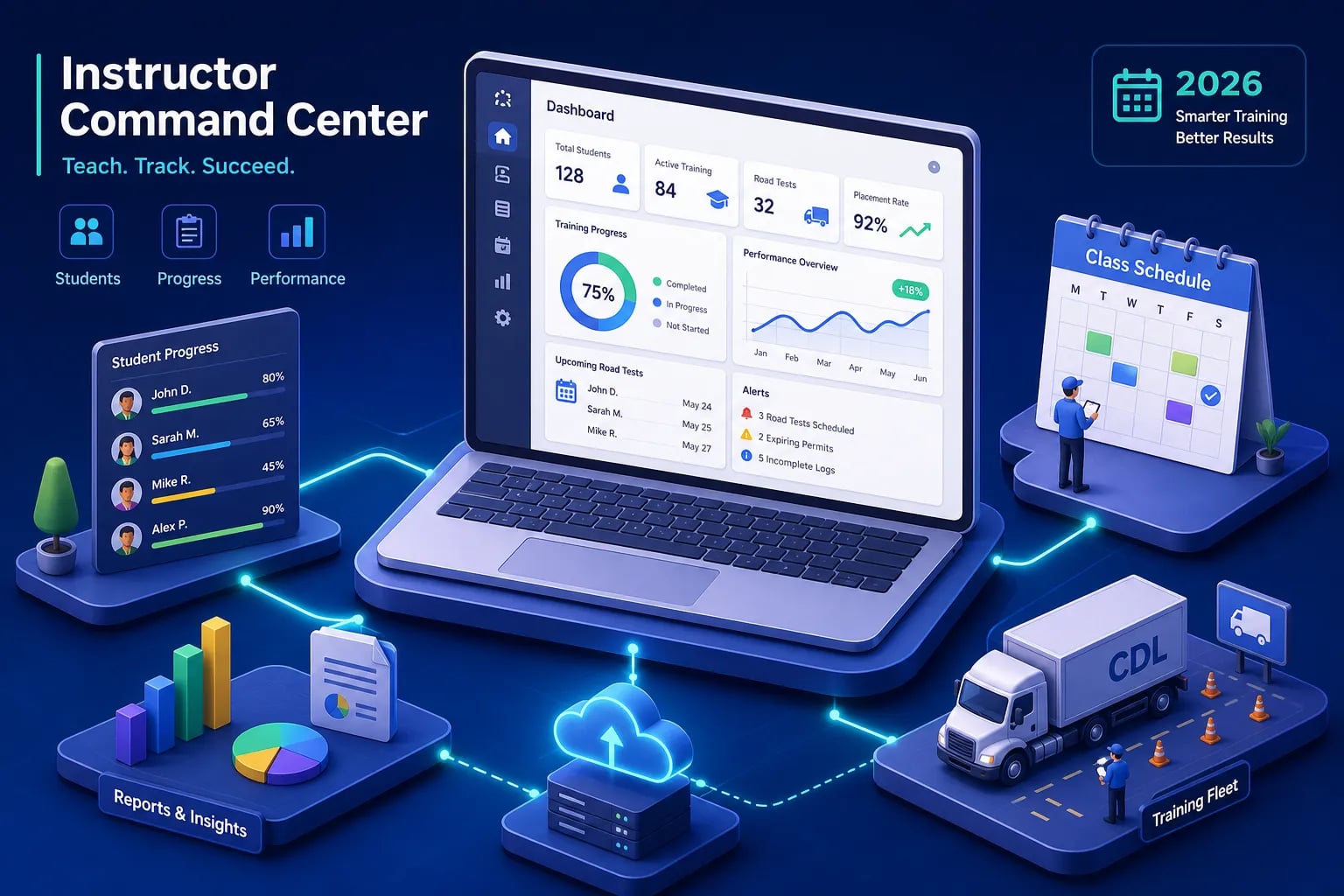
If you run a CDL school, you already know the spreadsheet problem. Student quiz scores in one file, behind-the-wheel logs in another, paper skills checklists stacked on a desk somewhere, and a compliance calendar that never quite lines up with what your instructors actually documented. It's not that CDL school administrators aren't organized. It's that the tools they're using weren't designed for them. Finding the best software for CDL schools to track student progress means cutting through a crowded market of generic platforms and full-suite enterprise tools to find what actually moves the needle on pass rates.
Generic LMS platforms handle video lessons and course completion tracking reasonably well. What they can't do is tell you which student is shaky on air brake systems, which one passed a general knowledge quiz because of luck rather than preparation, or whether your cohort as a whole is trending toward test-day readiness. CDL programs run on FMCSA-aligned knowledge requirements, and those requirements don't map cleanly onto platforms built for corporate onboarding or college coursework.
That's the gap that purpose-built CDL training software fills. CDLTest360, for example, was built specifically for CDL knowledge training: topic-specific quiz modules, a missed-question remediation loop, ELDT-aligned theory content, and a school dashboard that gives administrators real visibility into per-student readiness. This guide covers the features that actually matter when evaluating these platforms, what leading options cost, and a pre-purchase checklist you can use before you sign anything.
Why CDL schools can't rely on a generic LMS
The gap between "online learning" and CDL training management
Canvas, Moodle, and TalentLMS do a reasonable job of hosting video content and recording whether a student clicked through a module. What they don't do is break performance down by CDL knowledge domain, surface which students are struggling with hazmat regulations versus combination vehicle controls, or flag when a student's quiz scores have plateaued below the 80% threshold required to pass the actual CDL knowledge test. These platforms track completion. CDL programs need to track competency, and those are two very different things.
CDL school owners who've tried general-purpose LMS tools consistently report the same frustrations: one-size-fits-all content that doesn't adapt to individual knowledge gaps, no integration with FMCSA-specific curriculum, and analytics dashboards that show you what percentage of a course a student finished without telling you anything useful about what they actually retained. For a program where a student's failure at the DMV reflects directly on your school's reputation, that level of visibility isn't enough.
What purpose-built CDL software actually tracks
A platform built specifically for CDL schools connects quiz results to the knowledge areas that matter: air brakes, combination vehicles, hazmat, pre-trip inspection, general knowledge, and ELDT theory. It tracks individual readiness at the topic level, not just a course-completion percentage. When an instructor can see that a student scored 91% on general knowledge but 61% on air brakes, they can intervene before that student walks into the DMV unprepared and fails a test they could have passed with another week of targeted practice. That's the practical difference between software designed for CDL programs and a tool retrofitted from a corporate e-learning framework, the feature list looks different because the job is different.
Best software for CDL schools to track student progress: core features that matter
A feature checklist every administrator should use before buying
Before evaluating any platform, get clear on the non-negotiables. Your CDL school tracking software should deliver topic-specific quiz analytics, custom question bank management, individual student dashboards with score history, missed-question remediation tools, timed exam simulation that mirrors actual CDL test conditions, FMCSA-aligned content coverage across all major knowledge areas, and a school-level admin interface that doesn't require an IT background to operate.
CDLTest360 is built to cover those bases in one place. The platform includes topic-specific quiz modules for General Knowledge, Air Brakes, Combination Vehicles, ELDT Theory, Hazmat, and Pre-Trip Inspection, with both practice and timed simulation modes. The school dashboard lets administrators create a school profile, invite students, build custom question banks, and monitor individual student progress in real time.
Features that sound useful but rarely get used
Many platforms compete for your budget by stacking features: scheduling tools, billing integrations, HR modules, parent communication portals. These additions increase cost and complexity without improving student outcomes. If a vendor leads their demo with scheduling and billing before showing you what quiz analytics look like, that's a signal about where the product actually performs. Ask to see the individual student performance view before you ask to see the calendar.
Quiz performance analytics: knowing which students are exam-ready
Why completion rates are the wrong metric
A student who completed 100% of your online modules but scored 63% on the air brakes quiz is not ready to test. That's not a controversial statement, but it describes the situation that generic LMS platforms create when administrators rely on completion percentages as their readiness signal. Real exam readiness requires topic-level score data tracked over time: not just where a student stands today, but whether they're improving, plateauing, or sliding in specific knowledge areas.
Instructor-observed score distributions across CDL practice sessions consistently show that air brakes is the topic where candidates underperform most often. State-level test data from programs like Georgia's DDS has also flagged fines and penalties, load inspection, and lights and signals as areas with elevated failure rates among first-attempt test takers. If your tracking system doesn't surface performance specifically in those areas, you're flying blind on the questions your students are most likely to miss on test day.
How CDLTest360's missed-question loop changes the equation
CDLTest360's missed-question review system isolates only the questions a student answered incorrectly and re-drills them in subsequent sessions. For administrators reviewing the school dashboard, this means the platform shows you exactly where each student is struggling, not just whether they passed or failed a quiz overall. A student might score 78% on an air brakes practice set, but if you can see which specific questions they keep missing, you can assign targeted review before they attempt the timed simulation.
Pair that with timed exam simulation that mirrors the CDL knowledge test format, including the 80% passing threshold required under FMCSA's ELDT theory assessment rules, and you have a readiness signal that genuinely predicts test-day performance. That's a fundamentally different product from a generic LMS quiz tool that records a score, marks a module complete, and moves on.
Custom question banks and instructor-controlled content
Why your curriculum shouldn't depend entirely on vendor-supplied questions
Most CDL prep platforms ship with a fixed question bank sourced from state CDL manuals and FMCSA guidelines. That's a reasonable starting point, but it's not the whole picture for every school. CDL instructors often need to add yard-specific safety protocols, state-level regulatory details that go beyond the federal baseline, or questions tied to proprietary curriculum content their school has developed. A platform that locks you into its question library limits your ability to build a program that actually reflects the way your school teaches.
This matters especially for schools running multiple class cohorts or endorsement tracks simultaneously. A Class A cohort needs different question sets than a group focused on hazmat endorsement, and your software should support that without requiring you to build workarounds.
What instructor-controlled question management looks like in practice
CDLTest360's school dashboard lets administrators build and manage custom question banks alongside the platform's existing FMCSA-aligned content. Instructors can assign specific question sets to individual students or groups, keeping different cohorts on track without confusion. When evaluating any platform, check three things in the question bank interface: how easy it is to add and edit questions, whether questions can be tagged by topic or difficulty level, and whether custom content syncs automatically across all student accounts when updated. If any of those elements requires manual workarounds, the system will become a time sink rather than a time saver.
Individual student dashboards that show the full picture
What administrators actually need to see for each student
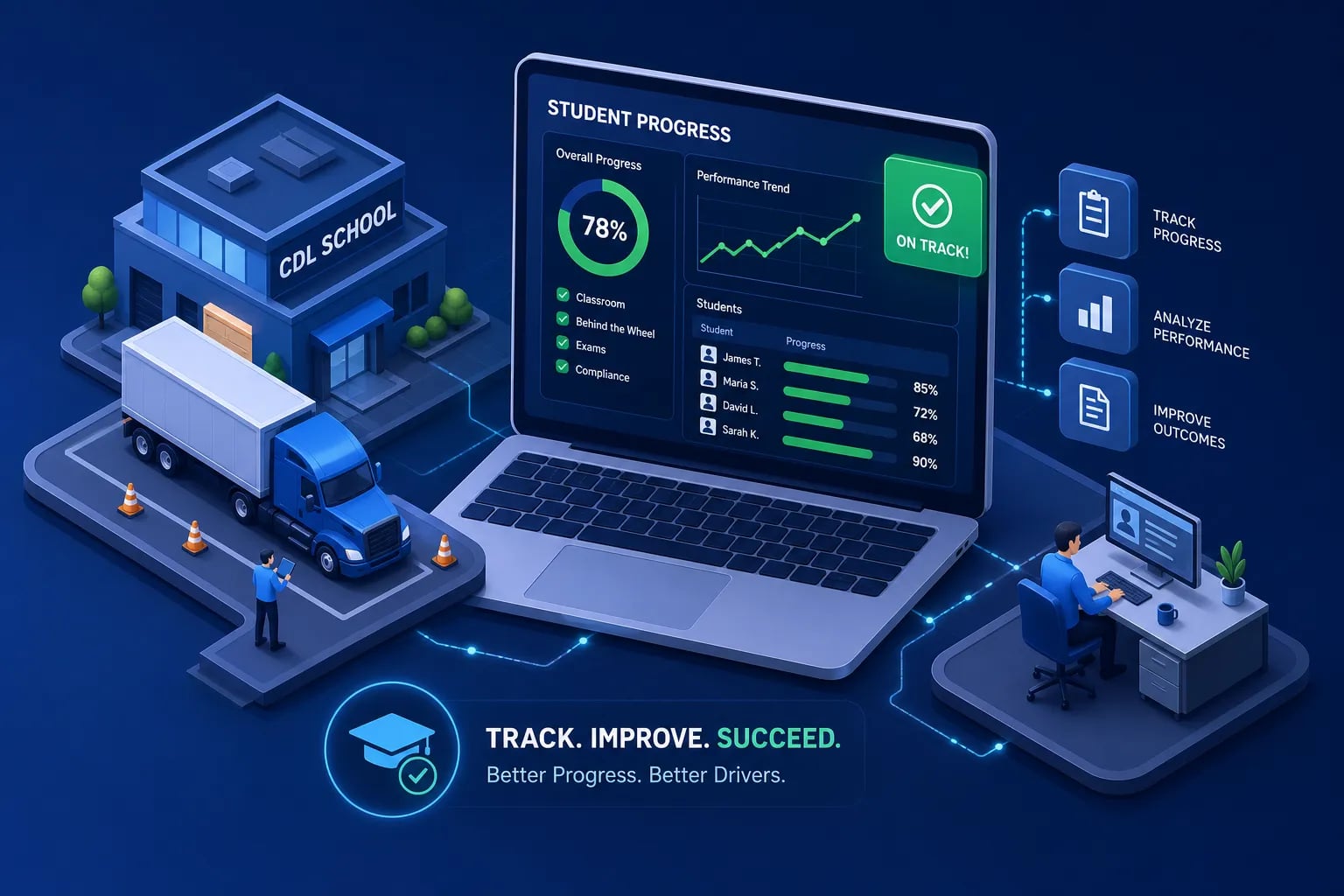
A genuinely useful student dashboard shows quiz scores by topic over time, which question banks a student has completed, their current simulated exam scores, and where their weakest knowledge areas are. That information should be visible at a glance, not buried in a report that takes three menu clicks to generate. The best dashboards surface the data an instructor needs to make a same-day intervention decision, not a next-week assessment decision.
Generic LMS platforms typically show you a course-completion log: module completed, percentage scored, date finished. That tells you a student showed up and clicked through content. It doesn't tell you whether they're ready to walk into a DMV testing center and score 80% or higher on the written knowledge exam.
How CDLTest360's per-student view supports instructor intervention
The school dashboard gives administrators a per-student progress view covering quiz performance across all assigned knowledge areas. When a student's air brakes scores aren't moving after three sessions, or their simulated exam scores are plateauing at 74% the week before their test date, an instructor can see it and act. Every failed test attempt costs a student time and money, and it costs your school reputation. A dashboard that surfaces individual performance data is what makes consistently strong pass rates achievable, not just occasional.
The business outcome CDL schools care most about is straightforward: fewer retakes, better pass rates, and a program that candidates recommend to others because it actually prepared them.
FMCSA compliance reporting and audit-ready documentation
What FMCSA and ELDT compliance actually requires from your software
CDL schools operating under FMCSA's Entry-Level Driver Training regulations must submit theory training completion data to the Training Provider Registry within two business days of a trainee completing the theory portion of their training. To certify completion, the school must document that all required ELDT theory topics were covered and that the trainee scored at least 80% on the theory assessment. Your software needs to capture that documentation in a format that can be submitted or audited on demand. In 2026, those requirements remain unchanged from prior years.
The key word in that requirement is documentation. It's not enough for your system to track what happened internally. The records need to be structured, timestamped, instructor-attributed, and exportable in a format that satisfies a TPR submission or an FMCSA audit review.
Where enterprise CDL software focuses vs. where CDLTest360 fits
Platforms like CDL PowerSuite, CDL Tracks, and DriverTrack are purpose-built for behind-the-wheel time logging, TPR submission workflows, and full ELDT documentation management. CDL PowerSuite runs $399 to $799 per month and includes direct TPR submission tools. Those are capable products for the BTW and administrative compliance layer, built to handle the road range, instructor logs, and regulatory submission pipeline.
CDLTest360 covers the theory and knowledge preparation layer: FMCSA-aligned quiz content across all CDL knowledge areas, ELDT theory curriculum modules, and per-student completion tracking that shows what topics a student has covered and how they scored. For many small to mid-size CDL schools, a combination approach makes operational sense. Use a BTW-focused platform for road documentation and TPR submissions, and use CDLTest360 to drive knowledge-test readiness and track theory preparation. Knowing where each tool fits prevents both coverage gaps and expensive feature overlap in your software stack.
Pricing models broken down: what schools actually pay
What CDL school software costs across the market
CDL school software pricing covers a wide range, and it's worth understanding what you're actually buying at each tier. CDL PowerSuite charges $399 per month for its Foundation plan, $549 for Suite, and $799 for Enterprise, with an additional $25 to $125 per student for ELDT theory courses depending on course type. DriverTrack starts at $299 per month for 20 student seats. One per-student model in the market lists approximately $65 per student as a one-time fee. Enterprise custom-built platforms are in a different category entirely, typically ranging from $30,000 to $450,000 depending on scope and customization requirements.
For a small CDL school running 10 to 30 students at a time, the enterprise tier is simply out of reach, and the mid-tier platforms represent a meaningful monthly commitment on top of all the other operational costs a school carries. That's not a criticism of those platforms. It's an honest description of who they're built for.
Where CDLTest360's pricing stands out
CDLTest360 is priced at $19.99 per month per student or $39.99 for a 90-day pass with no long-term commitment required. For a school running 15 students at any given time, that's roughly $300 per month for purpose-built CDL knowledge tracking, topic-specific quiz analytics, missed-question remediation, exam simulation, and a full school management dashboard. That's a fraction of what the full-suite compliance platforms charge, and CDLTest360 delivers the knowledge-readiness features that generic LMS tools at similar price points completely ignore.
The value calculation is straightforward: what does your school actually need right now? If you need TPR submission automation and behind-the-wheel hour logging, a BTW-focused platform is the right investment. If you need to improve knowledge test pass rates and give instructors real visibility into student readiness, CDLTest360 delivers that at a price point that works for programs of any size, including first-year schools that aren't ready for a $500-per-month platform commitment.
A practical pre-purchase checklist for CDL school software
Six questions to ask every vendor before buying
Start with the question that cuts through most sales pitches: does the platform track quiz performance by CDL knowledge topic, or does it only track course completion? If the honest answer is the latter, keep looking.
From there, ask whether instructors can build or customize question banks, or whether the school is locked into whatever question library the vendor ships with. Then look at the student dashboard and ask whether it surfaces actionable performance data without requiring manual reports. If seeing a student's air brakes score history takes more than two clicks, it won't get used consistently.
On the compliance side, ask what the platform's reporting actually produces. A downloadable PDF of completion records is not the same as a TPR-ready submission, understand exactly what format the export takes and whether it meets your FMCSA documentation requirements. Fifth, calculate the per-student cost at your current enrollment size, not at a hypothetical future enrollment. Many platforms look affordable per-seat until you multiply by actual headcount. Finally, ask whether the platform offers a trial that doesn't require a contract or a credit card number. Any vendor confident in their product will let you test it with real students before you commit.
How to run a meaningful trial in two weeks
A two-week trial is long enough to evaluate whether a platform will actually work for your program, provided you structure it correctly. Start by enrolling five to ten active students, not test accounts, but real candidates currently in your program. Assign topic-specific quiz modules across at least two knowledge areas and let students use the platform for a full week before you look at any data. After week one, review the student dashboard: can you see at a glance which students are struggling with specific topics? Can you tell whether scores are improving or plateauing? If the data isn't useful at that point, it won't become useful later.
In the second week, test the admin controls directly. Build a custom question bank, assign it to a subset of students, and verify that the assignment shows up correctly in their accounts. Run a simulated exam for one or two students and review how the results appear in the administrator view. If a platform offers a trial that doesn't require account setup before students can begin, that's an operational advantage worth noting, students can start practicing immediately while you evaluate the dashboard tools in parallel. That's the right way to buy software: test it with real students doing real preparation, then decide with actual data rather than a sales demo.
The bottom line on software for CDL schools to track student progress
The right CDL school software isn't always the most expensive option or the one with the longest feature list. What matters is whether it gives administrators clear visibility into student knowledge readiness, gives instructors meaningful control over what students practice, and fits the actual budget of a real CDL program. Those criteria eliminate a lot of options quickly.
CDLTest360 addresses all three: purpose-built CDL quiz analytics organized by FMCSA knowledge domain, custom question bank management through the school dashboard, and individual student progress views that surface actionable data without requiring manual report generation. The pricing works for programs running 5 students or 50, with no long-term commitment required to get started.
Run the two-week trial with your current students. Assign the quiz modules, review the dashboard after week one, and let the data tell you whether the platform earns a permanent place in your program. That's the most honest evaluation framework available, and CDLTest360 is built to pass it.
{ "@type": "Article", "datePublished": "2026-09-12T11:01:52.481Z", "dateModified": "2026-09-12T11:01:52.481Z", "headline": "Best Software for CDL Schools to Track Student Progress", "description": "Find the best software for CDL schools to track student progress. Compare must-have features, pricing tiers, and why CDLTest360 outperforms generic LMS tools.", "publisher": { "@type": "Organization", "name": "CDLTest360" }, "image": [ ] }