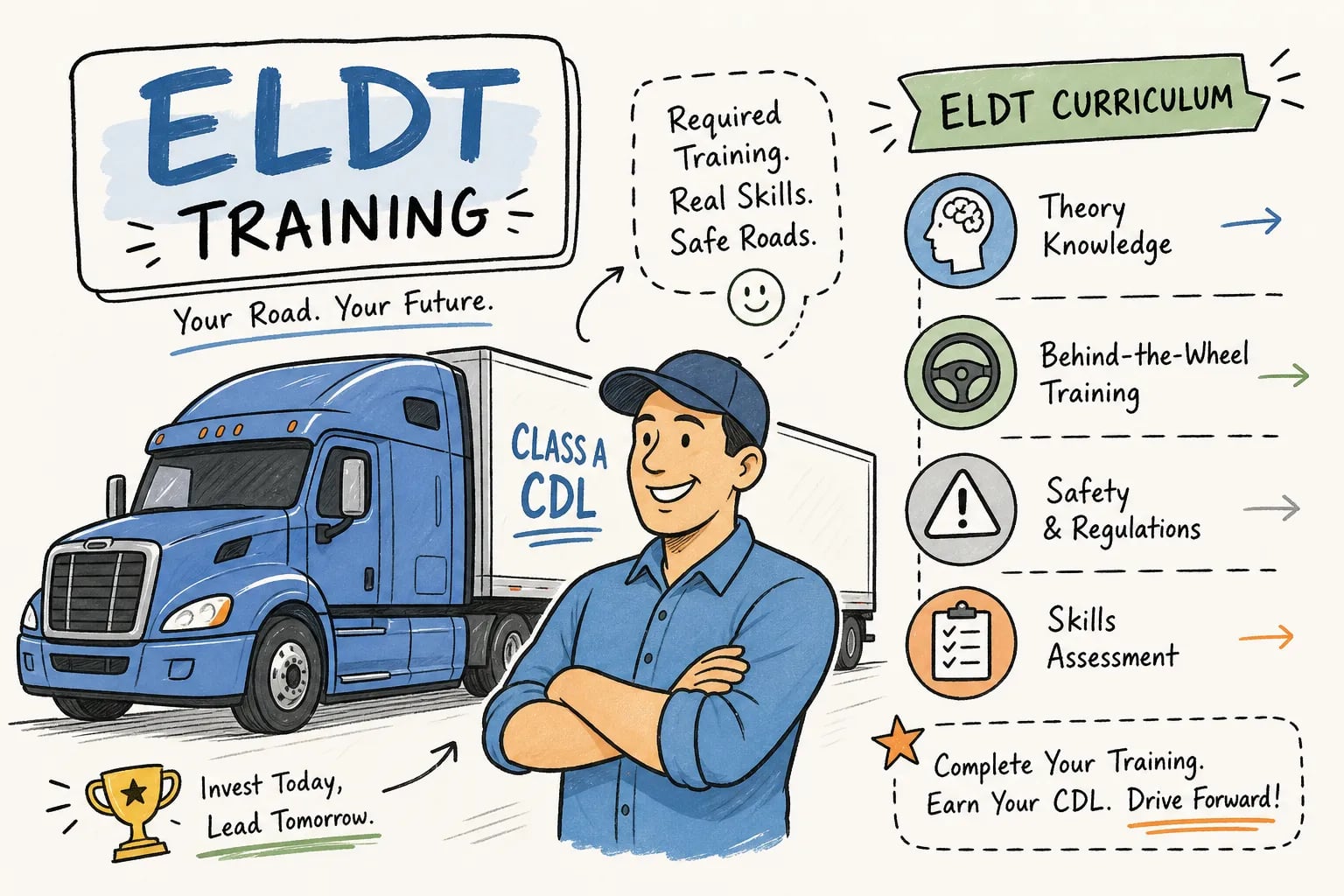
You got enrolled in ELDT, or someone told you it's required before your Class A CDL skills test, and now you're trying to figure out what that actually means. What topics do you have to study? How many hours does the theory portion take? What score do you need to pass? Many candidates report confusion about ELDT requirements because carriers, schools, and DMV clerks hand you the rule without explaining it, leaving you searching through federal regulation pages trying to piece it together yourself.
This article breaks down the ELDT theory curriculum requirements for Class A CDL in plain language, exactly what FMCSA mandates under FMCSA Appendix A to Part 380. By the time you finish reading, you'll have the complete topic checklist, the assessment rules, the steps to verify your provider, and a practical study approach you can use right now. At CDLTest360, we built our quiz modules around these same curriculum standards so candidates can practice each topic area without guessing what's testable.
Who ELDT applies to and why it matters for your Class A CDL
What triggered the ELDT rule and who it covers
The Entry-Level Driver Training rule took effect in February 2022. FMCSA made it mandatory for anyone applying for a Class A CDL for the first time, upgrading from a Class B license to Class A, or adding specific endorsements like passenger, school bus, or hazmat. If you fall into any of those categories, ELDT is not optional. Skipping it means you won't be eligible for the CDL skills test, period.
The intent behind the rule was straightforward: standardize the baseline knowledge and skills that new commercial drivers bring to the road. Before 2022, training quality varied wildly from one school to the next. FMCSA's Appendix A curriculum created a federal floor that every registered training provider must meet regardless of where in the country they operate.
Theory training vs. behind-the-wheel: two separate tracks
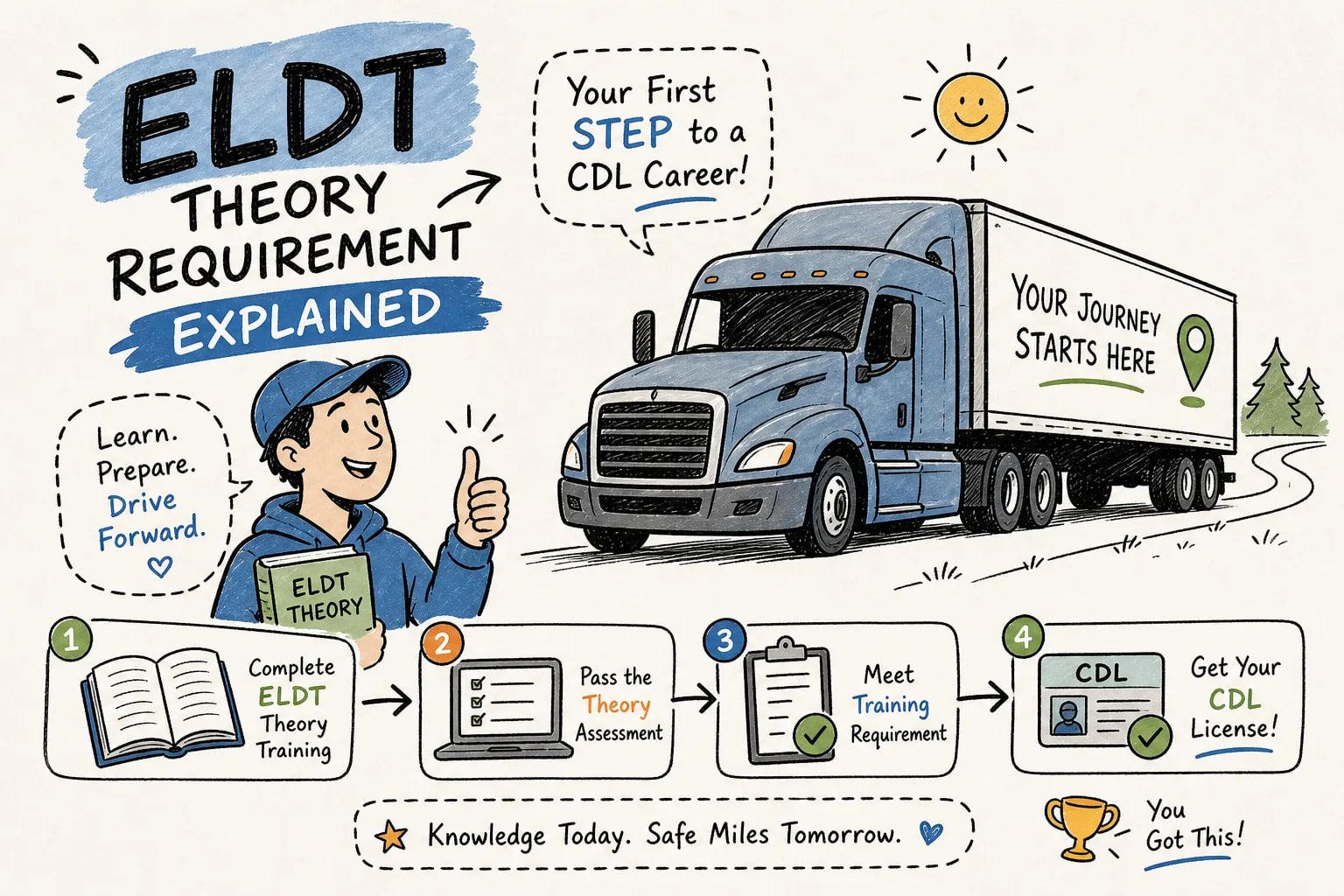
ELDT has two distinct components. Theory training covers knowledge-based content and is what this article focuses on entirely. Behind-the-wheel training covers range exercises and public road driving with a qualified instructor. These are separate tracks with separate completion requirements, and conflating them will lead you to prepare for the wrong thing at the wrong time.
A candidate who treats theory prep casually because they're confident behind the wheel often walks into the theory assessment underprepared. The theory assessment tests specific regulatory knowledge across five curriculum areas, and driving experience doesn't substitute for knowing the exact content Appendix A requires.
ELDT Theory Curriculum Requirements for Class A CDL, What Appendix A Requires
A1.1 basic operation and A1.2 safe operating procedures
A1.1 Basic Operation is the starting point for every Class A theory candidate. The course area covers orientation to commercial vehicles, control systems and dashboard familiarity, pre- and post-trip inspections, basic vehicle control, shifting and operating transmissions, backing and docking, and coupling and uncoupling. These topics form the mechanical and procedural foundation of Class A operation, and they show up consistently on provider assessments.
A1.2 Safe Operating Procedures extends that foundation into real driving behavior. The covered topics are visual search techniques, communication with other road users, distracted driving awareness, speed management, space management, night operation, and extreme driving conditions. Together, A1.1 and A1.2 represent the broadest portion of the theory curriculum and should be any candidate's starting point for structured study.
A1.3 advanced practices and A1.4 vehicle systems knowledge
A1.3 Advanced Operating Practices covers hazard perception, skid control and recovery, jackknifing, other emergency procedures, and railroad-highway grade crossings. Candidates often underestimate this section because the topics sound simple in plain language. Assessment questions on skid recovery and jackknife prevention typically require knowing specific procedural responses, not just a general awareness that those situations exist.
A1.4 Vehicle Systems and Reporting Malfunctions addresses identification and diagnosis of malfunctions, roadside inspections, and maintenance basics. This section overlaps significantly with what pre-trip inspection training covers. Candidates who study PTI content thoroughly will find A1.4 much more manageable, because the underlying knowledge base is the same. A1.4 is commonly tested, and thorough study of vehicle systems is recommended.
A1.5 non-driving activities: the most overlooked course area
A1.5 is the section that surprises the most candidates. Non-Driving Activities covers ten distinct topic areas: handling and documenting cargo, environmental compliance issues, Hours of Service requirements, fatigue and wellness awareness, post-crash procedures, external communications, whistleblower and coercion protections, trip planning, drugs and alcohol policy, and medical requirements for commercial drivers.
That list goes well beyond driving mechanics. A candidate who focuses all their study time on vehicle operation topics and ignores A1.5 will walk into the assessment with significant blind spots. Hours of Service rules alone cover enough regulatory detail to trip up someone who hasn't actively studied them. Working through these non-driving topics with practice questions before the assessment closes the gap that most candidates leave open.
The federal hour requirement (and why there isn't one)
What FMCSA actually mandates instead of hours
FMCSA does not require a minimum number of instructional hours for Class A ELDT theory training. That statement surprises most candidates because the assumption going in is that there's a seat-time requirement to fulfill. There isn't. What the federal rule requires is that the training provider covers every topic listed in Appendix A and that the candidate passes a theory assessment with a score of at least 80%.
This distinction matters practically. Some candidates spend considerable time searching for an hour count that simply doesn't exist at the federal level. Others assume that logging more classroom hours automatically qualifies them to test. Neither approach is correct. The federal standard is topic coverage plus a passing score, and the assessment is what determines whether you've met it.
What "covering all required topics" means for you as a student
From a candidate's perspective, the absence of a minimum hour rule shifts responsibility directly to you. You need to verify that your provider's curriculum addresses every Appendix A topic, and you need to score at least 80% on the assessment regardless of how many or how few hours of instruction you received. Self-study between sessions becomes a practical necessity rather than a supplemental option.
The practical implication is this: if your provider moves quickly through material or you miss a session, the assessment doesn't grade you on attendance. It grades you on knowledge. Building a parallel self-study practice that reinforces each course area as your provider covers it is the most reliable way to arrive at the assessment with no uncovered ground.
ELDT Theory Assessment and the 80% Passing Rule for Class A CDL
How the theory assessment works: format, scoring, and retakes
The theory assessment can be administered in written or electronic format, and the federal passing threshold is an overall score of 80%. FMCSA does not impose a federal limit on the number of times a candidate can retake the assessment, so most providers allow candidates to retest until they reach 80%. That flexibility exists, but relying on it as a strategy is a mistake. Each retake delays your timeline and adds stress to the process.
The smarter approach is treating 80% as a floor, not a target. Candidates who aim for 85% or higher on practice rounds give themselves a genuine safety margin for the real assessment. Exam-day nerves, unfamiliar question phrasing, and time pressure can all chip away at your score slightly. Practicing consistently at a comfortable level above the threshold means those variables don't push you below passing.
TPR reporting: how your completion gets recorded
Once you pass the theory assessment, your registered training provider submits your completion record to the FMCSA Training Provider Registry. FMCSA requires providers to submit that certification by midnight of the second business day after you complete training. The provider logs in to the TPR using a Login.gov account and enters your identity, CDL permit details, the type of training completed, and the date of successful completion.
That TPR record is what allows your state licensing agency to verify your eligibility before the CDL skills test. No TPR record means no clearance for the skills test, full stop. You cannot submit this record yourself, it must come from the provider. After completion, use the TPR's "Check Your Record" function to confirm your provider submitted correctly and that your record is visible in the system before you book your skills test appointment.
How to verify your training provider is TPR-registered
Finding a registered provider on the FMCSA Training Provider Registry
The verification process is straightforward. Go to the FMCSA Training Provider Registry and use the "Find a Provider" search tool. You can search by provider name, state, or location. The critical step is confirming that the listing specifically shows Class A CDL training, not just a generic listing that might cover a different course type. If a provider does not appear in the registry at all, FMCSA is unambiguous: that provider cannot deliver ELDT for CDL testing purposes.
This check takes five minutes and can save you the cost and time of repeating training with a compliant provider. Candidates who complete ELDT with an unregistered provider cannot have their completion recorded in the TPR, which means their training does not count toward CDL eligibility. Verify the registration before you sign anything.
What to confirm before you hand over tuition money
Appearing in the registry is necessary but not sufficient. FMCSA notes that providers self-certify their compliance with the federal curriculum; the agency does not individually approve or audit each provider's course content. That means a provider can be registry-listed while still delivering an incomplete curriculum. The verification responsibility falls partly on you as the candidate.
Before enrolling, ask the provider directly for their curriculum outline and match it against the five Appendix A course areas. A legitimate provider will have documentation ready. If a provider can't produce a clear topic breakdown that maps to Basic Operation, Safe Operating Procedures, Advanced Operating Practices, Vehicle Systems and Reporting Malfunctions, and Non-Driving Activities, treat that as a red flag. Your goal is to confirm that every Appendix A topic will be addressed before you pay for the course.
State-level requirements that stack on top of federal ELDT standards
Why federal minimums are not the whole picture
FMCSA sets the floor for Class A ELDT theory requirements, not the ceiling. States retain the authority to impose additional requirements on top of the federal curriculum, and several do. These additions can include extra behind-the-wheel hours before CDL issuance, stricter instructor qualification rules, additional training topics, or provider-specific requirements at the state level. A candidate who completes only the federal minimums may still fall short of what their state DMV requires to issue the license.
Texas, for example, follows the federal ELDT standard without adding a separate state Class A training mandate, but it does require a 14-day CLP hold and its own testing sequence through DPS before the CDL is issued. That's an additional step that candidates need to plan around. Other states may have their own procedural layers that affect your timeline even after theory training is complete.
How to check what your state requires beyond Appendix A
Check your state's DMV or motor vehicle agency directly for Class A CDL training requirements before you start training, not after. States along the Midwest freight corridor and high-demand trucking states like Texas, California, and Florida are worth checking carefully, as each has its own administrative process around CDL issuance that can affect your post-ELDT steps. This check takes minimal time and prevents the frustrating scenario of finishing theory training only to discover additional state-mandated steps still remain between you and the skills test.
Aligning your self-study to every Appendix A topic with CDLTest360
How CDLTest360 maps to each of the five Class A ELDT theory course areas
CDLTest360 maps its quiz modules to the five Appendix A course areas, giving Class A candidates a structured way to work through every ELDT theory topic systematically alongside their provider's instruction. The platform's question bank is built from FMCSA regulations and state CDL manuals, covering the subject matter that Appendix A addresses across Basic Operation, Safe Operating Procedures, Advanced Operating Practices, Vehicle Systems and Reporting Malfunctions, and Non-Driving Activities.
The practical workflow is simple: as your provider covers each Appendix A course area in class, use CDLTest360 to immediately reinforce that material through topic-specific quiz modules. Moving through content in sequence ensures you're not leaving any course area unaddressed. Candidates who build a parallel study habit rather than cramming at the end tend to arrive at the assessment with fewer uncovered gaps.
Using missed-question drills and exam simulation to hit 80% with confidence
CDLTest360's missed-question review system isolates only the questions you answered incorrectly and re-drills those specifically. This is far more efficient than re-reading entire chapters after a poor practice session. When you finish a quiz module and see which Appendix A topics produced the most misses, you know exactly where your knowledge gaps are and can target them directly in the next session.
The platform's timed exam simulation mode lets you practice under realistic conditions before you sit for the provider-administered assessment. For Class A ELDT theory candidates, reaching consistent scores of 85% to 90% in simulation is the signal that you're genuinely ready, not just close to ready. CDLTest360 offers a free trial so you can start identifying weak topic areas right away, before your assessment date arrives.
Your practical Class A ELDT theory checklist before the assessment
Confirming you've covered every required topic area
Before your assessment day, run through this confirmation check for each of the five Appendix A course areas. For each one, you should be able to confirm two things: your provider addressed it in the curriculum, and you can answer practice questions on those topics at a passing level. This is a knowledge-coverage check, not a document collection exercise.
-
A1.1 Basic Operation: Can you explain pre- and post-trip inspection procedures, basic vehicle control, shifting techniques, backing and docking, and coupling and uncoupling?
-
A1.2 Safe Operating Procedures: Do you understand visual search patterns, communication with other road users, speed and space management, night operation, and extreme driving conditions?
-
A1.3 Advanced Operating Practices: Can you identify hazard perception principles, skid control and recovery procedures, jackknife prevention, and railroad crossing rules?
-
A1.4 Vehicle Systems and Reporting Malfunctions: Do you know how to identify and diagnose common malfunctions, what happens during a roadside inspection, and basic maintenance responsibilities?
-
A1.5 Non-Driving Activities: Can you answer questions on Hours of Service rules, cargo handling documentation, post-crash procedures, drugs and alcohol policy, and medical requirements?
If you find a gap in any of those areas, go back to your practice modules and drill that topic before booking the assessment. Walking into the test with known blind spots is avoidable, and avoiding it is entirely within your control.
After passing: your path to the skills test
Once you pass the theory assessment, your provider has until midnight of the second business day to submit your completion record to the TPR. Don't assume this happened automatically. Use the TPR's "Check Your Record" function to confirm your record is visible in the system before you book your skills test appointment. If your record isn't showing up after two business days, contact your provider directly and ask for confirmation of the submission.
Also confirm with your state DMV whether any additional steps are required between theory completion and skills test eligibility. State-level procedural requirements like CLP hold periods, specific scheduling processes, or additional documentation can add time to your timeline if you don't account for them upfront. The theory assessment is a major milestone, but it's one step in a sequence. Knowing what comes next keeps you moving forward without unnecessary delays.
The clearest path through ELDT theory starts with knowing what's actually required
The ELDT theory curriculum requirements for Class A CDL are not complicated once you know exactly where to look. Five Appendix A course areas, an 80% passing threshold, no federal minimum hours, and a TPR-registered provider with a complete curriculum are the core pieces. Candidates who treat each Appendix A topic as testable material and practice systematically before assessment day are the ones who pass on the first attempt and move forward without delays.
CDLTest360's modules give Class A candidates a structured, topic-by-topic way to build that readiness without guessing what the assessment covers. The missed-question drill system, timed simulation mode, and topic-specific quiz modules map to the five course areas this article covered. Whether you're starting theory training next week or your assessment is coming up in a few days, CDLTest360 gives you a clear way to measure where you stand and close the gaps before it counts.
Follow these ELDT theory curriculum requirements for Class A CDL as your roadmap. Verify your provider. Cover every course area. Practice above the threshold before you sit. The theory assessment is passable with the right preparation, and now you know exactly what that preparation looks like. Start practicing now on CDLTest360.
{ "@type": "Article", "datePublished": "2026-09-08T11:01:48.095Z", "dateModified": "2026-09-08T11:01:48.095Z", "headline": "ELDT Curriculum Requirements for Class A CDL, Explained", "description": "Learn every ELDT theory curriculum requirement for Class A CDL: required Appendix A topics, the 80% passing score rule, TPR provider tips, and how to study smart.", "publisher": { "@type": "Organization", "name": "CDLTest360" }, "image": [ ] }