If you're asking, "How do I get my CDL permit?" you're in the right place. Many applicants mistakenly believe the process is as simple as showing up at the DMV with a driver's license. It's not. There's a specific sequence of steps, and skipping any one of them sends you back to square one. This guide breaks down exactly how to obtain your Commercial Learner's Permit (CLP) in 2026, from confirming you're eligible to walking out of the DMV with that credential in hand. Whether you're starting fresh or you've been putting this off, you'll have a clear roadmap by the end of this article. The biggest takeaway from candidates who pass on the first try: preparation beats luck every time.
The CDL permit process has more moving parts than most drivers expect. You're dealing with federal regulations, state-level document requirements, medical examinations, and mandatory training, all before you take a single written test. Getting clear on the full sequence before you start saves you time, money, and the frustration of being turned away at the counter because you're missing one piece of paperwork.
How do I get my CDL permit? Quick overview
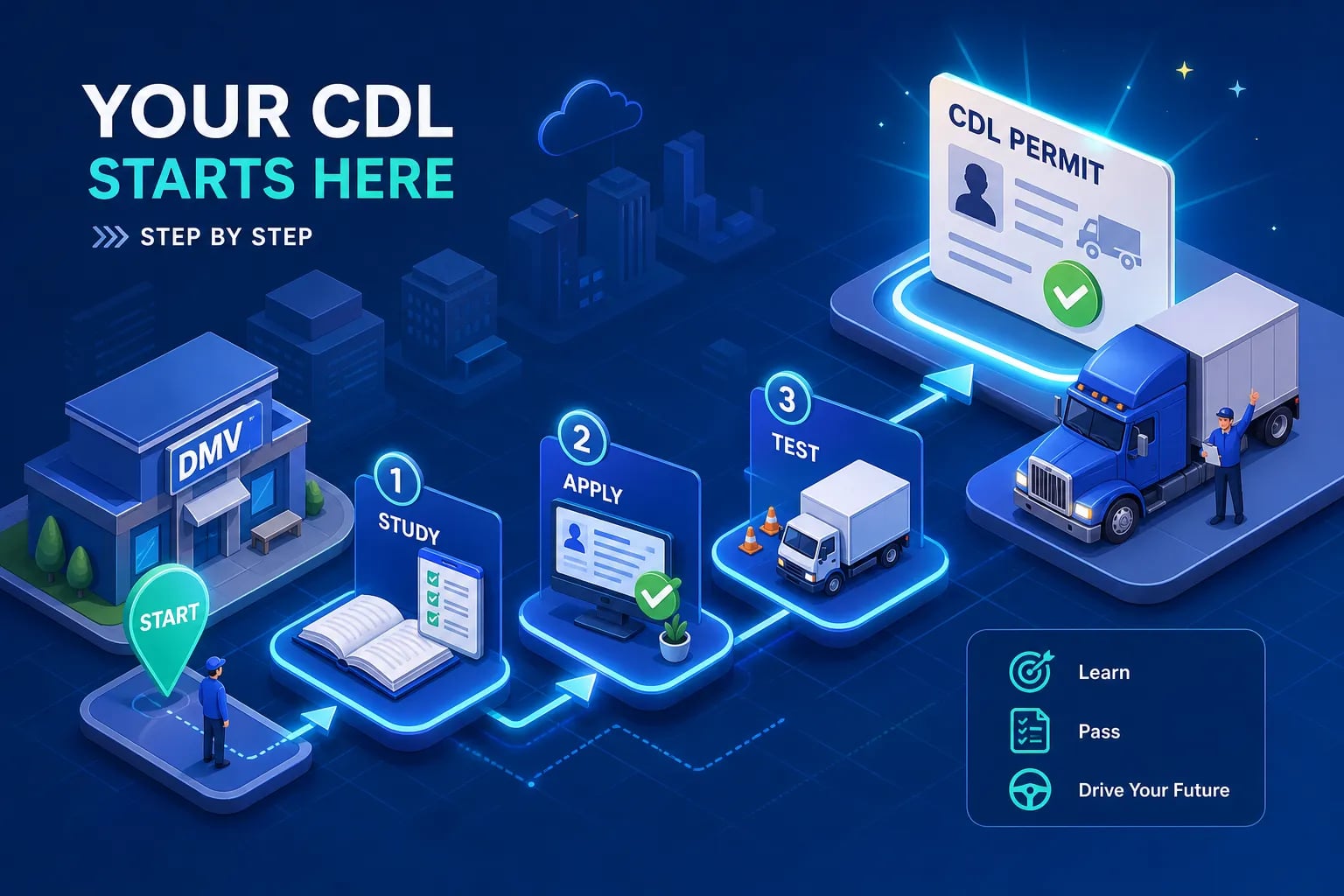
The short answer: confirm your eligibility, gather your documents, complete a DOT physical, finish Entry-Level Driver Training (ELDT) if required, study for and pass the knowledge tests, then visit the DMV to receive your CLP. The sections below walk through each of those steps in detail. Keep reading to make sure you don't miss a single one.
1. What a CDL permit actually is (and why you need one first)
CLP vs. CDL: understanding the difference
A Commercial Learner's Permit is the mandatory first credential before a full CDL. Think of it as the commercial equivalent of a learner's permit for a regular driver's license. A CLP lets you operate a commercial vehicle on public roads, but only with a fully licensed CDL holder seated in the passenger seat. Per federal regulations, you cannot drive solo on a CLP on public roads. The permit class you apply for corresponds directly to the CDL class you're working toward: Class A covers combination vehicles, Class B covers heavy straight vehicles, and Class C covers smaller commercial vehicles.
The terms "CDL permit" and "CLP" refer to the same document. You'll see both used interchangeably in state DMV materials, but they mean one thing: the learner-level commercial credential that unlocks your path to the full license.
The 14-day hold rule
Under federal regulations (49 CFR Part 383), a CLP must be held for a minimum of 14 days before the applicant can take the CDL skills test. The clock starts the day your CLP is issued, not the day you feel ready. This rule exists to ensure that CLP holders get real supervised driving experience before attempting the skills exam. Missing this window means your skills test appointment gets rescheduled, so plan accordingly.
CLP validity periods vary by state, but most states issue permits valid for 180 days, with one renewal allowed for another 180 days. Colorado, for example, issues CLPs valid for one year with no renewal option, always verify the exact policy with your state DMV. An expired CLP means starting the entire application process over, so track your expiration date carefully.
What you can and can't do on a CLP
Every time you operate a commercial vehicle on a CLP, a qualified CDL holder must be in the cab with you. No exceptions for on-road driving. Drivers under 21 face an additional restriction: they cannot operate a commercial motor vehicle across state lines, regardless of what the CLP allows. The same applies to hauling federally regulated hazardous materials. Endorsement restrictions also apply during the permit stage, so if your eventual CDL will carry a Passenger or Hazmat endorsement, those privileges aren't active until the full license is issued.
2. Are you eligible? Checking the requirements before you apply
Age limits and what they mean for your driving scope
Federal rules split eligibility at two ages. Drivers 18 and older can apply for a CLP and CDL for intrastate commercial driving, meaning within a single state. Drivers must be 21 or older to operate commercially across state lines or to transport federally regulated hazardous materials. This distinction matters: if you're 19 and planning a long-haul trucking career, you'll hold an intrastate-only CDL until your 21st birthday, at which point interstate driving becomes available. Confirm the specifics with your state DMV or FMCSA guidance, as interstate access upon turning 21 generally requires no additional testing if all other qualifications are already met.
Other federal eligibility requirements
Beyond age, federal eligibility requires that you hold a valid regular driver's license, apply through the state where you legally reside, and hold only one driver's license. You'll need to disclose every state where you held a license during the past 10 years. States run a nationwide driving record check to verify this. You must also demonstrate U.S. citizenship, lawful permanent residency, or qualifying non-domiciled status. Finally, you must certify that you are not disqualified from holding a CDL under federal or state law.
Disqualifying conditions to know about upfront
Some conditions end the application immediately. Holding active driver's licenses from multiple states is an automatic disqualifier. Prior CDL disqualification under federal or state law is another. Failing to meet federal medical standards can also prevent issuance. Running through this quick self-check before investing time in documents and appointments helps you identify any issues that need to be resolved first.
3. How do I get my CDL permit: Documents required
The four core document categories
Every state DMV requires documents in four core categories. Bring originals or certified copies, photocopies are not accepted at most offices, and arriving with the wrong version wastes the entire visit.
-
Identity and date of birth: A U.S. passport, certified birth certificate, or current state driver's license.
-
Citizenship or lawful presence: A birth certificate, passport, Certificate of Naturalization, or Permanent Resident Card.
-
Social Security number: Your Social Security card, a W-2, or another state-accepted SSN document.
-
State residency: One or two documents showing your name and physical residential address, lease agreement, mortgage statement, utility bill, bank statement, or vehicle registration. P.O. boxes don't qualify.
How document requirements vary by state
The biggest difference between states comes down to how many residency documents you need. New York typically requires one proof of residency for a standard credential. California and Georgia commonly require two, from separate sources. South Carolina generally requires one. The safest approach: bring two address documents regardless of your state. A lease plus a utility bill, or a bank statement plus vehicle registration, covers the strictest requirement and eliminates the chance of being turned away for this reason alone.
Medical and driving history documents
Commercial applicants need additional documentation beyond the standard driver's license packet. Your medical examiner's certificate, ELDT completion documentation from your training provider, and any out-of-state license records should all be in your folder. If your name has changed since any of your identity documents were issued, bring the legal documentation covering that change. Treating your document packet like a complete file, rather than a minimum requirement, prevents delays on the day of your appointment.
4. Getting your DOT medical card
Finding an FMCSA-certified medical examiner
A regular personal physician cannot perform your DOT physical unless they are certified by FMCSA and listed in the National Registry of Certified Medical Examiners. This is a common mistake that wastes time and money. Use the FMCSA National Registry search tool on the FMCSA's official website, filter by your location, and confirm the provider appears as active. In most urban and suburban areas, appointments are typically available within a few days based on general practitioner availability in those markets, though your experience may vary. The exam itself generally takes 30 to 45 minutes.
What the DOT physical covers and what to expect
The DOT physical evaluates vision, hearing, blood pressure and cardiovascular health, respiratory function, musculoskeletal health, neurological function, and your complete medical history. Some conditions, including certain vision impairments, specific diabetes cases, and prior seizure histories, may require FMCSA waivers or additional documentation but don't automatically disqualify you. Knowing this ahead of time prevents unnecessary anxiety: a condition requiring documentation is not the same as a condition that ends the application.
Submitting your medical certificate to the DMV
Under the FMCSA National Registry requirements, certified medical examiners must transmit your examination results electronically to FMCSA by midnight of the next calendar day following your exam. States retrieve this information electronically, so many DMVs no longer accept a paper certificate handed in by the applicant. After your exam, ask your examiner exactly when the result was transmitted, then follow up with your state DMV to confirm it has posted to your record before you schedule the knowledge test appointment. Keep a copy of Form MCSA-5876 for your own records regardless of how your state processes the submission.
5. ELDT: the federal training requirement you can't skip
Who needs Entry-Level Driver Training and for which credentials
Entry-Level Driver Training has been a federal requirement since February 7, 2022. It applies to first-time Class A and Class B CDL applicants, anyone upgrading from a Class B to a Class A license, and applicants seeking a Passenger or School Bus endorsement. For Class A and Class B, ELDT includes both theory training and behind-the-wheel training on a range and public roads. For the Hazmat endorsement, ELDT covers theory training only. All ELDT must be completed through a provider listed in FMCSA's Training Provider Registry before you take the applicable knowledge or skills test.
To find a registered provider, search the FMCSA Training Provider Registry at tpr.fmcsa.dot.gov. Filter by state and training type, confirm the specific location you plan to attend is listed, and verify directly with the provider before enrolling. A company's website alone doesn't confirm active registry status.
What ELDT does and does not cover
There is no federally mandated minimum hour count for behind-the-wheel ELDT. The training provider must certify that the required curriculum and proficiency standards were completed. Adding Air Brakes, Doubles/Triples, Tanker, or Combination Vehicles endorsements does not independently trigger the federal ELDT rule. Renewing an existing CDL doesn't trigger it either. If you already held the applicable CDL or endorsement before February 7, 2022, ELDT generally doesn't apply to that credential retroactively.
HAZMAT endorsement: ELDT plus the TSA background check
The Hazmat endorsement requires two separate processes, and they are not interchangeable. ELDT covers the theory training component, which must be completed before you take the state Hazmat knowledge test. The TSA Security Threat Assessment is a separate federal background check that must be completed before the endorsement is actually issued. Both must happen, in order. Completing ELDT without the TSA check means you can pass the knowledge test but won't receive the endorsement until background clearance comes through.
6. Preparing for the CDL knowledge tests (this is where most candidates lose time)
Which written tests you'll actually need to take
General Knowledge is required for every CDL applicant. Class A candidates also typically take Air Brakes and Combination Vehicles. Endorsement tests for Hazmat, Tanker, Passenger, School Bus, or Doubles/Triples are added on top of the base tests. According to FMCSA and state CDL manual standards, every test requires a minimum score of 80% to pass. In California, per state DMV policy, failing a test three times voids the entire application, meaning you pay the fees and start over from scratch. Walking into the DMV underprepared is genuinely expensive.
The most commonly failed areas include stopping distances, vehicle inspection sequences, cargo securement rules, air brake system components, hours-of-service limits, and emergency procedures. These aren't obscure topics. They're the core of the exam, and they require structured, repeated practice to lock in.
How to study efficiently with CDLTest360
CDLTest360 is built specifically for this stage of the process. The quiz modules are organized by topic and aligned with FMCSA regulations and state CDL manuals, so the content you're studying matches what appears on actual state tests. The missed-question review system is one of the platform's most practical features: instead of redoing an entire quiz, the system isolates only the questions you got wrong and re-drills those until you've demonstrated retention. That's a more efficient use of study time than a generic flashcard deck.
The timed exam simulation mode presents 50 questions with an 80% passing threshold, so you can gauge your real readiness before your DMV appointment. No account is required to access the free trial, open it and start. For candidates who'll eventually need the skills test, the PTI phrase trainer drills the exact wording required during the pre-trip inspection portion of the exam, a feature not commonly found in other CDL prep tools.
Building a realistic study timeline before your DMV appointment
Start studying before you schedule any DMV appointment. A two-to-three-week study window with daily practice sessions is a realistic target for most candidates. Use CDLTest360's exam simulation mode as your benchmark: once you're consistently scoring 85% or higher on simulated tests, you're genuinely ready to book the appointment. Scheduling the DMV visit before you're prepared doesn't save time. It risks a failed test, a retake fee, and a longer overall timeline than if you had spent two more weeks studying first.
7. Scheduling your DMV appointment and what happens on test day
How to book your CLP knowledge test appointment
Most states require an in-person appointment at a DMV or driver licensing office for CDL knowledge testing. The general process: complete the state's CLP or CDL application form online or in person, confirm your document packet is complete, and book a knowledge test appointment through your state's official portal. New York, for instance, requires in-person visits for CDL knowledge testing. Walk-ins may be accepted at some locations, but they typically mean extended waits, sometimes several hours, while scheduled appointments move through faster. Appointment availability ranges from a few days to several weeks depending on state and location, so book early once your study prep is on track.
What CDL permit fees look like across states
Fee structures vary significantly. New York charges approximately $10 for the application, with an additional $5 for any test taken separately. California's CLP-related DMV charges typically fall in the $36 to $45 range, with the combined CLP and CDL totaling around $76. Georgia charges approximately $10 for the CLP with a $32 CDL fee. Texas runs $25 for the CLP and $97 for the CDL. These figures cover issuance charges but often exclude knowledge test fees, skills test fees, endorsement charges, and background check costs. Verify the current fee schedule directly with your state DMV before your visit, schedules change, and the total out-of-pocket cost consistently runs higher than the base permit fee.
What to expect during your DMV visit on test day
Arrive with your complete document packet: identity documents, Social Security documentation, proof of residency, your posted medical certificate confirmation, and ELDT completion records if applicable. At the counter, you'll complete any remaining paperwork, pay the applicable fees, and then take the required knowledge tests. Tests are multiple choice. In states like New York, budget up to three hours for the full visit including processing and testing. Passing all required tests with a valid medical certificate on file and ELDT completed where required results in the CLP being issued on the same visit at most offices. You leave with your permit in hand and the 14-day clock starts immediately.
8. What comes next after your CLP is issued
The 14-day supervised driving period
The moment your CLP is issued, the mandatory 14-day hold period begins. During this time, you must practice driving with a qualified CDL holder in the cab. Use this period productively. Practice your pre-trip inspection procedure until the sequence and wording are automatic. Work on basic vehicle controls, backing, and maneuvering. If you still have endorsement knowledge tests ahead, continue studying with CDLTest360 during this window. The 14-day period is not downtime; it's structured preparation time for the skills test.
The CDL skills test and what it covers
The skills test has three parts: vehicle inspection (pre-trip), basic vehicle control, and the on-road driving test. All three must be passed to receive a full CDL. Most CDL schools incorporate skills test preparation into their ELDT curriculum, so candidates enrolled in a school will practice these components with an instructor. Candidates who are self-directing their preparation can schedule the skills test through third-party testing sites or, in some states, directly through the DMV. Failure on any one of the three parts requires a retest of that section.
Next steps: endorsements, state restrictions, and the full CDL
After passing the skills test, the full CDL is issued and your CLP is replaced by the full license. You can now operate commercially within the scope of your CDL class. Drivers under 21 remain restricted to intrastate operation until they reach age 21, at which point interstate driving becomes available without additional testing. Adding endorsements requires separate knowledge tests for each, and the Hazmat endorsement additionally requires the TSA Security Threat Assessment to be completed before the endorsement is issued. Adding Air Brakes, Tanker, or Doubles/Triples endorsements involves knowledge tests but doesn't trigger a new ELDT requirement.
The CDL is the beginning of a commercial driving career, not just the end of a checklist. Every endorsement you add expands your eligibility for higher-paying freight types and routes. Starting that career with a solid knowledge foundation, built through structured test prep, sets you up to pass efficiently the first time and move forward without costly retakes.
Your clear path to the CDL permit
The full sequence is straightforward once you see it laid out: confirm eligibility, gather your documents, complete the DOT physical, finish ELDT if required, study for and pass the knowledge tests, visit the DMV, receive your CLP, complete the 14-day supervised driving period, and pass the skills test. Every step is predictable and manageable when you know the order and the requirements at each stage.
The knowledge tests are where most candidates stall. Either they don't know what to study, or they walk into the DMV before they're genuinely ready and pay the price in retake fees and lost time. CDLTest360 exists specifically to close that gap. The content is aligned with FMCSA regulations and state CDL manuals, the missed-question drill targets your weakest areas instead of making you repeat everything, and the free trial starts the moment you open it, no account required.
So if you're still wondering, "How do I get my CDL permit?", follow the steps above, start practicing today, and make your DMV visit a formality, not a gamble. The permit is the first step, and the right preparation makes it a fast one.
Frequently asked questions: How do I get my CDL permit?
How do I get my CDL permit if I've never held a commercial license?
Start with the eligibility check in Section 2, then gather your documents, complete a DOT physical, finish ELDT if required for your CDL class, and pass the required knowledge tests at your state DMV. Most first-time applicants complete the CLP application within two to four weeks once they have their documents and medical exam done.
Can I skip ELDT if I'm only adding an endorsement?
It depends on the endorsement. Passenger and School Bus endorsements trigger ELDT. Hazmat requires ELDT for theory training. Air Brakes, Tanker, and Doubles/Triples endorsements do not independently require ELDT. Always verify with your state DMV and the FMCSA Training Provider Registry before enrolling.
How long does a CLP stay valid?
Most states issue CLPs valid for 180 days with one 180-day renewal. Some states differ, Colorado, for example, issues CLPs for one year with no renewal option. Check your state DMV's current policy to confirm your specific validity window.
What happens if I fail a CDL knowledge test?
Retake policies vary by state. California voids the entire application after three failed attempts, requiring fees and paperwork to be resubmitted from scratch. Other states allow multiple retakes with waiting periods between attempts. Study with CDLTest360 until you're consistently scoring 85% or higher on practice simulations before booking your DMV appointment.
{ "@type": "Article", "datePublished": "2026-10-08T11:02:11.082Z", "dateModified": "2026-10-08T11:02:11.082Z", "headline": "How to Get Your CDL Permit: The 2026 Step-by-Step Guide", "description": "Wondering how to get your CDL permit? This 2026 step-by-step guide covers eligibility, documents, DOT medical, ELDT, and knowledge tests. Start preparing today.", "publisher": { "@type": "Organization", "name": "CDLTest360" }, "image": [ ] }