Qualifying on air brakes for your CDL comes down to one specific outcome: removing the L restriction from your commercial driver's license. To do that, you must pass the air brakes knowledge test, and, in most cases, complete a skills test in a full air-brake-equipped CMV. Air brake certification is not a separate endorsement you earn like Hazmat or Passenger. There is no federal air brake certification card. The qualification lives directly on your CDL, either as a clean license or as a restriction that limits which vehicles you can legally operate.
That distinction matters because at CDLTest360, we hear the same confusion repeatedly from candidates who show up to study without knowing what they are actually studying for. They search "air brake certification," land on content built for technicians, and spend days reading the wrong material. This article fixes that. By the time you finish it, you will know exactly what the L restriction is, what the written and skills tests require, where candidates lose the most points, and how to prepare without wasting a single study session.
Key takeaways
-
No separate endorsement: Air brake qualification removes the L restriction from your CDL; it does not add an endorsement column to your license.
-
Two restrictions to know: The L restriction blocks all air-brake CMVs; the Z restriction only blocks full air-brake systems, allowing air-over-hydraulic vehicles.
-
Specific numbers get tested: Governor cut-in (approximately 100 psi), cut-out (approximately 125 psi), low-air warning (60 psi), and spring-brake activation (20–45 psi) appear directly on the exam. These thresholds come from FMCSA CDL manual guidance; check your state's CDL manual for any state-specific wording variations.
-
Skills test requires the right vehicle: You must test in a CMV equipped with full air brakes, or the restriction stays on your license.
-
Topic-isolated study wins: General CDL practice tests rarely include enough air brakes questions to build real fluency; focused module practice is faster and more effective.
-
Timeline runs 2–6 weeks: From study through reissued CDL, depending on DMV scheduling, state waiting periods, and processing time. Some states can process restriction removals within a few days once results are submitted; others extend the timeline significantly.
What "air brake certification" actually means on your CDL
The L restriction: what it is and where it comes from
When a CDL applicant does not pass the air brakes knowledge test, or takes their skills test in a vehicle without a full air brake system, the state DMV prints an L restriction directly on the issued commercial driver's license. That restriction means you cannot legally operate a commercial motor vehicle equipped with a full air brake system. It shows up on the face of the license, and both employers and DOT inspectors can see it immediately during a roadside check or pre-hire review.
The restriction is not buried in a database somewhere. It is visible and it is limiting. For any driver pursuing a Class A trucking position, an unresolved L restriction commonly serves as a disqualifier because the overwhelming majority of freight-hauling combination vehicles use full air brake systems.
Why the term "certification" creates confusion
The reason so many candidates search for "air brake certification" is that the process genuinely feels like earning a credential. You study a distinct body of knowledge, sit for a separate written exam, and often demonstrate hands-on competency in a vehicle. That pattern matches how people think about certifications. The outcome, though, is a restriction removal rather than a new column added to the license. Understanding that reframe before you start studying keeps you focused on the right target.
Who issues this qualification?
Your state DMV administers both the air brakes knowledge test and the skills evaluation. Content is standardized around the FMCSA CDL manual, but the controlling source for exact question wording, pressure thresholds, and procedural steps is the CDL manual published by the state where you are taking the test. CDLTest360 covers all 50 states and includes state-specific CDL manuals inside the platform precisely because those small differences between states can affect test outcomes.
How does the air brake restriction differ from a CDL endorsement?
Endorsements add privileges; restrictions remove them
This is the structural distinction that clears up most of the confusion. Endorsements such as H (Hazmat), N (Tank), P (Passenger), T (Double/Triple Trailers), and X (Combination Tank/Hazmat) expand what a driver is authorized to do. Restrictions work in the opposite direction: they limit what the driver can legally operate. Air brakes fall entirely on the restriction side of that equation. You either qualify for unrestricted air brake operation or you carry the L restriction on your license. There is no "air brake endorsement" column on a U.S. CDL.
The Z restriction: a variation worth knowing
Some drivers receive a Z restriction rather than an L restriction. The Z restriction applies when a driver qualifies on air brakes but tested in a vehicle with an air-over-hydraulic system rather than a full air brake system. A Z-restricted driver can operate vehicles with air-over-hydraulic brakes but cannot operate CMVs with full air brake systems, which includes most tractor-trailers and buses. Removing the Z restriction follows the same general path as the L: pass the knowledge test if you have not already, then complete a skills test in a full air-brake-equipped CMV. Check your state CDL manual or DMV directly for the specific policy that applies to your situation.
What employers and recruiters actually look at
Hiring coordinators at trucking carriers run a CDL check before an interview goes anywhere productive. An L or Z restriction on a Class A license signals immediately that the driver cannot operate the company's primary equipment. Most freight positions require Class A operation of combination vehicles with full air brakes, so the restriction effectively ends the application before it starts. Removing it is not optional for a driver who wants access to the full range of commercial trucking jobs.
Who actually needs to pass the CDL air brakes knowledge test?
First-time CDL applicants
In every U.S. state, the air brakes knowledge test is part of the CDL written exam process, it is not optional, and it is not folded invisibly into the general knowledge test. Failing it does not necessarily fail the overall CDL written exam in every state, but it does trigger the L restriction on the license that gets issued. A candidate can pass general knowledge, hazmat, and combination vehicles, then walk out of the DMV with a brand-new CDL that already restricts what they can drive. Check your state's CDL manual to confirm the exact procedure in your jurisdiction.
Drivers who already hold a restricted CDL
Drivers who already hold an L or Z restriction on an active CDL must go through a restriction-removal process. If the air brakes knowledge test was never passed, that is the first step. From there, the process typically involves obtaining an updated commercial learner's permit, waiting out any state-required holding period, South Carolina, for example, requires 14 days between CLP issuance and skills testing, and then scheduling a skills retest in a full air-brake-equipped CMV. Once the DMV processes the results and collects any reissuance fee, the updated CDL is issued without the restriction. Federal rules generally do not require ELDT training solely to remove an existing L restriction, but candidates should confirm current requirements with their state DMV.
ELDT students and career changers
Entry-Level Driver Training students completing federally mandated theory requirements and mid-career adults transitioning into commercial trucking are among the most common CDLTest360 users who arrive underprepared specifically on air brakes content. They often complete their ELDT theory training and general knowledge prep. Then they discover the air brakes section is a separate, testable knowledge set with its own exam pool and pressure-value vocabulary they never fully studied.
What does the CDL air brakes knowledge test actually cover?
System components and how they work together
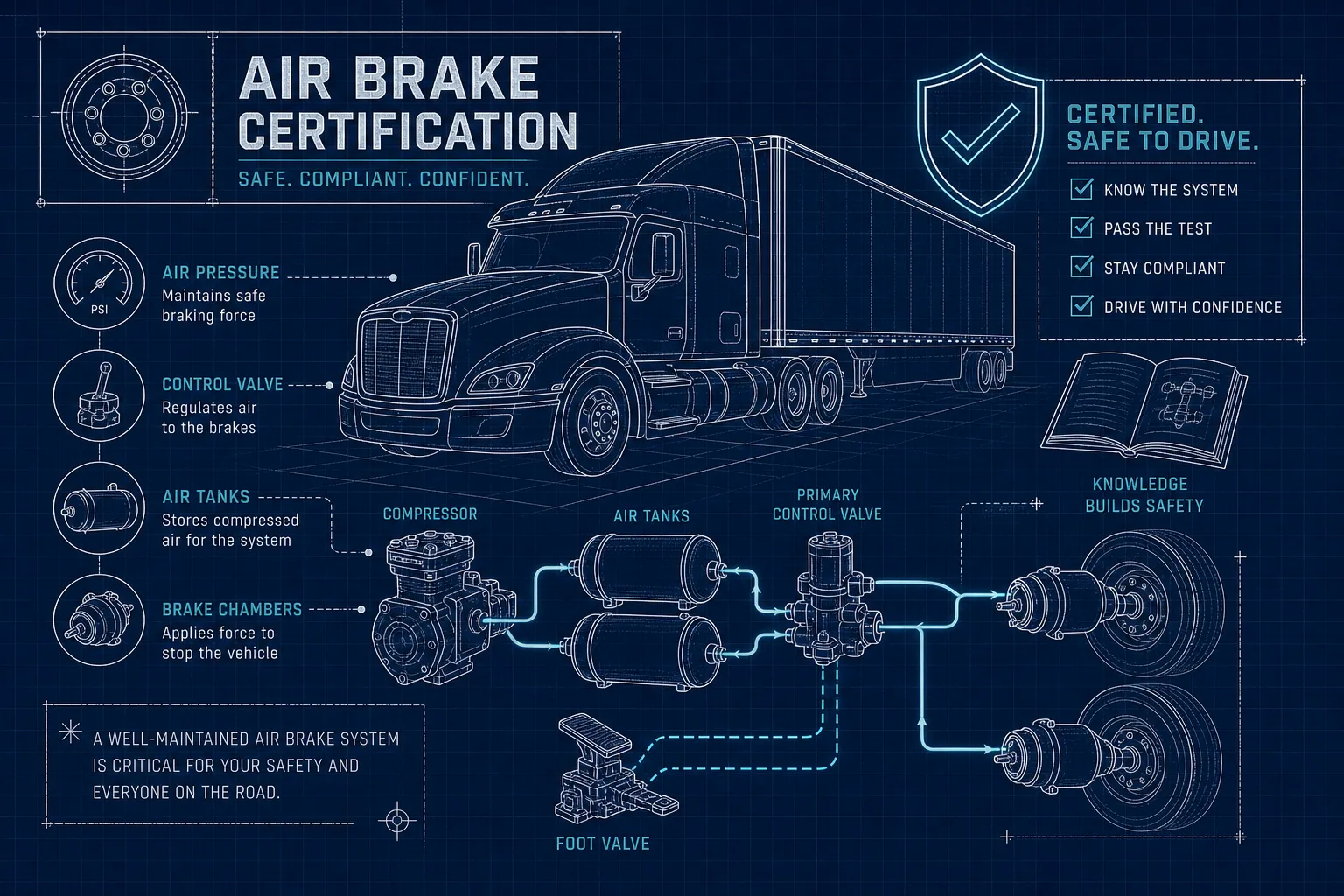
The test demands real component knowledge, not just name recognition. You need to understand what the air compressor does, how the governor controls cut-in and cut-out pressure, what the air dryer removes from the system, and how reservoirs store compressed air for service, secondary, and parking use. The foot valve, relay valves, quick-release valves, brake chambers, slack adjusters, and S-cam foundation brakes are all testable. Examiners expect candidates to know not just what each part is called, but what it does during normal operation and what fails when a component malfunctions.
Pressure values and warning devices
This is where most candidates lose points. The exam tests specific numerical thresholds: the governor cuts in at approximately 100 psi and cuts out at approximately 125 psi. The low-air warning device must activate before pressure drops below 60 psi. Spring brakes apply automatically somewhere in the 20–45 psi range. These are not approximate concepts to be casually absorbed; they are exact values that appear as answer choices on the test. Candidates who read the CDL manual once and move on tend to confuse these numbers under exam pressure.
Dual air systems and emergency operation
The exam covers how the primary and secondary circuits function independently and what a driver must do when pressure drops in one circuit while driving. Candidates are often tested on the correct response to a low-air warning that activates mid-trip, not just on what the warning means in isolation. The right answer matters: manually applying the parking brake control on a moving vehicle is wrong, because spring brakes apply automatically as air pressure falls and abrupt manual application can cause loss of vehicle control.
Inspection and leakage testing
The written test includes procedural questions on air leakage limits that candidates commonly miss on practice tests. For a single vehicle, the maximum leakage rate is 2 psi per minute with brakes released and 3 psi per minute with brakes applied. For a combination vehicle, those limits are 3 psi and 4 psi respectively. Tank drainage, brake adjustment, pushrod travel limits, and the sequence of the seven-step air brake check are all tested. Studying these procedures also prepares candidates for the skills test component, which covers the same ground with a physical demonstration.
What are the most common mistakes on the air brakes written exam?
Mixing up pressure numbers
The most frequently missed questions on the CDL air brakes written exam involve the specific psi thresholds. Candidates who studied once often confuse governor cut-in with cut-out, or get the low-air warning threshold and the spring-brake activation range reversed. Under timed exam conditions, those numbers blur together quickly. Repeated quiz practice on pressure-value questions specifically is what builds the reliable recall the test demands. Reading the manual again rarely fixes this problem; retrieval practice does.
Skipping the inspection and leakage content
Many candidates prioritize understanding how the brake system operates and skim the inspection and testing procedures section. That is a costly shortcut. Leakage rate limits, pushrod stroke maximums, and the correct sequence for the seven-step air brake check carry the same point weight as component function questions, and examiners write tests that reflect exactly which sections candidates are most likely to skip. If you did not study the specific leakage limits for single and combination vehicles, you will miss those questions.
Studying general knowledge content instead of air brakes content
This is the most time-consuming mistake candidates make. Using a general CDL practice test to prepare for the air brakes exam means a candidate might complete 200 questions and encounter fewer than 15 air brakes items. That exposure level does not build the component vocabulary, pressure-value fluency, or procedural sequence recall the exam requires. The air brakes knowledge test is a separate exam drawn from its own item set, and preparing for it with general knowledge questions simply does not work.
How do you study for air brake certification efficiently?
Why topic-isolated practice outperforms general test prep
Broad CDL practice tests distribute questions across general knowledge, hazmat, combination vehicles, pre-trip inspection, and air brakes. A candidate who completes a 50-question general session might see eight air brakes questions. Eight questions is not enough repetition to solidify numerical thresholds, component sequences, and leakage limits. Topic isolation changes that equation: every question in the session targets the content that will be on the exam, and study time compounds instead of spreading thin.
Using CDLTest360's air brakes quiz module
CDLTest360's dedicated air brakes quiz module isolates the content completely. Every question in a session is drawn from material aligned with FMCSA CDL manual content and state-specific requirements. There is no filler from other knowledge areas. After each practice session, the platform's missed-question review system automatically identifies every question answered incorrectly and re-drills those specific items. Study time concentrates exactly where the knowledge gaps are, rather than cycling through content the candidate already knows.
Preparing for air brake certification: timed simulation vs. practice mode
Practice mode builds foundational knowledge on components, procedures, and pressure values without time pressure. Use it first, until you can answer component function and pressure threshold questions with confidence. Then shift to timed simulation mode, which replicates actual exam conditions. Many jurisdictions use an 80% passing threshold, though question counts and passing scores vary by state, confirm the specifics in your state's CDL manual. Consistent scores at 80% or better in simulation mode means you are ready to schedule; anything lower tells you exactly which questions to target before you go, eliminating the costly restart that comes from failing and waiting to retest.
What does the air brakes skills test actually look like?
The air brake inspection walk-through
The skills test requires you to physically identify major air brake components and explain their function to the examiner. The sequence typically follows a seven-step air brake check. That check covers:
-
Governor operation test
-
Static leakage test
-
Applied leakage test
-
Low-pressure warning test
-
Spring brake activation test
-
Parking brake holding test
-
Service brake test and final visual inspection of brake chambers, hoses, tanks, valves, and slack adjusters
You must build system pressure, verify that the governor cuts in and out at the correct pressures, confirm gauges are reading accurately, and demonstrate that the low-air warning activates before pressure drops below 60 psi.
What examiners are watching for during the road test
The on-road portion of the skills test evaluates brake-related driving behavior: smooth and controlled stops, correct use of engine braking and proper gear selection before downgrades, appropriate parking brake use on slopes, and the correct response if an air system warning activates during the drive. One non-negotiable: you must arrive in a CMV equipped with full air brakes. Candidates who appear in a vehicle without air brakes cannot complete the full qualification. The examiner will issue the L restriction, and you will restart the process.
Costs, timelines, and what to bring to your DMV appointment
What the process typically costs and how it is scheduled
The air brakes knowledge test fee is typically bundled with the CDL learner's permit fee or the skills retest fee rather than charged separately. State fee schedules vary, so contacting your state DMV directly for current pricing is the most reliable approach. Skills retests for restriction removal carry their own scheduling fee and often require a waiting period before testing. Many states require holding an unrestricted CLP for at least 14 days before the skills test can be scheduled. Candidates who fail the knowledge test restart that waiting period, which is one concrete reason to be fully prepared before walking in.
Documents to bring and what the full timeline looks like
For most restriction-removal appointments, you will need a valid government-issued ID, your current CDL or CLP, medical certification if you are in a non-excepted operating category, and any state-specific forms your DMV requires. First-time applicants follow the standard CLP application process before any skills testing is possible. The full timeline from the start of study through receiving an updated CDL without the restriction typically runs 2–6 weeks, depending on how quickly you complete the knowledge test, how long your state's waiting period is, and how soon a skills test appointment is available in your area. In some states, once results are processed, the restriction can be removed within a few days; in others, DMV scheduling and processing delays extend the timeline considerably.
  Stage
  What happens
  Typical timeframe


  Study and preparation
  Complete [air brakes module](https://cdltest360.com/guides/air-brakes/air-brakes-study-guide), hit 80%+ in simulation mode
  3–10 days (estimated, self-paced)


  Knowledge test at DMV
  Pass the air brakes written exam; CLP issued or updated
  Same day


  CLP waiting period
  State-required hold before skills testing (commonly 14 days)
  14 days (varies by state)


  Skills test appointment
  Air brake inspection and on-road test in full air-brake CMV
  Depends on DMV availability


  CDL reissuance
  State processes results and issues updated CDL without restriction
  A few days to 2 weeks


  Total process
  Study through clean CDL in hand
  2–6 weeks
The bottom line on qualifying for full air brake operation
Air brake certification for your CDL means passing a specific knowledge and skills test so you can operate air-brake-equipped commercial vehicles without restriction. It is not a separate endorsement, and there is no federal certification card. The knowledge test covers a narrow, well-defined content set: component functions, pressure thresholds, dual-air systems, inspection procedures, leakage limits, and safe operation principles. Every item on that list is testable and every item is learnable with the right preparation.
Candidates who study broadly and hope air brakes content surfaces naturally in a general practice session are setting themselves up for a retest. The air brakes exam pulls from its own item set, and the pressure-value questions that cause the most failures require specific numerical recall, not general familiarity. Topic-isolated practice, particularly with a missed-question drill loop that forces you to confront weak areas directly, is the fastest path through this exam.
CDLTest360's air brakes quiz module is built exactly for this scenario: every question targets air brakes content, the missed-question system re-drills what you got wrong, and the timed simulation mode tells you honestly whether you are ready before you book your DMV appointment. Run a free practice session on CDLTest360 now. The missed-question system will show you exactly where you stand before you book the DMV appointment.
Frequently Asked Questions
How can I tell if my CDL has an L or Z restriction on it?
Your CDL will show the L or Z restriction visibly on the face of the license, so you can read it directly. Employers and DOT inspectors can see that restriction during a roadside check or pre-hire review.
Can I remove the L or Z restriction without taking a skills test in a full air-brake vehicle?
No, you must complete a skills test in a CMV equipped with full air brakes to remove the restriction. Passing the air brakes knowledge test alone is not enough if you did your skills test in a vehicle without a full air brake system.
Do I need Entry-Level Driver Training (ELDT) just to remove an existing L restriction?
Federal rules generally do not require ELDT training solely to remove an existing L restriction. Candidates should still confirm current state-specific requirements with their state DMV.
Will an L or Z restriction prevent me from being hired for most Class A trucking jobs?
Yes, an L or Z restriction on a Class A license typically disqualifies a driver from operating most freight-hauling combination vehicles. Hiring coordinators run a CDL check and the restriction signals the driver cannot operate the company's primary equipment, ending the application for those roles.
{ "@type": "Article", "datePublished": "2026-10-19T11:02:47.281Z", "dateModified": "2026-10-19T11:02:47.281Z", "headline": "Air Brake Certification for CDL: What Drivers Need to Know", "description": "Air brake certification on a CDL means removing the L restriction. Learn what the knowledge test covers, common exam mistakes, and how to study smart.", "publisher": { "@type": "Organization", "name": "CDLTest360" }, "image": [ "https://composeo-article-images.s3.us-east-1.amazonaws.com/air-brake-certification-for-cdl-what-drivers-need-to-know-1792325283056.webp" ], "author": { "@type": "Organization", "name": "CDLTest360" } }
{ "@type": "FAQPage", "mainEntity": [ { "@type": "Question", "name": "How can I tell if my CDL has an L or Z restriction on it?", "acceptedAnswer": { "@type": "Answer", "text": "Your CDL will show the L or Z restriction visibly on the face of the license, so you can read it directly. Employers and DOT inspectors can see that restriction during a roadside check or pre-hire review." } }, { "@type": "Question", "name": "Can I remove the L or Z restriction without taking a skills test in a full air-brake vehicle?", "acceptedAnswer": { "@type": "Answer", "text": "No, you must complete a skills test in a CMV equipped with full air brakes to remove the restriction. Passing the air brakes knowledge test alone is not enough if you did your skills test in a vehicle without a full air brake system." } }, { "@type": "Question", "name": "Do I need Entry-Level Driver Training (ELDT) just to remove an existing L restriction?", "acceptedAnswer": { "@type": "Answer", "text": "Federal rules generally do not require ELDT training solely to remove an existing L restriction. Candidates should still confirm current state-specific requirements with their state DMV." } }, { "@type": "Question", "name": "Will an L or Z restriction prevent me from being hired for most Class A trucking jobs?", "acceptedAnswer": { "@type": "Answer", "text": "Yes, an L or Z restriction on a Class A license typically disqualifies a driver from operating most freight-hauling combination vehicles. Hiring coordinators run a CDL check and the restriction signals the driver cannot operate the company's primary equipment, ending the application for those roles." } } ] }