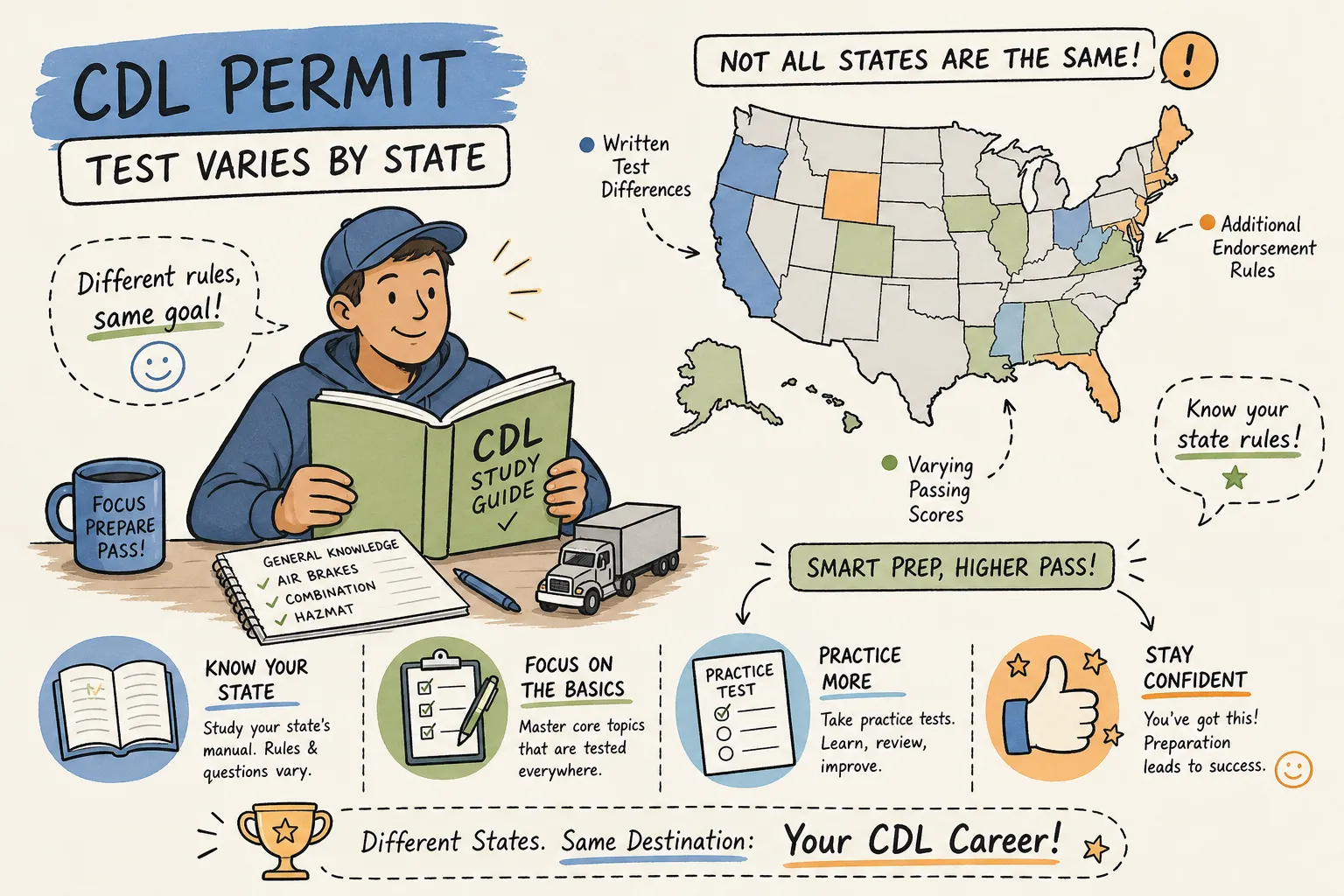
The CDL permit test by state varies more than most candidates expect, and that gap between expectation and reality is exactly where applications stall. The test runs on a federal FMCSA framework, so the subject matter is consistent across all 50 states. General Knowledge, Air Brakes, Combination Vehicles, and endorsement sections are federally mandated based on CDL class and vehicle type, and every state sets an 80% passing threshold on each section. What changes state to state is everything around that content: the number of questions on the screen, what you pay at the counter, how many attempts you get before your application closes, and where you physically walk in to sit down.
Those state-level details blindside candidates who studied the federal manual and assumed the test experience would be uniform. A candidate in Michigan faces up to 70 General Knowledge questions for a Class A application. A candidate in New Jersey pays $125 before touching the keyboard. A candidate in Texas as of June 2026 must take the exam entirely in English, with no interpreter assistance allowed. None of that is in the federal manual.
That's exactly why CDLTest360 builds state-specific CDL manuals directly into the platform alongside FMCSA-aligned practice modules, so your prep covers both layers without hunting across multiple agency sites. This guide maps the key state-level variables so you know what to expect before you walk into the testing room.
Key takeaways
-
Federal baseline is consistent: All states test the same subject areas under 49 CFR Part 383 and require at least 80% correct on each knowledge section.
-
Question counts vary: The AAMVA-model counts are common but not universal; Michigan uses 70 questions for Class A General Knowledge, not the standard 50.
-
Fees differ significantly: State CLP and testing fees range from a few dollars to $125 or more depending on where you apply.
-
Retake limits are state-controlled: Texas closes your application after three failures or 90 days. California limits you to three attempts per knowledge test before reapplication.
-
Endorsements add tests: Pursuing Class A with HazMat, Tanker, and Passenger endorsements can mean five separate knowledge exams depending on your state.
-
Your state's CDL manual is the primary source: Third-party summaries frequently contain outdated fee and procedure information.
What stays the same no matter which state you test in
The federal FMCSA framework all states must follow
Under 49 CFR Part 383, every state must test CDL applicants on federally specified subject areas, require a minimum of 30 questions on the General Knowledge exam, and set an 80% passing threshold on each applicable knowledge section. The federal framework also dictates which knowledge sections are required based on CDL class and vehicle type. Class A applicants must pass Combination Vehicles. Applicants operating vehicles with air brakes must pass the Air Brakes knowledge section. Endorsement tests for HazMat, Tanker, Passenger, and School Bus are required when the applicant seeks those privileges. The required content is the same across all states; the delivery, question count, scheduling process, and cost are state decisions entirely, and those decisions produce significantly different test experiences depending on where you apply.
Why "standardized" doesn't mean "identical"
Many states use the AAMVA-model format, which provides a common question count and test structure. Even among states that adopt this model, the actual test experience can vary based on how the state configures its computer-based system, whether it has adopted the AAMVA Modernized Testing System, and what intrastate or local content it adds to the question pool. Maine and Vermont began transitioning to the AAMVA Modernized Testing System in 2025; Wisconsin completed its launch of the same system in November 2024, revising its vehicle-inspection test to remove redundant questions and focus on safety-critical components.
The federal baseline gives you a strong content foundation, but the state-level details control the actual test experience. That means candidates preparing for the CDL permit test in any state need to consult their state's current CDL manual before scheduling an appointment, not after. A third-party summary or outdated prep guide is not a substitute for the official source.
How the CDL permit test by state varies: question counts and passing scores
The AAMVA-model question counts most states use
The table below reflects the standard AAMVA-model format that many states follow. These are common counts, not a guaranteed figure for every state. Your state's licensing agency is the only authoritative source for the exact number of questions on your specific exam. Consult AAMVA guidance and your state's official CDL manual to confirm the counts that apply to you.
  CDL knowledge test
  Common question count
  Passing score


  General Knowledge
  50
  80% (40 correct)


  Air Brakes
  25
  80% (20 correct)


  Combination Vehicles
  20
  80% (16 correct)


  Hazardous Materials
  30
  80% (24 correct)


  Tank Vehicles
  20
  80% (16 correct)


  Doubles/Triples
  20
  80% (16 correct)


  Passenger
  20
  80% (16 correct)


  School Bus
  20
  80% (16 correct)
States that deviate from the standard
Michigan is one of the clearest examples of a state that breaks from the standard count. Group A applicants in Michigan face up to 70 General Knowledge questions plus a separate 20-question Combination Vehicles test, compared to the 50-question standard most candidates expect. Michigan also requires 25 Air Brakes questions and 30 HazMat questions, with an 80% score required on each. Texas uses the standard structure, 50, 25, 20, 30, and 20-question exams by test type, with computer-based delivery, and as of June 2026, all exams are conducted entirely in English with no interpreter assistance.
A candidate who studied for a 50-question General Knowledge test and shows up in Michigan is walking in underprepared by 20 questions. That's not a small gap. Check the official state CDL manual for your state's actual question count before you sit down.
Why the 80% threshold still trips people up
Eighty percent sounds achievable, but the margin for error is smaller than most candidates expect. On a 50-question General Knowledge exam, missing 11 questions means you fail. On a 25-question Air Brakes exam, missing six means you fail. Candidates who read the manual once and assume they've "got it" often discover those gaps at the testing center, where a failed attempt counts against their retake limit.
Targeted missed-question review is more efficient than rereading the full manual. Identifying the specific questions you consistently answer incorrectly and drilling those repeatedly lets you close gaps without burning time on material you already know.
CDL permit test by state: fees and what they cover
Why fees vary so dramatically across states
States set their own CLP application fees, knowledge-test fees, and endorsement fees independently, and there is no federal fee floor or ceiling. The range is substantial. New York charges $10 for the application plus $5 per knowledge test taken after the first. New Jersey charges a $125 commercial examination test receipt fee before you even sit at the computer. Georgia charges a $35 Commercial Application Permit fee plus a $10 permit fee. Missouri bundles its $25 knowledge exam into a $44 total CLP transaction. Arizona's fees vary by transaction type, verify the current amount on the Arizona MVD's official site before your appointment, since fee schedules can shift. These differences are not administrative oversights; they reflect genuine state-level policy decisions.
What your state fee usually covers
Most candidates encounter several distinct fee categories: the CLP application fee, a per-test knowledge-test fee for each section they must pass, and endorsement-specific fees charged separately for HazMat, Tanker, Passenger, and School Bus tests. HazMat uniquely adds a TSA Security Threat Assessment fee on top of the state knowledge-test fee. Kentucky collects a separate $3 background-check fee before the written test, independent of all other testing fees, confirm the current amount and timing on Kentucky's official licensing site. Some states bundle the knowledge exam fee into the application; others charge per attempt.
Fees change without announcement, and third-party prep sites frequently list outdated amounts. The only reliable source for current fee information is your state's official DMV or DPS website. Verify what you owe before you show up, because most states do not issue refunds for cancelled appointments.
How many attempts do you get if you fail the written test?
Federal minimum vs. state retake policies
Federal rules establish minimum content standards for the CDL knowledge test but do not mandate a universal retake limit or waiting period between attempts. States control those rules entirely, and the variation is significant. Texas closes an application after three failures or 90 days from the original application date, whichever comes first. California allows three attempts per required knowledge test before requiring the applicant to reapply. Georgia allows up to three failures under the current application before requiring a new one, with a 2-day wait after the first failure and a 7-day wait after the second and third. Kansas allows up to four attempts before imposing a 6-month wait, confirm the current policy on the Kansas DMV site before relying on this figure, since retake rules can change.
What happens when you hit your state's limit
In states with a hard attempt cap, exhausting your allotted tries means restarting the CLP application process, paying fees again, and waiting out any mandatory interval before retesting. For a candidate counting on a commercial driving job, that delay directly affects income. Some states tie the attempt limit to the application's validity period rather than a fixed number of retakes, which means the clock starts running from the day you apply regardless of how many attempts you've made.
Online testing introduces additional complexity. Ohio allows only two online attempts per 6-month period, separate from in-person attempt rules. Tennessee caps online testing at two attempts as well. The retake policies for online and in-person testing are not always the same, so candidates using online options need to verify both sets of rules before scheduling.
The smarter approach: simulate before you sit
Treating a real attempt as a diagnostic is an expensive way to find your gaps. One focused study session using a timed exam simulation at the 80% passing threshold tells you exactly whether you're ready before you use an official attempt. If you score below 80% on a simulation, you haven't wasted a state attempt, you've identified a gap that a missed-question drill can close. Running that loop until every flagged question is answered correctly is a more efficient use of the day before your appointment than reading the manual from the beginning again.
Which endorsement tests require a separate written exam in your state?
Air brakes and combination vehicles: tested but not lettered endorsements
A common source of confusion is the difference between knowledge sections and endorsement codes. Air brakes and combination vehicles do not produce a lettered endorsement on your CDL. Air brakes knowledge testing removes the L restriction from your license. Combination vehicles knowledge is required for Class A. Both are typically administered as separate exams, but they're tied to CDL class and vehicle type, not to the endorsement letter system. Your state's manual will specify whether they appear as standalone tests or as part of the CDL-class testing path.
The lettered endorsements and how states handle them
The lettered endorsements are H (HazMat), N (Tanker), P (Passenger), S (School Bus), and X, which represents H and N combined. HazMat stands apart from all others because it requires a TSA fingerprinting appointment and a Security Threat Assessment in addition to the written knowledge test. The X endorsement is not a separate exam; it represents satisfying both H and N requirements. States differ on whether H and N are administered as two separate exams or in a single combined session. Texas, for example, administers separate HazMat and Tank Vehicle exams that together produce the X endorsement.
An applicant pursuing a Class A CDL with Air Brakes, Combination Vehicles, HazMat, Tanker, and Passenger privileges could face up to five separate knowledge exams depending on how their state structures the testing path. That's a significant volume of preparation, and downloading only the General Knowledge section of the state manual leaves major gaps uncovered.
State variations candidates miss most often
The most common surprises come from candidates who didn't verify whether their state combines or separates HazMat and Tanker testing, whether Passenger and School Bus endorsements require separate skills-test vehicles, and whether the state includes intrastate-specific content on any of the endorsement exams. Agricultural exemptions, intrastate routing regulations, and local vehicle requirements appear in the state manual's supplemental sections, not in the federal FMCSA material. Download the complete state CDL manual, including every endorsement section applicable to your license class, before you schedule your appointment.
Where do you actually go to take the CDL permit test?
DMV offices, third-party centers, and CDL school testing
Most states administer the CDL knowledge test at DMV or DPS offices, and not every branch location handles CDL applicants. A candidate who drives to the nearest DMV and assumes it processes CDL applications may find out on arrival that CDL testing is only conducted at specific branches. Call ahead or check the state DMV site to confirm which locations in your area accept CDL applicants and what scheduling process they use.
Some states authorize third-party entities to administer CDL knowledge tests. Iowa and Texas are among the states with clear authorization for third-party knowledge testing, allowing qualified organizations to test their own students or employees. Many other states authorize third-party skills testing but not knowledge testing, so the distinction matters. If your state or CDL school offers on-site knowledge testing, verify that authorization applies to the knowledge exam, not only the skills portion.
2026 testing procedure changes worth knowing
Two changes from the past year directly affect how candidates prepare and what they can bring into the testing room. Wisconsin completed its launch of the AAMVA Modernized Testing System in November 2024, revising its vehicle-inspection knowledge content to remove redundant questions and emphasize safety-critical components. Candidates preparing for the CDL permit test in Wisconsin need to align their PTI and inspection study with that updated emphasis rather than the older, broader format. Maine and Vermont began the same transition in 2025.
Texas made a more immediate change: as of June 1, 2026, all CDL and CLP knowledge exams are English-only. Interpreters are no longer permitted during the exam. For non-native English speakers who relied on translated assistance, this is a direct impact on test strategy and preparation time. The state-level testing bulletin in your CDL manual is the authoritative source for current procedures, check it before assuming the format you read about six months ago still applies.
What ID, age, and medical documents does your state require?
The 18 vs. 21 rule and what it actually means for your career
Most states allow candidates to obtain a Commercial Learner's Permit at age 18, but that permit comes with a geographic restriction. An 18-year-old CDL holder is limited to intrastate commercial driving only. Interstate driving, transporting hazardous materials in commerce, and carrying passengers across state lines require age 21. Virginia and Oregon apply this 18/21 distinction explicitly in their licensing rules. Candidates planning a career in long-haul interstate trucking need to factor that timeline into their planning, because the CLP at 18 does not unlock those routes.
Documents you'll need at the DMV
The standard documentation package across most states includes state-approved proof of identity, proof of Social Security number, proof of state residency (typically two documents, and P.O. boxes do not qualify), and proof of U.S. citizenship or lawful immigration status. Most states also require an existing non-CDL driver's license before issuing a CLP. State-specific requirements add complexity at the margins: New Jersey requires six points of ID, including SSN and proof of lawful permanent residence or citizenship, plus a valid New Jersey Class D license. New York requires applicants to certify any out-of-state licenses held during the prior 10 years and charges $10 for the application plus $5 per subsequent knowledge test.
Arriving at the DMV without the correct documents typically means the appointment is cancelled with no refund of any fees already paid. Assemble your complete document package and verify it against the state's checklist before you schedule, not on the morning of your appointment.
Medical certification requirements
Federal rules require CDL applicants to self-certify one of four operating categories, and the category you choose determines whether you must submit a current Medical Examiner's Certificate. Non-excepted interstate applicants must have an MEC on file before operating a commercial vehicle. Self-certification and submitting a medical card are not the same step, and candidates frequently confuse them. Arizona requires that the MEC be submitted electronically by an NRCME-certified examiner before testing begins. California requires the medical examination report and MEC for applicable applicants before the application is approved. Check your state's specific process; the sequence of steps matters for when you can schedule the knowledge test.
How to build a prep plan that covers both federal and state content
Start with your state's official CDL manual
The single most important prep step is downloading the current CDL manual directly from your state's licensing agency, not from a third-party summary or CDL prep site. State manuals include intrastate rules, local agricultural exemptions, routing regulations, and endorsement-specific guidance that doesn't appear in the federal FMCSA material. A candidate who only studies the FMCSA handbook will have gaps on the actual exam, because the state question pool draws from both federal and state content.
Download the complete manual, including every endorsement section you'll need, not just the General Knowledge chapter. The endorsement sections cover content that appears on separate knowledge exams, and skipping them because "it's just one more test" is how candidates end up scheduling a second appointment.
How CDLTest360 bridges federal and state prep
CDLTest360 includes state-specific CDL manuals built directly into the platform alongside FMCSA-aligned practice modules, so you're not toggling between a state agency PDF and a separate practice site. The topic-specific quiz modules cover General Knowledge, Air Brakes, Combination Vehicles, HazMat, Tanker, Passenger, and School Bus content in both practice mode and timed exam simulation mode at an 80% passing threshold, replicating actual test conditions. The missed-question drill isolates only the questions you answered incorrectly, then re-tests on those until the gaps close.
For candidates who've already failed once, that targeted loop is far more efficient than rereading the full manual from page one. The Pre-Trip Inspection phrase trainer drills the wording required during the PTI portion of the skills test, an area many CDL prep tools underemphasize. Whether you're preparing for your first attempt or coming back after a failed test, CDLTest360 combines state manuals and FMCSA-aligned simulations under one login. Pricing starts at $39.99 for a 90-day pass or $19.99 per month; a no-account-required free trial lets you start immediately.
A pre-test checklist to use before your appointment
Work through this checklist before you schedule your test date, not after:
-
Confirm your state's current question counts, fees, and retake rules on the official DMV or DPS website
-
Download and read your state's complete CDL manual, including every endorsement section applicable to your license class
-
Complete at least three full timed exam simulations and hit 80% on each before scheduling
-
Run the missed-question drill until every flagged question is answered correctly across multiple attempts
-
Assemble all required identity, residency, and medical documents before booking your appointment
-
Confirm your test location accepts CDL applicants and verify the scheduling procedure, including whether you need to call, book online, or walk in
The bottom line: know your state before you show up
The CDL permit test by state is more variable than most candidates expect, and the ones who get surprised are the ones who treated it as a uniform federal exam. Fees, question counts, retake limits, language rules, and document requirements all depend on where you live and where you test. The fix is direct: verify your state's current rules on the official DMV page, use your state's complete CDL manual as the primary study source, and practice under real exam conditions before you use an official attempt.
The federal content is the same across all 50 states. That foundation is worth building correctly, with FMCSA-aligned practice that runs at the same 80% threshold and time pressure as the real exam. Layering in your state's specific manual content, fees, and procedures is what separates a candidate who walks in prepared from one who walks in confident but underprepared.
CDLTest360 combines both layers under one login: state-specific manuals, FMCSA-aligned quiz modules, timed exam simulations, and a missed-question drill designed to close gaps before they cost you an official attempt. Compare the CDL permit test by state, start a free trial on CDLTest360 today, no account required, and use the platform's built-in state manuals to make sure your prep matches exactly what your state puts on the screen.
Frequently Asked Questions
If I fail the written test, do online attempts count against in-person attempts?
It depends on your state; online and in-person attempt rules are not always the same. Ohio allows only two online attempts per 6-month period separate from in-person rules, and Tennessee also caps online testing at two attempts, so you must verify both sets of rules for your state.
Do I need to submit a Medical Examiner's Certificate before I take the knowledge test?
It depends on the state and the operating category you self-certify. Arizona requires the MEC be submitted electronically by an NRCME-certified examiner before testing begins, and California requires the medical examination report and MEC for applicable applicants before the application is approved, so check your state's process and timing.
Can I use an interpreter during the CDL knowledge exam?
That depends on the state; some states allow interpreters and others do not. For example, Texas requires all CDL and CLP knowledge exams to be conducted entirely in English as of June 1, 2026, with no interpreter assistance permitted.
Will I get a refund if I cancel my CDL testing appointment?
Most states do not issue refunds for cancelled appointments. Confirm the refund policy on your state's DMV or DPS site before you pay any fees, because fee schedules and refund rules vary by state.
{ "@type": "Article", "datePublished": "2026-10-18T11:02:19.357Z", "dateModified": "2026-10-18T11:02:19.357Z", "headline": "CDL permit test by state: key differences and prep tips", "description": "The CDL permit test varies by state in fees, question counts, and retake rules. Know what your state requires and prep smarter with CDLTest360's state manuals.", "publisher": { "@type": "Organization", "name": "CDLTest360" }, "image": [ "https://composeo-article-images.s3.us-east-1.amazonaws.com/cdl-permit-test-by-state-key-differences-and-prep-tips-1792238911918.webp" ], "author": { "@type": "Organization", "name": "CDLTest360" } }
{ "@type": "FAQPage", "mainEntity": [ { "@type": "Question", "name": "If I fail the written test, do online attempts count against in-person attempts?", "acceptedAnswer": { "@type": "Answer", "text": "It depends on your state; online and in-person attempt rules are not always the same. Ohio allows only two online attempts per 6-month period separate from in-person rules, and Tennessee also caps online testing at two attempts, so you must verify both sets of rules for your state." } }, { "@type": "Question", "name": "Do I need to submit a Medical Examiner's Certificate before I take the knowledge test?", "acceptedAnswer": { "@type": "Answer", "text": "It depends on the state and the operating category you self-certify. Arizona requires the MEC be submitted electronically by an NRCME-certified examiner before testing begins, and California requires the medical examination report and MEC for applicable applicants before the application is approved, so check your state's process and timing." } }, { "@type": "Question", "name": "Can I use an interpreter during the CDL knowledge exam?", "acceptedAnswer": { "@type": "Answer", "text": "That depends on the state; some states allow interpreters and others do not. For example, Texas requires all CDL and CLP knowledge exams to be conducted entirely in English as of June 1, 2026, with no interpreter assistance permitted." } }, { "@type": "Question", "name": "Will I get a refund if I cancel my CDL testing appointment?", "acceptedAnswer": { "@type": "Answer", "text": "Most states do not issue refunds for cancelled appointments. Confirm the refund policy on your state's DMV or DPS site before you pay any fees, because fee schedules and refund rules vary by state." } } ] }