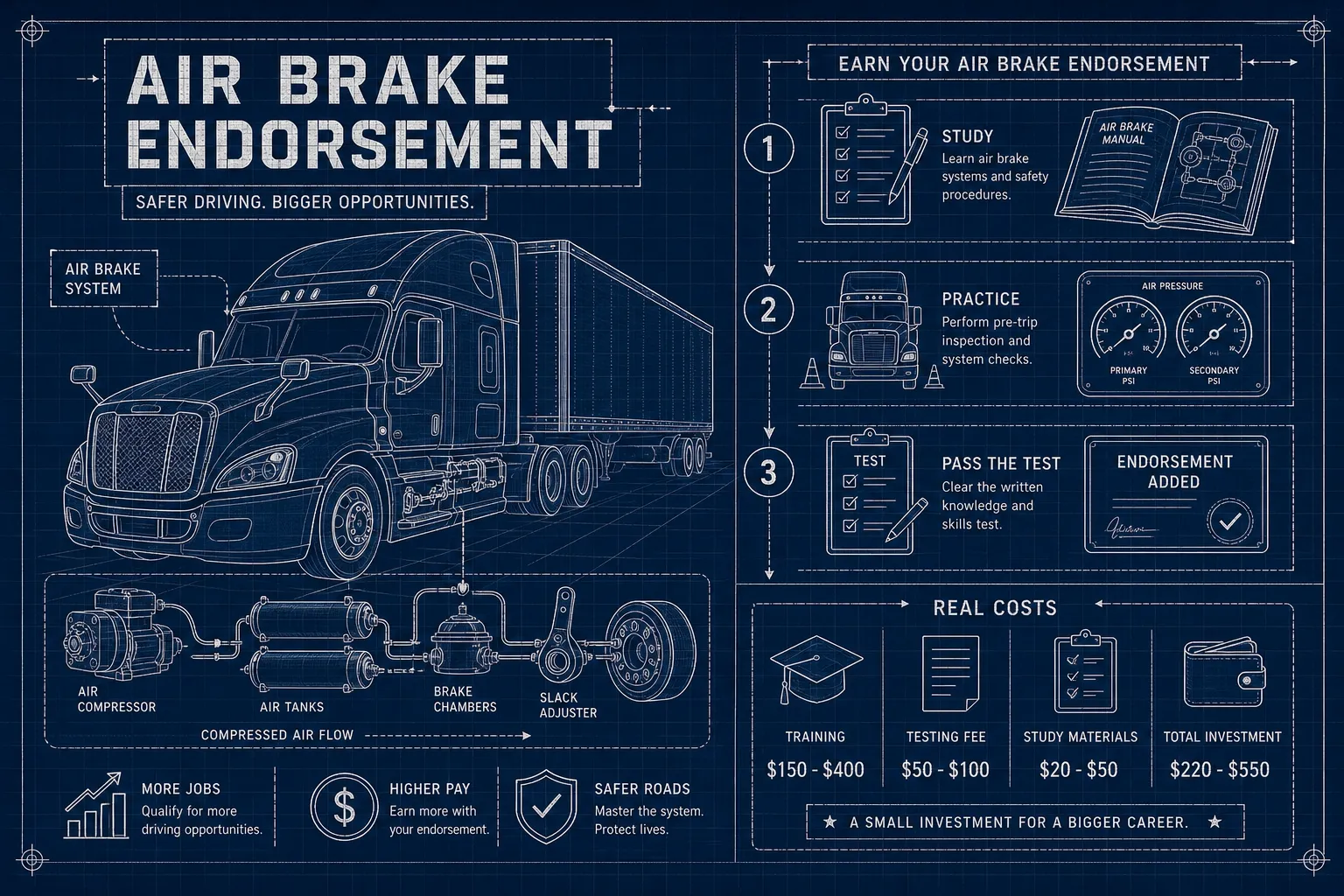
If you've been searching for a "commercial drivers license with airbrake endorsement," you've already hit the first wrinkle in the CDL process: the federal licensing system doesn't actually use that term. There is no standalone air brake endorsement the way there is for Hazmat or Tanker. What exists instead are restriction codes, specifically the L and Z restrictions, that get placed on your CDL when you don't complete the air brake knowledge test or when you take your skills test in the wrong vehicle. The goal isn't to "get" a commercial drivers license with airbrake endorsement the way most people picture it; it's to avoid those restrictions in the first place, or remove them if they're already on your license.
At CDLTest360, the air brakes section consistently ranks as one of the toughest knowledge areas for first-time CDL candidates. That's not because the material is impossible. It's because most people underestimate how specific the test gets: exact pressure thresholds, system sequences, leakage limits, and scenario-based questions that punish surface-level reading. By the end of this guide, you'll know exactly what to study, what the DMV expects from you, and how to walk out with a clean CDL that doesn't limit your career before it starts.
What "commercial drivers license with airbrake endorsement" actually means on your CDL
The federal rules don't call it an endorsement
Under FMCSA regulations, air brakes are not classified as a separate endorsement. Endorsements like Hazmat (H), Tanker (N), and Passenger (P) are add-ons that expand what a driver can haul or operate. Air brakes work differently: the system applies restrictions to your license when you fail or skip the required testing. This is one of the most misunderstood parts of the commercial licensing process, and the confusion leads many candidates to the DMV without a clear picture of what they're actually trying to accomplish. When people search for a commercial drivers license with airbrake endorsement, what they're really looking for is how to get a CDL that has no air brake restrictions attached to it.
Understanding the L restriction vs. the Z restriction
The L restriction means no air brakes at all. A driver carrying an L restriction cannot legally operate any commercial motor vehicle equipped with air brakes, period. The Z restriction is narrower: it prohibits operating vehicles with a full air-powered brake system, but allows the driver to operate vehicles with air-over-hydraulic brakes. The L restriction typically results from failing or skipping the air brake knowledge test, or from failing the air brake inspection component during the skills test. The Z restriction is issued when a driver completes the skills test in a vehicle with air-over-hydraulic brakes rather than a fully air-equipped CMV. Both codes are federally standardized and used across all 50 states. The restriction you receive depends on the circumstances of your testing, not on which state you happen to live in, which is a common misconception among candidates who assume state variation plays a bigger role than it does.
Why the distinction matters for your license class
Class A and Class B vehicles are almost universally equipped with full air brake systems. A freight tractor, a dump truck, a school bus, and a transit coach all run on air brakes. Carrying either an L or Z restriction on a Class A or Class B CDL is a serious career limitation, not a minor technicality. Carriers review CDL restriction codes before making job offers, and many will disqualify applicants at the screening stage without ever reaching an interview.
Who actually needs to pass the air brake test
Class A and Class B applicants
If you're pursuing a Class A or Class B CDL, plan on taking the air brake knowledge test. The vehicles in those license classes run on full air brake systems, and skipping the test means the restriction goes on your license automatically. This isn't optional for anyone aiming at freight hauling, flatbed work, tanker routes, school bus operations, or construction equipment. The test is a requirement, not a formality.
CLP holders, first-time testers, and the CLP air brake test sequence
The commercial learner's permit stage is the right time to handle the air brake knowledge test. Here's the standard sequence broken down:
-
Study the FMCSA air brake material thoroughly before your DMV visit.
-
Take the CLP air brake test at the DMV as part of your CLP application.
-
Hold the CLP for the federally required minimum of 14 days.
-
Complete your CDL skills test in a vehicle equipped with a full air brake system.
Check every box in that sequence and you get a clean CDL. Miss any part of it, especially the vehicle selection for the skills test, and the restriction follows you until you complete a full retest process.
State DMV CDL air brake requirements: eligibility and what you need before you test
Basic eligibility requirements
The federal baseline requirements apply regardless of whether you're testing for the first time or trying to remove an existing restriction. You must be at least 18 years old for intrastate commerce and 21 for interstate driving. You need a valid medical examiner's certificate from a DOT-authorized physician, Social Security number verification, and state residency documentation. These requirements don't change based on the air brake situation; they apply to every CDL transaction.
How state DMV CDL air brake requirements vary more than you'd expect
The knowledge test content is driven by FMCSA regulations and stays consistent across states, but the administrative side is a different story. Some states bundle the air brake knowledge test into the general CDL knowledge test fee; others charge separately. Some require a full new permit transaction to remove a Z restriction; others handle it through a DMV appointment for a skills retest. California, for example, requires a driving test and charges around $100 to remove the restriction, making it an outlier compared to states like Illinois, which charges only $5 to add or change a restriction code. Before you schedule anything, check your state DMV's CDL section for the exact procedure and current fee schedule.
What the air brake knowledge test actually covers
Core system components and how they work
The knowledge test is not a glossary quiz. Questions test your understanding of how components function together, not just your ability to recognize part names. You need to know how the air compressor generates pressure, how the governor controls cut-in and cut-out, and how the reservoir stores the air that powers the system. Brake chambers, pushrods, slack adjusters, S-cam brakes, and wedge brakes are all fair game, as are the dual-circuit structure of modern air brake systems and what a driver is expected to do when one circuit fails.
Pressure management, warning systems, and leakage limits
This is where most candidates lose points. The test is heavy on specific numbers, and those numbers need to be memorized, not approximated. The governor typically cuts in around 100 psi and cuts out around 125 psi. The low-air warning must activate at 55 psi or below, or at one-half of governor cut-out pressure, whichever is lower. Spring brakes apply in the range of 20 to 45 psi. The safety valve is set at approximately 150 psi. Leakage limits are equally specific: a single vehicle in a static test should lose no more than 2 psi per minute; a combination vehicle should lose no more than 3 psi per minute. Applied leak rates are slightly higher, 3 psi per minute for single vehicles and 4 psi per minute for combinations. Knowing these numbers cold before your test date is not optional.
Spring brakes, in-cab inspection, and emergency procedures
The seven-step air brake inspection sequence is a structured, ordered process, and the test expects you to know it in sequence. In-cab checks include verifying pressure build-up, confirming low-air warning activation, and testing spring brake engagement. Beyond inspection, you need to understand brake fade, correct downhill braking technique, when and how to use runaway truck ramps, and how to respond after brake failure. ABS is also tested: what it does, what it doesn't do, and the correct technique when it activates.
The air brake practical test: what happens behind the wheel
Pre-trip inspection of the air brake system
The skills test requires you to perform a complete pre-trip inspection on a CMV equipped with full air brakes. Examiners watch for correct component identification, accurate pressure build-up verification, proper low-air warning device checks, governor function confirmation, leak test execution, and spring brake engagement. You're expected to narrate what you're doing and why, not just touch the parts in the right order. If you take the skills test in a vehicle with air-over-hydraulic brakes instead of a full air brake system, you receive the Z restriction regardless of how well you perform on everything else.
Road test expectations and what keeps the restriction on
The road test itself doesn't change dramatically for air brakes, but your vehicle selection is one of the most consequential decisions you'll make in the entire CDL process. Many candidates who are otherwise well-prepared end up with a Z restriction because their training vehicle didn't qualify. Confirm with your CDL school or skills test examiner that the vehicle you'll use has a full air brake system, not an air-over-hydraulic system, before your test date. Removing a Z restriction after the fact requires a new CLP, the 14-day waiting period, and a complete skills retest. That's not a paperwork correction; it means starting the practical exam process over from scratch.
How to remove Z restriction from your CDL: what it costs to get or remove the air brake restriction
Typical cost breakdown by component
Cost varies significantly by state, but here's a realistic breakdown of testing and administrative fees alone:
-
CDL application or CLP fee: $10 to $100 or more depending on the state
-
Air brake knowledge test: $10 to $60, often bundled into the CDL testing fee
-
Restriction add or removal: $5 to $50 in most states
-
Skills test: $50 to $150 in most states, higher in some
-
Study materials and optional training: $20 to $800 or more
For a candidate who already holds a CLP and passes on the first attempt, the realistic out-of-pocket cost for testing and fees runs between $30 and $150. Including the initial permit application, most candidates land in the $50 to $250 range before adding training or vehicle rental costs.
State-by-state cost examples
A few confirmed examples illustrate how wide the range gets. Arizona charges approximately $7 for the restriction add-on. Colorado's skills test fees can reach $275 including administrative costs. Florida charges around $10 to $13 for the air brake knowledge test component, with the permit running about $48. Georgia charges a $35 commercial application fee covering four test attempts, plus a $10 permit fee. Illinois charges just $5 to add or change a restriction code, though the CLP itself costs $50. Oregon charges $56 for the restriction removal test. Wisconsin charges $50 to lift the air brake restriction with a vehicle inspection required. California is the outlier: removing the restriction requires a driving test and runs about $100 for the transaction, with third-party tester and vehicle rental fees on top of that. Check your state DMV's current CDL fee schedule before planning your budget, because these figures change and many states don't publish a separate line item for air brake transactions.
How dropping the restriction expands your career options
Jobs that require full air brake certification for CDL holders
The list of CDL jobs that require a clean license without air brake restrictions covers nearly every high-paying route in commercial driving. Over-the-road freight, flatbed hauling, tanker operations, school bus and transit work, refuse and roll-off hauling, ready-mix concrete delivery, utility contracting, and municipal highway departments all commonly require vehicles equipped with full air brakes. Carrier job postings often include language like "CDL without air brake restriction" or "no L or Z restriction" as a hard eligibility requirement, and that screening happens before a recruiter picks up the phone. A restricted license doesn't just limit your options; it removes you from consideration before the hiring conversation even begins.
The pay and opportunity gap between restricted and unrestricted drivers
An L or Z restriction quietly cuts your negotiating leverage on pay, limits which freight lanes you can work, and blocks advancement into higher-value hauling categories. The cost of completing the air brake test is $30 to $150 in most states. The cost of not completing it shows up in job postings you can't apply to, pay rates you can't access, and career paths that close before they open. Treating the air brake test as optional is one of the most expensive decisions a new CDL candidate can make.
How to study for the air brake knowledge test without wasting time
What most study plans miss
The standard study approach for CDL candidates is to read through the air brakes chapter of the state CDL manual once and assume they're ready. That works fine for general knowledge concepts, but the air brake test is a different animal. It's built around specific numerical thresholds, system operation sequences, and scenario-based questions that require active recall, not passive recognition. Reading about leakage limits is not the same as being able to answer a timed question about them under pressure. Candidates who show up having only read the manual once consistently underperform on the numerical questions and on questions that ask what to do when a system fails.
CDLTest360's air brakes quiz module: built for this exact test
CDLTest360's air brakes quiz module covers every FMCSA air brake knowledge test topic with both a practice mode and a timed exam simulation mode. The quiz runs 50 questions and uses an 80% passing threshold that reflects the standard used in most states. The missed-question review system is what separates it from generic study tools. Instead of making you repeat material you already know, it isolates every question you answered incorrectly and drills you specifically on those gaps. That's how you turn a practice session into actual test readiness. No account is required to start, you can jump into the quiz right now and see where your knowledge actually stands before you find out at the DMV.
Recommended study timeline
For candidates who are new to air brake systems, budget 30 to 40 hours of total study time spread across three to four weeks. That's not 30 hours of reading the same manual chapter repeatedly; it's a mix of content review, active practice testing, and focused drilling on weak areas. Complete at least three full timed practice exams before booking your DMV appointment. If you're consistently hitting above 85% on timed simulations, you're ready. If you're not, the missed-question loop will tell you exactly what to fix before you spend a test fee finding out the hard way.
Getting your commercial drivers license with airbrake endorsement cleared: the steps in plain order
Getting a CDL without the air brake restriction isn't complicated, but every step matters.
-
Understand the restriction codes so you know what you're working to avoid.
-
Meet the federal and state DMV CDL air brake requirements before you schedule anything.
-
Study the FMCSA air brake content thoroughly, with specific focus on the numerical thresholds that generate the toughest test questions.
-
Confirm your skills test vehicle has a full air brake system before your test date, not after.
-
Handle the state DMV paperwork correctly the first time so you're not paying for a second permit and waiting out another 14-day period.
The CDLTest360 air brakes quiz module is available right now with no registration required. Start a timed practice session and find your knowledge gaps before they cost you a test fee, that's the most actionable thing you can do in the next 20 minutes if a CDL knowledge test is on your calendar.
Frequently asked questions
How do I remove Z restriction from my CDL?
To remove a Z restriction, you generally need to obtain a new CLP (if required by your state), wait out the 14-day minimum holding period, and then retake the CDL skills test in a vehicle with a full air brake system, not an air-over-hydraulic vehicle. The exact process and fees vary by state, so confirm the procedure with your state DMV before scheduling. In California, for example, the process requires a driving test and costs around $100. In Illinois, the administrative fee is just $5, though you still must complete the retest.
Is the air brake knowledge test the same in every state?
The content is driven by FMCSA regulations, so the core material is consistent nationwide. Administrative details, fees, bundling with other tests, and paperwork requirements, vary by state.
Can I get a commercial drivers license with airbrake endorsement authorization without a CDL school?
Yes. There is no federal requirement to attend a CDL school specifically to take the air brake knowledge test. You study the FMCSA-regulated material, go to your state DMV to test, and pass on your own preparation. A CDL school may be required or preferred for the skills test portion, depending on your state's rules and your access to a qualifying vehicle.
{ "@type": "Article", "datePublished": "2026-10-13T11:02:47.611Z", "dateModified": "2026-10-13T11:02:47.611Z", "headline": "CDL Air Brake Endorsement: Steps, Tests, and Real Costs", "description": "Learn what a CDL air brake endorsement means, how the L and Z restrictions work, what the knowledge test covers, and how to remove the restriction. Start prepping now.", "publisher": { "@type": "Organization", "name": "CDLTest360" }, "image": [ "https://composeo-article-images.s3.us-east-1.amazonaws.com/cdl-air-brake-endorsement-steps-tests-and-real-costs-1791806848692.webp" ] }