Many first-time candidates struggle with the CLP knowledge exam, not because the material is impossible to learn, but because most people study the wrong things in the wrong order, or rely on random online quizzes that have nothing to do with what the DMV actually tests. If you've been staring at a 200-page manual wondering where to start, this CDL learner permit study guide gives you the systematic roadmap you need.
This is a practical, FMCSA-aligned guide that covers exactly what the commercial learner's permit exam tests, how to find your state's official CDL manual, which endorsements apply to your situation, and how to self-test before exam day so you're not guessing when it counts. CDLTest360 pairs with your manual as a digital study companion that targets your weak spots once you've done the reading. Together, they give you an efficient path from "where do I start?" to a passing score.
What the CLP Knowledge Exam Actually Tests
Before you open a single study resource, get a clear picture of what you're walking into. The commercial learner's permit is a federally regulated credential governed by FMCSA standards. Federal standards set the passing threshold and core content requirements, though exact question counts and some test-administration details can vary by state DMV. You're not preparing for a local quiz; you're preparing for a federally standardized knowledge test.
How Many Questions and What Passing Score You Need
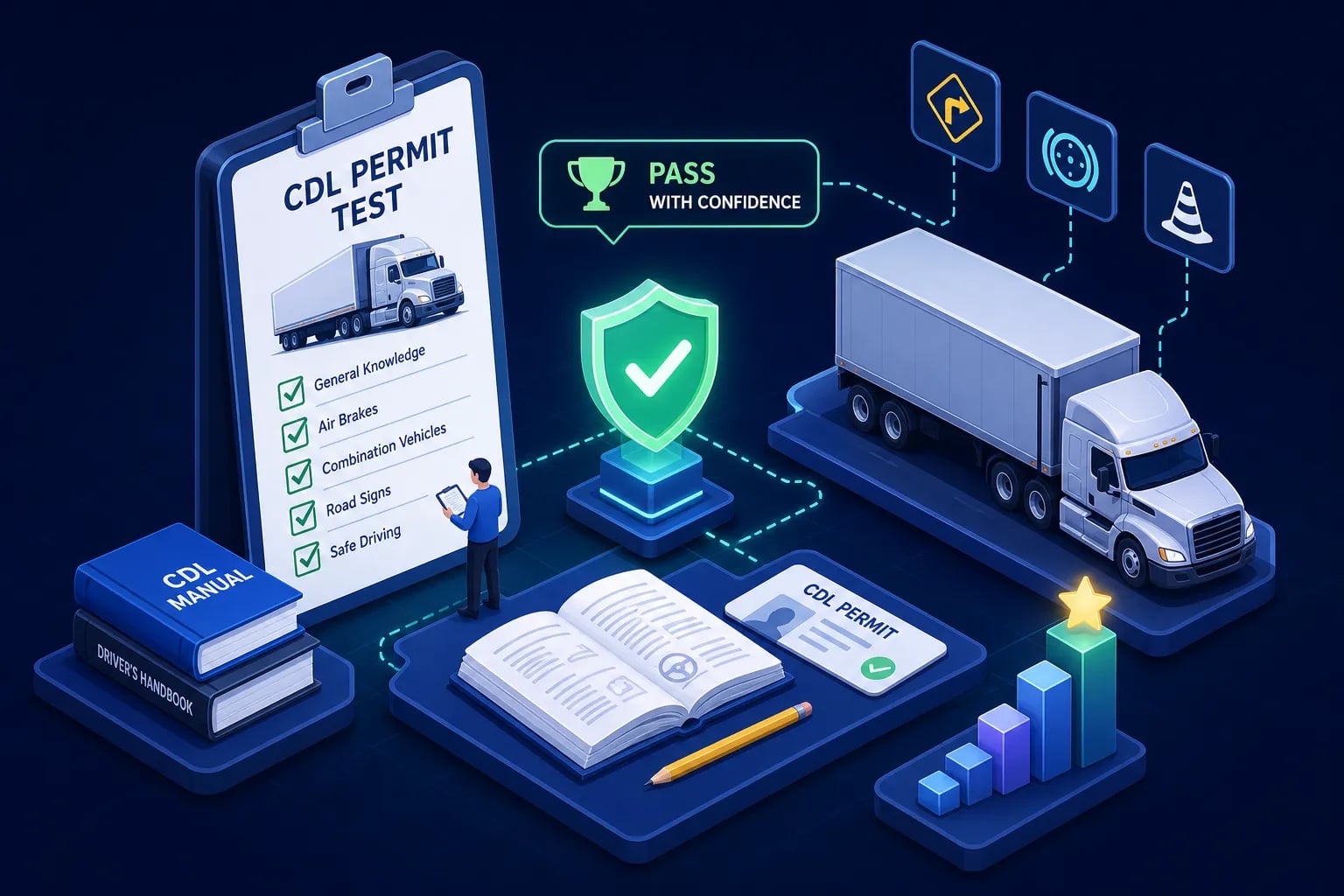
The general knowledge test follows a common format of 50 questions with an 80% passing threshold, meaning you need 40 correct answers. That benchmark is set at the federal level. Endorsement tests carry their own question counts: air brakes runs 25 questions, combination vehicles runs 20, hazmat runs 30, and tanker runs 20. Each still requires 80% to pass, so know your target before you crack the manual. Check your state DMV's website to confirm the exact format used in your state.
How the FMCSA CDL Manual Shapes Every Question
CLP knowledge test questions are drawn from the official FMCSA CDL manual and your state's commercial driver handbook, which are aligned with federal guidance. Mastering the manual is the entire job, and that means you can anticipate and prepare for every topic that will appear on your exam. This CDL learner permit study guide will show you how to do that systematically, rather than hoping you covered enough ground.
CLP Eligibility: What You Need Before You Show Up at the DMV
Spending hours studying only to discover you're missing a required document wastes everyone's time. Before you commit to a study schedule, confirm you're eligible and know what you need to bring to the DMV on application day.
Age Requirements and Federal Baseline Rules
The federal minimum age for a CLP is 18. Interstate commerce generally requires age 21, while intrastate operation is often permitted at 18, check your state's specific rules since requirements vary. First-time Class A or Class B applicants are also subject to ELDT (Entry-Level Driver Training) theory requirements under rules that took effect in February 2022, which means you need to complete federally mandated theory training from a registered provider before your skills test. You must also certify that you have no active CDL disqualifications and that you don't hold a driver's license in more than one state.
Documents to Bring to the DMV
The exact document list varies by state, but the federal baseline is consistent. Plan to bring the following to your appointment:
-
Your current valid non-commercial driver's license
-
Proof of identity and lawful presence (U.S. citizens and non-citizens have different acceptable documents)
-
Proof of state residency showing your name and residential address
-
Social Security number or Social Security card
-
A DOT Medical Examiner's Certificate if your class of driving or state requires it
-
The state-specific CLP application form (Nevada uses CDL 002; Louisiana uses DPSMV2211)
States like Massachusetts require you to hold a valid Class D license for the full permit period. Nevada requires in-person application with a valid Nevada driver's license. Louisiana adds its own supplemental form on top of the federal baseline. Check your state DMV's website directly for the exact current list before you go.
CDL Learner Permit Study Guide: Finding and Using Your State's Official Manual
The official state commercial driver handbook is the only prep resource that matters. Every exam question comes from it, which means any study guide that isn't built from this source is working against you. The problem is that most candidates either don't know where to find the manual or download it and then read it passively, and passive reading doesn't work.
Where to Download Your State CDL Manual PDF
Each state's DMV, DOT, or licensing agency publishes its own version of the CDL manual, aligned with FMCSA federal content but including state-specific rules and supplements. Your first stop is your state's DMV website. New York's manual is downloadable by section in multiple languages including English and Spanish. Michigan offers chapter-by-chapter PDF access through the Secretary of State. Wisconsin publishes a full commercial drivers manual PDF through its DOT. For candidates who want everything in one place, CDLTest360 keeps state-specific CDL manuals accessible inside the platform for all 50 states, so you don't have to hunt across agency websites while you're trying to study.
How to Read the Manual So the Content Actually Registers
Passively reading a 200-page manual from cover to cover is the fastest way to retain nothing. The smarter approach is active chapter-by-chapter processing: read one chapter, take notes on specific rules and numerical thresholds, then quiz yourself on that chapter before moving to the next. This active reading loop forces your brain to retrieve what it just processed rather than simply recognizing familiar text. Candidates who pass on the first attempt tend to use this approach consistently. Those who struggle often say they "read the whole manual" without testing themselves along the way, so build the self-testing habit from day one.
The Core Knowledge Areas Every CLP Candidate Must Master
Not all sections of the CDL manual carry equal weight on your exam. Knowing which topics to prioritize and what each section actually tests gives you a significant edge before you spend a minute with a practice question. This section of the CLP study guide breaks down each knowledge area so you can allocate your time wisely.
General Knowledge: The Section That Determines Your CLP
General knowledge is the full 50-question baseline test that every CLP candidate must pass, regardless of what class of license or endorsements they eventually pursue. The key subtopics inside general knowledge are vehicle inspections, emergency procedures, weather and mountain driving, braking distances, shifting technique, cargo securement, and safe following distances. This is the non-negotiable foundation of any CDL learner permit study guide. Class A, B, and C candidates all take this test, it's the one test you cannot skip.
Air Brakes and Combination Vehicles: The Next Tier
The air brakes test is the second most commonly required endorsement exam, covering 25 questions with an 80% passing threshold. It covers system components, brake operation, air pressure inspections, and brake fade. If the vehicle you intend to drive has an air brake system, you need this test. Combination vehicles runs 20 questions and focuses on coupling and uncoupling procedures, turning and backing large rigs, and trailer safety. Class A candidates driving semi-trucks typically need both. Class B candidates usually need air brakes but not combination vehicles. Knowing which applies to you before you study saves significant time.
Pre-Trip Inspection, Cargo, and Driving Safety
Pre-trip inspection, cargo weight and securement rules, hours-of-service basics, and defensive driving in adverse weather conditions all feed directly into general knowledge questions. The pre-trip inspection section deserves close attention because many state examiners expect thorough familiarity with specific inspection wording and procedures, not just a general understanding of the steps. CDLTest360's PTI phrase trainer is designed to drill the inspection wording candidates need to recall during this section of the exam, which is something most generic flashcard tools skip entirely. If you've struggled to memorize the inspection sequence, targeted phrase drills are the fix.
CDL Endorsements That Require Separate Knowledge Tests
Not every candidate needs every endorsement. The endorsements covered in this section include hazmat, tanker, doubles/triples, passenger, and school bus. Studying for tests that don't apply to your situation is wasted time, so use this section to decide which additional knowledge tests are relevant to your CDL class and intended job before you build your study plan.
Hazmat, Tanker, and Doubles/Triples: Endorsements for Specialized Freight
Hazmat is the largest endorsement test at 30 questions. According to FMCSA and TSA guidance, the hazmat endorsement also requires a TSA Security Threat Assessment (background check) before the endorsement is issued. Tanker covers 20 questions focused on liquid cargo surge, loading and unloading procedures, and emergency protocols for bulk liquid transport. Doubles and triples is a separate written endorsement test covering safe handling of multi-trailer combinations, including brake checks and turning clearances, confirm your state's specific testing format with your DMV. These endorsements are only required if your job specifically involves that type of cargo or vehicle combination. All three can be added after your initial CLP is issued, so don't feel pressured to study them all at once if your first job doesn't require them.
Passenger and School Bus Endorsements
The passenger endorsement applies to drivers transporting 16 or more people and requires its own separate knowledge test based on FMCSA manual content. The school bus endorsement is specific to transporting children in a school bus and comes with additional testing requirements beyond the passenger endorsement. Both have distinct FMCSA manual sections covering emergency exit procedures, student management, and loading zone safety. Check your employer's requirements before deciding which endorsements to pursue at the permit stage, since adding them later is straightforward once your core CLP is in hand.
CDL Learner Permit Study Guide: Building a Prioritized Study Plan
Downloading the manual is not a study plan. Having access to CLP practice tests is not a study plan. A study plan is a time-blocked sequence that covers everything you need without burning you out or leaving gaps in the final days before your exam.
Prioritizing Topics Based on Your CDL Class
Start with general knowledge. Every candidate needs it, and it's the largest single test you'll take. From there, add the endorsement tests that apply to your CDL class and intended vehicle type. Class A candidates add combination vehicles and almost always air brakes. Class B candidates typically add air brakes. Endorsements like hazmat, tanker, or doubles/triples come last, after the core tests are solid. This order reflects the logical dependency of the tests. Rushing through general knowledge to get to endorsements is a common and avoidable failure pattern.
A Realistic Weekly Study Schedule
For most first-time candidates studying 45 to 60 minutes per day, a 2 to 3 week window is a reasonable starting framework, though required time will vary based on prior experience and individual learning pace. Use the first four days for general knowledge chapters, reading one chapter at a time and quizzing yourself at the end of each. Days 5 through 7 cover air brakes and combination vehicles. Days 8 through 10 are for any additional endorsements you need. Save the final 3 to 4 days for full-length CLP practice tests under timed conditions, followed by review of every question you missed. Adjust the pacing based on how your practice scores are trending.
Retention and Self-Testing Strategies That Actually Work
Reading the manual gets you familiar with the material. Self-testing is what builds the kind of memory that holds up under pressure during a real exam. The two activities are not interchangeable, and skipping the testing phase is the single most common mistake candidates make.
Active Recall Beats Re-Reading Every Time
Re-reading creates familiarity, not memory. Active recall forces you to retrieve information without looking at the page. That retrieval process builds the retention that holds up during a real 50-question timed exam. Close the manual after each chapter and write down every rule, threshold, and procedure you can recall from memory. Use blank note cards for key numbers: stopping distances, air pressure ranges, weight limits, and inspection sequences. Recite the pre-trip inspection sequence out loud from memory, not from a prompt. These feel uncomfortable at first, which is exactly how you know they're working.
Why Self-Testing Is the Best Exam Predictor
Test-prep research consistently supports practice testing as one of the strongest predictors of exam performance. The key is replicating real conditions: timed, no notes, full question sets at the 50-question length. Reviewing your score isn't enough on its own. Every wrong answer deserves a full explanation review so you understand why the correct answer is correct, not just what it is. This distinction matters because the exam can phrase the same concept multiple ways. Candidates who review wrong answers deeply tend to see their scores improve steadily in the final days of study. Those who retake tests without that review tend to plateau.
How CDLTest360 Turns Your Manual Reading Into Active Exam Prep
Reading the manual gives you the knowledge. CDLTest360 turns that knowledge into exam-ready recall by drilling you on the content you're most likely to miss. According to CDLTest360, the platform is built from FMCSA regulations and state CDL manuals, with quiz questions mapped to actual exam content areas. You're not practicing on generic trivia.
Topic-Specific Quizzes and the Missed-Question Drill System
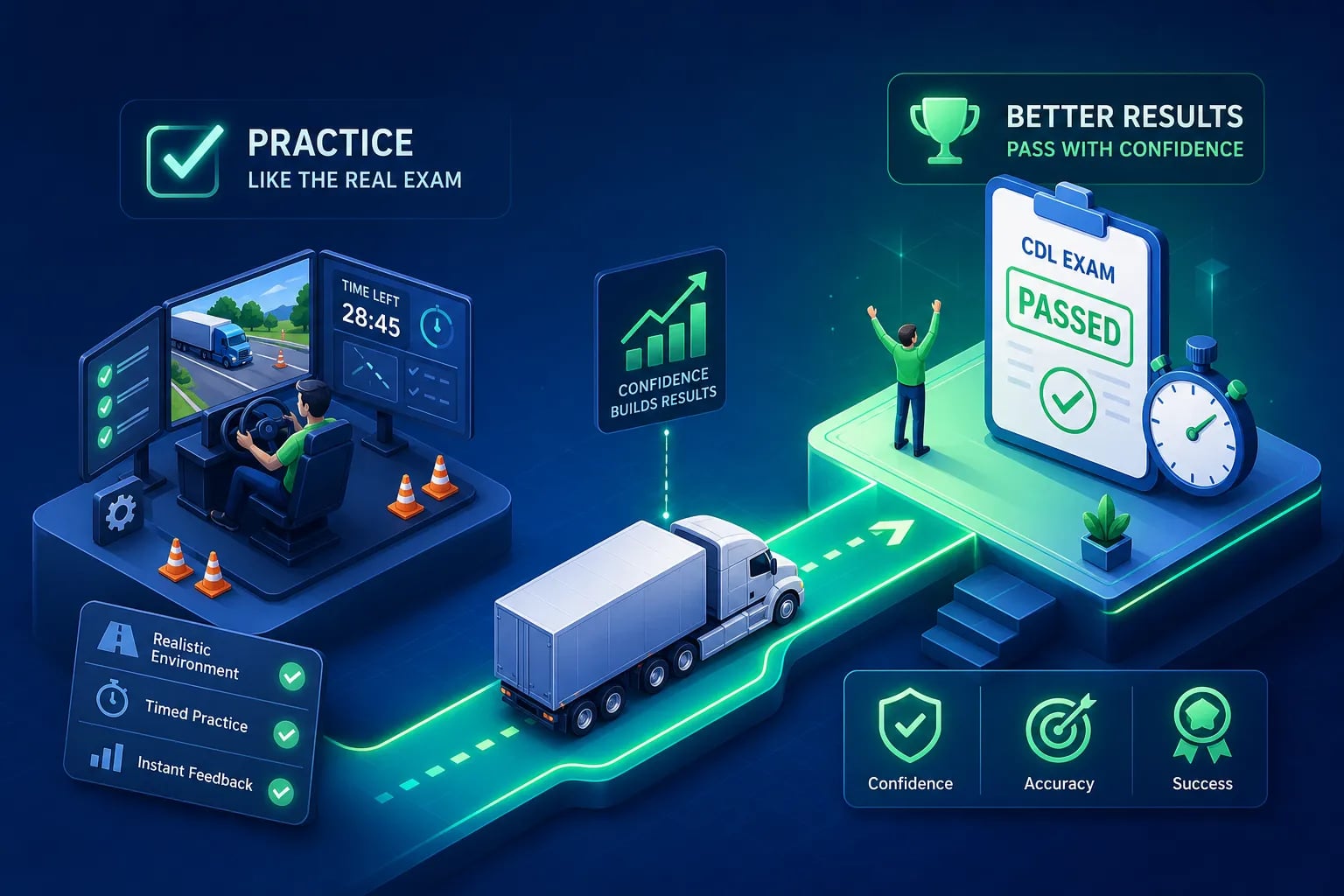
CDLTest360 lets you drill by topic: General Knowledge, Air Brakes, Combination Vehicles, Hazmat, Pre-Trip Inspection, and more. You can work in practice mode to review as you go, or jump into a timed 50-question exam simulation at the 80% passing threshold to replicate actual test conditions. The missed-question review system is where CDLTest360 sets itself apart from basic practice test tools. After any quiz, the platform isolates the questions you answered incorrectly and re-drills those specific items until you get them right consistently, so you don't have to manually track where your gaps are.
Exam Simulation Mode and How to Start Without Creating an Account
CDLTest360's timed exam simulation mirrors the CLP test environment: 50 questions, real-time pressure, no ability to check answers mid-quiz. This is the closest thing to sitting in the DMV testing room without actually being there. Candidates can start practicing immediately with no account required, which means you can run through your first quiz before deciding whether to continue. Visit CDLTest360's website for current pricing and access options, including state-specific CDL manual availability inside the platform. For candidates who want an efficient path from manual reading to a passing score, CDLTest360 is a practical digital companion that bridges that gap without the cost or bulk of traditional CDL school supplemental materials.
Get Your CLP on the First Attempt
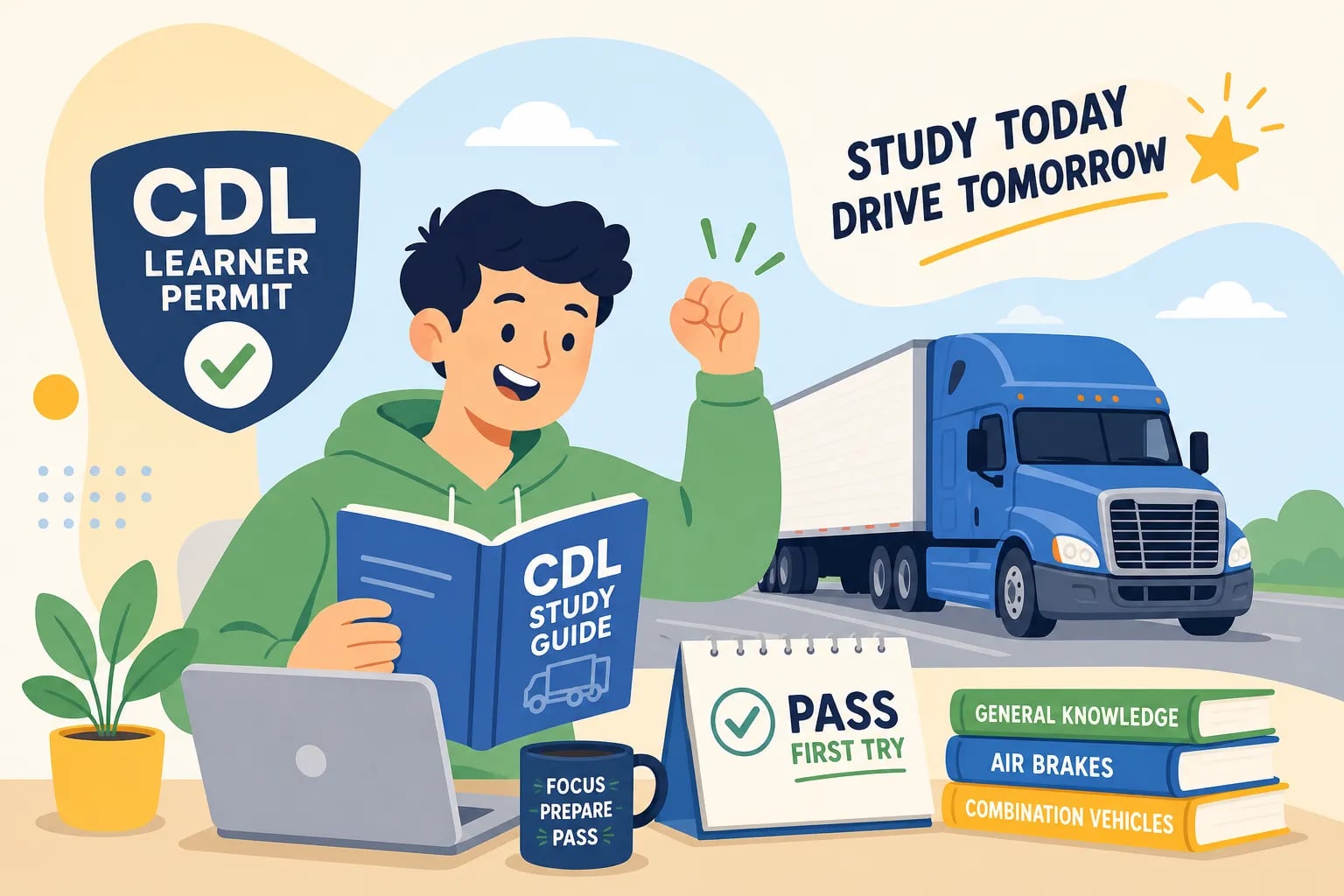
Candidates who pass the CLP knowledge exam on their first try aren't smarter than those who don't. They're more systematic. They find and read their official state CDL manual, study the right topics in the right order based on their CDL class and intended endorsements, and self-test actively with realistic CLP practice tests before exam day. That's the entire framework this CDL learner permit study guide covers.
The FMCSA CDL manual is your source of truth. Every question on your exam draws from it, which means no app or shortcut replaces actually knowing that material cold. What CDLTest360 does is make it faster to find where your knowledge has gaps and close them before you sit down at the DMV. The missed-question drill system, the PTI phrase trainer, and the timed exam simulation all exist to make your study time more efficient, not to replace the manual.
Start with your state CDL manual, build your study schedule around the topics that apply to your CDL class, and take a free practice test on CDLTest360 today to see exactly where you stand. No account required to start. You just need to start.
{ "@type": "Article", "datePublished": "2026-09-22T11:01:59.771Z", "dateModified": "2026-09-22T11:01:59.771Z", "headline": "CDL Learner Permit Study Guide: Pass on Your First Try", "description": "This CDL learner permit study guide covers every test topic, your state manual, key endorsements, and a proven study plan. Start practicing today.", "publisher": { "@type": "Organization", "name": "CDLTest360" }, "image": [ ] }