CDL school costs between $5,000 and $8,000 at most private programs, and that number doesn't include the DOT physical, drug screening, permit fees, or the income you lose during the weeks you're not working. Candidates entering the trucking industry are often managing all of that simultaneously, looking for every way to reduce financial exposure before their first paycheck as a licensed driver. A CDL monthly plan addresses one piece of that financial puzzle directly: test prep costs stay low, commitment stays short, and you only pay for the time you actually need.
Many candidates underestimate the written knowledge exam. Before you ever sit in a truck for behind-the-wheel training, you have to pass the CDL knowledge test at your state DMV. That test is 50 questions, requires an 80% passing score, and covers everything from air brakes and hazardous materials to hours-of-service and pre-trip inspection procedures. Failing it pushes back your entire CDL school timeline and adds financial stress on top of an already expensive process.
A CDL monthly plan is a low-risk, no-commitment way to close that prep gap without layering another long-term obligation on top of your CDL training costs. Rather than buying a 90-day pass upfront or bundling prep into a paid course you haven't evaluated, a month-to-month option lets you pay only for what you use. CDLTest360 offers exactly this at $19.99 per month with no lock-in and no account required to start. This guide breaks down how these plans work, what's worth paying for, and how to pass the written test within your first month of focused study.
What a CDL monthly plan actually covers (not all are equal)
Most candidates assume a CDL prep subscription is just a large pile of practice questions. A well-built CDL monthly plan is structured around the actual FMCSA knowledge domains, not loosely organized trivia pulled from outdated sources. The quality of the content directly determines whether your study time translates into a passing score.
What the core modules should look like
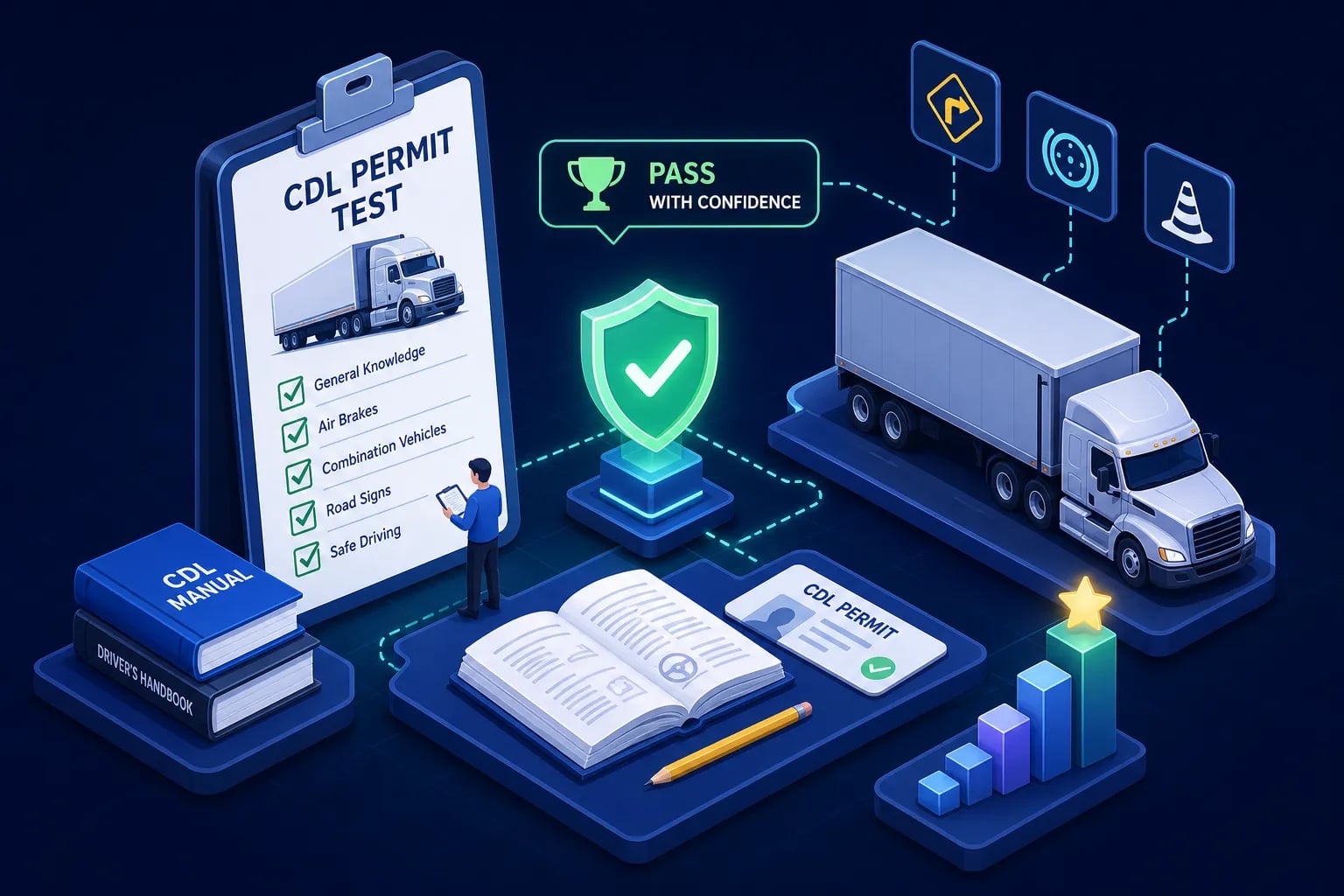
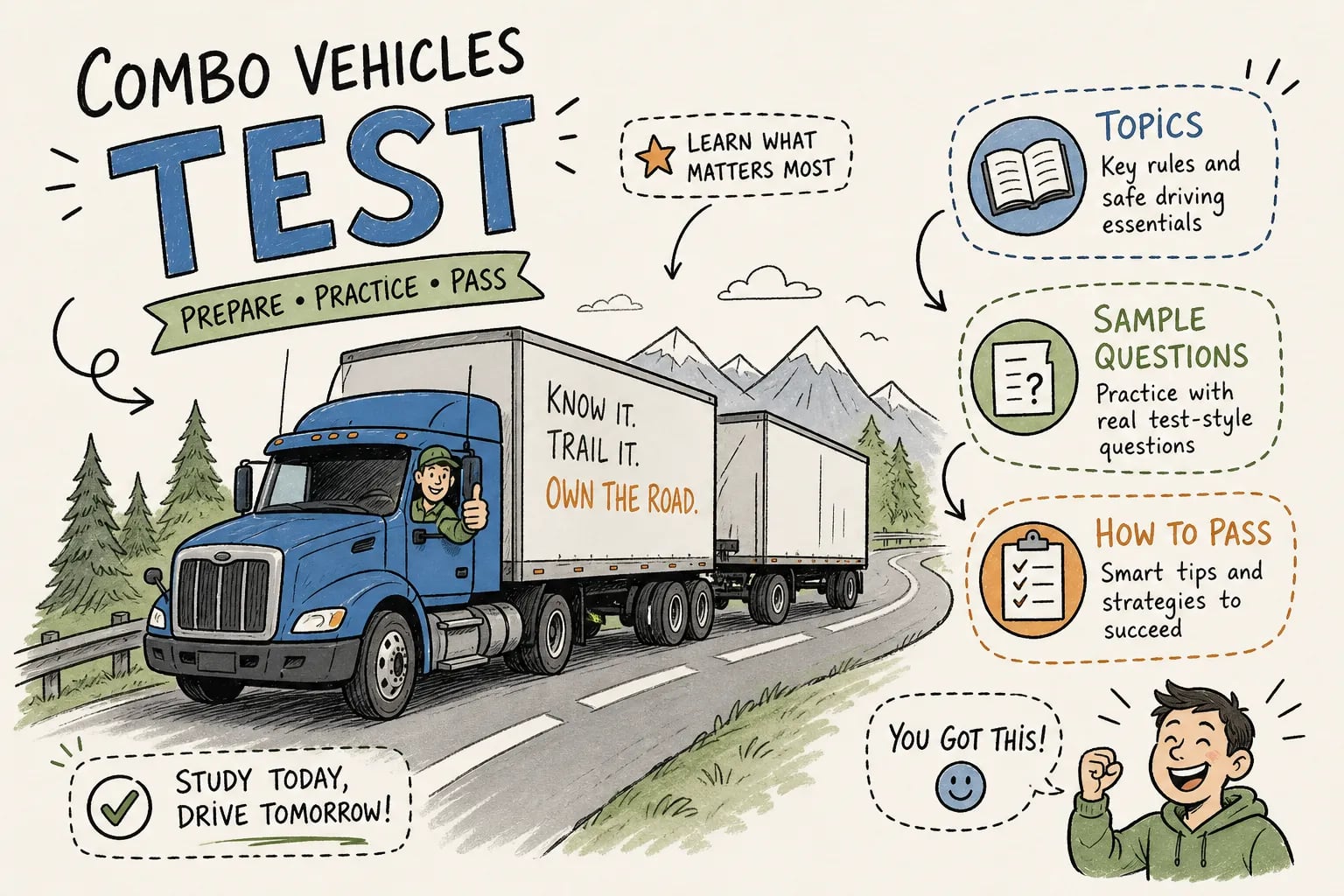
A complete CDL monthly plan covers every major knowledge domain: General Knowledge, Air Brakes, Combination Vehicles, Hazardous Materials, and Pre-Trip Inspection. Each module should include both an open practice mode, where you can work through questions without a timer, and a timed exam simulation that mirrors the actual test format with 50 questions and the 80% passing threshold. Any subscription that skips a major domain is incomplete by definition, and that gap will show up on test day.
What separates a structured plan from a random question bank
A real study plan does more than serve up questions. It tracks where you're weak, surfaces those gaps automatically, and adjusts what you practice based on your performance history. Static PDF question dumps and generic flashcard apps have no logic behind question delivery, so you can score 78% repeatedly, never understand why, and walk into the DMV unprepared. The structure of how questions are presented and reviewed is as important as the questions themselves.
FMCSA alignment: why it matters more than question count
Every CDL knowledge test question in the United States originates from FMCSA regulations and the corresponding state CDL manual. A platform boasting 1,500 questions means nothing if a significant portion uses imprecise wording, tests obscure details not on the real exam, or reflects what someone thought the test covers rather than what FMCSA regulations actually require. If a platform's content isn't sourced directly from those publications, the question bank drifts from what's actually tested.
Month-to-month vs. long-term CDL prep subscriptions
How a CDL monthly plan is priced determines how much financial risk you take on before you know whether the platform actually works for you. This decision is especially relevant for candidates already managing CDL school financing, weighing company-sponsored CDL training options, or trying to minimize total out-of-pocket costs before tuition reimbursement kicks in.
What "no commitment" actually means (and what to watch for)
A true no-commitment subscription lets you cancel at any time without penalty, with no remaining balance owed. Before entering payment information, check the cancellation terms carefully: does a free trial convert automatically to a paid plan without a clear prompt? Are state-specific manuals or endorsement modules priced separately? Is there an auto-renewal disclosure buried in fine print? These hidden friction points are common in lower-quality platforms and can turn a $9.99 intro offer into an unexpected charge two weeks later. As a baseline standard, look for a platform that offers at least some no-account, no-credit-card access so you can evaluate content quality before committing to monthly CDL payments.
When a longer-term pass makes sense vs. when monthly wins
A 90-day access pass makes sense if you already know your CDL school timeline runs three months and you want to lock in a lower per-day cost. A CDL monthly plan wins when your schedule is uncertain, you're retaking the test after a failed first attempt, or you want to evaluate content quality before committing to a longer window. The monthly option also wins for anyone who studies efficiently: a candidate who passes in 30 days on a monthly plan pays less total than someone who buys a 90-day pass and only uses five weeks of it.
How the $19.99 vs. $39.99 decision plays out
CDLTest360 prices its plans at $19.99 per month with no lock-in, or $39.99 for a 90-day pass. A candidate who passes the written test in one month pays $19.99 total. Someone who needs two months pays $39.98, which is the same as the 90-day pass. At three months, the monthly path costs $59.97 compared to $39.99 for the pass, making the 90-day option the better value for anyone who knows they'll need the full window. The math is straightforward: if you're confident in your timeline, go for the pass; if your schedule is unpredictable, start monthly.
The features worth paying for in a CDL monthly plan
Not all paid CDL training platforms are built the same, and the feature gap between them is wider than most candidates realize. Before entering payment information anywhere, run the platform through this checklist. A useful study tool looks very different from a glorified PDF, and the distinctions below are where that gap shows up.
Timed exam simulation vs. open practice mode
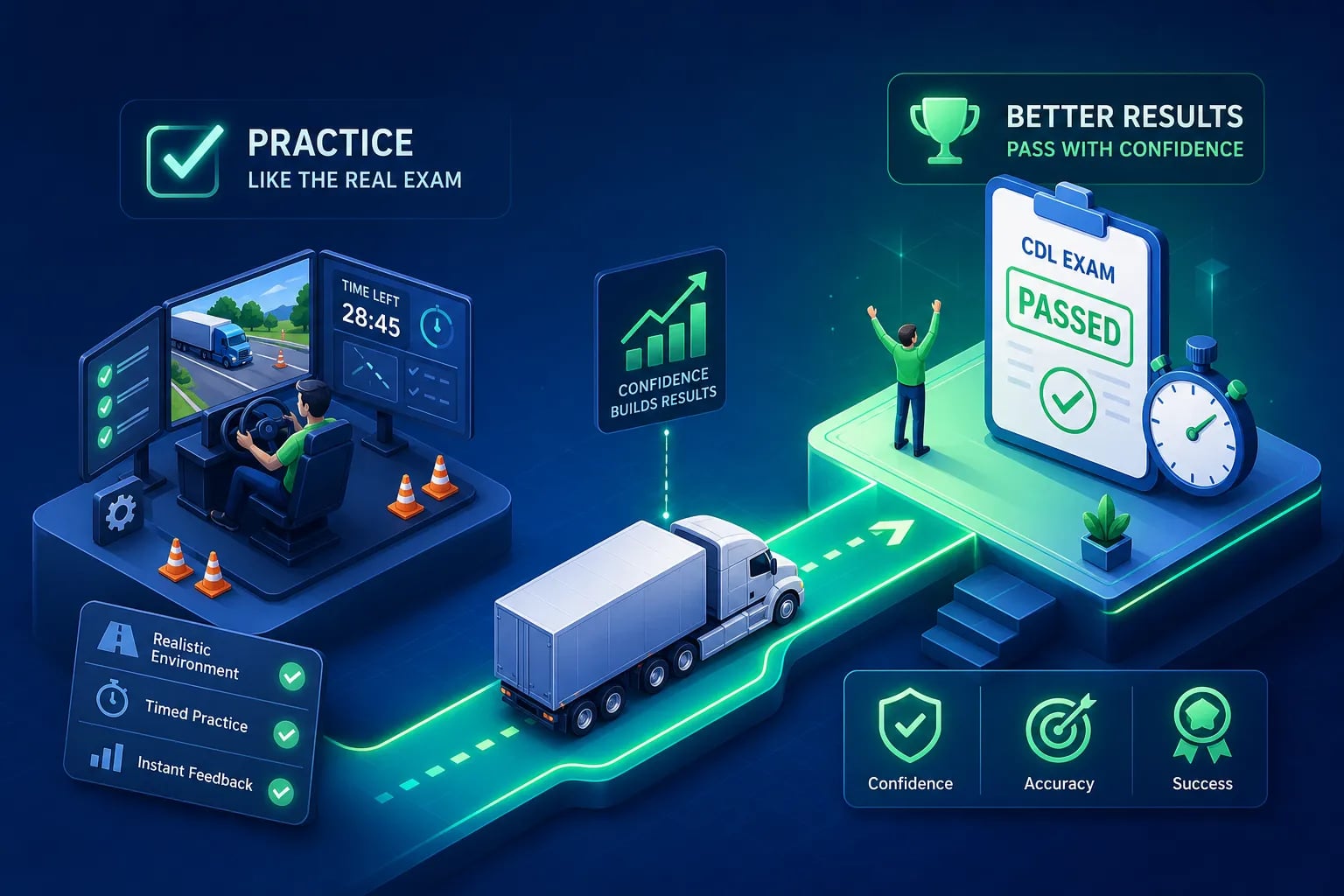
A platform that only offers open-ended practice is not preparing you for real test conditions. Timed exam simulations are valuable for pacing practice, since time pressure during a 50-question test can catch unprepared candidates off guard. Timed simulation mode forces you to work through questions at a realistic pace, which builds the focus and stamina the actual exam requires. Both modes should be available: open practice for learning, timed simulation for testing readiness.
Missed-question drill: the feature most platforms skip
This is the single highest-value feature in any CDL monthly plan. Instead of retaking the same 50-question test repeatedly, a missed-question loop isolates only the questions you answered incorrectly and re-drills them in a focused session. Most generic apps skip this entirely, which is why candidates keep scoring 75% on full tests without understanding what's holding them back. The missed-question system turns each wrong answer into a targeted study event rather than a number on a score report you forget immediately.
PTI phrase trainer: why walkaround prep is different from written prep
The pre-trip inspection is a verbal recall exercise, not a multiple-choice question. During the CDL skills test, examiners expect candidates to identify and describe inspection items verbally, working through vehicle components in a logical sequence. Practicing common inspection phrasing improves performance because a text-based question bank cannot train this skill. Look for a platform that prompts you to recall specific PTI phrases by component, because that's the format of the actual evaluation. Most CDL prep tools ignore this entirely, which means candidates arrive at the walkaround portion of their test having never practiced saying the words out loud from memory.
How CDLTest360's CDL monthly plan works and what you get
CDLTest360 is built as a complete CDL prep solution, not a supplemental add-on to a textbook course. Every feature in the platform is designed around one goal: getting you to a passing score efficiently, without wasting study sessions on content you already know or formats the real exam doesn't use.
No account required to start, no long-term lock-in
CDLTest360 lets you begin practicing immediately without creating an account, you can be mid-practice session in under a minute. The $19.99 per month subscription carries no long-term commitment and no separate charges for endorsement modules or state manual access. If you pass your written test in three weeks, you cancel after one month and pay $19.99 total. That's the entire obligation.
What's inside: modules, modes, and state-specific manuals
The platform covers all major FMCSA knowledge domains: General Knowledge, Air Brakes, Combination Vehicles, Hazmat, and Pre-Trip Inspection. Each domain includes both open practice mode and timed exam simulation with the standard 50-question, 80%-threshold format. The missed-question review loop is built into every session, and the interactive PTI phrase trainer prompts you to recall inspection wording by component. State-specific CDL manuals are available inside the platform, which handles the minor regulatory variations between states without requiring you to track down and read a separate document.
The 90-day pass alternative for longer timelines
For candidates enrolled in longer CDL programs or those who want a three-month window without any auto-renewal pressure, the $39.99 for 90 days option is available as a one-time purchase. There's no subscription to cancel and no billing that continues after the access window closes. For candidates retaking the exam after a failed attempt who want extra time to work through weak spots methodically, this option provides a defined study window at a fixed, predictable cost.
How to pass your CDL written test in one month of focused study
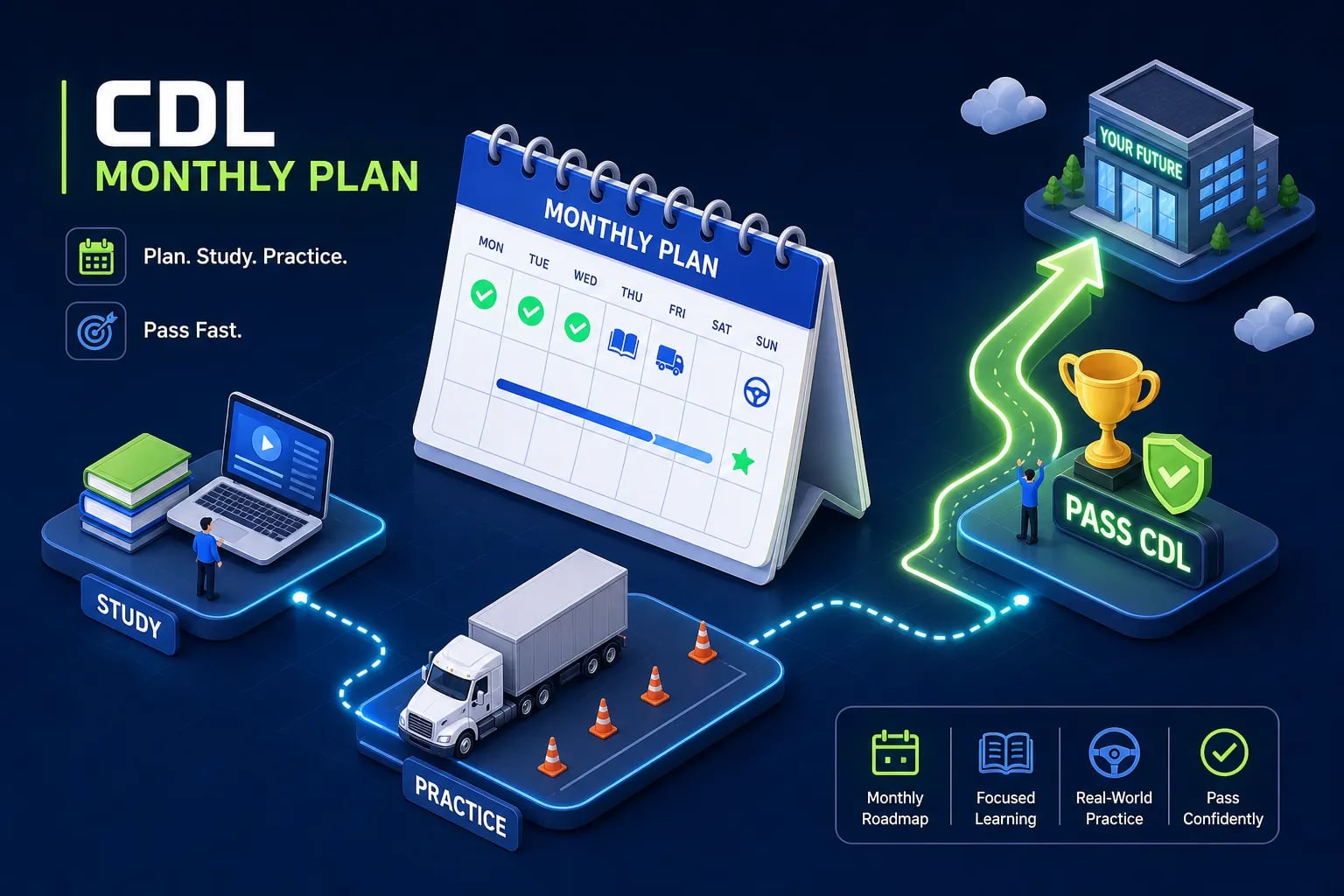
The average first-time CDL candidate takes three to four weeks to pass the written knowledge exam with consistent daily study totaling around 30 to 40 hours. That timeline fits cleanly inside one monthly billing cycle, which means a focused candidate can pass before their first renewal charge. Here's the framework that makes that realistic.
Week 1: run a baseline and prioritize the hardest domains
Start with a full timed simulation on day one to establish a baseline score. Don't study first; take the test cold so you get an honest picture of where you're starting. Use those results to identify your two or three weakest modules, then dedicate the first week entirely to those areas. General Knowledge and Air Brakes trip up the most first-time candidates because of the volume of regulatory specifics involved, so if those show up as weak spots, that's where week one goes.
Weeks 2 and 3: work the missed-question loop daily
After each practice session in weeks two and three, return to only the questions you missed. Run that loop every day. This is where the real score improvement happens, because you're not spreading study time evenly across material you already know. Research consistently supports targeted missed-question review as one of the most effective ways to close knowledge gaps, and candidates who apply this method daily typically see notable gains within a few weeks. Supplement with open practice mode on any module where you're still scoring below 75%, but keep the missed-question drill as the core of each session.
Week 4: full simulations and PTI phrase review
Spend the final week running nothing but timed, full-length simulations. Aim to hit 85% or above consistently before scheduling your actual DMV appointment. That 5-point cushion above the 80% passing threshold accounts for test-day nerves and the occasional unfamiliar question wording. Layer in daily PTI phrase trainer sessions so verbal recall is sharp and automatic by the time you're standing in front of an examiner at the vehicle. Written prep and walkaround prep are different skills, and week four is when both need to be sharp simultaneously.
Red flags that tell you a CDL prep subscription isn't worth it
The market for CDL prep tools is full of platforms that look credible on the surface but fall apart when you actually try to use them for targeted study. Some charge more than CDLTest360 and deliver a fraction of the functionality. Here's what to watch for before you commit money to any platform.
Generic questions that aren't sourced from FMCSA regulations
If a platform can't tell you where its questions come from, that's a serious problem. Questions that are loosely written or paraphrased from non-regulatory sources often test the wrong detail or use wording that doesn't match what the real exam expects. The CDL written test is very specific about numbers: following distances, air brake application thresholds, cargo securement ratios, hours-of-service limits. An imprecise question bank trains imprecise answers, which fails you on the exact details the test targets most.
No progress tracking or remediation logic
A subscription with no progress history is a quiz generator, not a study tool. If the platform can't show you which topics you're consistently missing, you're going to waste study sessions retaking full tests when you should be drilling specific weak spots. Progress tracking isn't a premium feature, it's the minimum standard for any platform charging monthly CDL payments for test preparation.
Locked into 6 to 12 months with no free trial
Any platform that requires a long-term financial commitment before you've verified the content quality is not confident in what it's selling. A reputable CDL monthly plan should offer at least some no-account, no-credit-card access so you can evaluate question quality, the platform's interface, and whether the modules cover your specific test before paying anything. CDLTest360's no-account-required free trial exists for exactly this reason: try it before you decide, not the other way around.
Picking the right CDL monthly plan for where you are right now
The best plan depends on your specific situation, not a generic recommendation. Here's a practical decision framework for the three most common scenarios candidates bring to this decision.
If you're a first-timer starting CDL school soon
The $19.99 per month plan is the right starting point. Begin studying two to three weeks before your scheduled written test date so you have time to complete the four-week framework without rushing. One focused month is genuinely enough to pass the general knowledge exam if you're consistent with the missed-question loop and practicing under timed conditions in week four. Most CDL schools also recommend passing the written test before or early in the program, so starting prep before school begins keeps your training timeline clean.
If you've already failed the written test once
Don't restart with a full course from the beginning. Start with a timed simulation to identify your current gap, then go directly into missed-question drills for the specific domains where you're breaking down. Candidates who failed their first attempt almost always have a concentrated weakness in one or two areas, air brakes, combination vehicle coupling procedures, or HOS regulations, rather than a broad knowledge failure across every module. The CDLTest360 missed-question loop is built for exactly this situation: targeted remediation without wasting time on material you already know.
If your CDL school needs prep tools for a full class
CDLTest360's school dashboard allows instructors to create a school account, invite students, assign specific modules, manage custom question banks, and monitor individual student progress from a single interface. This makes it a practical digital supplement for CDL programs that want structured, trackable prep without purchasing expensive school management software. The dashboard is designed to scale from a small class of five students to a full cohort, giving instructors a consistent tool regardless of class size.
The bottom line on CDL monthly plans
A CDL monthly plan doesn't need to be expensive, complicated, or locked in to be effective. The written knowledge exam is a specific, learnable test built from a finite set of FMCSA regulations, and one focused month of study is genuinely enough to pass it when the platform is built correctly. The prep cost should never be the barrier that delays your CDL, especially when a complete, FMCSA-aligned CDL monthly plan costs less than a tank of fuel.
CDLTest360's $19.99 per month option removes every friction point: no account required to start practicing, no long-term commitment, no hidden charges for state manuals or endorsement modules, and content aligned with FMCSA regulations. Start with a free practice session today, no account required. Run a baseline test, see your score, and decide whether the platform earns your $19.99 before you spend a dollar. If it can't prove its value in a free session, it doesn't deserve your money.
{ "@type": "Article", "datePublished": "2026-09-21T11:01:59.716Z", "dateModified": "2026-09-21T11:01:59.716Z", "headline": "CDL Monthly Plan: What It Includes and How to Pass Fast", "description": "A CDL monthly plan gives you flexible, no-lock-in exam prep. See what to look for, how CDLTest360's $19.99/month plan works, and how to pass in 30 days.", "publisher": { "@type": "Organization", "name": "CDLTest360" }, "image": [ ] }